CHAINING
A rather sophisticated logical technique—but not a difficult one—is chaining, or laying out various options in the form of a diagram that shows how some options precede others.
Chaining is useful in those situations where you are faced with a number of choices, and you need to make sure you have accounted for all of them. You may also need to get the choices arranged in some meaningful way so you can understand them and discuss them with someone else.One of the useful diagrams for chaining is the tree diagram. This is simply a sketch that shows a group of branching lines, one for each major option you want to consider. Some options will have suboptions associated with them. These you represent with other lines that branch off further from the main lines. To illustrate the use of a logic tree, let’s suppose you wake up on a Sunday morning and want to decide how to spend a leisurely, enjoyable day. You think about such considerations as whether to spend it alone or with a friend, whether to take a short trip somewhere or stay around home, and how long a day to make it. These options might look like this, when expressed in words.
1. How much time?
a. Half day
b. Full day, but not evening
c. Full day, including evening
2. Company?
a. Just me
b. Callafriend
3. Distance?
a. Stay around home
b. Takeadrive
Here you have three major options and each option has two or more suboptions. Suboptions can also have suboptions, such as which friend to invite, what to do around home—play games, watch a movie, got to the park, etc., and where to go on a tripmountains, beach, a favorite resort, a charming little town, etc. Note that some suboptions only apply to certain major options. For example, you cannot stay around home and also visit a charming little town fifty miles away. So you must make your decision in stages.
You have to narrow down the options progressively, moving in a logical pattern.Now, let’s see how your chaining process might look when expressed in the form of a decision tree.
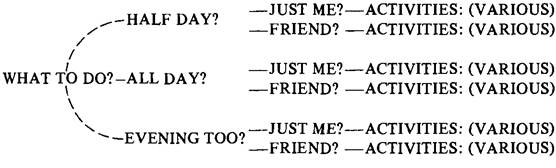
Note that a multilevel decision problem like this fans out to many individual choices. In this case, you get three primary options, multiplied by two suboptions, and each of the suboptions is multiplied by whatever number of activities you want to consider. You could easily have 20 or 30 different choices. Chaining them together can help you to account for all of them and think about them in a systematic way.
Now, here is an example of a problem that invites the use of the logical tactic of chaining. Take your pen and paper and give it a try. Draw a logic tree that shows the choices the two players have as they take turns. Then read the expert thinker’s attack, referring to the diagram at the end of the chapter.
I
EXAMPLE PROBLEM 9-1 (CHAINING)
A curious little two-person game involves the use of five coins, arranged on the table to form a circle, like this.
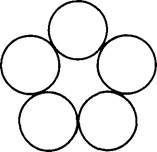
The two players take turns picking up coins and the person who manages to pick up the last coin wins the game. The rules are simple: You can pick up either one coin or two coins when it’s your move, but you can only take two coins if they are touching each other. You cannot pick up two coins that are separated; you can only take one of them. Question: To have the best chance of winning, should you be the first person to move or the second?
Ready? Here’s how our friend the logical thinker attacked it.
“Hmm... a game using coins, the object is to pick up the last coin—whatever it takes to do that. Seems like the person who moves first has the best chance of winning because he or she would probably have more options. But, maybe that isn’t true.
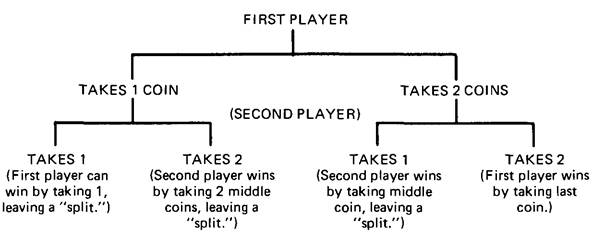
Let me (!)account for all the moves and submoves by drawing a logic tree (picturing, chaining). It should be a fairly simple diagram, because with five coins the game will be over in just a few moves. Well, let me see what it looks like. I’ll start with the first player, and diagram his or her possible moves—oh, it’s really simple; the first player can pick up one or two coins, that’s all there is to it. So, I’ll (!)have two main branches to my diagram, showing the first player’s two possibilities (picturing). Now, from each of those two branches, I’ll show the second player’s two possible moves, and from each of those branches, I’ll show what the first player can do when it’s his turn again.“So, here’s my diagram. [See solution at the end of the chapter.] Now, let’s start to evaluate the best moves (stepping). I’ll also (!)take these five coins and put them on the table so I’ll have a physical model of the game to work from (picturing). Let me see, if the first player takes one coin, what can the second player do? Aha! If the second player takes the two middle coins from the remaining ring of coins, that leaves player number one with a ‘split.’ (!)He can only pick up one of the two separated coins, leaving the other for the second player, who will win (stepping). Hmm, what do you know about that? Well, the first player has another option—he can pick up two coins on the first move. What happens then? Hmm... if he picks up two coins, that leaves a group of three for the second player. Oh, yes... the second player then picks up the middle coin from the group of three, again leaving the first player with a split. That’s remarkable! So, the second player can win every time if he makes the correct moves, no matter what the first player does. That’s certainly counterintuitive, but it makes sense when you look at the logic of it. So, Td rather be the second player to move.”
See how the simple tactic of chaining can change the way you look at something? Drawing a logic tree often creates a sense of order in an ambiguous situation, thus giving you an insight into the problem you might otherwise not have had.
Your diagram and the chaining process you use don’t necessarily have to be formal or elaborate. By combining the tactic of chaining with other tactics such as picturing, fencing, and stepping, you can often cut the problem down to manageable size so it isn’t even necessary to explore all of the options and suboptions. Here are some practice problems you can try where a simplifying approach can make the chaining technique go a long way.PracticeProbIem 9-1 (Chaining)
A man wants to cross a river and he must take three items with him. The items are a wolf, a goat, and a giant cabbage. He has a boat, but the boat is only large enough to hold him and one of the items so he must transport them across the river one at a time. He is further handicapped by the fact that he cannot leave the wolf and the goat together unattended, since the wolf will eat the goat. Nor can he leave the goat and the cabbage together unattended, since the goat will eat the cabbage. It is permissible, however, for him to leave the wolf and the cabbage together because the wolf is not interested in the cabbage. Question: By what sequence of crossings does he succeed in getting himself, the boat, the wolf, the goat, and the cabbage, safely to the opposite side of the river?
Practice Problem 9-2 (Chaining)
You have an 8-gallon container full of water. You also have an empty З-gallon container and an empty 5-gallon container. None of the containers has any measuring scales; in fact you have no way of measuring the water at all, except by filling either of the two empty containers completely full. Nevertheless, it is possible, merely by pouring the water back and forth between containers, to add and subtract quantities of water until you have divided the 8-gallon quantity into two 4-gallon quantities. How can you do this?
By now, I hope you’re feeling fairly comfortable with the tactic of chaining, and in fact with all of the linear, sequential processes we have been studying. The more often you see them used, and the more often you put them to use in your own thinking processes, the greater your skill will become.
Solutions to Problems
Example Problem 9-1 (Chaining)
Practice Problem 9-1 (Chaining)
1. First, the man takes the goat across the river, leaving the wolf and cabbage behind. (Alternatively, he could have taken the cabbage, with the same eventual solution.)
2. He leaves the goat on the far side and returns in the empty boat.
3. Then he takes the wolf over to the far side, exchanges the wolf for the goat, and brings the goat back to the near side.
4. He leaves the goat on the near side and takes the cabbage across.
5. He leaves the wolf and the cabbage on the far side and returns in the empty boat.
6. He then takes the goat over to the far side and he is finished.
Practice Problem 9-2 (Chaining)
Make a chart like the following, and proceed to fill in the status of each container after each pouring step.
| Step | З-Gallon Has | S-Gallon Has | 8∙Gallon Has |
| 1 | 0 | 0 | 8 (start) |
| 2 | 0 | 5 | 3 (fill 5) |
| 3 | 3 | 2 | 3 (fill 3 from 5) |
| 4 | 0 | 2 | 6 (empty 3 into 8) |
| 5 | 2 | 0 | 6 (empty 5 into 3) |
| 6 | 2 | 5 | 1 (fill 5 again) |
| 7 | 3 | 4 | 1 (“top off’ 3) |
| 8 | 0 | 4 | 4 (empty 3 into 8) |
More on the topic CHAINING:
- The Caribbean: The ‘Yoke of Slavery'
- Rituals of Punishment
- Crime and Punishment
- Blood Sport and Ritual
- Tatar Logistics
- Evil Dreams and Insomnia in the Babylonian Incantation Bowls
- RESURRECTION
- Warfare, Empire and Roman Militarism
- The Birth of a Messiah