JUMPING THE TRACK
The problem-solving tactic of jumping the track is one of the most useful of our seven key tactics, and yet it is the most difficult to explain. It is easy to demonstrate how to do it in a specific instance, and yet it is virtually impossible to prescribe a formula, or a recipe for it.
In fact, it is not really a logical tactic as such, but rather a tactic that enhances the use of the other logical tactics. To jump the track, as a problem-solving technique, means to abandon your current approach and try something altogether different. It means, figuratively, to stop trying to dig the hole deeper, and to start digging in a new place altogether. It also means staying alert when you size up a problem and not letting yourself be drawn into the obvious path without considering various possibilities.Because jumping the track is virtually impossible to define, let’s just study a few examples to get the feel of the process. Let’s listen in as our friend the logical thinker attacks a problem that calls for abandoning a fixed line of attack and jumping to another approach. Using your pen and paper, give the next problem a try before you read the solution.
EXAMPLE PROBLEM 10-1 (JUMPING THE TRACK)
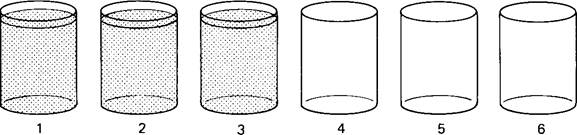
Six ordinary drinking glasses are in a row on the table. The first three are filled with water and the last three are empty. By handling and moving only one glass, it is possible to change this arrangement so that no full glass is next to another full glass, and no empty glass is next to another empty glass. How is this done?
Let’s hear from the logical thinker. Refer to the diagram at the end of the chapter.
“Hmm... you can only move one glass? That seems like a very severe limitation. Well, let me first (!)make a diagram (picturing). If I understand correctly, the situation looks something like this: [See diagram at end of chapter.] “Let me see...
(!)if I could produce a situation where the glasses were ‘full, empty, full, empty, full, empty,’ Γd have it (rephrasing). But how can I do that if I only move... wait! The word move is the key. (!)I don’t have to relocate it, all I have to do is relocate its contents (jumping the track). If I can move the water from the middle full glass to the middle empty glass, I’ll have it. It’s easy—just pick up the middle full one, pour its water into the middle empty one, and put it back in its original position. Ha! I’m so clever, I amaze myself sometimes.”Did you notice the sudden turn of the thinker’s attack? He or she shifted attention from the glasses to the water. The problem then, was no longer “how to move the glasses,” but “how to move the water.” I know of no way to put that process into a formula or a procedure. What goes on in your brain when you jump the track is an absolute mystery to psychologists. They know it happens, and call it an insight leap, but they have no idea how your brain does it. This is one of the great mysteries of the human mind, and it is one of the most precious faculties you and I possess. It is the basis of great scientific breakthroughs and an important part of creative thinking.
Let’s take a look at one more example, and then you can have fun trying your hand—or, more correctly, your mind—at a few of them.
EXAMPLE PROBLEM 10-2 (JUMPING THE TRACK)
How many months of the year have 31 days? How many have 30 days? Finally, how many months have 28 days?
Let’s hear from our friend the expert thinker.
“Hmm... how does the old rhyme go? ‘Thirty days hath September, April, June and November. All the rest have thirty- one, except February, which has twenty-eight, except when leap year gives it twenty-nine.’ That means four months are thirty days long. Allowing one more for February, that leaves seven months with thirty-one days. Only February has twentyeight days... hmm... (!)wa-a-a-i-t a minute... o-o-o-h-h! I get it—it’s a trick! (insight leap) All twelve months have twenty-eight days.
Most of them have more, but they all have twenty-eight. Very sneaky, but they didn’t put one over on me!”Again, a leap of insight that utterly defies analysis or description. It would seem, at first thought, that if we can’t analyze and describe this leap of insight, we can’t very well teach it to others, or that we can’t very well practice it and improve on it. This is not entirely true. If you observe this leap-of-insight phenomenon often enough on the part of creative, effective thinkers, you can begin to develop an intuitive sense of what it is and how it works. By exposing yourself to problem-solving situations that invite you to jump the track, you can increase your alertness to new possibilities. Here are a couple of problems for practice. Keep your wits about you, and stay alert for the unusual.
Practice Problem 10-1 (Jumping the Track)
I needed a small supply of a certain item for my weekend home improvement project. I went to the hardware store to see what kinds they had and how much they cost. The clerk said, “One will cost you 50 cents, 50 will cost you a dollar, and 100 will cost you a dollar and fifty cents.” What would I have been buying that would have such a strange quantity-pricing pattern?”
Practice Problem 10-2 (Jumping the Track)
A bottle and a cork together cost $1.10. The bottle cost $1.00 more than the cork cost. How much did the cork cost? The answer is not 10 cents. Think it over carefully.
Practice Problem 10-3 (Jumping the Track)
Why does the barber in Oatmeal, Nebraska say, “I would rather shave ten skinny men than one fat man?”
Solutions to Problems
Example Problem 10-1 (Jumpingthe Track)
PracticeProblem 10-1 (Jumping the Track)
I was buying house numbers. They cost fifty cents per digit.
Practice Problem 10-2 (Jumping the Track)
Don’t fall into the trap of simply subtracting ten cents from $1.10. That would give $1.00 for the bottle and 10 cents for the cork, which is a difference of 90 cents, not one dollar. The correct answer is 5 cents for the cork and $1.05 for the bottle.
Practice Problem 10-3 (Jumping the Track)
The barber would make ten times as much money shaving ten men as he would shaving one man, fat or skinny.