PUTTING IT TOGETHER
Well, I hope you’ve found our little excursion through logical thinking enjoyable, enlightening, and useful. What you derived from reading this book probably depends more on where you were when you started than on any other factor.
If you were already a seasoned puzzle-solver, chances are you found much of it familiar, although you may not have been clearly aware of the seven logical tactics we’ve explored.On the other hand, if you were suffering from a severe case of Iogicophobia-and you’re still reading this—you probably gained some ground but you feel the need for more practice and skill building. It would not be reasonable to expect to transform your skills completely as a result of a few hours’ work; this can only be a start. If, indeed, you were in the category of extreme Iogicophobia, you would probably profit enormously by going into a good bookstore and buying one of the many books of thinking puzzles available, and working out every one of them with a pen and paper. If you do this, just make sure you get a book of easy puzzles, suited to your learning process. You don’t want to get overwhelmed and discouraged by trying to attack the kinds of puzzles that are the favorite of the confirmed puzzle nut. There is no profit in that for you. Stick to the ones you can solve, and use them for skill building.
It is more likely, however, that you fall somewhere in between thelogicophobe and the Iogicophile. If you’re like the majority of people, you can handle logical problem-solving processes to some extent, but you would like to get a better grip on the approaches. If you are in this category, then I hope the book has helped you to clarify what the logical mind—your mind—does when it operates in a disciplined, effective way. I also hope it has given you some useful labels to use in describing the thought process of logical reasoning.
The labels are extremely important and useful. It is not essential that you refer to the seven logical tactics by the exact same labels I have applied, but it will be very helpful if you memorize them as tactics. You need to be able to call them to mind in various situations, and to apply them when appropriate. Please take the time right now to review and memorize the seven key tactics of logical thought. They are as follows.
1. Stepping
2. Picturing
3. Rephrasing
4. Fencing
5. Itemizing
6. Chaining
7. Jumping the track
Make sure you can define each of them in your own words, and give an example of how you might use it in a problem-solving situation.
Keep in mind, also, that every one of these seven logical tactics applies across a whole wide range of problems, not only to puzzle problems like those we have been using for skill building. The same reasoning process you used to figure out the identity of the three face-down cards is a process you can use to decide how to invest your money, how to change your career, or how to make a sale. By keeping alert for various problemsolving situations, and by consciously applying these logical tactics, you will be developing your brain power every day and becoming more effective at virtually everything you want to do that involves effective, organized, systematic thought.
To round out your skill-building process, here are several thinking puzzles that call upon more than one logical tactic at a time. You may find it extremely helpful to put these various techniques together and to use them in combination on various problems. Here is a chance to practice the integration process. As you attack the following puzzles, try to use as many of the logical tactics as you can.
PracticeProbIem 11-1 (Combination)
A certain clock takes two seconds to strike two o’clock. How long will it take to strike three o’clock? (Be careful!)
Practice Problem 11-2 (Combination)
Bob, Carol, Ted, and Alice are sitting around a table discussing their favorite sports.
a. Bob is sitting directly across from the jogger.
b. Carol is to the right of the racquetball player.
c. Alice sits across from Ted.
d. The golfer sits to the left of the tennis player.
e. A man is sitting on Ted’s right.
What sport does each of the four prefer?
Practice Problem 11-3 (Combination)
One glass is one-quarter full of wine. A second glass, of equal size, is one-half full of wine. Fill each of the glasses to the brim with water and empty them both into another container. Now fill up one of the glasses with the mixture of water and wine. What fraction of the contents of the glass now consists of wine?
Solutions to Problems
Practice Problem 11-1 (Combination)
The interval between consecutive strikes of the clock is two seconds. For two strikes, there will be two intervals, or four seconds.
PracticeProblem 11-2 (Combination)
Bob plays tennis, Carol jogs, Ted plays golf, and Alice plays racquetball.
Practice Problem 11-3 (Combination)
The mixture is three-eighths wine and five-eighths water.
NOW... Announcing these other fine books from Prentice-Haii-
BRAINPOWER: Learn to Improve Your Thinking Skills, by Karl Albrecht. Providing illustrations, games, and puzzles to stimulate brain power, this book helps students sharpen their thinking skills and shows how to use creative problem-solving strategies in the business world. Shows specific techniques for maintaining a positive frame of mind while tackling a problem.
$6.95 paperback, $14.95 hardcover
BRAIN MUSCLE BUILDERS: Games to Increase Your Natural Intelligence, by Marco Meirovitz and Paul I. Jacobs. From the famous inventor of the MASTERMIND® game, here is a collection of entertaining and highly educational games that can sharpen thinking skills beyond belief. With just the board and cards included in the back of the book, anyone can play to increase deduction, induction, strategy, memory, and creativethinking skills.
$11.95 paperback, $13.95 hardcover
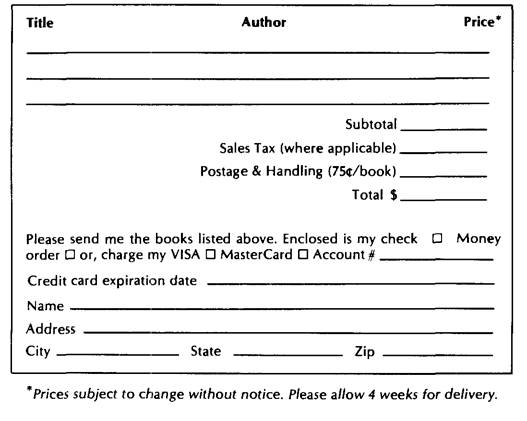
To order these books, just complete the convenient order form below and mail to Prentice-Hall, lnc., General Publishing Division, Attn. Addison Tredd, Englewood Cliffs, N.J. 07632