Rituals of Punishment
The high degree of brutality and violence found in popular culture was paralleled by the tortures and punishments inflicted on criminals by the state. In late imperial China, as in Europe, punishments were meant to be frightful displays of terror and violence staged by the state for public viewing.
Like rock fights and cockfights, floggings and executions also were popular forms of entertainment.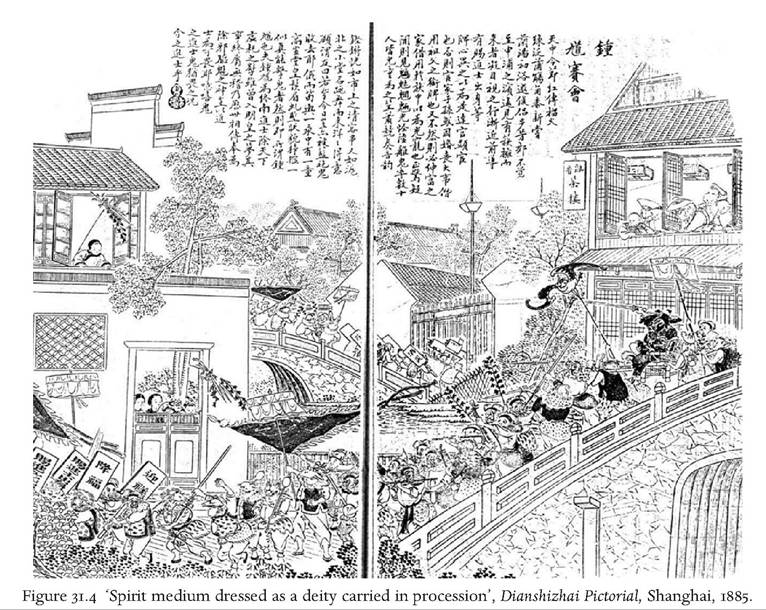
In traditional China flogging, tattooing and mutilation were all common types of corporal punishments meant to inflict both pain and shame on offenders. They were also used in conjunction with other more severe forms of punishments, including penal servitude, banishment and death. Judicial torture was part of the trial process and accepted as necessary for obtaining confessions. Prisoners were publicly tormented at trials, in jails and in streets and marketplaces. Although torture was legally sanctioned and regulated, nonetheless extralegal forms of torture were frequently also applied to prisoners as well. During trials the accused were subject to beatings with canes on their faces, backs and legs, or were made to kneel before the judge's bench on broken glass and chains. Witnesses, too, were flogged in court. Tattooing the crime on the face or shoulder of convicts was a common auxiliary punishment. Although less common, some prisoners were mutilated in addition to receiving other punishments and tortures. Rebels who had received imperial pardons nonetheless routinely had one or both ears cut off before being released from custody. Other forms of mutilation included gorging out eyes and cutting off tongues, arms, feet and penises.[933]
Although incarceration was not as bad a punishment, jails were nevertheless places of great suffering and death, or as one writer put it, ‘habitations of cruelty'.
People likened prisons to hell because of the torture and violence inflicted on inmates. Jails were notoriously overcrowded and ridden with disease. Most prisoners were kept fettered in chains. Some were ‘tied up by ropes which are made fast under their arms, their feet not being allowed to touch the ground'. For prisoners, incarceration was a dehumanising process: ‘Their death-like countenances, emaciated forms, and long coarse, black hair, gave them the appearance rather of demons than of men.' Deaths from beatings and sickness were so frequent that temporary places of internment referred to as ‘dead-houses', were erected next to prisons. In 1804, for instance, the Board of Punishment reported that in the two months of May and June some 490 prisoners had died in Guangdong jails. Evidence suggests that roughly 25 per cent of 5,100 prisoners died in those same jails between 1760 and 1845.[934]Besides incarceration in jails, many prisoners were also put on public display where they were ‘daily exposed to the scorn of all passers-by'. Typically, petty offenders - such as gamblers and common thieves - were made to wear cangues, heavy wooden collars a yard or so square and several inches thick: ‘The victim gets no rest, and he cannot even take his food without assistance as it is impossible for his hands to reach the mouth.' Offenders who were punished in this way wore the cangue both day and night for several weeks to three months and in a few cases in perpetuity. In Canton each morning they were taken from jail and made to stand at one of the main city gates, in front of popular temples or at some public hall, where they were treated as objects of humiliation. Those who had committed more serious crimes were confined in tiny cages or were chained to large stones or long iron bars. Most punishments also included parading prisoners through the streets. Handcuffed and bound in chains, they were led by runners beating gongs while lectors rhythmically flogged them on their backs.
Bystanders too joined in to mock and throw rocks and filth at the bound prisoners. Because processions lasted several hours and toured through several streets, ‘the flow of blood is often very great'.[935]The death penalty was the ultimate form of violence imposed by the state on its subjects. Executions were death by torture in the sense that they were calculated gradations of pain - from strangulation to decapitation to death by slicing. For the authorities executions were staged as solemn ceremonies, but for ordinary people they were festive occasions. In Canton on the appointed day condemned prisoners, dressed in red, were bound and carried in open baskets - like pigs to the market for slaughter - through the streets to the execution ground, a potter's field between the south gate and the river. They were fed hard liquor in the hopes of making them compliant victims. Soldiers, armed with spears, swords and matchlocks, marched in front and behind the prisoners, while a high-ranking official in formal attire, carried in his sedan chair, followed them. A herald on horseback at the rear of the procession carried a small yellow banner bearing the imperial command sanctifying the execution. Making its way through the crowded streets, the procession always stopped at the small temple of the Five Genii, near the place of execution. The officials prayed to these divine warriors for protection from the vengeful ghosts of the soon-to-be-executed criminals. There were always crowds of jeering spectators that followed the procession to view the
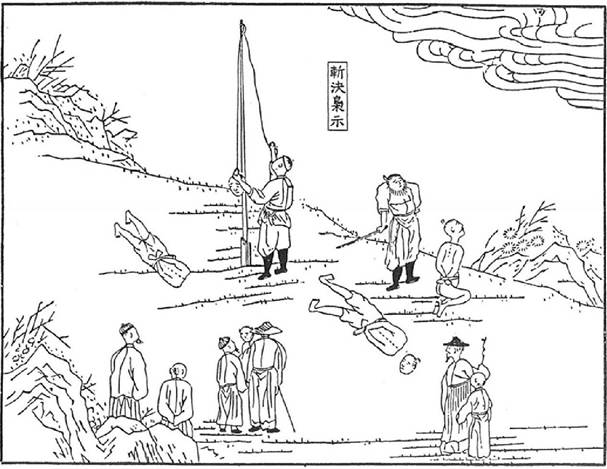
Figure 31.5 Punishment of beheading and public exposure of the head. Da Qing xinglu tu (Illustrated Penalties of the Qing Code), eighteenth century.
hideous spectacle. Vendors tagged along to sell food and drink. At a strangulation the condemned criminal was tied to a cross while the executioner twisted a rope around the neck until dead; at a beheading the prisoner kneeled, facing in the direction of the imperial throne, as the executioner's sword severed the head.
In the most heinous cases convicted criminals would suffer death by slicing, a lingering death whereby the condemned would be slowly cut to pieces. Afterwards the severed heads were either laid in piles alongside a wall at the execution ground, or, in the cases of notorious bandits and pirates, transported back to the place of the crime to be exposed in public in cages or suspended from poles by their queues.[936]In the early modern age, a time of mounting social disorder throughout south China, the spectacle of decapitated heads dangling in the air in markets and port towns must have been a pervasive sight. In the hundred years before the Opium War (1839-42), more pirates and bandits were executed in Guangdong than in any other province. Guangdong also had the third highest number of executions of people convicted for killings in affrays. Fujian province was not far behind in the number of bandits and executions. Banditry was such a severe problem that it was not unusual for groups of twenty, thirty, forty or more bandits to be summarily beheaded at a time. During the height of pirate disturbances during the first decade of the nineteenth century several thousand criminals were executed every year, and the numbers continued to remain high in the decades that followed. For example, the Indo-Chinese Gleaner reported that in 1817 over 1,000 and perhaps as many as 3,000 prisoners were executed in Canton. In 1829 one executioner, who had done his job for over thirty years, claimed that he had killed ‘upwards of ten thousand criminals' in his lifetime. With so many death-row inmates, each year just before the lunar New Year, a time for communal purging and purification, officials cleared the prisons in Canton with ‘wholesale executions'.[937]
The death penalty was a form of ritual killing. The condemned became sacrificial victims whose deaths were necessary for the purification of society. Executioners, who were drawn mainly from the dishonourable trades of pig butchers and soldiers, were akin to sorcerers in that they too exorcised the polluting evils from the community with their swords.
But in their case evil was visible and tangible. Heaven, state and society demanded the blood of bandits, pirates and murderers as retribution for their excessive offences. Death was fair punishment for their crimes and their blood was necessary to assure nature's harmony. To consummate the sacrifice the victim's blood, life's essence for both man and god, needed to be ingested. The blood of convicted criminals was regarded as being especially potent and charged with positive yang forces. The executioner-cum-sorcerer collected the blood and body parts of executed criminals to sell to druggists and spectators as cure-alls for diseases. People dipped rags in the blood and tied them to the bedposts to keep demons away, or they ingested the blood, liver or some other internal organ believing that by doing so they would subsume the victim's strength and courage.