Sorcerers, Exorcism and Flagellation
Scholars and officials repeatedly mentioned that the people of southern China were extremely superstitious, having deep beliefs in ghosts and sorcery. Despite the discouragement of the educated and prohibitions by the government, fortune tellers, geomancers, diviners and sorcerers were ubiquitous in China.
Nearly every village had a religious specialist who worked out of his or her home or local temple or shrine. Others travelled about the countryside from village to village and from market to market peddling their services and cures, usually earning no more than a subsistence living. What I call sorcerers and witches were the wu, who danced in trances, spoke in tongues and used magical techniques (fashu), charms (fu) and spells (zhou). At the end of the seventeenth century the scholar Qu Dajun vividly described their rites after a visit to a village on the outskirts of Canton: ‘Every night I heard exorcists blowing on ox horns and making ghostly sounds till early in the morning. Sorcerers continually recited spells over water and wrote charms. Among them were those who had deities descend upon them, or were youths bewitched by fairies, or were shamans being questioned.'18 This scene and ones like it were repeated daily throughout Guangdong, Fujian and Taiwan, as sorcerers culled supernatural powers to cleanse villages of evils and to expel demons from the sick.Sorcerers and witches were indispensable village practitioners - doctoring the sick, assuring good harvests, settling disputes and quieting hungry ghosts. Although looked down upon by officials and scholars as charlatans and troublemakers, nonetheless they were both respected and feared by villagers because they possessed awesome magic that could benefit or harm people. By and large most of these folk diviners came from the lower orders of society.
Sorcerers were everywhere because ghosts and demons were everywhere.
Indeed, there was little separating the human world and the spirit world. For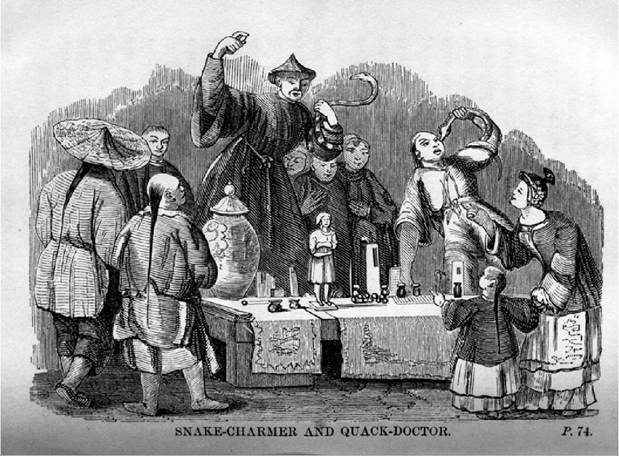
Figure 31.3 ‘Snake-charmer and quack-doctor', in W. Gillespie, The Land of Sinim, or China and Chinese Missions (Edinburgh: M. Macphail, 1854).
most Chinese, spirits were real: ‘worship is conducted not merely for the sake of carrying on tradition, but because the spirits are thought of as being able to interact with human beings, bringing them good or evil fortune’.[925] Ghosts and demons were the harbingers of plagues and other calamities. Armed with swords, spears and other weapons, black-faced demons with jagged teeth attacked humans at night. They were the spiritual equivalent of bandits. A Cantonese sorceress called the Fat One who, while in a trance during a seance, reported that the souls of three village children had been kidnapped by a ghost who refused to release them unless a ransom in gold spirit money was paid.[926] Ghosts were like bandits because they were dangerous, because they operated outside the hierarchy of gods, and because they supported anyone who worshipped and sacrificed to them.
The eternal struggle against evil, a central feature of Chinese folk religion, was represented as a military campaign. Violent and destructive demonic beings could only be driven away or destroyed by equally violent means. Exorcism was therefore necessarily violent. ‘The act of exorcism,' Stephan Feuchtwang has suggested, ‘is a commanding, military evocation and performance.'[927] It was common for shamans and Daoist priests, while performing ritual dances with swords in hands, to expel demons by summoning spirit soldiers (shenbing or yinbing). Their ritual performances were battles with acrobatic charges and the thrusting of swords set to the tumult of furious drumming and gonging. In the seventeenth century on Hainan island there was a famous Daoist magician named Huang Jing'er who had been called upon to save his village from a terrible drought.
Donning Daoist robes and loosening his hair, he first sacrificed a cock and then performed a rain dance with his sword while simultaneously chanting spells. Countless folk tales told of ghosts and vixens that had to be exorcised by Daoists or sorcerers possessing magical swords and incantations.Chinese believed that the spirit soldiers were actually the souls of men who had died violent deaths in battle and were therefore dangerous and bloodthirsty demons. But controlled through ritual, they became positive forces in the hands of Daoists and shamans. They made covenants - often in the form of an oath using the blood of a cock - with spirits and gods to fight evil and to protect the community. Coloured flags that stood for the five cardinal points - black for north, red for south, green or blue for east, white for west, and yellow for centre - denoted the five spirit armies, which in south China were called the Five Encampments. A divine general commanded each army. The popular exorcising deity Nozha or Santaizi (Third Prince), who led the centre camp, was the commanding general. In 1748 the authorities in Chenghai county arrested the ‘bandit' Li Awan and his mother for conspiring ‘to rob the rich and to stir up the ignorant masses'. Li, who had been born into a family of local Daoists, possessed an ‘unorthodox' book of spells and five coloured flags that he used to summon spirit armies. In Hong Kong female shamans, while in a trance and travelling through the netherworld, would conjure up spirit soldiers or ‘spirit policemen' to combat the ghosts that caused illnesses. Married women in the suburbs of Canton hired witches, known locally as ‘Mi-Foo-Kow', to use black magic to call up demons to kill their abusive husbands.[928]
Charms and spells were the chief means used by religious specialists to expel and destroy evil spirits. Charms were potent because they were contracts between the religious adept and the deities who conferred them.
The most effective charms were written in blood, either using the blood of a cock or that of the ritual specialist. Charms were used for all sorts of purposes from curing illnesses to preventing crimes. A Ming dynasty magician named Tang Guhe from Lingshan in western Guangdong wrote charms to bring rain and to end pestilence, while a Conghua local ritual specialist fashi) named Gong used Thunder God charms and spells to end droughts and drive away bandits. Seemingly innocuous charms were efficacious because they violently dispelled evils. On them were written, often repeated many times for emphasis, commands for gods and spirits to devour (shi), kill (sha), behead (zhan) and repress (yan). Charms commanded dragons, snakes, the Jade Emperor, the Thunder God and other deities and spirits to destroy evil-causing demonic forces. Typically written on charms was the character for ghost (gui) with one of more strokes omitted, indicating that the ghost had been decapitated. Spells, which were often used in conjunction with charms and other magical techniques, were equally violent. In a ritual known as ‘driving away the shades', one Cantonese sorceress waved incense over her sick client while chanting a spell that ended with the phrase, ‘The Very High Laojun [i.e. Laozi] kill, kill, kill [the demons] as commanded'. This was a conventional expression frequently used to end spells.[929]When possessed by deities, some shamans flagellated themselves using various weapons and instruments of torture. Self-flagellation rituals, common throughout south China, usually occurred during exorcisms and religious festivals. Mediums verified their magical powers and demonstrated their invincibility by piercing their tongues with swords, sticking metal skewers with the heads of the five divine generals through their cheeks, dipping their hands and arms into boiling oil, climbing tall ladders ofknives or walking across blazing beds of charcoal, the underlying assumption being ‘that a spiritual being of vast and undefined powers possesses the body of a human medium and enables him to inflict injury upon himself without feeling pain, and to speak with divine wisdom, giving advice to worshippers and curing their illnesses'.[930] Mediums mortified themselves with skewers through their cheeks as a means of mustering spirit armies.
It was common for shamans to cut their tongues, or sometimes their arms, with swords and write out charms with their blood, for it was believed that human blood was especially efficacious in exorcising demons and curing ills. Afterwards the charms would be burned and the ashes mixed with water and consumed by the patient as medicine. The barefoot sorcerer likewise ascended a ladder of swords for the benefit of his patient believing that swords would scare away ghosts causing sickness, and he walked on fire for ritual purification. In local communities ritual self-flagellation served a positive function and was even an auspicious occasion in which parents brought small children to watch. They also served as a public spectacle and entertainment.[931]Processions during religious festivals also provided occasion for shamans and believers to mortify and flagellate themselves. Mediums, sometimes dressed in the costume of the deity who possessed them, would ride in temple sedan chairs brandishing swords and leading crowds of votaries on parade. It was not uncommon for processions to turn into riotous mobs. In Fuzhou, the capital of Fujian, penitents, wearing heavy wooden cangues or handcuffs, paraded through the streets during certain festival days to atone for their misdeeds. Gray described a festival in the Canton delta in which devotees appeared ‘in red dresses similar to the dresses of Chinese convicts, with chains round their necks, fetters on their ankles, and handcuffs on their waists, in sign of humility and unworthiness'. On Hainan island during the God of War (Guandi) festival in the fifth lunar month, for three days zealots would parade around the streets with cuffs on their hands and chains around their necks. Some would use knives to cut their flesh and others would burn their arms and chests with lit incense to atone for past transgressions.[932]
More on the topic Sorcerers, Exorcism and Flagellation:
- Sorcerers, Exorcism and Flagellation
- Antony Robert, Carroll Stuart, Pennock Caroline D. (eds.). The Cambridge World History of Violence. Volume 3: AD 1500-AD 1800. Cambridge University Press,2020. — 710 p., 2020