Cockfights, Gambling and Chicken Beheadings
Besides rock fights and public brawls other popular spectacles included the blood sport of cockfighting, which was popular throughout south China. The sport was, in the words of Clifford Geertz, ‘a bloody drama of hatred, cruelty, violence, and death'.[913] Unlike the rock fights in which everyone was a potential actor in the brawl, in cockfights the cock served as a surrogate or scapegoat, standing in the place of the owner and actualising the social tensions within the community.
It became the protagonist in a bloody battle for life, honour and valour. Although cockfighting had been popular among all classes in early China, by the sixteenth century it had become primarily connected with lower orders. It was a sport generally associated with unruly youths and idle rogues who had little regard for social conventions, and was so popular in the Ming dynasty (1368-1644) that enthusiasts organised cockfighting societies to promote it. The Cantonese, who had a reputation for cruelty toward animals, seem to have taken special delight in competitive sports with lots of blood and gore. The thrill of the cockfight was in the bloodshed and killing. The sight of blood and the smell of death brought out excitement and passion in men, exacerbated by wagers and betting. Like the rock fights, cockfights were noisy and festive.[914]Besides cocks, Chinese raised and trained all sorts of animals for fighting - quails, ducks, geese, oxen, rats, crickets, cicadas and fish. In Chaozhou, Guangdong, for instance, people raised fighting geese weighing up to 40 catties (approximately 20 kg). Many people preferred to fight quails because they were considered more bloodthirsty and fiercer than cocks. It was reported that ‘Great pains are bestowed upon fighting birds by their owners to prepare them for the fighting season'.
Some trainers fed them rice mixed with egg yolks, or with insects taken from boiled rice that had been exposed to the sun (presumably fortifying the yang forces), while others fed their birds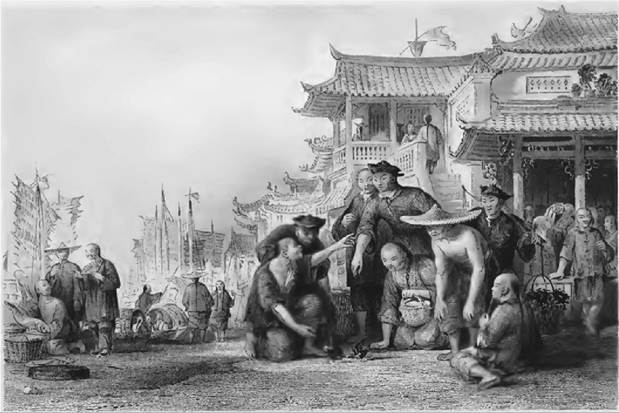
Figure 31.2 ‘Canton bargemen fighting quails’, in T. Allom, China Illustrated, 1843.
maggots from dogs’ flesh. Near Canton people raised a bird, called ‘Chu- Shee-Cha’, which fed on pig dung. People trained their birds to fight by tapping their heads and blowing on their feathers. Quail fighting had become so popular among the lower orders that sailors brought them aboard ship for amusement. The rearing, training and fighting of cocks and other animals became lucrative occupations.[915]
Cockfighting eloquently epitomised two of the most often mentioned evils in south China - fighting and gambling. Wherever there was a market, temple or some open space, there was sure to be a cockfight or some other betting game, vices closely associated with the breakdown of social order. There were, in fact, hundreds of different wagering games in Guangdong and Fujian. Every town and city had its gaming houses, frequently located on some backstreet hidden from the view of respectable residents. In and around the environs of Canton there were hundreds of casinos; the neighbouring entrepot of Foshan alone had forty to fifty. Even fruit stands turned into gaming tables, with crowds of young boys casting dice for tasty delights. In the nineteenth century, wrote S. W. Williams, out-of-work labourers and porters loitered about the streets of Canton in small groups ‘smoking, gambling, sleeping, or jeering at the wayfarers’.[916] [917] The Cantonese loved wagering so much that one writer described the entire province as a kingdom of gamblers. When passions arose, tempers flared and gambling became an occasion for brawls. Like fighting itself, gambling also provided an important release from the drudgeries of life and created possibilities for making money.
Gambling was associated with another evil - banditry. It was often said that ‘gambling was the root of violence and robbery’, and in fact writers claimed that many bandits started out as gamblers. In an imperial decree in 1729, the Yongzheng Emperor likened gamblers to good-for-nothing loafers and rascals. ‘Gambling,’ he reiterated, ‘is a cause of fights, a source of lawsuits, a reason for the rise of banditry, a centre of attraction for the disaffected, damaging in countless ways the good morals and customs of the people.’11 Gambling dens were the gathering places for thieves, robbers, pirates, smugglers, prostitutes and other marginal elements in society. These were places where robbers and thieves fenced loot and where soldiers and yamen runners peddled information.[918] [919] To eliminate banditry, officials said, it was first necessary to eliminate gambling. But how could the government expect to eliminate, or even curb, a vice that soldiers, runners and officials abetted in?
According to Clifford Geertz the cockfight represented bloody sacrificial offerings to placate demons, and in this sense they were much like the rock fights mentioned above. The shedding ofblood, whether of cock or man, was considered necessary to exorcise natural evils.13 If a cock was killed in battle, and had died bravely in a good fight, the owner would take the slain hero home to eat or to soak the guts and liver in liquor to be drunk as a potent elixir. The winner, of course, was caressed and indulged until one day he too would be killed. If chickens in general stood for good fortune (the Chinese word for chicken, ji, is a homonym for good fortune), even more so the male of the species. The universal phallic symbol, the cock was the embodiment of masculinity, virility and courage. As a positive yang force, representing the sun and fire, it was the source of warmth and life itself. For this reason, people ate hens but generally avoided eating roosters.
Because the latter were bestowed with magical powers, their flesh and blood were reserved for warding off evil and curing illnesses. Throughout China people hung roosters over their doors to frighten away goblins and ghosts. In south China there were countless folk beliefs associated with cocks. People used cocks to strengthen the souls of the dead by placing their images on coffins and gravestones, and ancestral tablets were given animation by dotting them with cock's blood. As a symbol of male sexual power, cocks were considered a potent cure for female infertility. The flesh of a red cock nullified poisons and warded off pestilence. Anyone suddenly struck dead by a demon could be revived by rubbing the blood of a cock below the heart.[920]For all their potency and efficaciousness cocks were nonetheless treated with extreme brutality. They were the victims of choice in most religious rituals. The victim had to be alive in order to elicit the full potency. One of the most common rites, begun in ancient times, was the ripping apart of live roosters to expel evil elements. It was said that in Fujian and Guangdong the first thing that anyone did when they got sick was to kill a cock as an offering to the evil spirits who caused the harm. Chinese sorcerers killed and deboned cocks as a popular method for divination. In Hong Kong in 1960, James Hayes witnessed a particularly cruel ritual involving a geomancer and a young live cockerel. The villagers of Pak Wai had hired the geomancer to perform a prophylactic rite to counter the ill effects of nearby road construction on the local feng shui. The climax of the rite came when the geomancer affixed the poor creature to a tree by plunging a nail through his eye and then sprinkling the blood on a bamboo talisman.1[921]
In contentious disputes in south China, it was common practice for the accused to ‘prove' his innocence by performing a beheading ritual. Grabbing a cock in one hand and a knife in the other he would cut off the bird's head while swearing that he was not guilty. Often performed in a temple, he pledged before the god: ‘If I am guilty may my head be cut off like this chicken.'[922] In some areas, instead of beheading a chicken the two sides in a dispute used a poisonous snake to decide who was right and who was wrong. Shamans used the blood of cocks, especially white cocks, in rituals and in covenants. So did the members of secret societies, bandit gangs and rebel groups.[923] [924]
More on the topic Cockfights, Gambling and Chicken Beheadings:
- Gambling
- Conclusion
- B. Halal
- Rituals of Punishment
- The Game of the World: A Timely Topic
- Conclusion
- Contents
- Ritualised Violence in Amerindian Rebellions
- “passover is passover”
- 4 Oesophageal stricture in a cat
- Conclusion
- DIAGNOSIS
- 20 Linear foreign body in a cat
- Index of Subjects and People
- INTRODUCTION
- OTHER PARVOVIRUS INFECTIONS