Rock Fights and Youth Culture
Despite repeated bans by officials and protests from the literati, street brawls and rock fights remained popular forms of entertainment and competitive sport in south China in the early modern period.
Rock fights were ritualised annual events usually occurring during the lunar New Year holidays or in some areas during the Double-Five (Dragon Boat) or Double-Nine (Chrysanthemum) festivals. They were violent, bloody public spectacles in which combatants and spectators could number in the hundreds.Unlike many other festivals and sports, rock fights were not associated with temples and temple fairs. Most took place on the outskirts of villages in open fields. While it is tempting to view rock fights as more ‘civilised' forms of inter-village and inter-lineage feuds (xiedou), they were no such thing. Judging by the printed descriptions and testimonies from oral interviews, they were basically free-for-alls, ‘sporting battles of strength', fought chiefly for the sake of displaying youthful masculine bravado in order to win honour
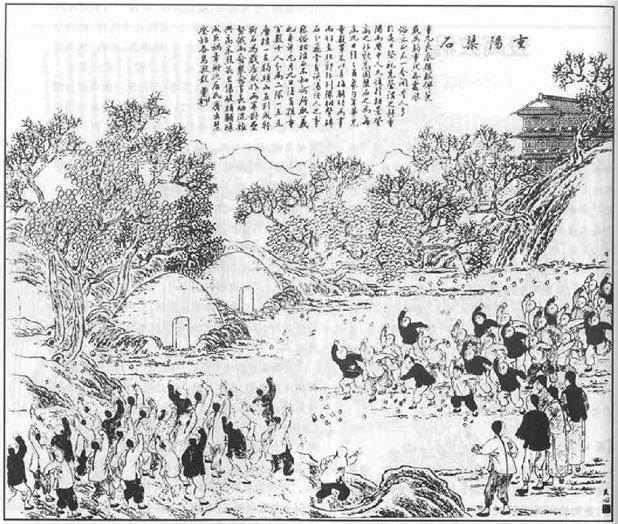
Figure 31.1 ‘Rock Fight during the Double-Nine Festival', Dianshizhai Pictorial, Shanghai, 1886.
and prestige. Fighting was a means of gaining respect. Rock fights were important release mechanisms for the pent-up tensions, frustrations and antagonisms that had accumulated over the previous year. They can hardly be called civilised sports because there were no apparent rules and they were brutal and bloody. It was not uncommon for participants, and sometimes even spectators who got too close, to be maimed or killed.
In most cases, rock fights were not organised or managed by local elites or powerful lineages, but rather by ordinary villagers. Most of the participants came from poor and landless families. In the rural district (xiang) of Shawan in Panyu county in the Canton delta, for example, the village most famous for rock fights was named Longqiao (Dragon Bridge), which appeared to be a satellite village, one which was both economically and politically dependent on a dominant lineage.
By the eighteenth century lineages had become the basic organisational feature of local society, whereby leading families maintained a strong sense of kin solidarity based on written genealogies and the maintenance of ancestor halls. By belonging to a lineage members gained social status and inalienable rights of settlement that distinguished them from outsiders. Lineages derived wealth and power largely from land ownership and control of markets.1 Shawan was dominated by the ‘five great surnames', the Li, Wang, Li (Lai), Zhao and He, all powerful landowning lineages in the area.The satellite villages were made up of tenant farmers and itinerant workers. The big lineages treated these client groups as outsiders, referring to them disdainfully as ‘sands people' (shamin), ‘lowly households' (xiahu), ‘trivial people' (ximin) or ‘floating twigs' (shuliu chai). The main distinctions between dominant lineages and lowly households were less geographic and more social, economic and cultural. The latter resided on the fertile polders or ‘sand fields' (shatian) in impermanent mat sheds or on boats on adjacent streams. They were poor and illiterate, lacked genealogies and had no ancestor halls of their own. The dominant lineages denied them the right to permanently settle on or own land, and members of the dominant lineages did not marry with them. Whatever social relations there were between the two groups related solely to business matters.[907] [908] The sands people were looked down upon by the rest of society as being uncivilised and having depraved customs, such as rock fights, and they too were the sorts of people who had reputations for ruthlessness, violence and banditry.
The rock fighters, who were described as ‘pugnacious youths' (dazai), were mostly adolescent males in their teens to early twenties. Because boys growing up in poor, lower-class families had to be tough just to reach adulthood, learning how to fight at an early age was essential for survival in a world that was competitive and unfair.
Children born of poor working-class parents were more likely to be exposed to violence than the well born. Children of the rich were taught values that allowed them to be law-abiding subjects who viewed violence as wrong. For the poor, however, violence was an integral part of the socialisation process, an inevitable fact of growing up. A number of psychologists have argued that children and adolescents learn violent behaviour by imitating aggression in adults. Children who grow up in violent environments will more likely be violent themselves. If violent behaviour is learned behaviour, then children growing up in families that approve and encourage aggression will believe violence is correct and acceptable behaviour. According to Elizabeth Englander, ‘violence occurs because the person has been rewarded for being violent, or has seen others rewarded for being violent'.[909] What these studies show is that daily exposure to violence desensitises people and allows them to accept violence as a normal part of life.In traditional China many children in poor and marginalised families grew up in environments that approved and encouraged violent activities. The pugnacious youths fought to the cheers of parents and elders, who regarded brawling as a lively spectator sport. Contests were held during festivals and were bacchanalian occasions. In the nineteenth century the Reverend John Henry Gray witnessed several rock fights near Canton. One involved about 700 fighters and attracted a crowd who viewed the fracas from hillsides overlooking the field where the fighting took place. In the carnivalesque atmosphere combatants took time off from the fighting to buy soup and fruit from peddlers and to mingle with the crowds. On another occasion he witnessed a rock fight on Henan (Honam) island, in the suburbs of Canton, where so many people were seriously injured that the village elders called upon the police to put a stop to the melee, but the fighters drove off the police and continued the ruckus.[910]
For most villagers rock fights were sacred affairs.
Participants believed that the winners in these battles would have good luck in the forthcoming year. In the villages in Guangdong, Fujian and Taiwan that took part in rock fighting, people accepted without question that unless blood was shed calamities - bad harvests, famines, pestilence, bankruptcies - would befall them. Coming as they did at the time of the lunar New Year, marking the opening of spring, these fights also were vernal fertility rites, which were important in all agricultural societies. The shedding of blood literally and symbolically impregnated the earth with life's essence. It is significant too that the rock fighters were primarily adolescent boys. Because pubescent lads were considered especially animated with positive yang forces, their blood was particularly potent. For this reason, ever since ancient times young boys between the ages of 11 and 15 have been the preferred mediums for exorcising demons.[911]Along these same lines we find further evidence for this bloody vernal ritual from rock fights in eighteenth-century Yangjiang, a county on the western fringe of the Canton delta. There the annual rock fights were not held during the lunar New Year but rather during the Double-Five festival (held on the fifth day of the fifth lunar month) at a place known locally as the ‘Killing Mound'. The fifth lunar month, a time of seasonal change, had always been a time of rampant pestilence and dangers, especially in the malarial south. Rock fights were held on this festival, as Wolfram Eberhard has suggested, because of the need for ‘scapegoats' to ward off the ‘overwhelming dark powers' that were present at this time of year. They actually predate the now more typical dragon boat races, and in fact trace their origins to bloody fertility rites of the Dai aborigines, who inhabited much of south China before the influx of the Han Chinese. To assure the fertility of their rice fields Dai gods demanded human sacrifice, the victim often being a Chinese settler who was kidnapped and fattened for this purpose. The scapegoat was dismembered and the body parts distributed among the villagers, who then interred them in their fields to ensure good harvests. Later, Eberhard explains, with the growing influence of Chinese civilisation a substitute for human sacrifice had to be found. Thus another form of ordeal became popular, the rock fights between rival villages that lasted until someone was seriously injured or killed. Wild singing and dancing accompanied the fights, and the whole affair ended with a great sex orgy in the nearby woods.
Both the rock fights and the later dragon boat races were believed to bring good luck and protection to the winners; both had prophylactic values for warding off evil and disease.[912]
More on the topic Rock Fights and Youth Culture:
- ‘I always was of opinion that the placing a youth to study with an attorney was rather a prejudice than a help. We are all too apt by shifting on them our business, to encroach on that time which should be devoted to their studies. The only help a youth wants is to be directed what books to read, and in what order to read them’.1
- Caesar Fights the Celts
- Interpersonal Violence between Samurai: Acts of Revenge, Quarrels and Fights
- Theories of Culture
- ETRUSCAN CULTURE
- The Power of Culture: How Ukraine Survived
- Bacterial Culture and Typing Procedures
- Christianity and Chinese Culture
- Kievan Culture
- CHAPTER EIGHT THE SPREAD OF KlEVAN CULTURE IN MOSCOW
- Legal Professional Culture
- Contemporary Culture Media
- Outside Contacts and their Impacts on Bonda Culture