Contemporary Culture Media
Both solid and liquid media can be used to cultivate MAP. Solid media are sometimes cheaper, involve less instrumentation and identification of the organism can be simpler. However, they have lower analytical sensitivity.
Culture media for MAP must include essential nutrients, often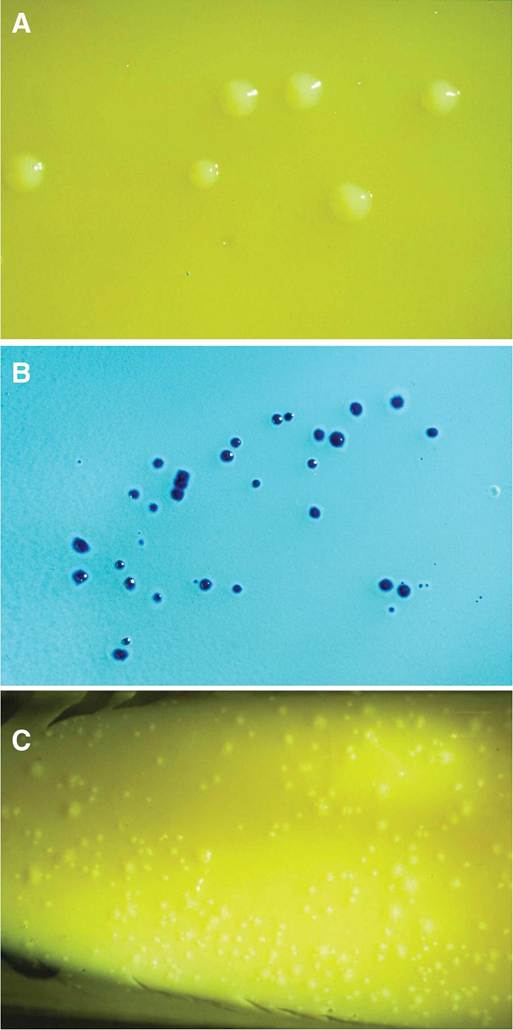
Fig. 18.1. Colonies of S strain Mycobacterium avium subsp. paratuberculosis (MAP) growing on modified Middlebrook 7H10 agar. Upper panel, subculture after 13 weeks' incubation; middle panel, subculture after 13 weeks' incubation with methylene blue incorporated in the agar; lower panel, primary isolate after 20 weeks' incubation.
Table 18.1. Comparison of contemporary solid media suitable for cultivation of Mycobacterium avium subsp. paratuberculosis Cattle-strains (MAP-C). Amounts are per litre.
| Ingredient | HEYMa | LJb |
| LJ base (Difco) | - | 23.25 g |
| Sodium chloride | 4.5 g | - |
| Beef extract | 2.7 g | - |
| Peptone | 9.0 g | - |
| Agar | 15.3 g | - |
| Whole egg | - | 625 ml |
| homogenate | ||
| Egg yolk | 120 ml | - |
| Malachite green | 100 mg | 250 mg |
| Glycerol | 34 ml | 7.5 ml |
| Sodium pyruvate | 4.1 gc | 4.0 g |
| Mycobactin | 2.0 mg | 2.0 mg |
| Cycloheximide | - | 0.75 g |
| Chloramphenicol | - | 0.20 g |
| Penicillin G | - | 2 ? 105 U |
a(Merkal and Curran, 1974; Herrold, 1931; Merkal et al., 1964; Merkal, 1970).
Most animal health laboratories in the USA include the antibiotics vancomycin, amphotericin B and nalidixic acid (VAN) in HEYM (Robbe-Austermann, pers comm, 2009) b(Kalis et al., 2000).cOptional.
include antimicrobials to discourage growth of contaminants and may include dyes to assist recognition of colonies.
18.8.1 Solid culture media
Many media were evaluated by early workers leading to progressive refinement of simple egg-based slants such as Dubos medium, but these have fallen out of favour and do not seem to have been used for more than 35 years (Saxegaard, 1985). Researchers eventually reached consensus that two media were most suitable for clinical microbiology: LJ in some European countries and HEYM elsewhere (Table 18.1). However, the media based on Middlebrook 7H10 or 7H11 (solid media) and 7H9 (broth) are arguably better base media for culture of all known strains of MAP within a reasonable incubation period (see below), but for optimal growth, egg yolk must be added to these media (Table 18.2).
18.8.2 Liquid culture media
Chemically defined liquid culture medium
Laboratory adaptation of some strains of MAP has enabled their propagation in the chemically defined Watson-Reid broth without mycobactin or egg (Table 18.2) (Watson, 1935; Morrison, 1965). This medium is unsuitable for cultivation of field strains of MAP (Merkal and Curran, 19 74) but is still used for bulk culture for antigen production.
Liquid culture medium with a radiometric growth indicator
The inclusion of C14-labelled palmitic acid as a carbon source in liquid medium to enable highly sensitive radiometric detection of C14-labelled carbon dioxide produced through microbial respiration was a breakthrough in medical microbiology (Middlebrook et al., 1977; Reggiardo and Tigertt, 19 77). The growth signal is not specific, but rather triggers an examination of the broth for the pathogen of interest. In practice, the culture bottles were incubated routinely and transferred periodically to a semi-automated ion-chamber reader (BACTEC 460 machine), which sampled the gas phase after piercing a rubber seal with a sterile needle.
This method was adapted for MAP by adding egg yolk and mycobactin to commercial BACTEC 12B medium (Becton Dickinson) (no longer available commercially), which has a Middlebrook 7H9 base (Damato et al., 1987; Damato and Collins, 1990).Liquid culture medium systems with another growth indicator
Other liquid culture systems designed for medical microbiology have been applied to cultivate MAP (Grant et al., 2003; Ellingson et al., 2004; Stich et al., 2004). All utilize a proprietary medium that is inevitably based on Middlebrook 7H9 broth. The BACTEC MGIT 960 system (Becton Dickinson) relies on detection of a fluorescent
| Table 18.2. Composition of the Middlebrook liquid and solid media, which are suitable for cultivation of both Mycobacterium avium subsp. paratuberculosis Cattle and Sheep strains (MAP-C and MAP-S), and the chemically defined Watson-Reid medium, which supports the growth of some laboratory adapted strains. Amounts are per litre. | ||||
| Ingredient | Modified Middlebrook 7H9 broth (M7H9C∕BACTEC 12B;)a | Modified Middlebrook 7H10 agarb | Modified Middlebrook 7h11 agarb | Watson-Reid mediumc |
| BASE MEDIUM | ||||
| Casein digest | 667 mgd∙θ | 1.0ge | 1.0 g | - |
| Ammonium sulfate | 333 mg | 500 mg | 500 mg | - |
| Monopotassium phosphate | 667 mg | 1.5 g | 1.5 g | 2 g |
| Disodium phosphate | 1.7 g | 1.5 g | 1.5 g | - |
| Sodium citrate | 67 mg | 400 mg | 400 mg | - |
| Magnesium sulfate | 33 mg | 25 mg | 50 mg | 1 g |
| Calcium chloride | 0.33 mg | 0.5 mg | - | 20 mg |
| Zinc sulfate | 0.67 mg | 1 mg | - | 10 mg |
| Copper sulfate | 0.67 mg | 1 mg | - | - |
| Arginine | - | - | - | 5 g |
| L-glutamic acid | 333 mg | 500 mg | 500 mg | - |
| Cobalt chloride | - | - | - | 2 mg |
| Sodium chloride | - | - | 850 mg | 2 g |
| Ferric ammonium citrate | 27 mg | 40 mg | 40 mg | 75 mg |
| Pyridoxine | 0.67 mg | 1 mg | 1 mg | - |
| Biotin | 0.33 mg | 0.5 mg | 0.5 mg | - |
| Malachite green | - | 0.25 mg | 1 mg | - |
| Bacto agar | - | 15 g | 15 g | - |
| ENRICHMENT | ADC∕- | ADC | OADC | |
| Oleic acid | - | - | 50 mg | - |
| Albumin fraction V, Bovine | 1.34/3.30 gd | 5.0 g | 5.0 g | - |
| Dextrose | 534 mg∕- | 2.0 g | 2.0 g | 10 g |
| Catalase | 0.8 mg∕32,000 Ud | 3 mg | 4 mg | - |
| ADDITIVES | ||||
| Egg yolk | 167 mlf | 250 ml | 250 ml | - |
| Mycobactin J | 0.83 mgf | 1.25 mg | 1.25 mg | - |
| PANTA3 | 33.3 mlf | 50 ml | 50 ml | - |
| Glycerol | - | 5 ml | 5 ml | 60 ml |
aAdapted from Whittington etal. (2013).
bAdapted from Whittington et al. (1999).
cFrom Merkal and Curran (1974).
dAlbumin: 1.34g added by user to form M7H9C; 3.30g added by manufacturer to form BACTEC 12B medium. Catalase:
0.8 mg added by user to form M7H9C; 32,000 U added by manufacturer to form BACTEC 12B medium. Dextrose: added by user to form M7H9C; not added to BACTEC 12B. BACTEC 12B also contains 667 uCi C-14 palmitic acid.
eAdded as casitone to M7H9C and 7H10 agar; already added by manufacturer to form BACTEC 12B.
fAdded to the enriched BACTEC 12B media at a rate of 1 ml egg yolk, 5 μg (100 μl) Mycobactin J, 200 μl PANTA and 700 μl water per 4 ml vial; final volume 6 ml/vial. (Data from Difco Manual 10th Edition 1984; Becton Dickenson BACTEC 12B package insert.)
gConsists of polymyxin B 1000 U/ml, amphoteracin B 100 μg∕ml, nalidixic acid 400 μg∕ml, trimethoprim 100 μg∕ml, azlocillin 100 μg∕ml; PANTA PLUS includes polyoxyethylene stearate, which is not essential.
signal, which develops from an indicator at the base of the culture vial as oxygen is consumed during microbial respiration; the amount of egg yolk that can be added is limited as it interferes with measurement of the growth signal. ESP culture technology (Trek Diagnostics) relies on detection of a change in the pressure of the gas phase in a sealed culture vial. The MB/BacT system (BioMerieux) is based on a colorimetric indication of carbon dioxide production. Each of these culture formats enables early identification of microbial growth by incubating culture vials within a machine that regularly monitors the growth signal. Like the original BACTEC 460 system, these newer methods require the formal identification of MAP when a growth signal is detected. The MGIT system is gaining acceptance for detection of MAP in clinical samples (Grant et al., 2003; Shin et al., 2007). However, vancomycin, an ingredient included at 18μg∕ ml in commercial MGIT ParaTB medium for paratuberculosis, is inhibitory to some common strains of MAP (Thornton et al., 2002; Gumber and Whittington, 2007).
Others found 100 μg/ ml vancomycin to be the threshold concentration for inhibition of growth (Pribylova et al., 2012).Liquid culture media without a growth indicator
M7H9C liquid medium was developed in Australia as a direct response to the withdrawal of commercial BACTEC 12B medium from the global market. M7H9C medium was validated using MAP-C and MAP-S strains and a large number of clinical samples in Australia and subsequently in Germany (Whittington et al., 2013; Schwalm et al., 2018). Based on Middlebrook 7H9 medium and after supplementation, M7H9C mimics modified BACTEC 12B in composition so that prior evaluations demonstrating capacity of the latter to support the growth of diverse strains of MAP remain relevant (Whittington et al., 2011). The shelf life of M7H9C exceeds 12 months at 7-8°C (Schwalm et al., 2018). It can be made in any laboratory by appropriately experienced staff and is cost effective compared with the commercial broths with growth readouts that are designed for specific machine platforms.
A comparison of the compositions of M7H9C, BACTEC12B and MGIT ParaTB medium is provided in Table 18.3. Other liquid media based on Middlebrook 7H9 have been developed but with limited validation. An example is that of Pozzato et al. (2011), partially described by the authors as consisting of Middlebrook 7H9 powder (0.47%), casitone (0.1%), glycerol (0.5%), 10% OADC, egg yolk (16%), mycobactin J (1 μg∕ml) and PANTA PLUS (2.5%).
18.9
More on the topic Contemporary Culture Media:
- Index
- Accountability and the Human Rights Act 1998
- Opportunities for parliamentary accountability
- Mapping accountability practices in Parliament
- Assertion and Reason