ON GIVING UNIVERSAL STATEMENTS EXISTENTIAL IMPORT
The principal difference between the traditional Aristotelian logic of the medieval schools and the modem approach we have followed above lies in the treatment of universal statements.
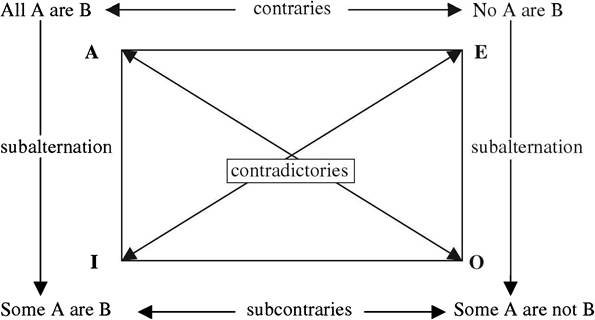
For according to traditional logic, an A-statement entails the corresponding !-statement, and an E-statement entails the corresponding O-statement. For instance, “All pro HOCKEY players have high DENTAL bills” entails that “Some pro hockey players have high dental bills”; similarly, “No one who HEARS the joke can FAIL to laugh” is understood to entail that there are people who hear the joke who will not fail to laugh. Getting from an A- to an I- or from an E- to an O-statement like this was called conversion by limitation, and the relationship between corresponding A- and !-statements and between E- and О-statements, was known as subalternation.Moreover, if I say “Surely, all electrons are composed of quarks,” and you reply, “On the contrary, no electrons are composed of quarks,” you are certainly correcting me. On the traditional view, this was interpreted as follows: both statements cannot be true (although they can both be false). If one is tme, the other is false. Two corresponding categorical statements having this relationship were said to be contraries.
A fourth kind of opposition—in addition to contradiction, contrariety, and subalternation—is that between I- and О-statements. If I say “Some raccoons are rabid,” and you say “Some of them aren’t,” you are opposing me in a way. But although both of us could be right, it is not the case that both of us could be wrong. Corresponding categorical statements which are such that both cannot be false are called subcontraries. These various relationships are encapsulated as follows in the Square of Opposition of traditional Aristotelian Logic:
The Traditional Square of Opposition:
All this may seem eminently reasonable.
But there are problems. First, it seems very difficult to deny that particular (i.e., I- and O-) statements have existential import, that is, that they assert the existence of the individuals falling in the subject category. If I say “Some of David CRONENBERG’S movies are OVER the top,” then I am saying that there exists at least one Cronenberg movie of that kind. Likewise, “Some species of insects do not have wings” commits me to the existence of at least one species of insect. In our Carroll diagrams this was represented by an x in the appropriate section of the box representing the subject term. But here’s the rub. If an !-statement is entailed by an А-statement and involves the existence of things in the subject category, then so must the corresponding А-statement. But then how can an А-statement be the contradictory of an О-statement, if both assert the existence of things in the subject category? For example, if “All students who are ABSENT in the exam will FAIL the course” commits us to the existence of at least one student who is absent in the exam, and so does its contradictory “There are students ABSENT in the exam who will not FAIL the course,” then both these statements will be false if there are no students absent in the exam. But then they cannot be contradictories! (The truth of a statement entails the falsity of its contradictory, and vice versa.)When Lewis Carroll faced this dilemma, he wrote (in Humpty Dumpty vein):
I maintain that any writer of a book is fully authorised in attaching any meaning he likes to any word or phrase he intends to use.[78] If I find an author saying at the beginning of his book “Let it be understood that by the word black I shall always mean white, and by the word white I shall always mean black,” I meekly accept his ruling, however injudicious I may think it.
And so, with regard to the question of whether a Proposition is or is not to be understood as asserting the existence of its Subject, I maintain that every writer may adopt his own rule, provided of course that it is consistent with itself and with the accepted facts of logic.
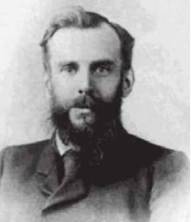
—Lewis Carroll, Symbolic Logic, 4th edition, p. 166Unfortunately, however, Carroll went on to beg precisely the question at issue, claiming that given that !-statements assert the existence of their subjects, “we must regard a Proposition in A [i.e., an А-statement] as making the same assertion [of existence of its subject], since it necessarily contains a Proposition in I [i.e., an !-statement].” This prevented him from seeing the best way out of this impasse, which is to deny that !-statements are always entailed by the corresponding A-statements.[79] [80] This last option is the one favoured by modem logicians. It is often called the Boolean approach, even though Boole himself did not assume that universal propositions have no existential import. It was forcefully promoted as the best solution by John Venn in his influential textbook Symbolic Logic.11 As Venn explains, it consists in taking the following line, (i) Particular statements seem clearly to have existential import, ii) But if they John Venn (1834-1923) was an English logician and philosopher, famous for his invention of Venn diagrams (Symbolic Logic, 1881), which are now widely used in set theory, logic, statistics, and computer science. He had earlier pioneered the frequency interpretation of probability in The Logic of Chance, 1866. do, then their contradictories cannot, (iii) But the contradictory of a particular statement is a universal statement (iv) This means that A- and E-statements do not have existential import, (v) This in turn means that the traditional notion called “conversion by limitation” fails: А-statements do not entail !-statements, and E-statements do not entail О-statements. As further consequences, as we shall see, (vi) contrariety fails too, and (vii) so does subcontrariety. But what of our intuitions about A- and E-statements? The short answer is that in most contexts we do presuppose that they have existential import. 18.2.2