SORITES
The second and the last arguments above are instances of a kind of argument called the sorites (pronounced so-RIGHT-eez). A sorites (plural: also, sorites) is a string of categorical statements, of which the predicate of one is the subject of the next (or the same in reverse order).
As Lewis Carroll pointed out, traditional logic only recognized two sorts of sorites: “the Aristotelian, whose premises are a series of Propositions in A, so arranged that the Predicate of each is the Subject of the next, and the Goclenian, whose premises are the very same series written backwards.”[72] With biting sarcasm he says of Goclenius that “we may apply to him what somebody (Edmund Yates, I think it was) said of Tupper, viz: ‘Here is a man who, beyond all others of his generation, has been favoured with Glimpses of the Obvious!’” (ibid.). It was in contrast to these “puerile— not to say infantile—forms of a Sorites” that Carroll presented us with the whimsical examples above.Clearly, though, it is very easy to make a mistake in filling in the above diagram for five or more categories. In contrast, these sorites are all easy to prove valid using the UI/UG strategy of chapter 16. For instance, the baby-crocodile syllogism is provable as follows:
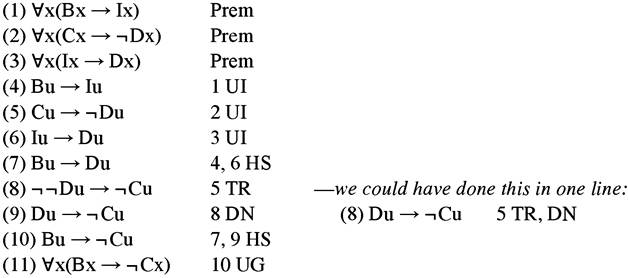
The Shakespeare sorites is provable by the same UI/UG strategy, with a couple of applications of TR. It may be symbolized as

Here’s another example, this time a proof devised by Gottfried Leibniz at the age of 23 for the immortality of the mind. This is set out as a long sorites with lots of subsidiary arguments for the various premises. He begins with the following characterization of the human mind: the HUMAN mind is a thing, one of whose activities is THINKING.
He then proceeds to prove that a thing, one of whose activities is thinking, is not a body. From here the argument to the immortality of the mind proceeds as follows:Whatever is not a BODY is not in SPACE; for to be in space is the definition of body. Whatever is not in space is not MOVABLE, for motion is change of space. Whatever is immovable is inDIS SOLUBLE, for dissolution is the motion of a part. Whatever is indissoluble is inCORRUPTIBLE, for corruption is internal dissolution. Everything incorruptible is IMMORTAL, for death is the corruption of the living, or dissolution of its fabric, through which self-moving things obviously move themselves. Therefore the human mind is immortal.[73]
Thus (ignoring the subsidiary arguments for each premise) we can symbolize the whole

Its validity is obvious, and can be proven by 7 applications of UI and 7 applications of the Chain Rule, with a concluding step of UG.
SUMMARY ______________________________________________________________
• The method of Carroll diagrams applies just as easily to statements involving things not falling in a given category, such as “Unexplored countries are fascinating,” (All non-E are F)
• and can be extended to apply to arguments containing 4 or more distinct predicates.
• A sorites is a sequence of universal categorical statements, of which the predicate of one is the subject of the next (or the same in reverse order);
• they are generally best proved valid using a formal proof and the UI/UG strategy.
EXERCISES 18.1
Using Carroll diagrams, determine whether each of arguments 1-5 is valid. Foreach that is, prove its validity using predicate logic.[74]
1. None of HIS stories are PROBABLE. Improbable stories are not easily BELIEVED. So none of his stories are easily believed. [UD: stories]
2. WARMTH RELIEVES pain. Nothing that does not relieve pain is useful for TOOTHACHE. So warmth is useful for toothache.
3. UNIVERSITY students are all EDUCATED. All uneducated people are SHALLOW. Therefore no university students are shallow. [UD: people]
4. No WHEELBARROWS are COMFORTABLE. No uncomfortable vehicles are POPULAR. Therefore no wheelbarrows are popular. [UD: vehicles]
5. Some HEALTHY people are OVERWEIGHT. No unhealthy people are good INSURANCE risks. Therefore some overweight people are not good insurance risks. [UD: people]
Assuming that every predicate or name is to appear exactly twice in the argument, use Carroll diagrams to work out what conclusion may be validly inferred for each of the following 4-predicate arguments:
6. My SAUCEPANS are the only thing I have that are made of TIN. I find all the PRESENTS you gave me USEFUL. None of my saucepans are of the slightest use. [UD: things of mine; S := is a saucepan, T := is made of tin, P := is a present you gave me, U := is useful]
7. None of the NEW potatoes have been BOILED. All the potatoes in this DISH are FIT to eat. No unboiled potatoes are fit to eat. [UD: potatoes]
8. No DUCKS WALTZ. No OFFICERS ever decline to waltz. All my POULTRY are ducks.
9. No TERRIERS wander among the signs of the ZODIAC. Nothing that does not wander among the signs of the zodiac is a COMET. Only terriers have cURLY tails. [U := has a curly tail]
10. No BOOJUM can be FOUND. No SLITHY things are TOVES. Some toves are boojums.
Use Carroll diagrams to work out what conclusion may be validly inferred for each of the following 4-predicate arguments:[75]
11. All things that are HARMFUL ought always to be AVOIDED. Some SNARKS do all manner of harm. Only BOOJUMS ought always to be avoided, [conclusion to involve S and B]
12. CONGENIAL SNARKS do no HARM. Some snarks are BOOJUMS. Boojums always do harm, [conclusion to involve B and C]
Instructions for exercises 13-15: Determine the conclusion of each of the following valid sorites arguments invented by Lewis Carroll,[76] either by a five-predicate diagram (in the case of 13), by informal reasoning, or by a formal proof:
13.
(CHALLENGE) There is no box of mine HERE that I DARE open.My writing-desk is made of ROSE-wood.
All my boxes are PAINTED except what are here.
There is no box of mine that I dare not open, unless it is full of live SCORPIONS.
All my rose-wood boxes are unpainted. [UD: boxes of mine, incl. writing desk]
14. (CHALLENGE) No husband who is always giving his wife new DRESSES can be a CROS S-grained man.
A METHODICAL husband always comes HOME for his tea.
No one who hangs up his hat on the gas-JET can be a man who is kept in proper ORDER by his wife.
A GOOD husband is always giving his wife new dresses.
No husband can fail to be cross-grained if his wife does not keep him in proper order.
An unmethodical husband always hangs up his hat on the gas-jet. [UD: husbands]
15. (CHALLENGE) All the policemen on this BEAT SUP with our cook.
No man with LONG hair can fail to be a POET.
Amos Judd has never been in JAIL.
Our cook’s “COUSINS” all love cold MUTTON.
None but policemen on this beat are poets.
None but her “cousins” ever sup with our cook.
Men with short hair have all been in jail. [UD: men]
16. The Clown in Shakespeare’s AIΓs Well that Ends Well offers the following humorous syllogism:
[H]e that COMFORTS my wife is the cHERISHER of my flesh and blood; he that cherishes my flesh and blood LOVES my flesh and blood; he that loves my flesh and blood is my FRIEND: ergo, he that KISSES my wife is my friend. (Act 1, Scene III, lines 45-49)[77] [UD: men]
Supply the missing premise. What kind of argument is this, specifically? (No need to prove it.)
18.2
More on the topic SORITES:
- SORITES
- Sorites Fallacy
- Responding to the Sorites
- Index
- Index
- Many Interpretations or One?
- NON-CLASSICAL STATEMENTS
- Arp R., Barbone S., Bruce M. (eds.). Bad arguments: 100 of the most important fallacies in Western philosophy. New York: Wiley-Blackwell,2018. — 450 p., 2018
- Line Drawing
- Contents