IIFT 2011
Directions for Questions 1 to 3: Read the following instructions and answer the questions.
After a discussion at a high level meeting of government officers, the criteria for issuing of import/export licence to eligible business firms for the year 2011—12 were finalised as follows.
The firms must—I. Have a Grade-A certified unit for any products.
II. Not have any legal dispute case against it.
III. Possess minimum assets worth' 40 lakhs.
IV.Submit an environment clearance certificate issued by the Pollution Control Board (PCB) of the state where the firm is located.
V. Deposit the margin money of' 1 lakh.
VI. Arrange for three guarantors with their personal identity cards (IDs).
However, if the firm satisfies all the above mentioned criteria except:
(a) Criteria (I), but is a traditional handloom production unit, then the case may be referred to Development Commissioner, Handloom (DCH) of the state.
(b) Criteria (IV), but is a local employment provider/thread (input) supplier/cloth supplier, the case may be referred to the Director, Department of Industry of the state.
(c) Criteria (V) but can deposit at least' 50000, the firm will be given import licence only and the case may be referred to the Deputy Director, Department of Industry of the state.
Based on the above criteria and information provided on each of the firms in the questions below, you have to decide which course of action should be taken against
each firm. Without assuming anything regarding any applicant firm, the decision should be based on the information provided.
1. Mahalaxmi Weaving Center is a traditional handloom production unit. It has property worth more than' 1 crore. It managed to get three guarantors with their personal IDs. No legal case is there against it. There is no problem submitting an environmental clearance, as the same is already issued to it by the State Pollution Control Board.
It is also ready to deposit' 1 lakh.(a) Licence can be issued
(b) Licence not to be issued
(c) May be referred to the Development Commissioner, Handloom
(d) May be referred to the Director of Industry
2. Ramayan Enterprise is a textiles firm which possesses assets worth' 50 lakhs and is located in Surat where no firm having any legal dispute is permitted to operate. The firm agreed to deposit' 1 lakh and give details of three guarantors with their personal details as required. It has got grade-A certificate and can submit an environment clearance certificate issued by the Pollution Control Board of the state.
(a) Licence can be issued
(b) Licence not to be issued
(c) May be referred to the Development Commissioner, Handloom
(d) May be referred to Deputy Director of Industry
3. Hirabhai Handlooms is a Vadodara based traditional Gujarati handloom firm keen to get an export licence. It is ready to pay the required security amount and possesses assets worth' 55 lakhs. Hirabhai Chamanlal is the owner of the firm as well as the President of State Handloom Association. Hence getting more than three guarantors with their IDs is not a problem. The firm possesses the environmental clearance certificate from the State Pollution Control Board after it was made mandatory for all handloom firms in the state.
(a) Licence can be issued
(b) Licence not to be issued
(c) May be referred to the Development Commissioner, Handloom
(d) May be referred to the Director of Industry
Directions for Questions 4 and 5: Each of the questions below starts with a few statements, followed by four conclusions numbered 1, 2, 3 and 4. You have to consider every given statement as true, even if it does not conform to the accepted facts. Read the conclusions carefully and then decide which of the conclusions) logically follow(s) from the given statements, disregarding commonly known facts.
4. Statements:
(a) Some boys are scholars.
(b) Some teachers are boys.
(c) All scholars are observers.
Conclusions:
(a) Some scholars are boys.
(b) Some scholars are not boys.
(c) Some observers are boys.
(d) Some teachers are scholars.
Answer:
(a) (a) and (c) follow
(b) (a) (c) and (d) follow
(c) Either (a) or (b) and (c) follow
(d) None of the above
5. Statements:
(a) All teachers are professors.
(b) All professors are researchers.
(c) All researchers are consultants.
Conclusions:
(a) Some consultants are teachers.
(b) All professors are consultants.
(c) Some researchers are teachers.
(d) All professors are teachers.
Answer:
(a) Only (a) and (b) follow
(b) Only (a) and (c) follow
(c) Either (a) or (d) follow
(d) None of the above
Directions for Questions 6 and 7: Study the information given below carefully to answer the following questions.
In a certain code language the following lines are written as:
‘lop eop aop fop’ means ‘Traders are above laws’;
‘fop cop bop gop’ means ‘Developers were above profitable’;
‘aop bop uop qop’ means ‘Developers stopped following traders’;
‘cop jop eop uop’ means ‘Following maps were laws’.
6. ‘Developers are following laws’ would be Correctlywritten as
(a) ‘bop cop uop eop’
(b) ‘lop bop eop uop’
(c) ‘oup cop lop aop’
(d) None of the above
7. ‘qop gop cop eop’ would Correctlymean:
(a) Profitable laws were stopped
(b) Developers stopped following laws
(c) Traders were above profitable
(d) None of the above
Directions for Questions 8 and 9: In each of the following letter series, some of the letters are missing, which are given below it. Choose the correct alternative.
8. D F DEE D EF DE F
(a) EFFDED (b) EFFDDF
(c) EFFDFE (d) None of the above
9. OPO QOPQ RQPO POR O
(a) APRQO (b) QPORO
(c) QPROO (d) None of the above
Directions for Questions 10 and 11: In each of the following questions, find the relationship that can definitely be deduced on the basis of the relations given.
The symbols used to define the relationship are as follows:@ means ‘greater than’
# means ‘less than’
$ means ‘not equal to’
% means ‘equal to’
10. If it is given that, 3 M % 2 N and N % 3 O, then:
(a) O @ M (b) M # O
(c) 2 O % M (d) None of the above
11. If it is given that, N@P, P#O, O@M and N % M, then:
(a) O@N (b)O#N
(c) O $ N (d) None of the above
Directions for Questions 12 and 13: In each question given below, a statement is followed by three courses of action numbered 1, 2 and 3. You have to assume everything in the statement to be true, and then decide which of the three suggested courses of action logically follow(s).
12. Statement: School dropout rate is very high in the rural areas as children support their parents in income earning activities.
Courses of action:
I. Public awareness programme on primary education should be expanded Immediatelyto educate parents.
II. Compensation should be given to those parents whose children are in the school.
III. Law on universal education and ban on child labour should be made rigorous.
(a) Only (I) and (II) follow
(b) Only (II) and (III) follow
(c) Only (I) and (III) follow
(d) All follow
13. Statement: In a recent bulletin the Meteorological Department of India has forecasted severe drought in the next cropping season which may cause failure of crops.
Courses of action:
I. The forecast should be widely published in media.
II. The drought relief team should be ready for relief work.
III. People should be advised to go for drought resistant variety.
(a) Only (I) and (II) follow
(b) Only (II) follows
(c) Only (II) and (III) follow
(d) None of the above
Directions for Questions 14 and 15: Read the following information carefully to answer the questions given below it.
Mr. Malhotra’s family is a traditional joint family from Jalandhar with six persons from three generations. Each member of the family has different food preference and they support different sports/games.
Only two couples are there in the family. Rakesh likes continental food and his wife neither likes dry fruits nor supports gymnastics. The person who likes egg supports Rugby and his wife likes traditional food. Mona is the mother-in-law of Sonalika and she supports Athletics. Varun is grandfather of Tarun and Tarun, who likes Punjabi food, supports Basketball. Nuri is the granddaughter of Mona and she supports Badminton. Nuri’s mother supports horse riding.14. Identify the correct pair of two couples from the following:
(a) Mona-Varun and Rakesh-Sonalika
(b) Varun-Mona and Rakesh-Nuri
(c) Rakesh-Sonalika and Tarun-Nuri
(d) Cannot be determined
15. Who likes Punjabi food, and what sport/game does he/she support?
(a) Nuri, Badminton
(b) Sonalika, horse riding
(c) Tarun, Basketball
(d) None of the above
Directions for Questions 16 and 17: Read the following paragraph and the conditions following it to answer the questions.
The Vice Chancellor of a University wants to select a team of five member organising committee for the next convocation of the University to be held in March 2012. The committee members are to be selected from five shortlisted professors (Prof. Ahuja, Prof. Banerjee, Prof. Chakravarty, Prof. Das and Prof. Equbal) and four short listed students (Prakash, Queen, Ravi and Sushil). Some conditions for selection of the committee members are given below:
I. Prof. Ahuja and Sushil have to be together.
II. Prakash cannot be put with Ravi.
III. Prof. Das and Queen cannot go together.
IV. Prof. Chakravarty and Prof. Equbal have to be selected.
V. Ravi cannot be selected with Prof. Banerjee.
16. If two members of the committee are students and Prof. Das is one of the members of the committee, who are the other committee members?
(a) Prof. Banerjee, Prof. Chakravarty, Prakash and Queen
(b) Prof. Ahuja, Prof. Banerjee, Sushil and Prakash
(c) Prof. Chakravarty, Prof. Equbal, Prakash and Sushil
(d) None of the above
17.
In case Prof. Ahuja and Prof. Chakravarty are members, who are the other members who cannot be selected for the committee?(a) Prof. Banerjee, Prof. Equbal and Sushil
(b) Prof. Equbal, Sushil and Prakash
(c) Prof. Equbal, Prakash and Queen
(d) None of the above
18. If the word ‘EXAMINATION’ is coded as 56149512965, then the word ‘GOVERNMENT’ is coded as:
(a) 7645954552 (b) 7654694562
(c) 7645965426 (d) 7654964526
19. In a certain code language ‘HORSE’ is written as 71417184, then the word ‘MONKEY’ is coded as:
(a) 11141216425 (b) 12141310424
(c) 12151411325 (d) 12151210424
Directions for Questions 20 and 21: Read the following information carefully and mark the correct answer to the questions given below.
Sampada Apartment is a housing society formed by a group of professors of a University. It has six flats on a floor in two rows facing North and South which are allotted to Prof. Purohit, Prof. Qureshi, Prof. Rathor, Prof. Sawant, Prof. Tripathy and Prof. Usman. Prof. Qureshi gets a North facing flat and it is not next to Prof. Sawant’s flat. Prof. Sawant and Prof. Usman get their flats which are diagonally opposite to each other. Prof. Rathor gets a south facing flat which is next to Prof. Usman’s flat. Prof. Tripathy’s flat is North facing.
20. Which of the following professors get South facing flats?
(a) Prof. Qureshi, Prof. Tripathy and Prof. Sawant
(b) Prof. Usman, Prof. Tripathy and Prof. Purohit
(c) Prof. Usman, Prof. Rathor and Prof. Purohit
(d) None of the above
21. If the flats of Prof. Tripathy and Prof. Purohit are interchanged, whose flat will be next to that of Prof. Usman?
(a) Prof. Rathor (b) Prof. Tripathy
(c) Prof. Usman (d) None of the above
Answer Key
| l.(c) | 2. (a) | 3∙(b) | 4. (a) |
| 5. (d) | 6. (b) | 7. (a) | 8. (c) |
| 9. (d) | 10. (C) | H. (a) | 12. (d) |
| 13. (d) | 14. (a) | 15. (d) | 16. (d) |
| 17. (d) | 18. (a) | 19.(b) | 20. (c) |
21. (a)
Solutions:
Solutions for Questions 1 to 3:
In these questions, for each of the situations described you have to check which of the conditions given in the original description matches and which ones do not match before you make a decision on either issuing a license, rejecting the license demand referring to the Development Commissioner, Handloomor referring to the Director of Industry.
Also it might benefit you in case you make a mental note in your mind to think of the option of referring to the Development Commissioner if and only if the firm is a “traditional handloom production unit” (of course the other condition being that the criteria ofhaving a Grade A certified unit for any products (criteria I) is not met);
Also make a mental note that referral to Director Industry can happen under two circumstances:
(i) Being a local employment provider/thread supplier/cloth supplier but not having an environmental clearance from the Pollution Control Board;
(ii) Not able to deposit the sum of' 1 Lakh but being able to deposit at least' 50000 (additional point here being that in this case the firm would be able to get only an import license).
Based on the above structures and logical ‘forks’ set up in your mind you can then move onto the individual questions in the set.
1. The first sentence says that Mahalaxmi Weaving Center is a traditional handloom production unit. Once you read this, you should first look for whether it meets the “Grade A certification” criteria. As you read further you realise that it does not have a Grade A certification, as nothing is mentioned specifically about it. Thus, if it meets all the other criteria the case would need to be referred to the Development Commissioner, Handloom Checking for the other conditions, you can clearly see that the other conditions from II to VI are being met.
Thus, we refer the case to the Development Commissioner, Handloom and option (c) is the correct answer.
2. The first statement confirms that conditions II and III are met. The second statement confirms conditions V and VI, while the last statement about Ramayan Enterprise confirms that it meets conditions I and IV too. Since the firm meets all of the six conditions a license can be issued to the firm
Option (a) is the correct answer.
3. For Hirabhai Handlooms, the moment you read the first statement (that it is a traditional Gujarati handloom firm) your immediate reaction should be to look for whether it also meets criteria I. If it does not meet that criteria but meets all other criteria we can conclude that the case may be referred to the Development Commissioner, Handloom
On scanning the remaining language it can be seen that it does not have a Grade A certified unit for any product. However, if we check for the other conditions, it can be seen that it does not meet condition II as it is not explicitly stated that it does not have any legal dispute against it. Since the question explicitly asks us to decide on the basis of the information provided about the firm and not to assume anything, we should take a decision of not issuing a license to the firm Option (b) is the correct answer.
4. The initial thought for this question is based on the figure below (Note: For the figure below, the circles for boys shown as boys 1 and boys 2 represent two possibilities about how boys could be placed and differ from each other in the context of the relationship that is shared between observers and boys.)
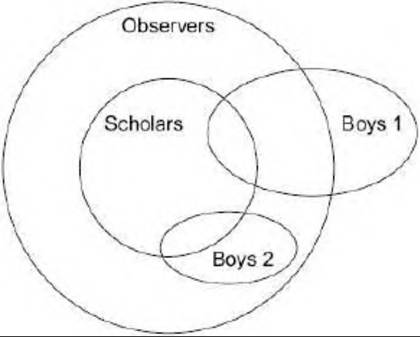
At this stage if you try to visualise where the teachers circle would be represented in the figure above, you would be able to visualise at least 4 to 5 places where the teacher’s circle could be drawn. Some of these are represented in the modified figure below. Note that the darker circles shown in the figure below are some of the possibilities where “Teachers” could be placed vis-a-vis scholars and observers.
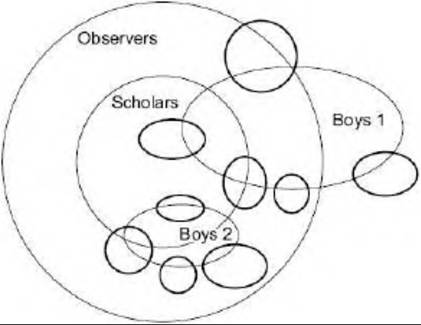
In order to decide which conclusions are definitely true, you must think of the conclusions which you cannot negate, no matter where you draw the teacher’s circle.
Thus, for instance in this problem, it is clear that we cannot draw the teachers’ circle in such a way that conclusion 1—some scholars are boys, is rejected (also realise that in order to reject ‘some scholars are boys’ you would need to have at least 1 feasible Situationwhere no scholars are boys).
Thus, conclusion 1 is definitely true.
Similarly conclusion 3 (some observers are boys) cannot be rejected because we cannot draw even a single figure where no observers are boys.
Also understand here that conclusions 2 and 4 do get rejected and this can be
seen on the basis of the following feasible diagram:
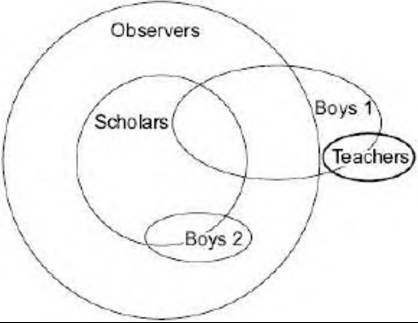
Figure rejecting conclusion 4, i.e. some teachers are scholars, by showing that no teachers are scholars is a feasible possibility in this situation.
Similarly, the following possibility rejects conclusion 2—some scholars are not boys, by showing that it is possible that all scholars are boys.
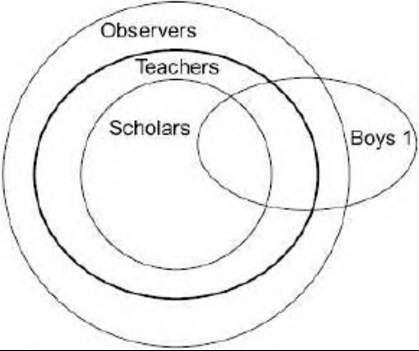
Thus, option (a) is the correct answer.
5. In this case, the solution figure is relatively less complex with a lower number of possibilities which you need to consider.
The most logical figure in this case is as seen below—fixing the relationships between Teachers, Professors, Researchers and Consultants.
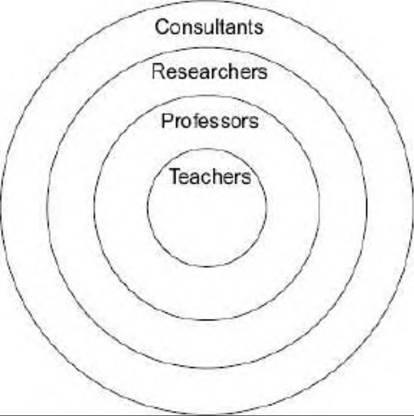
Note here that the circles for any two consecutive variables could overlap each other in such a case as the relationship “All teachers are professors” essentially throws up two basic figures as shown below:
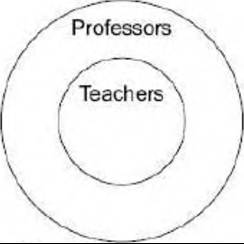
Possibility 1 for “All teachers are professors"

Possibility 2 for “All teachers are professors"
Based on this realisation, you can also visualise the other extreme for the problem solution figure, i.e. all the four circles overlap each other as shown below:

Or the following situation where three circles overlap each other as shown in the figure below where Professors, Researchers and Consultants overlap each other:
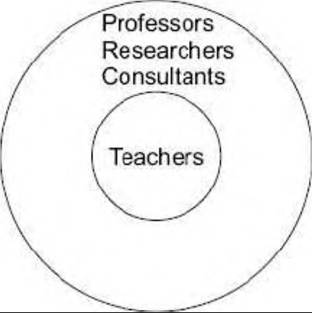
Based on these possible figures we can clearly see that none of the first three conclusions can be rejected. This is based on the following thought process: Conclusion 1 is definitely true: We cannot reject ‘Some consultants are teachers’ as we cannot show ‘No consultants are teachers’.
Conclusion 2 is definitely true: We cannot reject ‘All professors are consultants’ as we cannot show ‘Some professors are not consultants’.
Conclusion 3 is also definitely true: We cannot reject ‘Some researchers are teachers’ as we cannot show ‘No researchers are teachers’.
Conclusion 4 is something that does not necessarily follow as we can clearly see in the figures above that while all professors are teachers is a possibility and would occur if the teacher and professor circles overlap each other, it is not something that is definitely true as we can clearly see that it is possible that some professors are not teachers as seen in the figure above where the four circles were different from each other.
Thus, the correct answer should state: 1, 2 and 3 are true. However, this option
does not exist in the options given and hence the correct answer is option (d),
i. e. none of these.
6. The following table can be drawn in order to get the information in place before we start drawing our conclusions:
| Clue number | Phrase | Code |
| 1 | Traders are above laws | Lop eop aop fop |
| 2 | Developers were above profitable | Fop cop bop gop |
| 3 | Developers stopped following traders | Aop bop uop qop |
| 4 | Following maps were laws | Cop jop eop uop |
Based on the information in the table above, we can make the following conclusions:
1. From Clues 1 and 3, we get that traders is the only common word between the two and code ‘aop’ is the only common code between clues 1 and 3. Thus, traders = aop.
Using the same logic and combining 2 statements at a time the following additional conclusions can be drawn:
2. Using clues 3 and 4 we get: following = uop
3. Using clues 1 and 2: above = fop
4. Using clues 1 and 4: laws = eop
5. Using clues 2 and 3: developers = bop
6. Using clues 2 and 4: were = cop
7. Using conclusions 1, 3 and 4 we get: are = lop
8. Using conclusions 3, 4 and 5 we get: profitable = gop
9. Using conclusions 1, 2 and 5 we get: stopped = qop
10. Using conclusions 1, 3 and 4 we get: maps = jop
Based on these conclusions we can now solve questions 6 and 7.
For question 6 we have from the conclusions 5, 7, 2 and 4 that the codes used for the sentence “Developers are following laws” would be bop, lop, uop and eop. Option (b) matches this condition and hence is the correct answer.
7. For question 7 we have:
qop = stopped
gop = profitable
cop = were
and eop = laws
and hence the statement would be “Profitable laws were stopped”.
Option (a) is the correct answer.
Solutions for Questions 8 and 9:
8. Options (a) and (b) do not make any sense if they are put in the blanks of the series sequence:
Deffdeefddefededf using the option (a) shows no consistent pattern. Similarly the sequence DEFFDEEFDDEFDDEFF got by using the option (b) also shows no consistent pattern and hence can be rejected.
The sequence formed using option (c) is:
DEFFDEEFDDEFFDEEF. This sequence makes sense if you were to break the sequence into 3 terms at a time. You will get the sequence as:
DEF - FDE - EFD - DEF - FDE - EF
In the above sequence it can be seen that there is always a sequential order in which the three letters appear and also the second group of 3 alphabets starts from the last letter of the first group of 3 alphabets. And this trend continues uninterrupted throughout the sequence. Hence, we can mark option (c) as the correct answer.
9. The first three options give the following sequences:
(1) Aopopqopqrrqpoqporoo—Makes no sense as the letter a has no role to play in the sequence.
(2) Qopopqopqorqporporoo—Again this sequence makes no sense as there is no logical pattern that can be spotted, especially with the logic of introducing R midway in the series. Also, no pattern can be spotted even on breaking the series into parts with 3, 4 or even 5 terms, 4 terms or even 5 terms in the series to break it into parts.
(3) Qopopqopqrrqpooporoo—Again, no pattern can be spotted as there is no logic for the introduction of R midway through the series.
Thus, option (d) is correct.
10. The relationships are:
3M = 2N and N = 30 √E 3M = 6O.
Thus, 4M = 20 which is represented as 20 % M in option (c).
11. The relationships given in the problem are:
(i) N > P, (ii) P < O, (iii) O > M and (iv) N-M.
Combining (і) and (iv) we get:
N = M and hence both are greater than P.
At this point if we use the third relationship which tells us that O is greater than M we get a combined relationship as:
O>M = N>P.
Option (a) is the correct answer as O @ N means O > N.
12. The first course of action follows because running an expanded public awareness programme on primary education is likely to have a positive impact on the way the parents are thinking about educating their children; and in the case of primary education the decision making essentially lies with the parents only as the child is too young to decide on his own.
The second course of action also follows, as giving a compensation to those parents whose children are in school is likely to substantially mitigate the ‘negative’ financial effect that sending the children to school is likely to have on the family’s immediate Shorttermfinancial condition.
The third course of action is also a logical one to be followed as strengthening laws on universal education and implementing the ban on child labour more rigorously is likely to dissuade parents from sending their children to work at an age when they should be in school.
Thus, all the three courses of action follow in this case and hence option (d) is the correct answer.
13. In this case too all the three courses of action are logical and hence each of them should be implemented.
The first course of action is valid because widely publishing the forecast in the media is likely to inform the relevant stakeholders of the impending situation and help them take their own preventive steps well in advance.
The second course of action too is logical as preparing the drought relief team and making it ready for relief work well in advance would improve the efficacy of the relief operations that they would be required to undertake in case the forecast comes true.
The third course of action is also obviously valid as advising people to go for drought resistant varieties would help them mitigate the negative financial effects of a failed crop.
If we check the options, none of the first three options gives us the option of selecting all courses of action. Thus, we select option (d) as the correct option.
Solutions for Questions 14 and 15:
This question can be classified under Family relationships.
Reaction Tracker:
Since there are three generations in the family we create a three level tabular structure; but with an uncertainty about the number of people in each generation.
| Generation | Name ofMales | Name OfFemales | Relationships | Likes |
| 1st | ||||
| 2nd | ||||
| 3rd |
Once we have this, the first statement that can be used is the second last one which says that Nuri is the grand daughter of Mona and she supports Badminton. This statement in conjunction with the other information contained in the third last statement “Varun is grand father of Tarun and Tarun likes Punjabi food and supports basketball.”
Withthe composite use of this information we get the following tabular structure:
| Generation | Name ofMales | Name OfFemales | Relationships | Sport | Food |
| 1st | Varun | Mona | |||
| 2nd | |||||
| 3rd | Tarun | Nuri | Nuri - badminton Tarun - Basketball | Tarun - Punjabi food |
Fromthis point if we use the additional information in the last statement: “Nuri’s mother supports horse riding” as well as the information in the 5th statement: “Mona is the mother-in-law of Sonalika and she supports Athletics.” we get the following additional details filled up inside the table:
| Generation | Name of Males | Name of Females | Relationships | Sport | Food |
| 1st | Varun | Mona | Mona- athletics | ||
| 2nd | SonaUka | Sonalika is Mona’s daughter- in-law | |||
| 3rd | Tarun | Nuri | Nuri- badminton Tarun- Basketball | Tarun - Punjabi food |
Further at this point we realise that we have only 1 more person whose name has not come into this family relationship chart. Looking into the unutilized clues in the question we realize that we have not used Rakesh’s name and neither the clue about Rakesh and his wife. If we were to put the information from there in the table we have above we would get the following augmented table:
| Generation | Name of Males | Name of Females | Relationships | Sport | Food |
| 1st | Varun | Mona | Mona- athletic s | ||
| 2nd | Rakesh | Sonalika | Sonalika is Mona’s daughter in law & Nuri’s mother. Also Sonalika and Rakesh must be a married couple as it is clear that Rakesh is married and there are only 2 people in this generation so obviously he must be married to Sonalika only. | Sonalika- does not like gymnastics | Rakesh- continental food Sonalika- does not like dry fruits |
| 3rd | Tarun | Nuri | Nuri- badminton Tarun - Basketball | Tarun- Punjabi food |
At this point if we use the final information in the question: “The person who likes egg supports Rugby and his wife likes traditional food.” We realize that this person has to be male and among the males the only option left for whom we have not finalised the likings for either sport or food is Varun. Thus, the person referred to here must be Varun and his wife must be Mona. The table converts to the following:
| Generation | Name of Males | Name of Females | Relationships | Sport | Food |
| 1st | Varun | Mona | Varun and Mona are a couple | Varun- Rugby Mona- athletic s | Varun - egg Mona- Traditional food |
| 2nd | Rakesh | Sonalika | Sonalika is Mona’s daughter in law & Nuri’s mother. Also Sonalika and Rakesh must be a married couple as it is clear that Rakesh is married and there are only 2 people in this generation so obviously he must be married to | Sonalika- does not like gymnastics | Rakesh- continental food SonaUka- |
| Sonalika only. | does not like dry fruits | ||||
| 3rd | Tarun | Nuri | Nuri- badminton Tarun - Basketball | Tarun- Punjabi food |
At this point we can now move to the questions in the set.
14. The two married couples are Varun-Mona and Rakesh-Sonalika.
Option (a) is correct.
15. Tarun likes Punjabi food and he supports Basketball. Option (d) is correct.
Solutions for Questions 16 and 17:
This question can be classified under team formations and the basic process in order to solve such questions is essentially to make a mental note of all the constraints that the problem set places for the selection and then look at the individual questions in the set and try to check out which combination does not disobey any of the constraints of the selection situation.
In this question, if we denote the professors as A, B, C, D and E while we denote the students as P, Q, R and S respectively we can note the constraints as follows:
(a) A-S have to be together;
(b) P—not with R;
(c) D—not with Q;
(d) C and E have to be part of the 5 member team irrespective of anything else;
(5) R—not with B
With these constraints in front of us we can move on to solve the question set:
16. If there are three professors and D is one of them, we also know that the other two must be C and E. Further if D is selected, then amongst the four students P, Q, R and S we cannot select Q (due to constraint 3 shown above). This leaves us with only P, R and S for selection and two of them have to be selected as the question tells us that there are two students on the committee.
Also from the first constraint A & S have to be together. Since, A is not selected amongst the three professors, S would also not be eligible for selection. Thus, the two students have to be P and R.
The selection is C, E, D, P and R. Option (d) is the correct answer as none of the first three options gives us the C, E, D, P, R combination.
17. IfA and C are selected, E would also be selected (as both C and E are to be compulsorily taken). Taking A would mean also taking S. Each of the first three options gets rejected for the people who cannot be selected because each of these contains E’s name. Hence, option (d) is the correct answer.
18. The logic for EXAMINATION to be coded as 56149512965 is that each letter is represented by the sum of the digits of it’s position in the English alphabet. Thus, X being the 24th letter is represented by 6, E being the 5th letter is represented by 5, A = 1, M is the 13th letter and hence gets represented by 4 and so on. Thus, GOVERNMENT would become:
G = 7; O JE 15th letter = 6; V√E 22nd letter = 4; E = 5; R JE 18th letter = 9; N JE 14th letter = 5; M JE 13th letter = 4; E = 5; N = 5 and T = 2.
Thus GOVERNMENT = 7645954552. Option (a) is the correct answer.
19. The logic for HORSE to be coded as 71417184 is that each letter is represented by a number which is 1 less than it’s position in the English alphabet. Thus, H being the 8th letter is coded as 7, while O being the 15th letter is coded as 14 and so on.
MONKEY by the same logic would become: 12141310424.
Option (b) is the correct answer.
Solutions for Questions 20 and 21:
The following initial diagram is where you can start your thought process for this question:
| Flat Direction | Corner Flat | Middle Flat | Corner Flat | Professors facing South and North |
| South Facing Flats | ||||
| North Facing Flats |
Let the six professors be denoted as P, Q, R, S, T and U.
The first thing we should focus on doing is to identify which professors are in the North facing flats and Whichprofessors are in the South facing flats.
From the last two statements, viz: “R gets a south facing flat which is next to U’s flat” and “Τ’s flat is North Facing” we can modify the diagram to the following.
| Flat Direction | Corner Flat | Middle Flat | Corner Flat | Professors facing South and North |
| South Facing Flats | R,U | |||
| North Facing Flats | T |
At this point we also know that “S and U get flats which are diagonally opposite to each other” and since we know that U faces South, S would naturally face North; and we can also deduce that both S and U must be occupying corner flats.
| Flat Direction | Corner Flat | Middle Flat | Corner Flat | Professors facing South and North |
| South Facing Flats | R, U (comer flat) | |||
| North Facing Flats | T, S (comer flat) |
Further from the statement: “Q gets a North facing flat and it is not next to S’s flat” we realise two things:
T, S, Q are in the three North facing flats and since S and Q are not adjacent to each other, they must be both occupying corner flats while T would be occupying the middle flat in the North facing flats.
Consequently P would be in a South facing flat and the three people in South facing flats would be P, R, U. Also since R is next to U and we have alrady deduced that U is in the corner flat, we know that R would be in a middle flat.
The figure changes to the following:
| Flat Direction | Comer Flat | Middle Flat | Corner Flat | Professors facing South and North |
| South Facing Flats | P (comer flat), R (middle flat), U (comer flat) | |||
| North Facing Flats | T (in middle flat), S & Q (comer flat) |
Consequently we also realise that there are essentially the following 2 ways of arranging the 6 people:
Possibility 1:
| Flat Direction | Comer Flat | Middle Flat | Corner Flat | Professors facing South and North |
| South Facing Flats | P | R | U | P (comer flat), R (middle flat), U (comer flat) |
| North Facing Flats | S | T | Q | T (in middle flat), S & Q (comer flat) |
Possibility 2:
| Flat Direction | Comer Flat | Middle Flat | Corner Flat | Professors facing South and North |
| South Facing Flats | U | R | P | P (comer flat), R (middle flat), U (comer flat) |
| North Facing Flats | Q | T | S | T (in middle flat), S & Q (comer flat) |
Based on these reactions and deductions we can solve the questions.
20. P, R and U get South facing flats as deduced above and hence, option (c) is the correct answer.
21. From the final conclusions above, it is quite clear that there is no change in U’s neighbour if P and T interchanged their flats. Option (a) is correct.