Justification Awareness Models
We need more expressive power to capture epistemic differences between justifications and their consequent use by the knower. Some justifications are knowledge-producing, some are not.
The agent makes choices about which justifications should serve as a base for beliefs and knowledge and which justifications should be ignored. These actions are commonly present in epistemic scenarios—we will continue to focus on Russell Prime Minister Example, where the central points are these:• there are justifications w (Balfour was the late prime minister) and r (Bannerman was the late prime minister) for P;
• r is knowledge-producing for P whereas w is not;
• the agent opts to base belief that P on w and ignores r;
• the resulting belief is evidence-based, but is not knowledge.
We are about to discuss and adopt some natural properties of accepted and knowledge-producing justifications for a given sentence in a given model. First note that these sets are conceptually different: both Russell and Gettier examples, as well as their modifications, are built on this observation. Agents do not necessarily accept only knowledge-producing justifications as the basis for the agent’s belief, and some knowledge-producing justifications may be left not accepted due to unawareness, ignorance, and/or other reasons. This combination of acceptance and knowledge-producing predicates for justifications allows us to represent awareness (which has suggested the name Justification Awareness Models) in a way that is intuitive and maintains desirable closure conditions.
In our analysis of the Russell Prime Minister Example we will assume that justification constants are both knowledge-producing and accepted.
A fundamental natural assumption concerning the basic logical intelligence of agents is that if justifications s and t are accepted (or knowledge-producing) then their product s ■ t is also accepted (respectively, knowledge-producing) for the corresponding formulas. A more elaborate discussion of closure conditions of acceptance and knowledge-producing predicates will be found in Section 11.4.1.
Definition 11.2 A (basic) Justification Awareness Model (JAM) is a triple
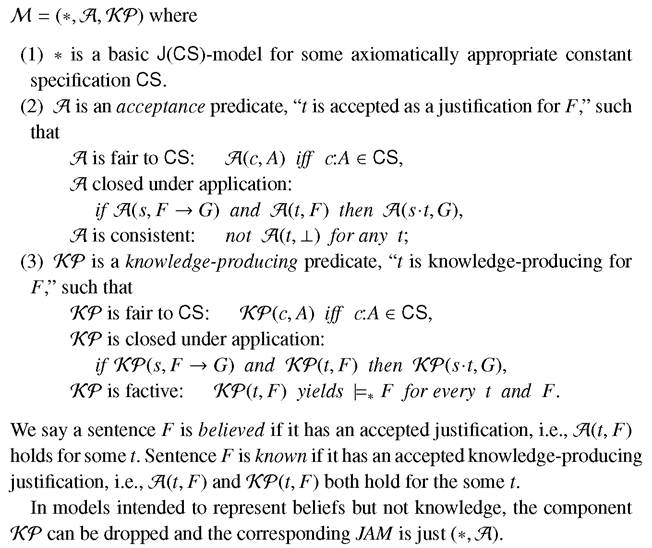
This definition builds in the assumption that constants in a model are both knowledge-producing and accepted, though one could envision a more refined analysis.
It is important to understand that JAMs do not analyze why certain justifications are knowledge-producing or accepted, but rather JAMs assume knowledgeproducing and accepted justifications to be given and provide a formal framework for reasoning about them.
11.4