TheRussellScenarioasa JAM
We now use the JAM semantics just introduced to formally analyze the Russell Prime Minister Example. Consider a version of J(CS) in a language with two justification variables w and r, one propositional letter P, and an axiomatically appropriate single-conclusion constant specification CS, i.e., each axiom A 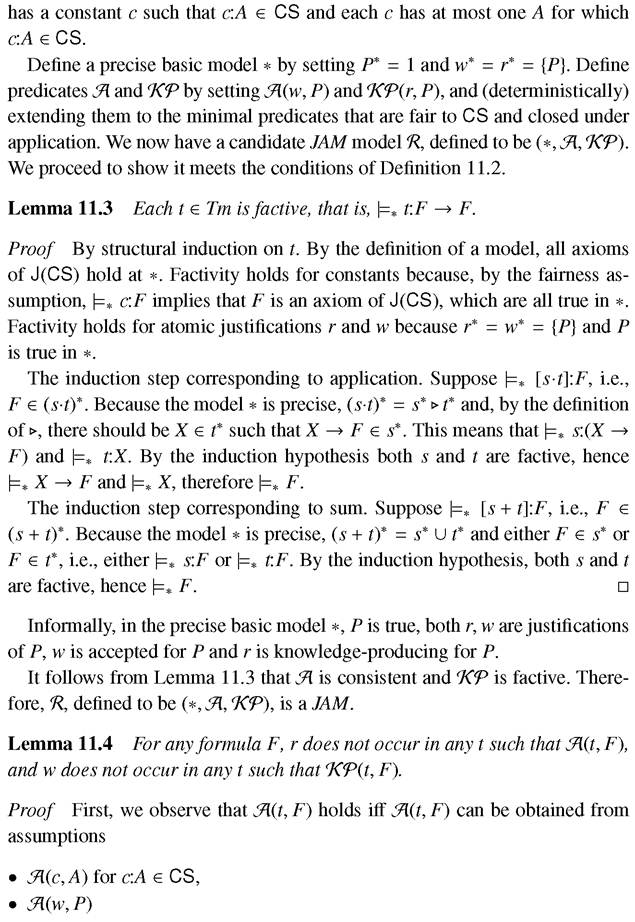
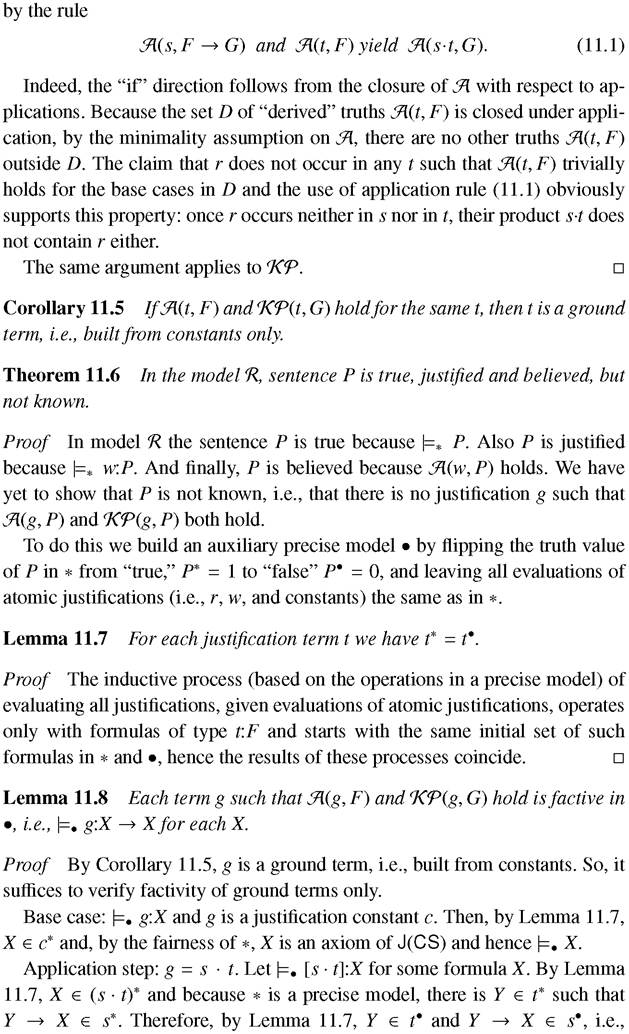
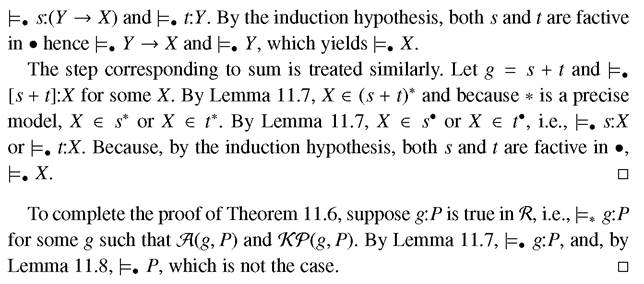
11.4.1 Closure Conditions for Acceptance and Knowledge-Producing Predicates
In this section we discuss why acceptance predicates A and knowledge-producing predicates KP are assumed closed under application “·” and not assumed closed under sum “+.”
Acceptance is a subjective act by an agent who possesses a certain amount of rationality.
In particular, the well-established epistemic closure principle for beliefs in its explicit form suggests that if 5 is accepted as belief-producing evidence for F → G and t is accepted as belief-producing evidence for F, then 5 applied to t should be accepted as belief-producing evidence for G.Similar considerations justify the closure of KP. If a justification 5 is knowledge-producing for F → G and t is knowledge-producing for F, then 5 · t is a knowledge-producing justification for G: a procedure of knowledge-producing for G could produce knowledge for F → G and F and then conclude that G.
As for the sum operation, within the Russell example it is easy to show that A and KP cannot both be closed under “+.” Indeed, otherwise the justification r + w would be both accepted, and knowledge-producing for P thus making P known, which is not the case.
We argue that actually none of A and KP, generally speaking, is closed under “+,” each for its own reasons.
Acceptance is subjective, and it may happen that the agent accepts 5 as a sufficient justification for believing that F, but considers a broader argument 5 + t less trustworthy. In particular, the additional component t may yield something that is incompatible with F, as in the Russell example.
On the basis of available observations (justification 5) we could believe that a doctor recommends medicines objectively (sentence F), exclusively based on the patient's health condition. However, a broader justification 5 + t, in which 5 is supplemented with additional evidence t stating that this doctor is a paid lobbyist of one of the relevant companies could well undermine our trust that F.
Knowledge-producing is more objective and thus more detached from the agent. A justification 5 may be knowledge-producing for F, for example,.s, could be a mathematically precise proof of F. However with another, possibly not proof-grade justification t added, the combined justification 5 + t may no longer be a solid mathematical proof of anything let along F. In addition, some kind of consistency argument appears to work here as well: t might be an argument for then 5 and t are incompatible and their sum 5 + t cannot be viewed as knowledge-producing.
One can ask why in the logic of proofs LP the operation + is legitimate. Our answer is that mathematical proofs themselves are both knowledge-producing and assumed accepted by a rational agent, hence A(t, F) and KP(t, F) are both equivalent to t:F and this guarantees their closure w.r.t. “+.”
11.4.2 Can Russell’s Scenario Be Made Modal?
One could try to express Russell Prime Minister Example in a modal language by introducing the justified belief modality

and the knowledge-producing modality

and by stipulating that F is known iff F is both accepted and supported by a knowledge-producing justification:

This, however, fails because both JP and EP hold in R, but KP does not. This is the essence of a Gettier-style phenomenon, when a proposition is supported by a knowledge-producing justification (hence true) and believed, but not known because knowledge-producing and accepted justifications for P are different. This illustrates the limitations of a purely modal language in tracking and sorting justifications.
11.5