Level of Difficulty (LOD)-II
Directions for Questions 1 to 5: The staff of AMS Careers presently consists of three senior faculty—A, B and C and five junior faculty—U, V W, X and Y. Mr Arun Sharma, CEO of AMS Careers, is planning to open a new office in another city using two senior faculty and three junior faculty of the present staff.
To do so he plans to separate certain individuals who do not Iiiction well as a team. The following guidelines were established to set up the new office:(i) Since U and X have been Competingfor promotion, they should not be a team.
(U) Senior faculty A and C are constantly finding fault with one another and should not be sent to the new office as a team.
(Hi) C and V function well alone but not as a team. Hence, they should be separated.
(iv) U and X have not been on speaking terms for many months. They should not be put together.
1. If A is to be moved as one of the senior faculty, which of the following cannot be a possible working unit?
(a) ABUVY (b) ABVWY
(c) ABUXY (d) ABVXY
2. If C and W are moved to the new office, how many teams are possible?
(a) 1 (b) 2
(c) 3 (d) 4
3. If C is sent to the new office, which member cannot go with C?
(а) В (b) U
(e) V (d) X
4. Given the conditions in the passage, which of the following must go to the new office?
(a) B (b) U
(c) V (d) T
5. IfU goes to the new office, which of the following is/are true?
(i) X cannot go with him
(ii) A cannot go with him
(iii) B is another faculty to go with him
(a) (i) only
(b) (iii) only
(c) Both (i) and (iii) only
(d) None of these
Directions for Questions 6 to 10 A wooden cuboid of dimensions 9 ¥ 7 ¥ 5 unit is painted in a fixed pattern.
(i) The two opposite faces in the front and back are painted in red with 9⅛ 7 cuts.
(U) The other two opposite faces on the sides are painted in green with 9¥ 5 cuts.
(Hi) The remaining top and bottom faces are painted in blue.The cuboid is cut into 315 small cubes.
6. How many cubes have all the three faces coloured?
(a) 8 (b) 32
(c) 24 (d) None of these
7. How many cubes have two faces coloured?
(a) 60 (b) 142
(c) 105 (d) None of these
8. How many cubes have one face coloured?
(a) 142 (b) 105
9. How many cubes have no face coloured?
(a) 142 (b) 60
(c) 105 (d) None of these
10. How many cubes have two faces coloured, that too Red and Green?
(a) 14 (b) 28
(c) 32 (d) None of these
11. While Balbir had his back turned, a dog ran into his butcher shop, snatched a piece of meat off the counter and ran out. Balbir was mad when he realised what had happened. He asked three other shopkeepers, who had seen the dog, to describe it. The shopkeepers really didn’t want to help Balbir. So each of them made a statement which contained one truth and one lie.
(i) Shopkeeper number 1 said: “The dog had black hair and a long tail.”
(ii) Shopkeeper number 2 said: “The dog had a short tail and wore a collar.”
(iii) Shopkeeper number 3 said: “The dog had white hair and no collar.”
Based on the above statements, which of the following could be a correct description?
(a) The dog had white hair, short tail and no collar.
(b) The dog had white hair, long tail and a collar.
(c) The dog had black hair, long tail and a collar.
(d) The dog had black hair, long tail and no collar.
12. Three tribes live on a remote island Rokas Phokas. The Greenies always tell the truth. The Fishmongers never tell the truth. The Wishy-Washies alternate telling the truth and lying with their statements alternating true and false or false and true.
The world renowned explorer, the Sammy, landed on the island and questionsed the natives, Tarun, Dipesh and Harish.
Explorer:
Tarun, to which tribe do you belong?
Tarun:
Tma Greenie.
Explorer:
Dipesh, to which tribe do you belong?
Dipesh:
Γm a Fishmonger.
Explorer:
Was Tarun telling the truth?
Dipesh:
Yes.
Explorer:
Harish, to which tribe do you belong?
Harish:
Γma Greenie.
Explorer:
To whichtribe does Tarunbelong?
Harish:
Tarun’s a Wishy-Washie.
Whichperson is the Fishmonger?
(a) Dipesh (b) Harish
(c) Tarun (d) Cannot be determined
13. Four friends, Mr. Barber, Mr. Carpenter, Mr. Stockbroker and Mr. Tanner all have different occupations, barber, carpenter, stock broker and tanner. But none of them has an occupation which matches his name.
Each man always wears the same colour shirt, black, crimson, silver or topaz. But the colour shirt he wears does not start with the same letter as his name or his occupation.
Mr. Stockbroker and the tanner dine together regularly.
The Stockbroker wears a black shirt.
Mr. Carpenter is the barber.
What is the Stockbroker’s occupation?
(a) Barbar (b) Tanner
(c) Carpenter (d) None of these
14. P, Q, R, S and T took a photography class together. The assignment was to photograph animals, so they decided to take a safari for 10 days. A different pair took the pictures each day. Some days they didn’t see any animals. But they returned home with pictures of five animals, each taken on different days.
T was not involved with the picture of the anteater.
Q was one of the pair which took pictures of the emu.
No one was on the teams which took pictures of both the anteater and the deer.
One person captured the photo of both the crocodile and the emu.
One person took pictures of the bear. He also took photograph of an animal when he was out with S.
P and Q were successful on their day together as a team
R and T, however, saw nothing on their day as a team
Each man participated in the photographing of two animals.
Q, S and T together had a hand in photographing all five of the animals.
Which pair photographed the bear?
(a) P and T (b) P and Q
(c) R and S (d) Cannot be determined
15.
Early one morning, four snails, A, B, C and D, set off together down the garden path. A and B kept the same steady pace, slithering only 8 metres by the time C and D had already reached the azalea.C was wounded and had to stop for an hour to rest. Although D was tired, too, she pressed on, but reduced her pace to be at the same speed as A’s and B’s.
C started off again just as A and B got even with her. She raced off at her original pace. A promptly sped up to the same speed as C and kept even with her. B just kept going at her original pace.
When A reached the end of the path, she was 1 metre ahead of B, but she was a half hour later than D was.
How many meters long was the path?
(a) 10 (b) 15
(c) 8 (d) None of these
16. Coach Pathak has one tennis scholarship left. He’s just heard of a family with four boys who are all great tennis players. He’s never seen them play, but his scouts assure him that all four play equally well. With no more knowledge available to him, he decides that he wants to give the scholarship to the tallest boy. But their parents do not want to show any favouritism.
The parents agree to have the boys exit the house, one at a time and let Coach Pathak pick the one he wants. He has to make an immediate decision on whether or not to offer the scholarship to that boy. If the coach uses his best strategy, what is the probability of him offering the scholarship to the tallest boy? Assume he can tell whether the boy is taller or shorter than the other boys he’s seen.
(a)0
(c) 11/24
(b) 1/3
(d) None of these
17. Fanny, Gopal and Harish play a challenge tennis tournament where two of them play a set, then the winner stays in the court to play the one who sat out.
During the tournament, Fanny played 15 sets, Gopal played 14 and Harish played 9.
Who played in set 13?
(a) Fanny and Harish (b) Gopal and Harish
(c) Fanny and Gopal (d) None of these
18. In the town of Rokas Phokas, all the married people lie all the time.
All the single people tell the truth all the time.Tennis is a popular pastime in Rokas Phokas. One day three women and three men decided to play. There were two couples and two single people among them.
If you asked Chandar whether Bandar is married to Tender, he would say,
“Haan.”
If you asked Pammi if she is married to Chandar, she would say, “Haan.”
If you asked Jimmy if he is married to Rashmi, he would say, “Nahin.”
If you knew enough about the local language to know whether “Haan” means “Yes” and “Nahin” means “No” or visa versa, you could figure out who is married to whom
Can you figure it out who is married to Chandar?
(a) Tendar (b) Rashmi
(c) Pammi (d) None of these
19. A, B and C each make four statements about each other. But only one of them made four true statements.
A said:
1. B owes me $10.
2. C owes me $5.
3. All of C’s statements are true.
4. All of B’s statements are false.
B said:
1.1 owe no money to A.
2. C owes me $7.
3.1 am Scandinavian.
4. All A’s statements are false.
C said:
1.1 owe no money to anyone.
2. B is Italian.
3.1 always tell the truth.
4. Two of B’s statements are true and two are false.
Find which statements are true and which are false for all three.
(a) B—All statements true, A’s and C’s Statements are false.
(b) B—All statements false, A—All statements true and C’s Statements are false.
(c) B—All statements true, A’s and C’s Statements are also true.
(d) None of these
20. My next door neighbour lies a lot. In fact, he only tells the truth on one day a week! One day he told me, “I lie on Mondays and on Tuesdays.”
The next day he said, “Today is either Thursday, Saturday or Sunday.”
The next day he said, “I lie on Wednesdays and Fridays.”
On which day of the week does my neighbour tell the truth?
(a) Monday (b) Tuesday
(c) Wednesday (d) None of these
21. In chess, a knight moves two squares in one direction and one square in another direction, ending up on the diagonally opposite corner of a 2 ¥ 3 grid.
Intervening squares can be occupied. Find the maximum number of knights which can be placed on an 8 ¥ 8 chess board so that so that no knight threatens another knight (can move into a square occupied by one of the other knights).(a) 34 (b) 32
(c) 30 (d) None of these
22. Three brothers, Armani, Birianni and Chutanmi are all different ages. They each do strange things with numbers, that is, instead of saying the actual number, they change it in a certain way first.
One brother divides the number in half.
Another brother squares the number.
The third brother reverses the digits. (21 becomes 12, 50 and also 5 become 5)
When they were asked their ages, the oldest whispered his “age” to the thinnest, who whispered it to Chutanmi, who whispered it to the youngest, who answered: 27.
Then the youngest whispered his “age” to the tallest, who whispered it to Birianni, who whispered it to the shortest, who answered: 23
Lastly, the youngest whispered his “age” to the shortest, who whispered it to the thinnest, who whispered it to Armani, who answered: 16.
What are the ages of the three brothers?
(a) 12, 16 and 8 (b)21,8andl6
(c) 5, 21 and 50 (d) 16, 21 and 50
23. Deepika was admiring the output of her new program to generate random numbers. She had printed out the first ten numbers of the results. She soon noticed something interesting. Each of the 10 numbers had exactly one digit, in the proper placement, of the 5 digit code she used to open her car door without a key.
In the first number 14073, for example, Deepika’s car code could not be 34170 (two digits Correctlyplaced) or 92365 (none).
Find Deepika’s car entry code from these first 10 randomly generated numbers: 14073, 79588, 05892, 84771, 63136, 42936, 37145, 50811, 98174 and 29402?

24. А, В, C, D and E all live on Pine Street which has house numbers from 10 to 111, inclusive. Two of them live in the same house. The others all live in different houses. They all have made remarks about where they live, but not all the remarks are true.
A said, “My house number is a factor of B’s house number. E’s house number is 10 greater than D’.”
B said, “My house number is greater than 70. A’s house number is greater than 30.”
C said, “My house number is both a cube and a square. D’s house number is greater than 50.”
D said, “My house number is a square. B’s house number is a cube.”
E said, “My house number is twice B’s”
But who’s telling the truth? It turns out that all statements made by people living in houses with numbers greater than 50 were false. All the other statements were true.
Can you find out the house number of E?
(a) 49 (b) 16
(c) 59 (d) None of these
25. During a game of five card draw poker, played with a standard deck, you are dealt a hand with the following characteristics:
• It contains no aces or face cards.
• No two cards have the same value.
• All four suits are present.
• The total value of the odd cards equals the total value of the even cards.
• There are no three card straights.
• The total value of the black cards is 10.
• The total value of the hearts is 1(d)
• The card with the lowest value is a spade.
Exactly what are the five cards in your hand?
(a) 2 of spades, 5 and 9 of diamonds, 4 of spades and 8 of clubs
(b) 2 of diamonds, 5 and 9 of spades, 4 of hearts and 8 of clubs
(c) 2 of clubs, 5 and 9 of hearts, 4 of diamonds and 8 of spades
(d) None of these
24. Divayabh gave an application for a new passport to the clerk on Monday afternoon. Next day was a holiday. So the clerk cleared the papers on the next working day on resumption of duty. The senior clerk checked it on the same day but forwarded it to the head clerk on the next day. The head clerk decided to dispose the case on the subsequent day. On which of the following days was the case put up to the head clerk by the senior clerk?
(a) Wednesday (b) Thursday
(c) Friday (d) None of these
Directions for Questions 27 and 28 Read the following information and answer the questions given below.
(i) Mark, a management representative (M. R.) from Mindvvorkzz Solutions Inc., has to meet 7 managers A, B, C, D, E, F and G on a particular day between 9 am and 4 pm.
(U) He takes 30 minutes with each manager and keeps a gap of 25 minutes between two appointments for travel and preparation except after the fifth visit, when he takes 50 minutes’ break for lunch, travel and preparation.
(Hi) He has to meet manager A immediately before E but immediately after F, who is the third manager to be met.
(iv) ‘G’ does not give time for M.R. before 9.30 am and after 10.30 am. ‘D’ and ‘B’ meetM.R. between 2pm and (c)30pm only.
25. Who among the following is likely to be the first manager of that day?
(a) G (b) C
(c) F (d) E
26. If manager ‘F’ asks him to visit again 25 minutes after his scheduled seventh visit is over, then at what time can he meet manager ‘F’?
(a) 3.55 pm (b) 3.40 pm
(c) 3.25 pm (d) None of these
Directions for Questions 29 and 30 Read the following information carefully and answer the Questions given below:
Sachin, Saurav, Rahul, Yuvraj, Mahendra and Suresh, six enemies of different heights and wearing different coloured jackets of red, blue, white, orange, yellow and green, are standing on either sides of a road with three on each side. Mahendra the tallest, is exactly opposite the person wearing red-coloured jacket. The shortest person is exactly opposite the person wearing green coloured jacket. Suresh is the person wearing orange-coloured jacket and is standing between Sachin and Yuvraj.
Rahul, who is wearing yellow-coloured jacket, is exactly opposite Sachin. Saurav who is wearing green-coloured jacket, is exactly opposite Suresh. Sachin, wearing the white-coloured jacket, is taller than Rahul but shorter than Yuvraj and Saurav.
27. What is the colour of the jacket of Yuvraj?
(a) Red (b) Blue
(c) Red or blue (d) None of these
28. What is the position of Sachin from top when the persons are arranged in descending order of their heights?
(a) Third (b) Second
(c) Fourth (d) None of these
Directions for Questions 31 and 32 Study the following information carefully and answer the questions given below:
Amar, Biswas, Calvin, Devendra, Ekta, Firoz and Gavli are seven persons who travel to office everyday by a local train which stops at five stations Kalyan, Thane, Kurla, Dadar and Mumbai Central respectively after it leaves base station.
(a) Three among them get in the train at the base station.
(b) Devendra gets down at the next station at which Firoz gets down.
(c) Biswas does not get down either with Amar or Ekta.
(d) Gavli alone gets in at station Dadar and gets down with Calvin after having passed one station.
(e) Amar travels between only two stations and gets down at Mumbai central.
(f) None of them gets in at Kurla.
(g) Calvin gets in with Firoz but does not get in with either Biswas or Devendra.
(h) Ekta gets in with two others and gets down alone after Devendra.
(i) Gavli and Devendra work in the same office and they get down together at Dadar.
(j) None of them gets down at Kalyan.
29. At which station does E get down?
(a) Thane (b) Kurla
(c) Dadar (d) None of these
30. After how many stations does Ekta get down?
(a) One (b) Two
(c) Three (d) Four
Directions for Questions 33 and 34 Study the following information carefully and answer the questions given below it:
Yudhishter passes through seven lanes to reach his School. He finds that ‘Truth Lane ’ is between his house and ‘Lie Lane ’. The third lane from his school is ‘Karma Lane ’. ‘Dharma Lane ’ is immediately before the ‘Yog Lane ’. He passes ‘Salvation Lane ’ at the end, ‘Lie Lane ’ is between ‘Truth Lane ’ and “Dharma Lane the sixth lane from his house is Devotion Lane ’.
31. How many lanes are there between ‘Lie Lane’ and ‘Devotion Lane’?
(a) One (b) Two
(c) Three (d) Four
32. If the house OfYudhishter, each lane and his school are equidistant and he takes two minutes to pass one lane, then how long will he take to reach school from his house?
(a) 18 minutes (b) 16 minutes
(c) 14 minutes (d) None of these
33. A man would like to take a new health insurance. An officer taking care of these matters says to the man: “Please tell me how many children you have.” The man answers: “I have three of them.” The officer: “What are the ages of your children?” The man answers: “The product of the ages is equal to 36.” The officer replies: “This is not enough information Sir!”; the man replied “Sorry that I was a little bit unclear, but the sum of the ages is equal to the number of shops in front of your office,” says the man. The officer: “This still isn’t enough information Sir!”; The man replies: “My oldest child loves chocolate.” The officer: “Thanks for your cooperation, Now I know the ages.”
Are you as smart as the officer? Then give the ages of the children.
(a) 13 (b)21
(C) 16
(d)38
Answer Key
| l.(c) | 2. (b) | 3.(c) | 4. (a) |
| 5. (c) | 6. (a) | 7. (a) | 8. (a) |
| 9. (c) | 10. (b) | ll.(b) | 12.(b) |
| 13.(c) | 14. (a) | 15.(b) | 16. (c) |
| 17.(c) | 18. (d) | 19.(b) | 20. (b) |
| 21∙(d) | 22. (b) | 23. (d) | 24. (c) |
| 25. (d) | 26. (b) | 27. (b) | 28. (c) |
| 29. (a) | 30. (c) | 31∙(b) | 32. (c) |
| 33. (d) | 34. (c) | 35. (c) |
Solutions
Solutions for 1 to 5:
Solve using constraints and checking the options for each constraint:
Constraint 1: The constraints are U and X not together
Constraint 2: A and C not together.
Constraint 3: C not with V
1. ABUXY contradicts constraint 1. Hence, this team is not possible. Thus Option c is correct. ABC UVWXY
2. C AND W are compulsory. Hence, of the senior faculties we need to take B. The teams possible then are: BC-WUY and BC-WXY Hence, only 2 teams are possible. Option (b) is correct.
3. Constraint 3 clearly defines that V cannot go with C. Hence, Option (c) is correct.
4. B must compulsorily go to the new office as we can select only one out of A and C. Hence, Option (a) is correct.
5. Both і and iii are true. Hence, Option (c) is correct.
Solutions for 6 to 10:
The six surfaces can be visualized as three surfaces of 9 ¥ 7, 9 ¥ 5 and 7 ¥ 5 (rows and columns) as shown in the figures below:
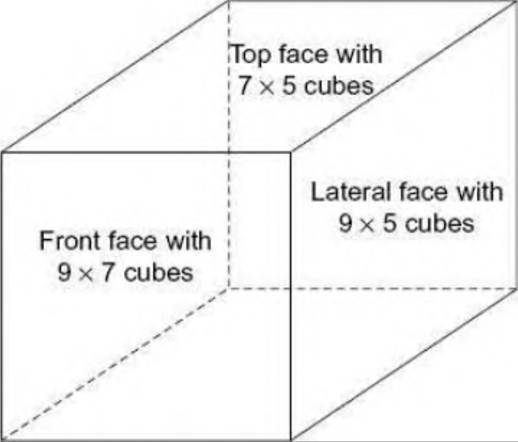
The individual surfaces would look as below: 9 rows ¥ 7 columns (two surfaces)
| Painted on all three surfaces | Painted on 2 surfaces | Painted on 2 surfaces | Painted on 2 surfaces | Painted on 2 surfaces | Painted on 2 surfaces | Painted on all three surfaces |
| Painted on 2 surfaces | Painted on 1 surface | Painted on 1 surface | Painted on 1 surface | Painted on 1 surface | Painted on 1 surface | Painted on 2 surfaces |
| Painted on 2 surfaces | Painted on 1 surface | Painted on 1 surface | Painted on 1 surface | Painted on 1 surface | Painted on 1 surface | Painted on 2 surfaces |
| Painted on 2 surfaces | Painted on 1 surface | Painted on 1 surface | Painted on 1 surface | Painted on 1 surface | Painted on 1 surface | Painted on 2 surfaces |
| Painted on 2 surfaces | Painted on 1 surface | Painted on 1 surface | Painted on 1 surface | Painted on 1 surface | Painted on 1 surface | Painted on 2 surfaces |
| Painted on 2 surfaces | Painted on 1 surface | Painted on 1 surface | Painted on 1 surface | Painted on 1 surface | Painted on 1 surface | Painted on 2 surfaces |
| Painted on 2 surfaces | Painted on 1 surface | Painted on 1 surface | Painted on 1 surface | Painted on 1 surface | Painted on 1 surface | Painted on 2 surfaces |
| Painted on 2 surfaces | Painted on 1 surface | Painted on 1 surface | Painted on 1 surface | Painted on 1 surface | Painted on 1 surface | Painted on 2 surfaces |
| Painted on all | Painted on 2 | Painted on 2 | Painted on 2 | Painted on 2 | Painted on 2 | Painted on all |
three surfaces surfaces surfaces surfaces surfaces surfaces three surfaces
9 rows ¥ 5 columns (two surfaces)
| Painted on all 3 surfaces | Painted on 2 surfaces | Painted on 2 surfaces | Painted on 2 surfaces | Painted on all 3 surfaces |
| Painted on 2 surfaces | Painted on 1 surface | Painted on 1 surface | Painted on 1 surface | Painted on 2 surfaces |
| Painted on 2 surfaces | Painted on 1 surface | Painted on 1 surface | Painted on 1 surface | Painted on 2 surfaces |
| Painted on 2 surfaces | Painted on 1 surface | Painted on 1 surface | Painted on 1 surface | Painted on 2 surfaces |
| Painted on 2 surfaces | Painted on 1 surface | Painted on 1 surface | Painted on 1 surface | Painted on 2 surfaces |
| Painted on 2 surfaces | Painted on 1 surface | Painted on 1 surface | Painted on 1 surface | Painted on 2 surfaces |
| Painted on 2 surfaces | Painted on 1 surface | Painted on 1 surface | Painted on 1 surface | Painted on 2 surfaces |
| Painted on 2 surfaces | Painted on 1 surface | Painted on 1 surface | Painted on 1 surface | Painted on 2 surfaces |
| Painted on all 3 surfaces | Painted on 2 surfaces | Painted on 2 surfaces | Painted on 2 surfaces | Painted on all 3 surfaces |
AND 7 rows ¥ 5 columns (two surfaces)
| Painted on all 3 surfaces | Painted on 2 surfaces | Painted on 2 surfaces | Painted on 2 surfaces | Painted on all 3 surfaces |
| Painted on 2 surfaces | Painted on 1 surface | Painted on 1 surface | Painted on 1 surface | Painted on 2 surfaces |
| Painted on 2 surfaces | Painted on 1 surface | Painted on 1 surface | Painted on 1 surface | Painted on 2 surfaces |
| Painted on 2 surfaces | Painted on 1 surface | Painted on 1 surface | Painted on 1 surface | Painted on 2 surfaces |
| Painted on 2 surfaces | Painted on 1 surface | Painted on 1 surface | Painted on 1 surface | Painted on 2 surfaces |
| Painted on 2 surfaces | Painted on 1 surface | Painted on 1 surface | Painted on 1 surface | Painted on 2 surfaces |
| Painted on all 3 surfaces | Painted on 2 surfaces | Painted on 2 surfaces | Painted on 2 surfaces | Painted on all 3 surfaces |
The answers to the questions can be visualized based on the above visualizations:
6. In all these kinds of questions, the number of cubes which would be painted on three sides would always be the corner cubes. There would be 8 corner cubes. Option (a) is correct.
7. The two faces colored cubes would be the cubes along each edge (except for the corner cubes). It can be visualized that the top edges of the cube would have 7 + 7 + 3 + 3 = 20 cubes and the bottom edges would also have the same number (i.e. 20 cubes).
The vertical edges would have a further 7 + 7 + 7 + 7 = 28 cubes.
Out of the total of 68 cubes which are on the edges, 8 cubes would be corner cubes. Hence, the number of cubes painted on two sides would be 68 - 8 = 60. Option (a) is correct.
8. The number of one face colored cubes would be:
On the front and back surfaces: 7¥5 + 7¥5 = 70 cubes, (you can remember this as (m-2) ¥ (n-2) where m and n are the number of rows and columns on the surface in question)
On the top and bottom surfaces: 5¥3 + 5¥3 = 30 cubes.
On the lateral surfaces: 7¥3 + 7¥3=42 cubes.
Thus a total of 142 cubes would have one side painted. Option (a) is correct.
9. The number of cubes with no face colored would be given by 7 ¥ 5 ¥ 3 = 105 [which can again be remembered as (m-2)(n-2)(p-2) where m, n and p are the number of parts in which the cube surfaces have been cut - in this case m=9, n=7 and p=5].
Alternately, you could also have solved this using: All cubes - cubes with 3 sides colored - cubes with 2 sides colored - cubes with 1 side colored = 315 - 8-60- 142 = 105.
Option (c) is correct.
10. The cubes along the vertical edges would be painted both red and green. There are 7 such cubes (with 2 faces colored) on each of the 4 edges of the cuboid. Thus, the total number of cubes which would be painted on two sides (in red and green) would be 7 ¥ 4 = 28. Option (b) is correct.
11. The statements can be mapped as follows:
Number 1: Black Hair Long tail
Number 2: Short tail wore a collar
Number 3: White Hair No Collar
Scenario 1: If statement 2 OfShopkeeper 1 is correct & his statement 1 is false: Statement 1 of shopkeeper would be false. Then his (shopkeeper 2,s) statement 2 would be correct and shopkeeper 3,s statement 2 would be false.This would mean shopkeeper 3,s first statement would be true.
It can be concluded that: The dog has white hair, he wears a collar and has a long tail.
Scenario 2: If statement 1 OfShopkeeper 1 is correct & his statement 2 is false: Statement 1 of shopkeeper would be true. Then his (shopkeeper 2,s) statement 2 would be false while his statement 1 would be true. Shopkeeper 3 ,s statement 2 would be true.This would mean shopkeeper 3,s first statement would be false.
It can be concluded that: The dog has black hair, wears no collar and has a short tail.
Option (b) is a possible description of the dog
12. Looking at the statements after the initial condition, it can be easily seen that Dipesh is lying when he says that he is a fishmonger- as nobody can say that he/she is a fishmonger truthfully Also, Dipesh would not be a fishmonger—and he cannot be a Greenie. Hence, Dipesh would be a Wishy Washy, thus making his second statement true. This means that Tarun is a greenie. This in turn means that Harish’s second statement about Tarun is false. This also means that Harish cannot be a greenie which renders his first statement also false. Thus, Harish must be a Fish monger.
Option (b) is correct.
13. In this question, the following would be the starting grid:
| Profession (Barber, Carpenter, Stockbroker, Tanner) | Shirt colour (Black, Crimson, Salmon, Topaz) | |
| Mr. Barber | ||
| Mr. Carpenter | ||
| Mr. Stockbroker | ||
| Mr. Tanner |
After using the clues, we get: The clues are used in the following manner to reveal the stockbroker’s profession:
Since Mr. Carpenter is the barber and the stockbroker is friends with the tanner - the stockbroker must be neither the baker nor the tanner. Also, since we know that no person has a profession which equals his name. Hence, Mr. Stockbroker must be the Carpenter:
| Profession (Barber, Carpenter, Stockbroker, Tanner) | Shirt colour (Black, Crimson, Salmon, Topaz) | |
| Mr. Barber | Tanner |
| Mr. Carpenter | Baker | |
| Mr. Stockbroker | Carpenter | Black |
| Mr. Tanner | Stockbroker |
Option (c) is correct.
14. The pairs who were successful getting pictures were:
P and Q photographed the anteater.
P and T photographed the bear.
R and S photographed the crocodile.
S and T photographed the deer.
Q and R photographed the emu.
There are 10 possible pairs. Each person went out four times, each time with a different partner. Each person got a photograph twice and got nothing twice.
First, to determine which pairs photographed an animal and which didn’t, make a 5x5 matrix with row and column headings of P, Q, R, S and T. Since we don’t always know what animal was photographed, assign the animals a number, 1 through 5.
Everybody took photographs of two animals. So you can assign animal 2 to P [(P, RST) = 2] and you can assign animal 3 to Q [(Q, RST) = 3] in the matrix.
Then you are left with assigning animal 4 to S and animal 5 to T [(R, S) = 4 and (S, T) - 5.]
Since S has both animals 4 and 5, S cannot have animals 2 and (3) That means that we can assign 2 to R and 3 to T.
The pairs who were successful were—(P, Q), (P, T), (Q, R), (R, S) and (S, T). Next, we need to determine which pair photographed which animal. We know that
• The Emu is animal 1 or (3)
• The Anteater is not 2 and 5.
• The Bear is not 4 and 5. Therefore, the bear is 2 or (3).
Consider these cases separately: (Emu, Bear) = (1, 2), (1, 3) and (3, 2). The first two cases lead to contradictions. Therefore, (Emu, Bear) = (3, 2) which leads to Crocodile = (4)
Then, since T did not photograph the Anteater, the Anteater cannot be 2 or 5. So the Anteater must be (1)
Then the Deer is 5.
15. The garden path is 15 metre long.
In the second part of the journey, once they passed the azalea, A and C beat B by 1 metre. They are a half hour behind D, but remember that C rested for an hour. C would have beaten D by half an hour if she had not rested.
Therefore, the slower speed is 1 metre in.5 hour, or 2 m∕hr.
That makes the first part of the journey 8 + 2 = 10 metre. The second part must be half as long, or 5 metre.
16. The best strategy is to not pick the first boy, then choose the next boy who is taller than the first. The probability is then 11/24 that he will pick the tallest boy.
Let’s call the boys: A, B, C and D, tallest to shortest.
If any of them are the first to leave the house, then the probability of picking the tallest boy is 0, 1, 1/2 or 1/3, respectively.
That results in a combined probability of P = (0 + 1 + 1/2 + 1/3) / 4 = 11/24.
17. Fanny and Gopal played in the 13th set.
The total number of sets played = (15 + 14 + 9) / 2 = 19.
Harish played 9 sets and must have sat out 10 sets. Since no one sat out two sets in a row, he must have played and lost in all the even numbered sets and sat out all the odd numbered sets.
18. Jimmy is married to Tender. B is married to Rashmi.
First, assume “Haan” means “Yes” and “Nahin” means “No.” Then Chander said that Bander is married to Tender. Pammi said that she is married to Chander. And Jimmy said that he is not married to Rashmi.
Pammi, then, can’t be single and must be married to Jimmy or Bander. But if Pammi is married to Jimmy, Jimmy couldn’t have said what he did. And if Pammi is married to Bander, then Chander lied and he is married and Jimmy is single. But you still wouldn’t know if Tender or Rashmi is single.
So assume that “Haan” means “No” and “Nahin” means “Yes.” Then Chander said that Bander is not married to Tender. Pammi said that she is not married to Chander. And Jimmy said that he is married to Rashmi.
Jimmy must be single. Pammi is either married to Chander or she is single. Chander is either single and Bander is not married to Tender OR Chander is married and Bander is married to Tender.
It isn’t possible for Chander to be married. If Chander is single, then Pammi is single. Jimmy is married to Tender and Bander is married to Rashmi.
19. All of B’s statements are true. All of A’s and C’s statements are false.
If all of A’s statements were true, they would lead to contradictions. His second statement would conflict with his third and with C’s first statement.
If all of C’s statements were true, they would also lead to contradictions. If they were all true, B’s second, third and fourth statements would be false, which contradicts C’s fourth statement.
If you assume all of B’s statements are true, there are no contradictions. If they are all true, you can determine that all of A’s and C’s statements are false.
20. My neighbour tells the truth on Tuesdays.
Take them one at a time and assume he is telling the truth on each of the three days that he makes a statement. Then assume he is not telling the truth on any of the days that he makes a statement.
The only case that works is the one where he is telling the truth on the third day. On that third day, from the statements he made, he lies on Wednesdays and Fridays. He tells the truth on Mondays and Tuesdays. Yesterday was not Thursday, Saturday or Sunday. That means that he couldn’t be telling the truth Monday because yesterday can’t be Sunday and therefore, he must tell the truth on Tuesdays.
21. The maximum number of knights is 32
22. Armani is 21 He is the tallest and squares numbers.
Birianni is 8. He is the thinnest and reverses numbers.
Chutanmi is 16. He is the shortest and divides numbers in half.
23. Deepika’s car entry code is 39876.
Concentrate on the digits which have multiple potential matches per position because there are 10 numbers listed, but the access code is only 5 digits long. That means 5 of the random numbers in the list must be duplicates or triplicates so they can be ignored.
The first digit in random number list does not have any duplicates... It must be left to the end to solve.
The second digit has 4’s and 9’s duplicated.
The third digit has 1’s triplicated and 8’s duplicated.
The forth digit has 3’s duplicated and 7’s triplicated.
The last digit has 1’s and 6’s duplicated.
Because the first digit has no duplicates, one or more triplicates must be used.
Because the 9th random number, 98174 uses both triplicates digits, we know that the answer cannot contain xxl7x, but must be either xxl3x or xx87x because we know that the other digit positions must all be duplicates. In other words, the solution will contain 1 unduplicated row (the first row), 3 duplicated rows, and 1 triplicated row.
The 5th random row, 63136 contains both the 1 and 3, leaving us with xx87x as the only possible solution.
By keeping track of which rows have been used, and which columns contain duplicates that must be used, the two duplicates are quickly found: x9876.
This leaves the 7th row which has not been used, which results in the final answer: 39876.
24.
| A | 16 |
| B | 64 |
| C and E | 59 |
| D | 49 |
25. Your poker hand consists of
• 2 of spades
• 5 and 9 ofhearts
• 4 of diamonds
• 8 of clubs
Since all suits are present, there must be at least two red cards and two black cards. And there is only one suit with two cards.
Since the hearts total 14 and there are no aces or face cards and all cards have a different value, the heart combination can only be (4, 10), (5, 9) or (6, 8).
The sum of the odd cards equals the sum of the even cards, therefore, there must be two odd and three even cards. The maximum of the odd cards is 7 + 9 = 16.
The minimum of the even cards is 2 + 4 + 6 = 1(2). Therefore, the sums must be 12, 14, or 16.
The only combination of cards that meets all these criteria is the one shown above.
26. During the first reading of the questions one needs to react to the chain of events taking place in the questions:
Divayabh submitted the application form on Monday. Tuesday was a holiday. Clearance from clerk on Wednesday and consecutive clearance from senior clerk on Wednesday itself. Finally the application reached to the head clerk on Thursday.
Hence option (b) is the correct answer.
27. The questions are approached by tabulating all the indirect and direct clues in the following table:
| Order | Manager | Duration OfMeeting | Gap taken by Mark |
| 1 | C | 9:00 AM TO 9:30 AM | 25 |
| 2 | G | 9:55 AM TO 10:25 AM | 25 |
| 3 | F | 10:50 AMTO 11:20 AM | 25 |
| 4 | A | 11:45 AMTO 12:15 PM | 25 |
| 5 | E | 12:40 PM TO 1:10 PM | 50 |
| 6 | D/B | 2:00 PM TO 2:30 PM | 25 |
| 7 | B/D | 2:55 PM TO 3:25 PM | - |
Now we can answer the questions:
Hence option (b) is the correct answer.
28. The time will be 3:50 pm. Hence option (d) is the correct answer.
29-30.
In these questions there are two types of clues given, since there are multiple objects in the questions which are to be arranged in a particular fashion. First are the primary clues and then are the secondary clues.
To solve the questions first use all the primary clues to create a clear structure of the situation in the following manner:
Let heights be Hl to H6. Where Hl being the tallest and H6 being the shortest. Since Suresh is wearing orange coloured jacket, he is standing between Sachin and Yuvraj, positions of all the three can be [Sachin, Suresh, Yuvraj] or [Yuvraj, Suresh, Sachin]. Now since Rahul is Wearingyellow-Colouredjacket and is exactly opposite Sachin and Saurav, the person wearing the green coloured jacket is exactly opposite Suresh, the positions of the persons may be given as:
Possibility 1 Possibility 2
Rahul Saurav Mahendra Mahendra Saurav Rahul
| (Yellow) | (Green) | (Blue) | (Blue) | (Green) | (Yellow) |
| ROAD | ROAD | ||||
| Sachin | Suresh | Yuvraj | Yuvraj | Suresh | Sachin |
| (White) | (Orange) | (Red) | (Red) | (Orange) | bgcolor=white>(White)
It is evident that Mahendra is opposite to Yuvraj. Now since Mahendra is opposite to the person wearing red-coloured jacket, it is given that Sachin is wearing white coloured jacket hence, by elimination Mahendra is the person wearing blue-coloured jacket.
Now delving into the heights of the six enemies, the height OfMahendra is H(I). The shortest person is Suresh because he is opposite to the person wearing green jacket. Hence Suresh is the shortest i.e. H6.
Since Sachin is taller than Rahul but shorter than Yuvraj and Saurav this means that Rahul and Sachin are H5 and H(4). But heights of Saurav and Yuvraj are still unknown.
Now we can tabulate all the information into a table:
| Person | Colour | Height |
| Sachin | White | H4 |
| Saurav | Green | H2∕H3 |
| Rahul | Yellow | H5 |
| Yuvraj | Red | H3∕H2 |
| Mahendra | Blue | Hl |
| Suresh | Orange | H6 |
29. Hence option (a) is the correct answer.
30. Hence option (c) is the correct answer.
31-32. The clues in the questions that can be decoded directly for tabulation will lead to the following table:
Table 1 for Questions 31-32
| Station | Get In | Get Down |
| Base Station | ???? | XXX |
| Kalyan | ???? | XXX |
| Thane | XXX | ???? |
| Kurla | Only Gavli | Biswas and Devendra |
| Dadar | Amar | Only Ekta |
| Mumbai Central | XXX | Amar, Gavli an Calvin |
Now from second clue Firoz gets down at Thane and he got in either at the base station or at Kalyan. Now since Firoz got down at Thane and he had got in with Calvin then it means that both Calvin and Firoz got in either at base station or at Kalyan. Since Biswas and Devendra got down at station Kurla then they too have got in either at the Base station or at Kalyan. It is given that Ekta got in with two other persons i.e. in a group of three persons. So, Ekta must have got in at the Base station.
Now we can tabulate the conclusions as:
Table 2 for Questions 31 and 32
| Station | Get In | Get Down |
| Base Station | Ekta and (Calvin, Firoz) or (Biswas, Devendra) | XXX |
| Kalyan | (Calvin, Firoz) or (Biswas, Devendra) | XXX |
| Thane | XXX | Only Firoz |
| Kurla | Only Gavli | Biswas and Devendra |
| Dadar | Amar | Only Ekta |
| Mumbai Central | XXX | Amar, Gavli and Calvin |
Now we can answer the questions.
31. Hence option (c) is the correct answer.
32. Hence option (d) is the correct answer.
33-35. From the sequence of statements, we can decode the clues to reach the following table:
Table for Questions 33 and 34
| House | Truth | Lie | Dharma | Yog | Karma | Devotion | Salvation | School |
Now we answer the Questionss.
33. Hence option (c) is the correct answer.
34. Hence option (c) is the correct answer.
35. The factors of 18 being 36, 18, 12, 9, 6, 4, 3, 2 and 1 we can clearly visualize that the possible products for the three numbers to get a multiple of 36 are:
18, 2, l(sumofages = 21); 12, 3, l(sumofages = 16); 6, 3, 2(sumofages = 11); 4, 3, 3(sum of ages = 10); 9, 4, l(sum of ages = 14 ); 9, 2, 2(sum of ages = 13); 36, 1, l(sumof ages = 38); 6, 6, l(sumof ages = 13).
We further know that the sum of the ages is not enough information to identify the ages. This can only mean that the sum of the ages must be 13 - since that is the only sum of ages that still leaves confusion, once the sum of the ages is known (the confusion only gets resolved when it is known that there is an oldest child.