Level of Difficulty (LOD)—III
Directions for Questions 1 to 5 Two of Sachin, Laxman and Rahul made centuries while playing a test match against Pakistan at Mohali, Chandigarh. The shorter of Sachin and Laxman is the older of the two century hitters.
The younger of Laxman and Rahul is the shorter of the two century hitters. The taller of Sachin and Rahul is the younger of the two century hitters.1. Who is older between the two century makers?
(a) Sachin (b) Laxman
(c) Rahul (d) Cannot be determined
2. Who is younger between the two century hitters?
(a) Sachin (b) Laxman
(c) Rahul (d) Cannot be determined
3. Who is taller between the two century makers?
(a) Sachin (b) Laxman
(c) Rahul (d) Cannot be determined
4. Who is shorter between the two century makers?
(a) Sachin (b) Laxman
(c) Rahul (d) Cannot be determined
5. Who among the three did not hit a century?
(a) Sachin (b) Laxman
(c) Rahul (d) Cannot be determined
Directions for Questions 6 to 8 Steffi, her brother, her daughter, and her son are tennis players. One day while playing tennis at home, a visitor noticed some facts.
(i) Steffi ,s brother was directly across the net from her daughter.
(U) Her son is diagonally across the net from the worst player ,s sibling.
(Hi) The best player and the worst player are on the same side of the net.
6. Who is the worst player?
(a) Steffi (b) Daughter
(c) Son (d) Data inadequate
7. Who is the best player?
(a) Brother (b) Daughter
(c) Son (d) Steffi
8. Which of the following pair is on either of the sides?
(a) Steffi & her brother (b) Brother & son
(c) Daughter & Steffi (d) Data inadequate
Directions for Questions 9 to 11 Abdul, Balwinder, and Charu go for dinner to Domino’s, a famous restaurant at C.R. Park. Each orders either Paneer Tikka or Roasted Chicken.
(i) If Abdul orders Paneer Tikka, then Balwinder orders what Charu had ordered.
(H) If Balwinder orders Paneer Tikka, then Abdul orders the dish that Charu doesn ,t order.
(Hi) If Charu orders Roasted Chicken, then Abdul orders the dish that Balwinder ordered.
9. Who among the three always orders the same dish?
(a) Abdul (b) Balwinder
(c) Charu (d) Data inadequate
10. If Charu ordered Roasted chicken, what is the dish ordered by Balwinder?
(a) Roasted Chicken (b) Paneer Tikka
(c) Data Inadequate (d) None
11. If on Tuesday, Balwinder, a devotee of Lord Hanuman eats only vegetarian food, what will Charu eat on Tuesday?
(a) Paneer Tikka
(с) None
(b) Roasted Chicken
(d) Data inadequate
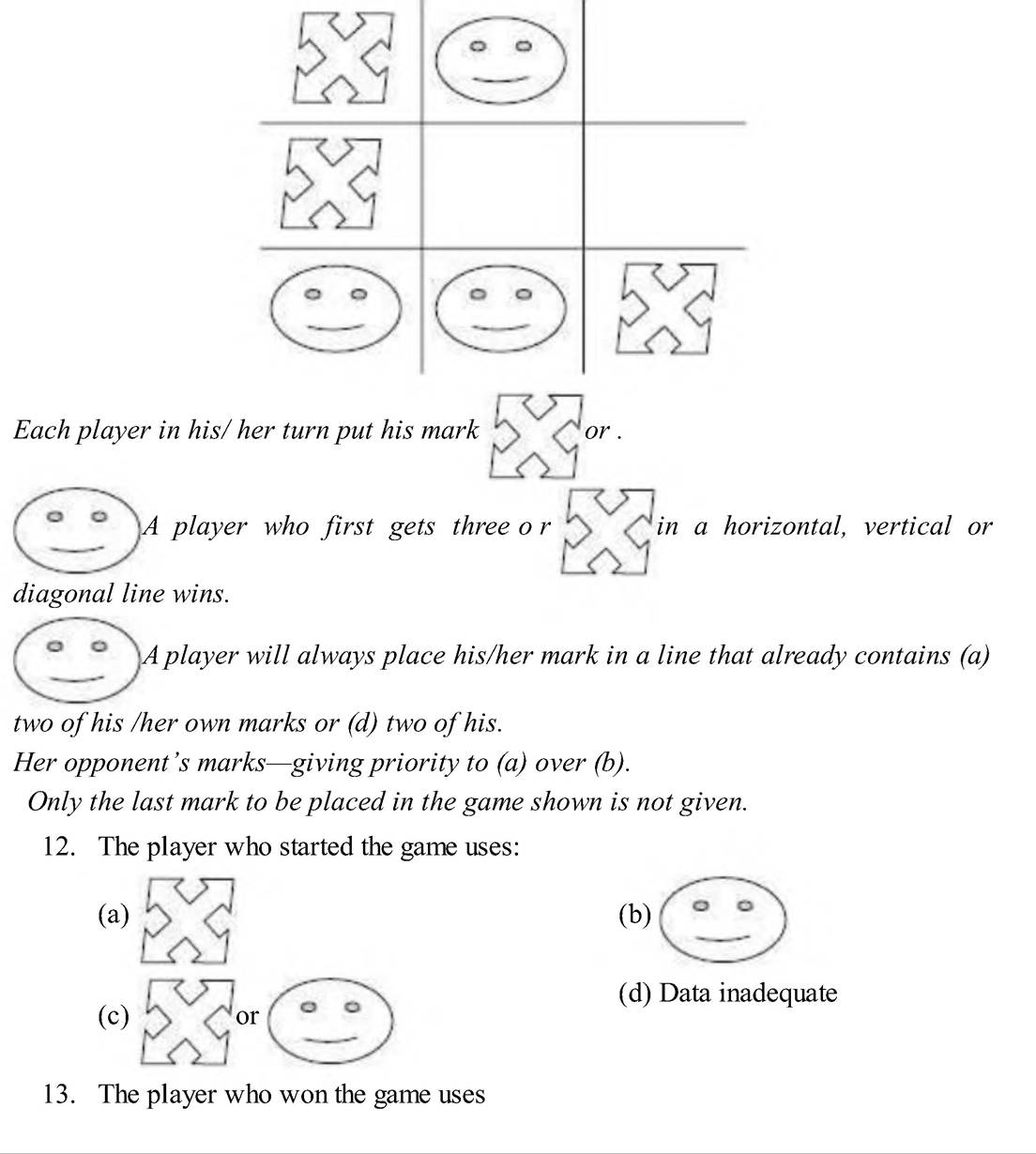
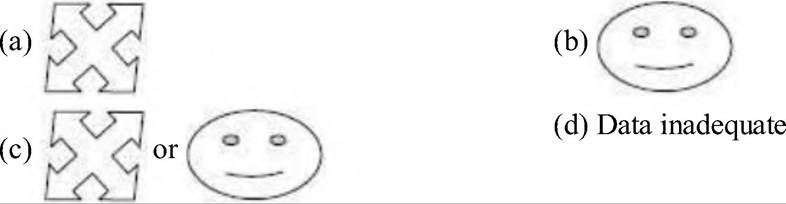
Directions for Questions 12 to 13 (Logical Reasoning) A game of Kattam-Kat is played between two players as shown below:
Directions for Questions 14 to 19Y∖∖e different film actors namely Amit, Shahrukh, Anil, Sunil, and Akshay are engaged in the shooting of five different movies with five different actresses Madhuri, Kareena, Aishwarya, Shilpa, and Juhi not necessarily in the same order, in different studios.
The director of each film decided to set a record by making the films as early as possible.
(i) Aishwarya ,s studio is between Amit ,s and Akshay ,s studios.
(U) Shahrukh ,s director who doesn ,t have Aishwarya as an actress in the shooting took three fourths as many as the number of days taken by Sunil ,s director.
(Hi) Akshay ,s studio number is 417.
(iv) Anils film took more days than Amit,s, while Amits film took more days than Aiswarya ,s to get finalised.
(v) The director from studio number 418 took 16 days lesser then the director from studio number 415, to complete his film.
(vi) Shilpa ’s film took 8 days more than Amit ,s and two days more than Juhi ,s.
(vii) Madhuri ,s studio number is 416
(viii)Madhuri s film took 8 day less then Aishwarya s film and Anil s films took maximum number of days for completion.
14. Who is the opposite of Kareena in her film?
(a) Amit (b) Shahrukh
(c) Akshay (d) Sunil
15. Which of the following pairs is correct for the film in studio number 418?
(a) Akshay and Shilpa
(b) Anil and Aishwarya
(c) Shahrukh and Aishwarya
(d) None of these
16. The director of which studio made the film in the least number of days?
(a) Studio No. 415 (b) Studio No. 416
(c) Studio No. 417 (d) Studio No. 418
17. Name the actress of studio No. 417.
(a) Kareena (b) Aishwarya
(c) Juhi (d) None
18. Sunil’s film was completed in:
(a) 44 days (b) 40 days
(c) 32 days (d) None
19. Anil’s opposite was:
(a) Juhi (b) Shilpa
(c) Aishwarya (d) Madhuri
Directions for Questions 20 to 25 Six cricketers from six different nations stay in a five star hotel in different rooms. Each of them eats a different variety of food in a meal and hits different number of sixes in an average match. Now read the given clues carefully.
(i) The player in room No. 142 eats twice as much as the number of varieties eaten by the player, who hits an average of 8 sixes per match, in a meal.
(U) The player from New Zealand and the player in room No. 146 eat a combined 40 varieties in a meal.
(Hi) The player from India eats 8 varieties less than the player from England but hits 10 more sixes in an average match.
(iv) Four times the number of varieties in a meal eaten by the player in room No. 144 is lesser than the number of sixes hit by him in an average match.
(v) The player in room No. 143 eats 12 varieties per meal and hits 8 sixes on an average in each match.
(vi) The player who eats 16 varieties per meal hits 24 sixes per match on an average.
(vii) The player in room No.
145 eats 8 varieties per meal and hits 2 sixes less than the player from Pakistan on an average in a match.(viii)The Australian player is staying two rooms after the English who is staying two rooms after the Pakistani player.
Now answer Questions 20-25 based on the above clues.
20. In which room is the Australian player staying?
(a) RoomNo. 142 (b) RoomNo. 143
(c) RoomNo. 144 (d) RoomNo. 145
21. What is the average number of sixes hit by the Indian player?
(a) 8 (b) 16
(c) 18 (d)24
22. How many varieties of food is eaten by the English player in his meal?
(a) 8 (b) 12
(c) 16 (d) 20
23. The player of which country is staying in room No. 146?
(a) India (b) Pakistan
(c) Sri Lanka (d) England
24. The player of which country hits 24 sixes on an average?
(a) India (b) New Zealand
(c) Pakistan (d) Sri Lanka
25. The player of which country eats the highest number of varieties of food in a meal?
(a) India (b) New Zealand
(c) England (d) Sri Lanka
Directions for Questions 26 to 31
Four bottles P, Q, R, and S are arranged side by side. Each contains a fixed amount
of soft drink measured in litres. The different soft drinks are Pepsi, Coke, Limca, and
Sprite.
Read the following clues carefully:
(i) Pepsi is between Sprite and Coke.
(U) The amount of Sprite is more than the amount of Pepsi, but lesser than that oj Coke.
(Hi) Limca is not in bottle R.
(iv) The bottle containing 2.2 Itr. of soft drink doesn ,t have Limca.
(v) Bottle R contains more amount than bottle P.
(vi) The difference between the amount contained by Limca and Sprite is 0.6
litres.
(vii) The bottle with Coke is between the bottles containing 0.6 Itr. and 11.
(viii)Bottle S doesn ,t contain Coke and doesn ,t have the least amount of soft drink in it.
Now answer Questions 26-31 based on the above clues:
26. What is the amount of soft drink in bottle Q.?
(a) 0.6 ltr. (b) 1 ltr.
(c)1.61tr. (d) 2.2 Itr.
27. Whichbottle contains 1.6 ltr. of soft drink?
(a) P (b) Q
(c) R (d) S
28. Bottle R contains:
(a) Pepsi (b) Coke
(c) Limca (d) Sprite
29. What is the amount of Limca in the bottle?
(a) 0.6 ltr. (b)1.61tr.
(c) 1 ltr. (d) 2.2 ltr.
30. Which bottle contains the highest amount of soft drink?
(a) P (b) Q
(c) R (d) S
31. The amount of Sprite contained by the bottle is:
(a) 0.6 ltr. (b) 1 ltr.
(c)1.61tr. (d) 2.2 Itr.
Directions for Questions 32 to 35 A quiz has three rounds of two questions each. In the first round, each correct answer carries 20 points; each incorrect answer carries a penalty of 10 points. Ifboth the questions are answered correctly, a bonus of 10 points is awarded. In the second round, each correct and incorrect answer carries the same number of points as in the first round. However, an additional penalty of 10 points is awarded if both the questions were answered incorrectly. In the final round, each correct answer carries 40 points and an incorrect one carries a penalty of 20 points.
32. In how many ways can a score of 40 be achieved in the quiz?
(а) 4 (b) 1
(c) 3 (d) 2
33. What is the probability of scoring 100 in the quiz?
(a) 2/9 (b) 2/27
(c) 4/27 (d) 1/9
34. If only two answers were correct, what is the probability that the score would be 20?
(a) 1/3 (b) 1/6
(c) 2/3 (d) 0
35. If two answers are incorrect, the minimum possible score is:
(a) 50 (b) 60
(c) 70 (d) 80
Directions for Questions 36 to 40 Refer to the caselet below:
Mr Ahluwalia, Mr Bhatia, Mr Chopra, Mr Dayal, and Mr Eeshwar have first and middle names as per the following conditions: (Each of them has different first and middle names).
(i) Four of them have a first or middle name of Ram, three of them have first or middle name of Shyam, two of them have a first or middle name of Tram and one of them has a first or middle name of Alam.
(U) Either Mr Ahluwalia and Mr Bhatia are both named Tram or Mr Chopra and Mr Dayal are both named Tram.
(Hi) Of Mr Bhatia and Mr Chopra either both are named Shyam or neither is named Shyam.
(iv) Mr Dayal and Mr Eeshwar are both not named Ram.
36. Which of these is a possible combination of names?
(a) Tram Ram Ahluwalia
(b) Alam Ram Chopra
(c) Ram Shyam Chopra
(d) None of these
37. The two Trams are:
(a) Mr Ahluwalia and Mr Bhatia
(b) Mr Chopra and Mr Dayal
(c) Mr Dayal and Mr Ahluwalia
(d) Mr Bhatia and Mr Dayal
38. Who is named Alam?
(a) Mr Ahluwalia (b) Mr Bhatia
(c) Mr Chopra (d) Mr Dayal
39. Mr Eeshwar is known as:
(a) Ram Shyam (b) Tram Ram
(c) Shyam Alam (d) Tram Shyam
40. Which of these people have the same name?
(a) Mr Bhatia and Mr Chopra
(b) Mr Chopra and Mr Dayal
(c) Mr Ahluwalia and Mr Eeshwar
(d) There is no such pair
Directions for Questions 41 to 45 Sixteen teams have been invited to participate in the ABC Gold Cup cricket tournament. The tournament is conducted in two stages. In the first stage, the teams are divided into two groups. Each group consists of eight teams, with each team playing every other team in its group exactly once. At the end of the first stage, the top four teams from each group advance to the second stage while the rest are eliminated. The second stage comprises several rounds. Each round involves one match for each team. The winner of a match in a round advances to the next round, while the loser is eliminated. The team that remains undefeated in the second stage is declared the winner and claims the Gold Cup.
The tournament rules are such that each match results in a winner and a loser with no possibility of a tie. In the first stage, a team earns one point for each win and no points for a loss. At the end of the first stage, teams in each group are ranked on the basis of total points to determine the qualifiers advancing to the next stage. Ties are resolved by a series of complex tie-breaking rules so that exactly four teams from each group advance to the next stage.
41. What is the total number of matches played in the tournament?
(a) 28 (b) 55
(c) 63 (d) 35
42. The minimum number of wins needed for a team in the first stage to guarantee its advancement to the next stage is:
(a) 5 (b) 6
(c) 7 (d) 4
43. What is the highest number of wins for a team in the first stage in spite of which it would be eliminated at the end of first stage?
(a) 1 (b) 2
(c) 3 (d) 4
44. What is the number of rounds in the second stage of the tournament?
(a) 1 (b) 2
(c) 3 (d) 4
45. Which of the following statements is true?
(a) The winner will have more wins than any other team in the tournament.
(b) At the end of the first stage, no team eliminated from the tournament will have more wins than any of the teams qualifying for the second stage.
(c) It is possible that the winner will have the same number of wins in the entire tournament as a team eliminated at the end of the first stage.
(d) The number of teams with exactly one win in the second stage of the tournament is 4.
Answer Key
| l.(b) | 2. (a) | 3∙(a) | 4. (b) |
| 5. (c) | 6. (d) | 7. (a) | 8. (d) |
| 9. (a) | 10. (a) | H-(a) | 12. (b) |
| 13.(b) | 14. (a) | ||
| 15. (d) [Sunil & Aishwarya] | 16. (b) | 17. (c) | |
| 18. (c) | 19. (b) | 20. (d) | 21. (c) |
| 22.(b) | 23. (c) | 24. (d) | 25. (b) |
| 26. (a) | 27. (a) | 28. (b) | 29. (c) |
| 30. (c) | 31. (C) | 32. (d) | 33. (b) |
| 34. (d) | 35. (b) | 36. (d) | 37. (b) |
| 38. (b) | 39. (a) | 40. (c) | 41. (c) |
| 42.(b) | 43. (a) | 44. (c) | 45. (c) |
Solutions
Solutions 1 to 5
In this question there are essentially three clues.
When we use the first clue (The shorter of Sachin and Laxman is the older of the two century hitters) we get two main possibilities depending on who is shorter between Sachin and Laxman. We get the following options:
| Possibility 1 | Possibility 2 | |
| L | S | |
| S | Older century Hitter | L |
If we introduce Rahul on the basis of his height into the above figure, we would get six possible arrangements on the basis of height.
| Possibility 1 | Possibility 2 | Possibility 3 | Possibility 4 | Possibility 5 | Possibility 6 | |
| R | R | |||||
| L | L | L | S | S | S | |
| R | R | |||||
| S | S | S | L | L | L | Older Century Hitter |
| R | R |
At this point if we use the third clue (viz: Taller of Sachin and Rahul is the younger century hitter) the table above would modify to:
| Possibility 1 | Possibility 2 | Possibility 3 | Possibility 4 | Possibility 5 | Possibility 6 | |
| Rγ | Rγ | |||||
| L | L | L | Sγ | Sγ | S |
| Rγ | R | |||||
| sγ | S | S | L | L | L | Older Century Hitter |
| R | R |
(In the above table Y denotes the younger century hitter)
At this stage and the constraint of clue 2 (viz: The younger of Laxman and Rahul is the shorter of the two century hitters.) Looking at individual possibilities of following deductions would emerge:
Possibility 1: Ruled out - Sachin is the older as well as the younger century hitter - not possible
Possibility 2 and 3: Rule out - The shorter century hitter has to come out of Laxman or Rahul, but in this case the shorter century hitter is Sachin.
Possibility 6: Ruled out: The younger of Rahul and Laxman has to be the shorter century hitter. But in this case Rahul is the younger century hitter while Laxman is the older century hitter (thus Rahul is younger than Laxman) yet is the taller one of the 2 century hitters also.
Possibilities 4 and 5 cannot be eliminated as they obey all 3 clues.
Thus Sachin is the younger century hitter while Laxman is the older century hitter (a conclusion which is consistent in both possibility 4 and 5).
The answers are:
(1) (b) Laxman
(2) (a) Sachin
(3) (a) Sachin
(4) (b) Laxman
(5) (c) Rahul
Solutions 6 to 8
If we see clue 1 we get that the brother and daughter of Steffi are directly across the net from each other. Once we place these two we have two ways of placing Steffi and her son.
The following figures illustrate this:
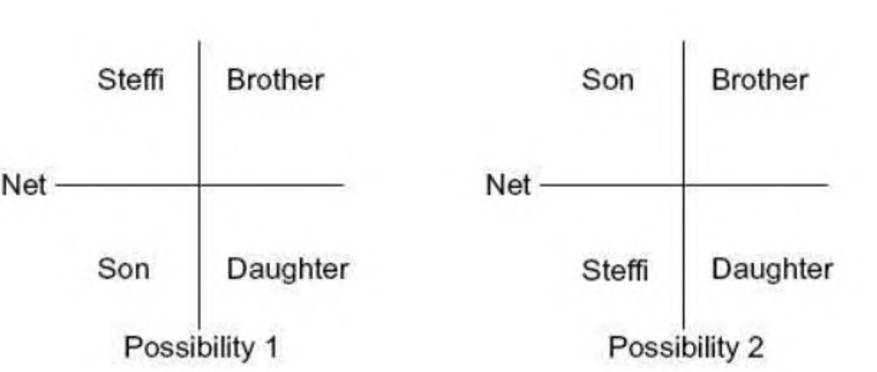
The following deductions can then be made:
| Possibility 1 | Possibility 2 |
| Using Clue 2 | Using Clue 2 |
| Worst player’s sibling JE Brother | Worst player’s sibling JE daughter. |
| Hence, worst player JE Steffi | Hence, worst player JE Son |
| Also using clue 3 (Best and worst player are on the same side of the net) We get. | Also using clue 3 (Best and worst player are on the same side of the net) we get. |
| Best player JE Brother | ∖ Best player JE Brother |
The answers are:
6. (d) Since we do not know about the worst player (as it changes from possibility 1 to possibility 2).
7. (a) The brother emerges as the best player in both possibilities.
8. Data inadequate again as the answer would change based on which possibility we consider. Since both possibilities are possible, hence (d).
Solutions 9 to 11
There are originally (by default) eight possibilities to distribute the three dishes amongst A, B and C.
(PT = Paneer Tikka, RC = Roasted Chicken)
These are:
| A | B | C | |
| Possibility 1 | PT | PT | PT |
| Possibility 2 | PT | RC | PT |
| Possibility 3 | PT | PT | RC |
| Possibility 4 | RC | PT | PT |
| Possibility 5 | RC | RC | PT |
| Possibility 6 | RC | PT | RC |
| Possibility 7 | PT | RC | RC |
| Possibility 8 | RC | RC | RC |
The three constraints are:
1. IfA-PT, B C
2. IfB-PT, Aπ C
3. IfC-RC, A-B
If we analyse the eight possibilities with respect to the constraints, the following results emerge:
| A | B | C | Result | |
| Possibility 1 | PT | PT | PT | Rejected, constraint 2 |
| Possibility 2 | PT | RC | PT | Rejected, constraint 1 |
| Possibility 3 | PT | PT | RC | Rejected, constraint 1 |
| Possibility 4 | RC | PT | PT | No contradiction with any constraint |
| Possibility 5 | RC | RC | PT | No contradiction with any constraint |
| Possibility 6 | RC | PT | RC | Rejected, constraint 2 |
| Possibility 7 | PT | RC | RC | Rejected, constraint 3 |
| Possibility 8 | RC | RC | RC | No contradiction with any constraint |
This gives us the possibility matrix for what is possible:
| A | B | C | |
| Final Possibility 1 (Possibility 4 in the table above) | RC | PT | PT |
| Final Possibility 2 (Possibility 5 in the table above) | RC | RC | PT |
| Final Possibility 3 (Possibility 8 in the table above) | RC | RC | RC |
Hence the answers are:
9. (a) Abdul always orders RC
10. IfC orders RC (Final possibility 3), B orders RC. Hence option (a) is correct.
11. IfB = PT (Final possibility 1) then Charu would also eat PT. Hence (a)
Solutions 12 and 13
For convenience the squares can be numbered as:
| 1 | 2 | 3 |
| 4 | 5 | 6 |
| 7 | 8 | 9 |
It is obvious that the person who plays next will win by putting his mark in square 5. We need to hence find who will make the next move.
Obviously the 7th move (winning one in this case) would be placed by the person who has not played the previous move. Hence, we need to see as to which of the 6 moves in the grid could possibly be the sixth and last one.
A little bit of introspection will give you that the cross in the ninth square is the only possible 6th move. Hence, the next move (7th) will be that of a face.
Thus the answers are:
12. (b)
13. (b)
Solutions 14 to 19
We start off by making a grid as follows (Note: in this grid we have used clues numbered 3 and 7)
| 416 | |||||
| Madhuri | Kareena | Aishwarya | Shilpa | Juhi | |
| Amit | |||||
| Shahrukh | bgcolor=white> | ||||
| Anil | |||||
| Sunil | |||||
| 417 Akshay | ¥ |
From clue 4 we get that Anil and Amit are in different films than Aishwarya. We also know from clue 2 that Shahrukh and Aishwarya are not together and from clue 1 that Aishwarya is not with Akshay too. Also since Aishwarya is between Akshay and Amit, Aishwarya’s number could only by 418 (As 416 is Madhuri) and Amit must be 419). Also, clue 6 gives us that neither Shilpa nor Juhi have acted with Amit. Based on these realisations, the grid above transforms into:
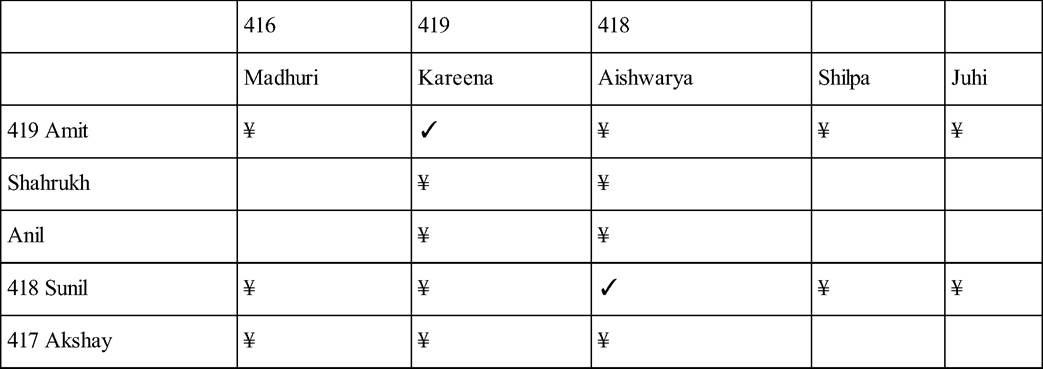
At this point we need to concentrate on the time of film completion to move further in the question.
From clue 2
Shahrukh’s film takes 3∕4th the time of Sunil’s film. (But we know that Sunil’s film has Aishwarya). Hence, we conclude (from clue 2 and clue 4)
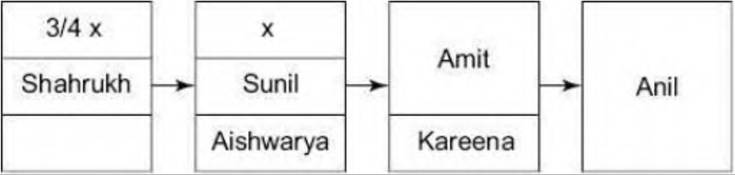
If we add the information from clue 6 to this, we realise that Shilpa and Juhi must be after Amit. Thus, only Madhuri is left for Shahrukh. Also, since Anil’s film took maximum number of days Anil must be with Shilpa. We then get the following chronological figure:

Also from clue 8, we get that x must be 32 days (Sunil’s film) and Shahrukh’s film must be 24 days and Anil’s film48 days.
The answers are:
14. Amit (a)
15. Sunil and Aishwarya (d)
16. 416(d)
17. Juhi (c)
18. 32 days (c)
19. Shilpa (b)
Solutions 20 to 25
For this question if you try to refer to the information with respect to the country of the player you will not get any headway, but if you try to reference the information with respect to the room number you will find it easier.
An obvious question that might crop up in your mind will obviously be - “But how do I know that?” and indeed “How do і decide what variable to reference for solving a complex question like this? The answer is simple really while reading the question for the first time, try to focus on spotting the variable with respect to which the maximum number of direct clues are associated.
In this question it is clear that the maximum number of direct clues here are associated with the room number and hence we try to associate things with the room number.
Fromclue number 5:
RoomNo. 143 T 12 m and 8 Sixes (meal = m and sixes = S)
From clue no. 7: RoomNo. 145 T 8m and (P-2S) (Where P is the number of sixes hit by the Pakistan player).
From clue 8: Pakistan, England and Australia can either be 141, 143 and 145 or 142, 144 and 146. But from question 20 (and it’s options) it is clear that Australia cannot be in Room 146. Thus, we get the following situation at this stage.
| 141 | Pakistan | |
| 142 | ||
| 143 | England | (12 m, 8 s) |
| 144 | ||
| 145 | Australia | (8 m, P-2s) |
| 146 |
We also have the following information:
Fromclue 1: RoomNo. 142 √zE 24 m (twice the player who hits 8 sixes).
From clue 3 we have that the Indian is 8 less than the English (Meals) and 10 more than the English (Sixes). This means that the Indian is 4 m and 18 S.
Fromclue 2: NZ + RoomNo. 146 = 40 (Meals).
Fromclue 6: someone has (16 mand 24 S).
Now since we have to adjust New Zealand, India and Sri Lanka (which we discover from options to question 24) and all the above facts the only way to do so is as shown below.
| 141 | Pakistan | |
| 142 | New Zealand | (24m,) |
| 143 | England | (12m, 8S) |
| 144 | India | (4m, 18S) |
| 145 | Australia | (8m, P - 2S) |
| 146 | Sri Lanka | (16m, 24S) |
This arrangement also satisfies clue 4.
The answer:
20. 145 (d)
21. 18(c)
22. 12(b)
23. Sri Lanka (c)
24. Sri Lanka (d)
25. New Zealand (b)
Solutions 26 to 31
We can make the following visual representations in order to represent the information:
Clue 1: Coke - Pepsi - Sprite OR Sprite - Pepsi - Coke
Clue 2:Coke
≠
Sprite
≠
Pepsi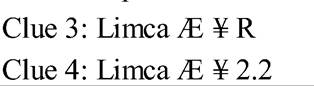
Clue 5: R>P
Clue 6: (and clue 2) Sprite and Limca will share 1 litre and 1.6 litre amongst themselves (we get the values of the 4 quantities from clue 7 and from the options to question 26).
Clue 7: 0.6 litre - Coke - 1 litre

At this stage we can make the first deduction:
Since Coke is neither 0.6 nor 1 litre nor 1.6 litre, Coke must be 2.2 and since 1 litre and 1.6 litre are shared between Limca and Sprite, Pepsi must be 0.6 litre.
This gives us 2 possibilities for distributing the 4 quantities:
Possibility 1: Pepsi (0.6), Limca (1.6 litre), Sprite (1 litre) and Coke (2.2)
OR
Possibility 2: Pepsi (0.6), Limca (1 litre), Sprite (1.6 litre) and Coke (2.2).
We now try to place both arrangements in order in terms of the bottles P, Q, R, S by obeying the constraints of the question.
Considering possibility 1 above and clue 7, we get:
pepsi Coke Sprite
or Sprite Coke Pepsi
as the two possible arrangements such that Coke comes between 0.6 litres and 1 litre.
However, according to clue 1, Pepsi is between Sprite and Coke and possibility 1 Clearlyviolates this condition. Hence, we reject possibility 1.
Thus, we have possibility 2 as the only possibility left i.e.:
Pepsi - 0.6
Limca - 1
Sprite = 1.6
Coke = 2.2
We just need to arrange the placement of these 4 cold drinks in the right order.
We need to realise at this point that both Coke and Pepsi cannot be extremes. Hence, the extremes have to be made up of Limca and Sprite. This can be done in two ways:
(A)
| P | Q | R | S |
| Limca | Sprite | ||
| (1) | 1.6 |
In this case we need to place Coke between 0.6 and 1. Thus we get:
| P | Q | R | S |
| Limca | bgcolor=white>CokePepsi | Sprite | |
| (1) | 2.2 | 0.6 | 1.6 |
But we can see that clue 5 is violated. (R > P)
Hence, we reject this arrangement and go to the next possibility:
(B)
| P | Q | R | S |
| Sprite | Pepsi | Coke | Limca |
| 1.6 | 0.6 | 2.2 | 1 |
This arrangement meets all constraints and gives us the answers as:
26. 0.6 litre (a)
27. Bottle P (a)
28. Coke(b)
29. 1 litre (c)
30. R(c)
31. 1.6 litre (c)
Solutions 32 to 35
Solve on the basis of the following table:
| I round | II round | III round | ||||||
| C | W | Net score | C | W | Net score | C | W | Net score |
| 2 | — | 50 | 2 | — | 50 | 2 | — | 80 |
| 1 | 1 | 10 | 1 | 1 | 10 | 1 | 1 | 20 |
| 0 | -2 | -20 | 0 | 2 | -30 | 0 | 2 | -40 |
32. 40 can be scored by:
(1) 50-30 + 20
or (2) 10 + 10 + 20. Hence option (d) is correct.
33. There are 3 ¥ 3 ¥ 3 = 27 possible scores. Out of these three there are only 2 ways of scoring 100.
Hence 2/27. option (b)
34. There are only two ways of scoring 20 from the table viz : 50 + 10 - 40 or 10+50 - 40. In both cases there are three right answers. Hence, the required probability is zero, option (d) is correct.
35. The maximum Penalty for 2 incorrect answers would occur when they happen in the last round. Hence, the score would be 50 +50 - 40 = 60
Hence option (b) is correct.
Solutions 36 to 40
A JE Ahluwalia
B JE Bhatia
C JE Chopra
D JE Dayal
E JE Eshwar
Based on clue number 1 you realise that there are 10 first and middle names for the 5
people and these are distributed as:
4 Rams (R)
3 Shyams (S)
2 Trams (T)
1 Alam(A)
From clue 2 we realise that we can put Tram in 2 ways:
Possibility (1) Both Ahluwalia (A) and Bhatia (B) are Trams (T)
| T | Ahluwalia | |
| T | Bhatia | |
| Chopra | ||
| Dayal | ||
| Eeshwar |
Or
Possibilty (2) Both Chopra and Dayal are Trams
| Ahluwalia | ||
| Bhatia | ||
| T | Chopra | |
| T | Dayal | |
| Eeshwar |
We now look at possibility 1 above:
Using clue 3, we can place both B and C as Shyam or neither B and C as Shyam (in which case the 3 Shyams must go to A, D and E)
Thus we have two further possibilities emerging out of possibility 1 above:
Possibility (A) for Possibility 1:
| T | Ahluwalias | |
| T | S | Bhatia |
| S | Chopra | |
| Dayal | ||
| Eeshwar |
Possibility (B) for Possibility 1:
| T | S | Ahluwalia |
| T | Bhatia | |
| Chopra | ||
| S | Dayal | |
| S | Eeshwar |
In each of the above scenarios we now have to place the 4 Rams.
However, in both cases both Dayal and Eshwar get named Ram, and this contradicts Clue 4. Hence, we rule out this possibility.
Moving on to possibility 2 and using clue 3, the following possibilities emerge:
Possibility (A) for Possibility 2:
| Ahluwalia | ||
| S | Bhatia | |
| T | S | Chopra |
| T | Dayal | |
| Eeshwar |
Possibility (B) for Possibility 2:
| S | Ahluwalia | |
| Bhatia | ||
| T | Chopra | |
| T | S | Dayal |
| S | Eeshwar |
In possibility A above, when we place the 4 Rams, we again contradict clue 4 (since both D and E are named Ram).
Hence, OnlypossibilityB remains and the final names are:
| R | S | Ahluwalia |
| A | R | Bhatia |
| T | R | Chopra |
| T | S | Dayal |
| R | S | Eeshwar |
Hence the answers are:
36. (d) None of the 3 name combination appears.
37. (b) Chopra and Dayal
38. Mr. Bhatia (b)
39. Ram Shyam (a)
40. Mr. Ahluwalia and Mr. Eeshwar are both named Ram Shyam.
Hence (c)
41. There will be 8C2 + 8C2 + 4 quarter finals + 2 semifinals + 1 final = 63 matches.
42. A team can be eliminated even if it wins 5 of its 7 matches (as 5 teams can possibly win 5 matches each) The logic for this is that in each group there are 8C2 = 28 matches, hence 28 winners. Thus, it is not possible for 5 teams to win 6 matches each. Hence if a team wins six matches it is safe. However, if a team wins 5 matches, 4 more teams could also have won 5 matches each and in that case the team would get eliminated. Hence, advancement is not guaranteed with 5 wins.
43. In this question we need to guarantee elimination. With 2 wins a team could still qualify (And hence elimination is not guaranteed) since there could be a scenario of (7+ 6 + 5 + 2 + 2 + 2 + 2 +2) wins giving a situation wherein at least one of the teams with 2 wins needs to qualify. Hence, only if a team has 1 win, it’s elimination is guaranteed. Option (a) is correct.
44. Quarter finals, semifinals and finals. Hence 3, option (c) is correct.
45. Option (c) is possible.
It is not necessary for the winner to have more wins than any other team. Since it is possible that a team with 2 wins in the first phase and 3 more wins (Quarterfinal, semifinal and final) in the 2nd stage wins the tournament and a team with 7 wins in the first phase loses the Quarterfinal. Hence (a) is not true.
Option (b) is also eliminated as it could happen that in one group a team with 5 wins is eliminated while in the other group a team with 2 wins advances.
Option (d) is also incorrect, since in the second stage of the tournament 4 teams who lose the quarterfinal will have no wins, 2 teams which lose the semifinals will have 1 win, 1 team which loses the final will have 2 wins and the team which wins the tournament will have 3 wins.
Option (c) could happen if a team is eliminated with 5 wins in the first stage and another team from the other group goes through to the second stage with 2 wins and then wins the 3 rounds in the second stage to emerge the winner with a total of 5 wins.