Model Test Paper (Base on the Latest Online Pattern)

Model Test Paper
Section I: Verbal Ability and Logical Reasoning
1. People in the South have observed that heavy frost is usually preceded by a full moon.
They are convinced that the full moon somehow generates the frost. Which of the following, if true, would weaken the peoples’ conviction?(a) The temperature must fall below 10 degrees Celsius (50 degrees Fahrenheit) for frost to occur.
(b) Absence of a cloud cover cools the ground which causes frost.
(b) People are superstitious.
(d) People are not experts in meteorology.
2. Professor Jha told his class that the method of student evaluation of teachers is not a valid measure of teaching quality. Students should fill out questionnaires at the end of the semester when courses have been completed.
Which of the following, if true, provides support for Professor Jha’s proposal?
(a) Professor Jha received low ratings from his students.
(b) Students filled out questionnaires after the midterm exam
(c) Students are interested in teacher evaluation.
(d) Student evaluation of teachers is voluntary.
Directions for Questions 3 and 4: In each of the following questions select the most appropriate word from the options given, which would meaningfully complete the sentence.
3. All achievers take the track travelled.
(a) frequently (b) less
(b) sincerely (d) casually
4. The company secretary pointed that the company’s entering into contract with
another firm did not____________ breach of faith.
(a) constitute a (b) vilify a
(c) tantamount to (d) propagate a
For each of the following questions find the sentence/s that is/are correct.
5.
A. When you look up a word, the main thing that you want to know was its basic meaning.
B. It’s time to winding up the discussion now.
C. A great many various words in English have more than one meaning.
D. That wasn’t a very fair thing to say!
(a) D only
(b) A & D
(c) A, B and D
(d) All of the above are correct
6.
A. She has a fair chance of winning the first prize.
B. Fair weather is forecasted for tomorrow.
C. There’s a fair on at the park this very week.
D. Don’t forget to wind down your watch.
(a) A only
(b) A & C
(c) A,B and C
(d) None of the above are correct
Directions for Questions 7 to 9: Arrange the sentences in a proper manner so as to create a coherent paragraph.
7.
A. I lived with my grandparents until I left home at 16.
B. She worked and did very well, but she still needed the support her parents provided, and we lived with them in New York for many years.
C. So all three of them my mum, Ondrea Smith, and my grandparents Eugene and Ellen Griffith-raised me.
D. Don’t get me wrong; my mum was around too.
E. But she was a single parent and had me when she was just 21.
(a) AEDCB (b) ADEBC
(c) CADEB (d) ACDED
8.
A. The man shook his head and pointed to a stage close to my wife, where the pianist was sitting at a grand piano, cheerfully playing away.
B. As the negotiations were completely new to her, she had to focus her full attention on the discussion.
C. She was invited by some customers to discuss business in a well-known tavern.
D. The background music bothered her greatly so when the waiter was passing her table, she asked if he could turn the music down.
E. My wife had just been appointed bank manager of a local branch.
(a) ECBDA (b) EBCDA
(c) BCDAE (D) BCDEA
9.
A. And long before anyone in my class had heard of ballroom dancing, my mother played swing music on the gramophone in the living room, took me in her arms and taught me how.
B. By age 12, after a series of operations, I could walk unaided.
C. By the time I was seven, my mother had moved on to tennis, which she decided I could play while wearing black galoshes over my brown orthopedic shoes.
D. When I turned 15, she signed me up for dancing school with boys.
(a) CABD (b) CBDA
(c) CDAB (d) CBAD
Passage -1 Anyone who trains animals recognises that human and animal perceptual capacities are different. For most humans, seeing is believing, although we occasionally brood whether we can believe our eyes. The other senses are largely ancillary; most of us do not know how we might go about either doubting or believing our noses. But for dogs, scenting believes. A dog’s nose is to ours as the wrinkled surface of our complex brain is to the surface of an egg. A dog who did comparative psychology might easily worry about our consciousness or lack thereof, just as we worry about the consciousness of a squid.
We who take sight for granted can draw pictures of scent, but we have no language for doing it the other way about, no way to represent something visually familiar by means of actual scent. Most humans cannot know, with their limited noses, what they can imagine about being deaf, blind, mute, or paralyzed. The sighted can, for example, speak of a blind person as “in the darkness,” but there is no corollary expression for what it is that we are in relationship to scent. If we tried to coin words, we might come up with something like “scent-blind.” But what would it mean? It couldn’t have the sort of meaning that “colour-blind” and “tone-deaf’ do, because most of us have experienced what “tone” and “color” mean in those expressions, but we don’t know what “scent” means in the expression “scent-blind” Scent for many of us can be only a theoretical, technical expression that we use because our grammar requires that we have a noun to go in the sentences we are prompted to utter about animal’s tracking. We do not have a sense of scent. What we do have is a sense of smell—for Thanksgiving dinner, skunks, and a number of things we call chemicals.
So if Fido and I are sitting on the terrace, admiring the view, we inhabit worlds with radically different principles of phenomenology.
Say that the wind is to our backs. Our world lies all before us, within a 180-degree angle. The dog has—well, we don’t know, do we?He sees roughly the same things that I see but he believes the scents of the garden behind us. He marks the path of the black-and-white cat as she moves among the roses in search of the bits of chicken sandwich I let fall as I walked from the house to our picnic spot. I can show that Fido is alert to the kitty, but not how, for my picture-making modes of thought too easily supply falsifying literal representations of the cat and the garden and their modes of being hidden from or revealed to me.
10. The phrase “other senses are largely ancillary” (first paragraph) is used by the author to suggest that
(a) only those events experienced directly can be appreciated by the senses
(b) for many human beings the sense of sight is the primary means of knowing about the world
(c) smell is in many respects a more powerful sense than sight
(d) The perceptual capacity of an animal is a function of its ability to integrate all of its senses
11. The missing phrase in the incomplete sentences “The dog’s—well, we don’t know, do we?” (Third paragraph) refers to
(a) color blindness
(b) depth perception
(c) perception of the world
(d) concern for our perceptions
12. The author uses the distinction between “that’ and “how” (last paragraph) in order to suggest the difference between
(a) a cat’s way and a dog’s way of perceiving
(b) verifiable hypotheses and whimsical speculation
(c) awareness of presence and the nature of that awareness
(d) false representations and accurate representations
Passage - ∏
Contemporary India is characterised by the blare and glare of globalisation and liberalisation, where economic considerations have relegated all other considerations to the background. The indices of the stock exchanges have shoved the indices of human development into oblivion. Everyone seems to have become ardent worshippers of the Mammon.
We walk smugly with cans of cold drinks in our hands and do not even care to, cast a glance towards the emaciated contours of frail human frames suffering in silence, looking towards us with beseeching eyes for our kindness. We look down upon them as abominable worms, blissfully forgetting that they too breathe the same air, have the same blood running in their veins and have the same limbs as we superhumans do. What these emaciated creatures lack is the deviousness and ingenuity to make money even at the cost of tears and toil of some body else’s.Unbridled consumerism in the wake of globalisation and liberalisation has commodified our approach to life; we have become utterly hedonistic and self-centred. We want to have everything for ourselves and don’t like to leave anything for others. We have become dehumanised. We have turned ourselves into robots. We have lost our humanistic and spiritual moorings and have become adrift in the sea of materialism, little realising that the sea can never quench anyone’s thirst. One has to go to the little pond or the well to quench it. The intoxication of materialism has made us forget that the matter only enslaves whereas the spirit liberates. Happiness in life is not contingent upon worldly possessions. On the contrary, it springs from a state of mind imbued with the feelings of compassion, love and caring for those who need our help.
Consumerism seems to have buried our faculties of sympathy and empathy Regrettably, the ruling elite have played a vital role in triggering this avalanche of desire for pelf. They seem to be more concerned with the economics of governance rather than the sociology of governance. Millions of hapless people in this country are dying of thirst and hunger and are abandoning their home and hearth simply because, for them, water is still a mirage even after more than half a century of Independence. We are busy manufacturing and importing myriad models of cars and spending billions of rupees on petrol and diesel.
Cars and petrol may be desirable but food and water are indispensable. It defies logic as to why, in the land of Swami Vivekananda and Mahatma Gandhi, we cannot lead a simple life with lofty ideals so that Gurudev Rabindranath Tagore’s vision of a world ‘Where head is held high and mind is without fear’ may become a reality.Of late, it has become a trend in our country to justify a thing on the basis of it being practiced in America or Europe. It is true that the civilisation of every country has some positive aspects, but it is also equally true that every country is unique in its own way. No country can do well to itself by imitating blindly and slavishly the practices of another country. India is a country where humanism and spiritualism have always reined supreme, where the value of renunciation for the common good have always held precedence over the desire for material wealth.
It is time we heeded the tenets of Gandhian economics and implemented them earnestly rather than look to the West for a model of economic development. Like Mahatma Gandhi has said: “The world has enough for everyone’s need, but not enough for everyone’s greed.” We should adopt a materialistic way of living only to the extent it is essential for a decent living. The latter should not be construed as living in luxury because too much of luxury depraves one morally and physically just as too much sugar in one’s diet can cause diabetes—a disease of attrition. The real joy in life is experienced only when we lend a helping hand to a man in need, when we provide food for an empty stomach, water to a parched throat, and smile to a desolate heart.
13. Why have indices of stock exchanges shoved the indices of human development into oblivion, according to the author?
(a) Because we have become worshippers of Mammon
(b) Because economic considerations have relegated all other considerations to the background
(c) Because we do care to cast a glance towards the emaciated contours of frail human frames
(d) None of the above
14. The author’s opinion about the poor is that
(a) they lack the will to work
(b) they are the same as any other human being
(c) they lack deviousness and ability to make money at someone else’s cost
(d) they deserve sympathy
15. The author’s advice is
(a) to go back to Gandhian economics
(b) to lend a helping hand to others
(c) to live simply
(d) none of the above
Passage - Ш
Bureaucracy is a remarkable thing. It is a self-perpetuating system existing for its own sake without regard for the people it is supposed to serve. It slows things down at the crucial point where the organisation actually is exposed to the customer. The cure for this is radically obvious. We have to design the organisation Ifomthe bottom up starting with the customer. Few established companies have trodden this path, however attractive it looks in theory; it is simply too different from the familiar past. But some at least, suggests Prof. Thomas Hunt at London Business School, have begun to experiment with the possibilities of adopting jobs to people rather than vice versa. Instead of the neat, logical lines of the typical functional division or business unit organisation chart, this leads apparently messy gross functional mixes—what Hunt called chiuord structures, amorphous, not easy for outsiders to understand and constantly changing according to the strengths and weaknesses of the available people. This is one factor, which Huntbelieves could characterise the management of the future as an area of constant realignment. Another is the breaking down of business units into ever-smaller entities to cope up with growing demand of middle managers, to get their teeth into something practical for which they can take responsibility.
Few changes are entirely costless, however. Change for change’s sake can easily become stressful and chaotic, leaving no time to actually perform the business. Similarly, the movement towards smaller units and continual alignment only serves the aims of flexibility if it is accompanied by real delegation of authority, plus clear performance measures.
Otherwise you get the worst of both worlds. Centralised bureaucracy and clear performance measures, as in some well-meaning civil service attempts, strengthens the hierarchy. Blancmange structures, meanwhile, not to mention self-employment, are only suitable for the very special sort of professionals who are comfortable in such fluid environments. Finally making units ever smaller needs a concomitantly complicated arrangement for strategy at the centre. There is a further dimension to this affair. In their relations with other organisations, organisations tend to become part of metabureaucracies—bureaucracies about bureaucracies. Some of these are evident—a doctor is a part of the National Health Scheme, which comes under the Department of Health, which is part of South Block, which is a part of others, and so on, but others are not evident. Although no less substantial, they are unofficial and invisible to the naked eye.
J.K. Galbriath has a term for the way private and public bureaucracy’s gang up to promote their mutual interest. He calls it ‘Bureaucratic Symbiosis’. For Galbriath, big firms are largely bureaucratically driven, rather than economically driven, as textbooks hold. ‘Bureaucratic Symbiosis’ goes for explaining the puzzling results of much modern ingenuity. It explains the demented logic of the arms race, where the interest of both the private and public bureaucracies across the Iron Curtain is even more frightening than Western and Eastern military-industrial complexes on their own. It explains the otherwise incomprehensible ordering of fundamentally flawed systems like the highly sophisticated US naval escort ship which turned out to be too valuable to use in its planned role, without the addition of heavy armour, after which it was too heavy to keep up with the ships it was supposed to escort and had to be re-engined; or similarly expensive and sophisticated military aircraft, which needed 75 hours servicing for every flying hour. It explains, too, the phenomenon of planned obsolescence, and the ludicrous over-development of some parts of the economy versus others; defence versus health care, roads versus rail, nuclear versus renewable sources of energy. Private affluence, in fact, versus public squalor.
16. According to the author, bureaucracy
(a) is a good example of organising capacity of humans
(b) is based on actual experiences
(c) slows things down
(d) serves a purpose
17. Which of the following statements is not true?
(a) In bureaucracy, the customer plays an important role.
(b) Organisation charts may tend to be too rigid.
(c) For better service and success, the organisation should be redesigned.
(d) Some have tried to experiment the chances of adopting jobs to people.
18. In para 1, the writer of the passage shows his aversion to
(a) strong and changing business units
(b) change for change’s sake
(c) the structural deficiencies in bureaucracy
(d) self-employment and other practical functional difficulties Ofbureaucracies
19. The author welcomes
(a) public affluence in bureaucracy
(b) better performances inside the bureaucratic set up
(c) private affluence in bureaucracy
(d) positive changes with least cost
20. The word ‘symbiosis’ is used by the author to mean
(a) Living together
(b) The shared interest of the private and public bureaucracies
(b) Association of two different organisations functioning detached to each other to their mutual advantage
(d) organisation living in symbiosis
Directions for Questions 21 to 23: Study the following information carefully and answer the questions given below:
Seven friends A, B, C, D, L, M and Z are going to a new year’s party on mobikes is Goa. Since it is late at night they do not anticipate any police presence and hence have taken only 3 bikes - an Enfield, a Honda and a TVS—with at least 2 of them sitting on each bike (hence there is triple riding on at least 1 bike). There is exactly one male on each bike. Amongst the group there are two executives, two designers and three psychologists.
(i) Cisa lady designer and she does not travel with the pair of sisters, A and M.
(ii) B, a male executive, travels only with Z, a psychologist on an Enfield bike.
(iii) D is a male designer.
(iv) Two persons belonging to the same profession do not travel on the same bike.
(v) Ais not an executive and travels on the Honda.
21. What is M’s profession?
(a) Executive (b) Psychologist
(c) Designer (d) Data inadequate
22. On which bike does C travel?
(a) Enfield
(b) Honda
(c) TVS
(d) Either Honda or TVS
23. Which of the following represents the three psychologists?
(a) ZLM
(c) ZLM or ZLA
(b) ZLA
(d) None of these
Directions for Questions 24 and 25: Each of the following questions contains six statements followed by four sets of combinations of three. Choose the set in which the statements are logically related.
24.
(A) Some girls are elegant.
(B) Harish loves Aishwarya.
(C) Harish loves elegant girls.
(D) Only smart persons are elegant.
(E) Some girls are smart.
(E) Aishwarya is elegant.
(a) CFB
(b) ABF
(d) CEB
(c) ADE 25.
(A) Most A’s are B’s.
(B) Most B’s are C’s.
(C) Most C’s are A’s.
(D) Most A’s are C’s.
(E) Most C’s are B’s.
(F) Most B’s are A’s.
(a) ABD
(b) EFB
(c) CAD
(d) None of these conclusions is valid.
Directions for Questions 26 to 29: Each question is followed by two statements, A and B. Answer each question using the following instructions:
Choose (a) If the question can be answered by using one of the statements alone but not by using the other statement alone.
Choose (b) If the question can be answered by using either of the statement alone.
Choose (c) If the question can be answered by using both statements together but not by either statement alone.
Choose (d) If the question cannot be answered on the basis of the two statements.
26. How many girls are taller than Rajeev in his class?
I. When students of Rajeev’s class are ranked in descending order of their height, Rajeev’s rank is 23rd from the top among all the students and 17th among boys.
II. Rajeev’s rank from the bottom on the basis of height among boys is 36th and among all students is 49th.
27. Out of the four teams Australia, Bangladesh, India and Pakistan, which team, is least likely to win the world cup as per the opinion poll?
I. As per the opinion poll, chances of team India’s winning are more than that of Australia but not as much as that of team Bamgladesh, whose chances of winning are more than that of Australia.
II. As per the opinion poll India’s chances of winning are less than that of Bangladesh but not less than that of Pakistan, whose chances of winning are more than that of Australia.
28. Tanveer is standing 22 steps to the left of a red mark and 35 steps to the right of a blue mark. He tosses a coin. If it comes up heads, he moves one step to the right; otherwise he moves one step to the left. He keeps doing this until he reaches one of the two marks, and then he stops. At which mark does he stop?
I. He stops after 217 coin tosses.
II. He obtains three more tails than heads.
29. Namrata paid for an article using currency notes of denominations Re. 1, Rs. 2, Rs. 5, and Rs. 10 using at least one note of each denomination. The total number of five and ten rupee notes used was one more than the total number of one and two rupee notes used. What was the price of the article?
I. Namrata used a total of 17 currency notes.
II. The price of the article was a multiple of Rs. 10.
Directions for Question 30: A company is planning to organize 8 lectures A, B, C, D, E, F, G, and H for 3 subjects Quants, D.I. and English.
The lectures are spread over three days.
Quants is to be covered first in 3 lectures followed by English and then D.I. in 2 lectures. Lectures A, C, and D have to be on the same day. Lectures B and E have to be on separate day, but lecture B cannot be clubbed with A or G or D. Lecture G and H should come on the same day. [Lecture Aisa lecture on Quants and Lecture C cannot be on the last day. It is also known that there are at least 3 lectures on day 1.]
30. Which of the following pairs of lectures can go along with lecture ‘A’ on Quants?
(a) B, C (b) G, H
(c) D, E (d) Data inadequate
Section ∏: Quantitative Aptitude UndDatabiterpretation
31. How many house number plates in a newly constructed defence colony can be made, if the no. plates have two letters of English alphabet followed by a two digit no., if repetition of digits or alphabets is not allowed?
(a) 50000 (b) 56800
(c) 58500 (d) 56500
32. A three digit number is divided into three two digit numbers and if all these three two digit numbers form an AP with a common difference of 20, how many three digit numbers satisfy this condition?
(a) 54 (b) 45
(c) 46 (d) 55
33. If Anuj walks at the rate of 5 km. per hr, he misses the train by 6 minutes. However, if he walks at the rate of 6 km. per hr, he reaches the station 6 minutes before the arrival of the train. Find the distance covered by him to reach the station.
(a) 8 km (b) 5 km
(c) 6km (d) 7 km
Directions for Questions 34 and 35: A fimction/is defined for x, у ε such that f(fi,y)=y2-l
f(x+l,y)=f(x,y + 4)
34. Find the value off (8,4)
(a) 1225 (b) 1000
(c) 1024 (d) 1295
35. Find the value off (5,7) + f (3,8)
(a) 1225 (b) 1227
(c) 1226 (d) 1224
36. Walking at 5/6 of his usual speed, Deepak is 15 minutes late for an appointment.
Find the usual time he takes to cover the journey.
(a) 90 min (b) 115 min
(c) 60 min (d) 75 min
37. How many signals can be given with four traffic lights of different colours?
(a) 34 (b) 64
(c) 38 (d) 58
38. ABC is a triangle in which D, E and F are the mid -points of the sides AC, BC and AB respectively. What is the ratio of the area of the shaded to the unshaded region in the triangle?
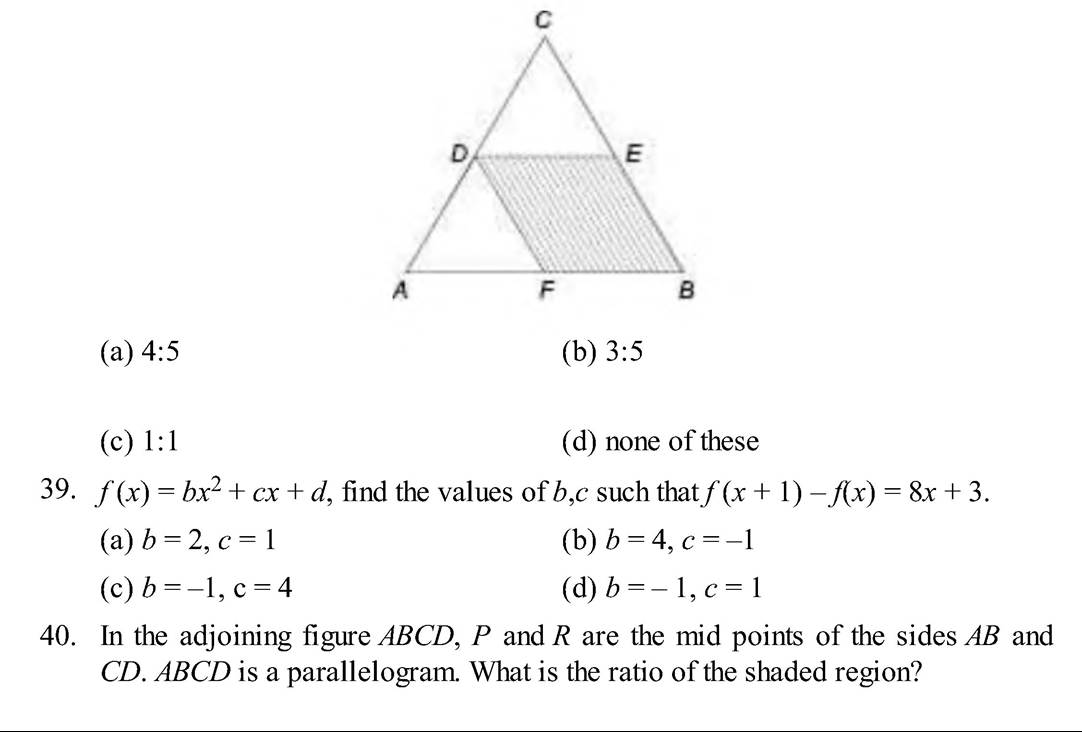
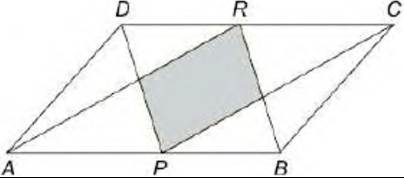
(а) 1/3 (b) 1/2
(с) 1/4 (d) none of these
41. A bus after travelling 50 km. from A faces an accident and proceeds at 4/5th of the initial speed and reaches its destination 45 minutes late. Had the accident happened 20 km further, it would have arrived 12 min. sooner. Find the original speed and the distance.
(a) 25 km∕hr, 110 km
(b) 30 km∕hr, 115 km
(c) 20 km/hr 120 km
(d) 25 km/hr, 125 km
42. If- 20 £ a £ 0, then the probability of the function у = 16x2 + 8(α + 5) x - la - 5 being always positive is:
(a) 1/2 (b) 1/17
(c) 17/20 (d) 13/20
43. Of all the 4 digits numbers (with distinct digits) that can be formed using any four of the five digits 1, 2, 3, 4 & 5, what is the sum of all those numbers which are divisible by 3?
(a) 79992 (b) 78822
(c) 54675 (d) 79982
44. Let/(x) be be a function such that f(x + 1) + f(x - 1) =√(x) for every real x. Then for what value of N is the relation f(x + N) =J{x) necessarily true for every real x?
(a) 6 (b) 5
(c) 4 (d) 3
45. 2! + 4! + 6! + 8! + 10!.................. 100! divided by 3 would leave a remainder of:
(a) 0 (b) 1
46. ⅛⅛? distance between two stations and Q is 230 km. Two bikes start simultaneously IfomP and Q respectively, towards each other and the distance between them after 3 hours is 20 km If the speed of one bike is less than that of the other by 10 km∕hr, then the speed of the slower bike is:
(a) 40 km/hr (b) 30 km/hr
(c) 20 km/hr (d) 10 km/hr
47. In how many ways the letters of the word ASHISH can be arranged?
(a) 100 (b) 140
(c) 150 (d) 180
48. The least value of expression 21og5 a - logfl( 1/25) for x > 1
(a) 4 (b) 3
(c) 5 (d) 2
49.
All the capital letters of the English alphabet from A to Z followed by the lower case letter from ia, to iz, are placed one in each slot, in 52 slots around a circle in clockwise direction. All the slots are counted in the clockwise direction starting with the slot containing A, and the letter in every fifth slot is removed. How many more slots will have letters left in them immediately after im, is removed from its slot?
(а) 13 (b) 14
(с) 16 (d) 12
50.
In the adjoining figure, chord ED is parallel to the diameter AC of the circle. If angle CBE = 65o, then what is the value of angle DEC!
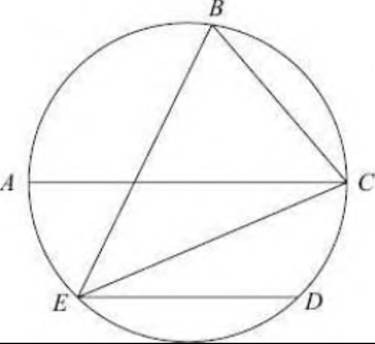
(b) 55
(a) 35
(C) 45
(d) 25
Directions for Questions 51 to 54: The following table gives the price per kg (in Rs.) of a commodity sold in various towns listed below. The table also includes data about distance of these towns IfomNew Delhi.
| Bhagalpur | Lucknow | Agra | Allahabad | Shimla | New Delhi | |
| Rice | 105 | 135 | 120 | 75 | 90 | 150 |
| Wheat | 45 | 42 | 60 | 90 | 75 | 75 |
| Maize | 60 | 66 | 51 | 72 | 75 | 69 |
| Barley | 45 | 30 | 24 | 36 | 42 | 51 |
| 120 | 126 | 117 | 99 | 90 | 150 | |
| Distance from New Delhi (in Kms) | 600 | 700 | 800 | 1000 | 1200 | - |
Cost of transport per IOO kgs = Rs.3 per km
51. If a person in New Delhi had to buy 50kg each of wheat and maize from one place, which would be the most cost-effective place, given that both items can be transported together?
(a) New Delhi (b) Lucknow
(c) Agra (d) Bhagalpur
52. What is the highest percentage change exhibited for any commodity in terms of it’s price in Bhagalpur as against it’s price in any other town/city?
(a) 43% (b) 60%
(c) 80% (d) 100%
53. If Cheap and Best store, a supermarket in New Delhi were to get 100 kgs each of all commodities from all the towns listed and sell at New Delhi prices, then on what commodity does it earn the highest percentage of profits (ignore cost of transport)?
(a) Barley (b) Rice
(c) Corn (d) Maize
54. If a family in Bhagalpur consumes equal quantities of all these commodities every month, then a shift to which town results in maximum percentage change in the family’s average monthly expenditure on these 5 commodities?
(a) Lucknow (b) New Delhi
(c) Bhagalpur (d) Shimla
Directions for Questions 55 and 56: Answer the questions based on the following information.
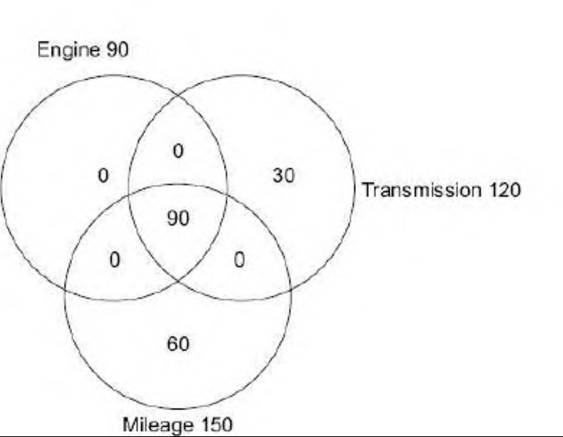
The following data was observed from a study of car complaints received from 180 respondents at Amruti’s workshop viz., engine problem, transmission problem or mileage problem. There was no one who faced exactly two of these problems. There were 90 who faced engine problems, 120 who faced transmission problems and 150 who faced mileage problems.
| 55. How many of them faced all the three problems? | |
| (a) 30 | (b) 60 |
| (c) 90 | (d) Cannot be determined |
| 56. How many of them faced either transmission problems or mileage problems? | |
| (a) 30 | (b) 90 |
| (c) 180 | (d) Cannot be determined |
Directions for Questions 57 and 58: Refer to the table below and answer the questions that follow:
| LIC’s business pattern | |||
| Class Ofbusiness | 2019-20 | 2020-21 | 2021-22 |
| Individual assurances | 85.5% | 88.4% | 88.4% |
| Group assurances | 7.6% | 6.3% | 5.8% |
| Individual pensions | 4.6% | 1.0% | 1.8% |
| Group pensions | 2.3% | 4.3% | 4.0% |
| Total premium income | 4,489 | 22,977 | 27,851 |
| (In rupees crores) | |||
57. The approximate percentage increase in Individual assurances from 2019 to 2022 was (approximately)?
(a) 560% (b) 660%
(c) 535% (d) 635%
58. Between the years 97-98 to 98-99 the lowest percentage change has been for:
(a) Individual Assurances
(b) Group assurances
(c) Individual pensions
(d) Group pensions
Directions for Questions 59 and 60:
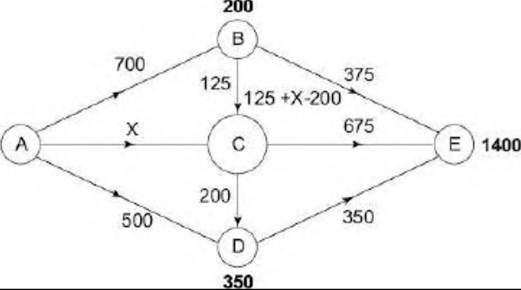
In the network diagram above, the figures represent the flow OfNatural Gas through pipelines between major cities A, B, C, D & E (in suitable units). Assume that supply equals demand in the network (although not on individual nodes).
59. What is the number of units demanded at B?
(a) 175 (b)200
(c) 225 (d) 250
60. If the number of units demanded in C is 225, what is the value of x?
(a) 975 (b) 875
(c) 775 (d) 950
Answer Key
| l.(b) | 2. (b) | 3∙(b) | 4. (c) |
| 5. (a) | 6. (a) | 7. (b) | 8. (a) |
| 9. (a) | 10. (b) | H. (c) | 12.(c) |
| 13.(b) | 14. (c) | 15. (a) | 16. (c) |
| 17. (a) | 18. (c) | 19. (d) | 20. (c) |
| 21. (a) | 22. (c) | 23. (b) | 24. (c) |
| 25. (d) | 26. (a) | 27. (a) | 28. (b) |
| 29. (d) | 30. (b) | 31. (c) | 32. (c) |
| 33. (c) | 34. (d) | 35. (b) | 36. (d) |
| 37. (b) | 38. (c) | 39. (b) | 40. (c) |
| 41∙(d) | 42. (d) | 43. (a) | 44. (a) |
| 45. (c) | 46. (b) | 47. (d) | 48. (a) |
| 49. (a) | 50. (d) | 5L(d) | 52. (d) |
| 53. (a) | 54. (b) | 55. (c) | 56. (b) |
| 57. (a) | 58. (c) | 59. (b) | 60. (a) |
Solutions
SectionI
Solutions to Questions 1 and 2:
1. Option (b) [clearly option b provides a legitimate point which could weaken the argument and give a reason as opposed to the one given in the argument.]
2. Option (b) [Since he emphasises about the end of the semester, hence it is clear that earlier students were doing it before the end]
3. Option (b) [we are talking about exceptions here in the case of achievers being few, so ‘less’ is the correct option.]
4. Option (c) [the correct answer is closest in meaning to the phrase ‘Equivalent in effect or value’. Thus ‘tantamount to’ is the best choice.
5. Option (a) [the sentence D is the correct one, all others are grammatically incorrect]
6. Option (a) [ all the others are incorrect]
7. Option (b) ADEBC
8. Option (a) ECBDA
9. Option (a) CABD
10. Option (b) [Clearly the first paragraph suggests that for human beings, it is only sight that matters.]
11. Option (c) [The link can be easily found out as before this phrase, the author is
talking about the world.]
12. Option (c) [ that is inferred by the usage]
13. Option (b) [The first line of this passage depicts this answer.]
14. Option (c) [This is an indirect question and the answer lies in the first paragraph, last line.]
15. Option (a) [ that he thinks is the only solution. This is given in the fifth para, first line itself, it means that we need to go into the tenets of Gandhian economics.]
16. Option (c) it is a direct question given in the first para, second line.
17. Option (a), nowhere in the passage it is given that in bureaucracy, customer plays an important role, as per the first Para, fourth line,this is not true.
18. Option (c) in the second and third paragraphs, the author is clearly telling about the deficiencies in democracy.
19. Option (d) [very clearly the author’s wish]
20. Option (c) as per the last paragraph, last line the option should be (c).
The following structure would emerge for the three bikes:
| Enfield | Honda | TVS |
| BZ’ | A’ M’ D | C’ L |
| Executive Psychologist | Psychologist, Executive, Designer | Designer, psychologist |
The answers are:
21. Executive. Option (a) is correct.
22. On the TVS. Option (c) is correct.
23. Z, L and A represent the three psychologists. Option (b) is correct.
24. CFB is not logical because we do not know that Aishwarya is a girl. ADE is the most logical sequence.
25. Option (d) is correct as we cannot conclude upon any of the three options.
26. Using statement (I) we can clearly answer the question but with statement (II) we cannot answer the question. Hence, Option (a) is the correct answer.
27. From Statement II alone we know that Australia has the least chance of winning as per the opinion poll being referred to. Hence, Option (a) is correct.
28. He will stop at the blue mark as per the first statement. Also, the second statement alone is also sufficient as from it we know that the number of steps he must have taken is odd (and he can only reach the blue mark in an odd number of steps.). Hence, Option (b) is correct.
29. Option (d) as we cannot answer the question even if we use both the statements together.
Solution to Question 30:
Given that A, C, and D have to be separate and that A is Quants, and C cannot be on the last day. Also that there are 3 lectures (at least) on day 1, the order of A, C and D must be
| Dayl | Day 2 | Day 3 |
| A | C | D |
Further B cannot be clubbed with A or D, hence must be on the second day. Thus F must also be on the same day. This gives us the following table.
| Dayl | Day 2 | Day 3 |
| A | C | D |
| B | ||
| F |
This leaves us with G, H and E. Since, Day 1 has to have at least 3 lectures, G and H must be on day 1. This leaves us with E, which can be placed on either day 1 or 2 or 3.
Thus, the final table is :
| Dayl | Day 2 | Day 3 |
| A, G, H, E? | C, B, F, E? | D,E? |
Hence the answers are:
30. G, H. Option (b) is correct.
Section ∏
31. The alphabets have to be arranged by selecting 2 from 26 and arranging them Also, 2 digits out of 10 digits have to be arranged 26P2 *iqP2 = 58500.
Hence, Option (c) is correct
32. The highest number which satisfies the given condition = 99 + 79 + 59 = 237
And for minimum number x + x + 20 + x + 40 ≥ 100.
x> 13.33
X = 14 and the number will be = 102
Thus, 14 £x £ 59
fi Total such numbers = 59-14+1= 46
Option (c)
33. Lettherequireddistancebexkm.
Then the difference between time taken @ 5kmph & @ 6kmph is 12 minutes i.e. 1/5 hour.
Therefore X/5 -X∕6 = 1/5
6x - 5x = 6
X = 6 km.
Hence, Option (c) is correct.
34. F(8, 4) =/(7, 8) =/(6, 12) =/(5, 16) =√(4, 20) =/(3, 24) =/(2, 28) =/(1, 32) = /Ό, 36)
F(0, 36) = 362- 1 = 1295
Hence, Option (d) is correct.
35. F(5, 7) =/(0, 27) = 272- 1 =728
F(3, 8) =/(0, 20) = 202 - 1 = 399
F(5, 7) +/(3, 8) = 728 + 399 = 1227
Hence, Option (b) is correct.
36. New speed = 5/6 of the usual speed.
Therefore new time taken = 6/5 of the usual time
Therefore (6/5 of usual time) - (usual time) = 15min.
Therefore 1/5 usual time = 15min OR usual time = 75 min.
Hence, Option (d) is correct.
37. No. of signals using one light = 4P1 = 4
No. of signals using two lights = 4P2 =12
No. of signals using three lights = 4P3 = 24
No. of signals using four lights = 4P4 = 4! = 24.
Total = 64 signals. Hence, Option (b) is correct.
38. D, E and F are the mid points of AC, BC and AB.
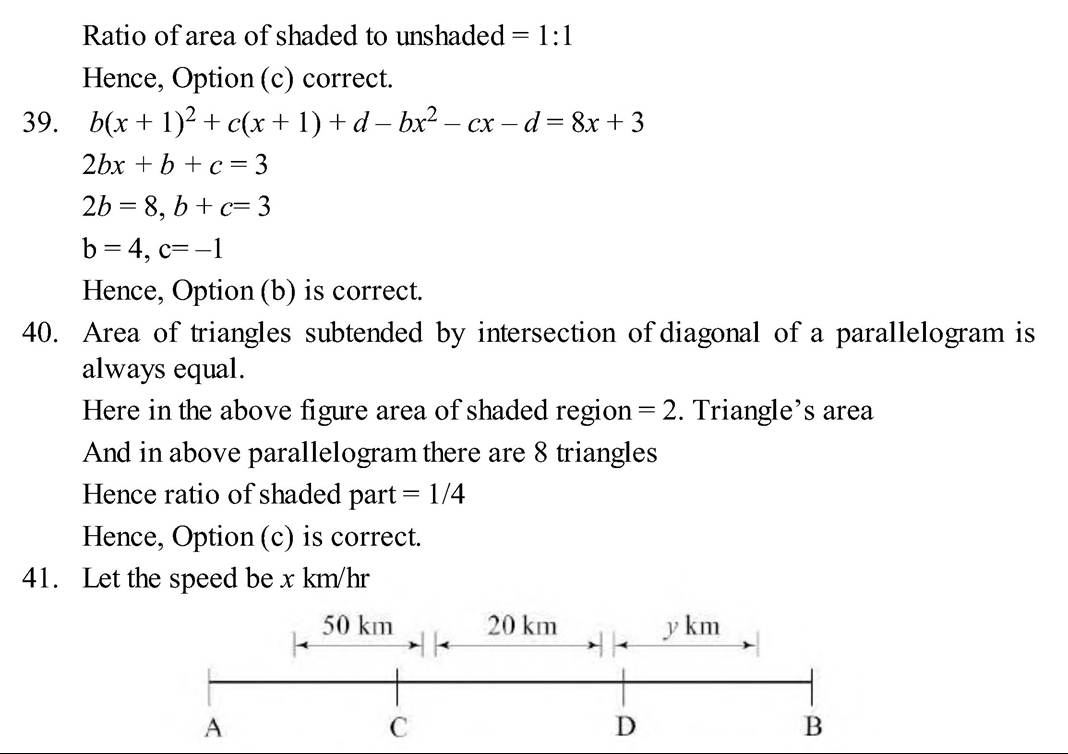
When the bus travels with its usual speed throughout, it reaches 45 minutes earlier than after reducing the speed to 4∕5th after 50 kilometres.
When the bus travels with its usual speed throughout, it reaches 33 (45 - 12) minutes earlier than after reducing the speed to 4∕5th after 70 kilometres.
When the speed becomes 4/5th of the usual, time taken would become 5∕4th the usual, i.e. l∕4thmore of the usual time.
So, l∕4th of the usual time taken to travel CB - 45min.
l∕4th of the usual time taken to travel CD (i.e. 20 km) - 12 min.
Usual time to travel 20 km. - 48 min.
Usual Speed - 20 ¥ 60/48 - 25 km/hr
Usual time taken to travel CB - 45 ¥ 4 - 3 hrs
Distance CB - 25 ¥ 3 - 75 km.
Total distance - 50 + 75 - 125 km.
Hence, Option (d) is correct.
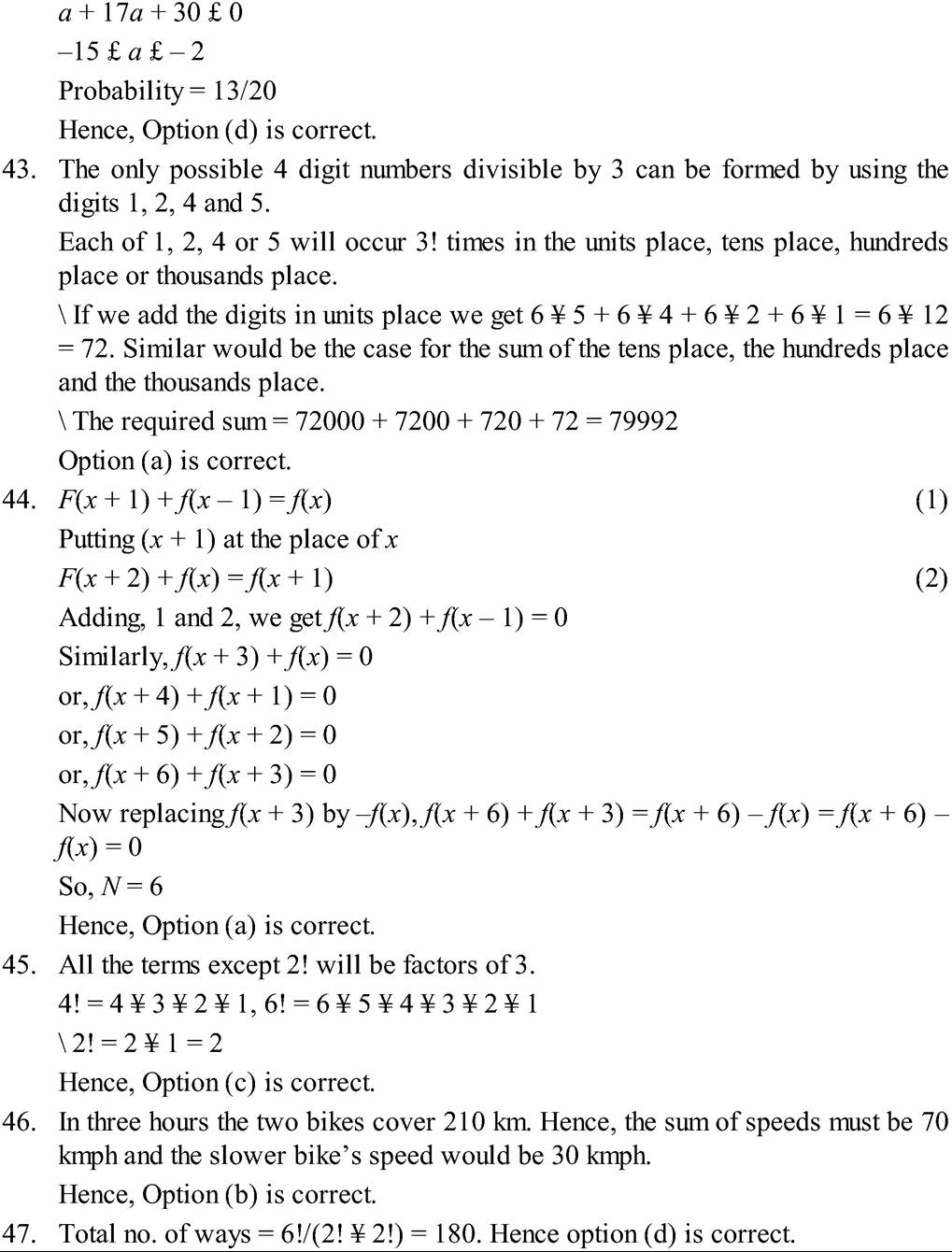
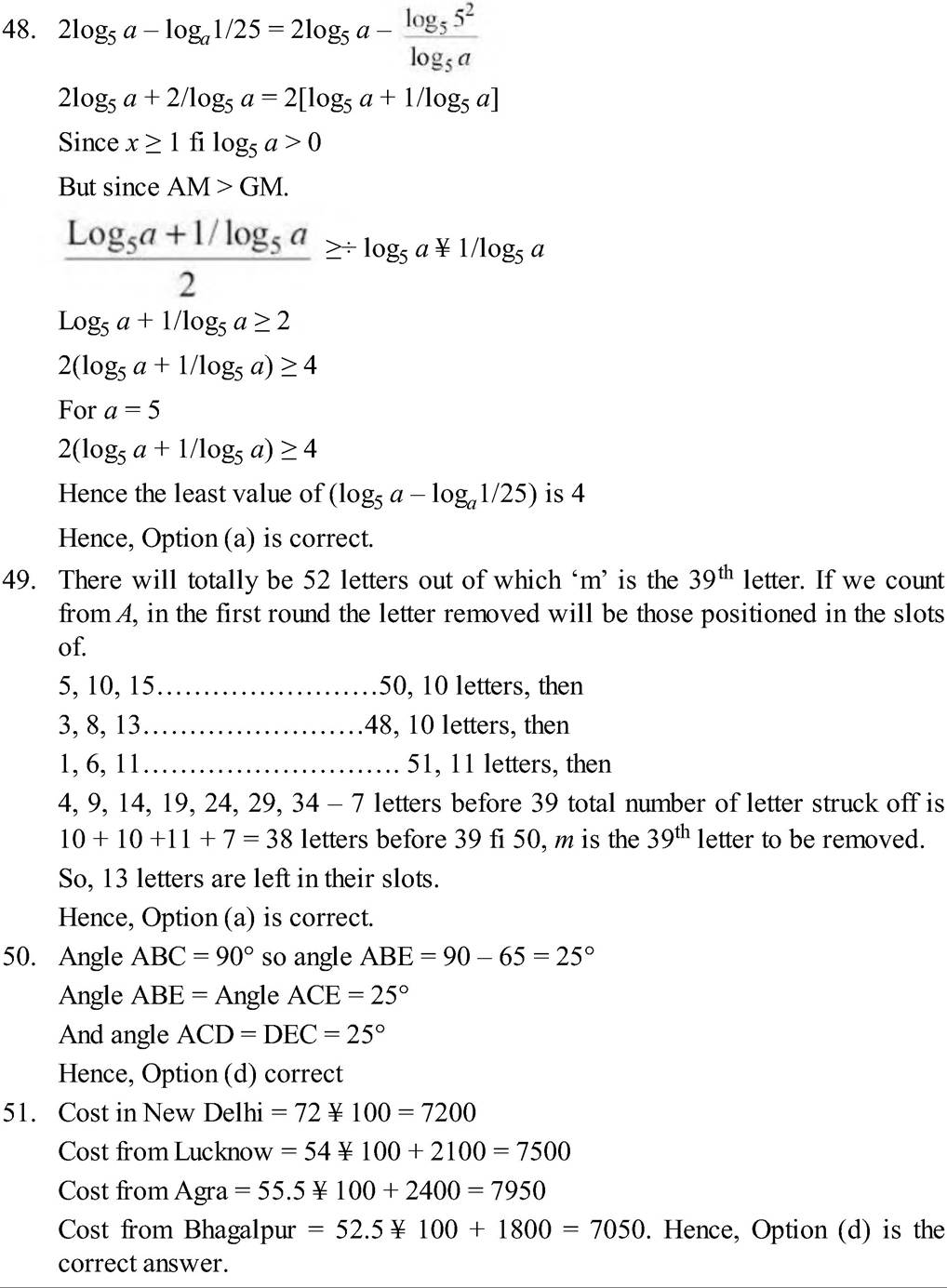
42. D£0
64(« + 5)2 + 64(7α + 5) £ 0
52. Highest change in Wheat will be from 45 to 90. Hence, 100%. Option (d) is correct.
53. Here the cost of transport need not be considered as all the commodities will have to bear this cost.
Average price of Barley from the 5 towns = 177/5 = Rs.35.4. Profit of the supermarket will be Rs. 15.6. Percentage profit 44%
Average price of Rice in 5 towns is Rs. 105, profit of supermarket is Rs. 45. Percentage profit 42.8%.
Average price of Corn is 110.4, profit is Rs.39.6. percentage profit is less than 40%
Average price of Maize is Rs. 64.8. profit is Rs.4.2 and the percentage profit is less than 10%
Hence profits are highest from barley. Hence option (a) is the correct answer.
54. A shift to New Delhi would create the highest percentage increase in average monthly expenditure on the 5 commodities. Hence, Option (b) is the correct answer.
55. Option (c)
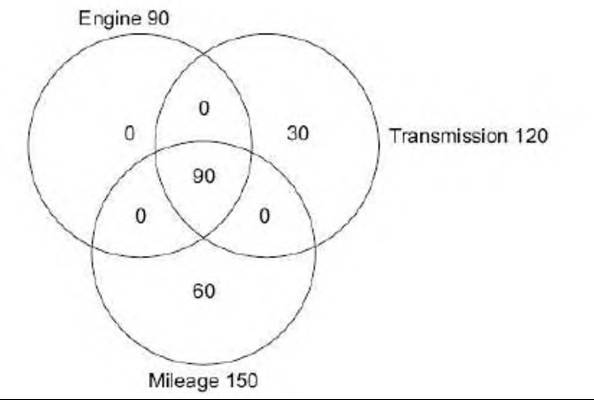
56. There are 90 such people. Option (b) is correct.
57. 100 ¥ 1.855 ¥ 1.884 ¥ 1.884 - 658. Thus, 658 - 100 - 560 % approximately. Hence, Option (a) is correct.
58. It is clearly for individual pensions.
Refer to the following figure for the solution:
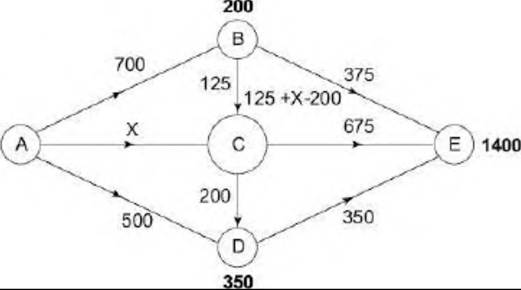
Hence, Option (c) is correct.
59. From the figure it would be 700 - (375 + 125) =200. Hence, Option (b) is correct.
60. 125 + X- 200 - 675 = 225 JE X= 975. Hence, Option (a) is correct.
8. Income on day 1:=20; Income on day 2 = 21 ;
Income on day 3 = 22 ; Income on day 4 = 23;
Thus, income on day 10 = 28 9.