SNAP 2006
1. Study this matrix.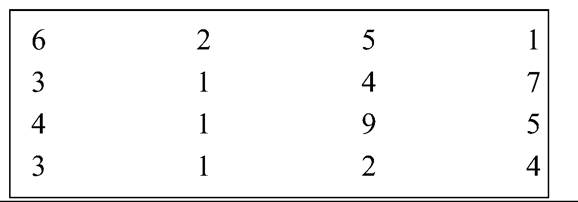
In this game there are two players. The first player can split the matrix vertically into two equal halves and choose one half for further play.
The next move on this half is by the other player who will split it only horizontally and choose one half for further play. The game will continue in this manner. At the end, the last number left is the first player’s gain.If you start the game, retain the right half and, again right half after your opponent’s move, then how should your opponent play to minimize your gain?
(a) Retain upper, retain lower
(b) Retain upper, retain upper
(c) Retain lower, retain upper
(d) Retain lower, retain lower
2. What is the next letter in the series?
U, F, Q, J, M, N
(a) I (b) T
(с) О (d) M
3. Sonal, a mathematician, defines a number as ‘connected by 6’ if it is divisible by 6, or if the sum of its digits is 6, or if 6 is one of the digits of the number. Other numbers are all ‘not connected with 6,. As per this definition, the number of integers, from 1 to 60 (both inclusive) which are not connected with 6 is
(a) 18 (b)43
(c) 22 (d) 42
4. Leena, Nitin, Arun and Mohan crossed a lake in a canoe that could hold only two persons. The Canoe held two persons on each of three forward trips across the lake and one person on each of two return trips. Leena was unable to paddle when someone else was in the canoe with her. Nitin was unable to paddle when anyone else except Arun was in the canoe with him. Each person paddles continuously for at least one trip. Who paddled twice?
(a) Leena (b) Nitin
(c) Mohan (d) Arun
5. A, B, C, D, E, F and G are the members of a family consisting of 4 adults and 3 children, two of whom, F and G are girls. A and D are brothers and A is doctor.
E is an engineer married to one of the brothers and has two children. B is married to D and G is their child. Who is C?(a) G’s father (b) F’s father
(c) E’s daughter (d) A’s son
6. If every alternative letter of English Alphabet from B onwards (including B) is written in lower case (small letters) and the remaining letters are capitalised, then: How will be the first month of the second half of the year be written?
(a) AuGuSt (b) JuLy
(c)jUlY (d) AugUSt
7. A rich merchant had collected many gold coins. He did not want anybody to know about them. One day, his wife asked, “How many gold coins do we have?” After pausing a moment, he replied, “Well! IfI divide the coins into two unequal numbers, then 48 times the difference between the two numbers equals the difference between the squares of the two numbers.” The wife looked puzzled. Can you help the merchant’s wife by finding out how many gold coins the merchant has?

8. An enterprising businessman earns an income of' 1 on the first day of his business. On every subsequent day, he earns an income which is just double of that made on the previous day. On the IOth day of business, his income is
(a)' 29 (b)' 210
(c)' IO2 (d) ' 10
9. One night three naughty boys stole a basketful of apples from the garden, hid the loot and went to sleep. Before retiring they did some quick counting and found that the fruits were less than a hundred in number. During the night one boy awoke, counted the apples and found that he could divide the apples into three equal parts if he first took one for himself. He then took one apple, ate it up and took 1/3 of the rest, hid them separately and went back to sleep. Shortly thereafter another boy awoke, counted the apples and he again found that if he took one for himself the loot could be divided in to three equal parts. He ate up one apple, bagged 1/3 of the remainder, hid them separately and went back to sleep.
The third boy also awoke after some time, did the same and went back to sleep. In the morning when all woke up, and counted apples, they found that the remaining apples again totaled to 1 more than could be divided into three equal parts. How many apples did the boys steel?(a) 67 (b) 79
(c) 85 (d) None of the above
Directions for Questions 10 and 11: Choose Ifomthese four diagrams the one that best illustrates the relationship among three given classes.
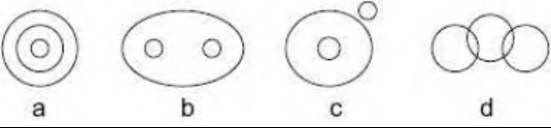
[1] Chilli, Salt, Vegetables
[1] Students of Law, Students of Science, Men
Directions for Questions 12 to 16: Study the following example and answer the questions.
An electronic device rearranges numbers step-by-step in a particular order according to a set of rules. The device stops when the final result is obtained. In this case the device stops at Step V.
| Input: | 85 | 16 | 36 | 04 | 19 | 97 | 63 | 09 |
| Step I | 97 | 85 | 16 | 36 | 04 | 19 | 63 | 09 |
| Step II | 97 | 85 | 63 | 16 | 36 | 04 | 19 | 09 |
| Step III | 97 | 85 | 63 | 36 | 16 | 04 | 19 | 09 |
| Step IV | 97 | 85 | 63 | 36 | 19 | 16 | 04 | 09 |
| Step V | 97 | 85 | 63 | 36 | 19 | 16 | 09 | 04 |
| 12. Which of the following will be Step III for the input below? | ||||||||
| Input: | 09 | 25 | 16 | 30 | 32 | 18 | 17 | 06 |
| (a) | 32 | 09 | 25 | 16 | 30 | 18 | 17 | 06 |
| (b) | 32 | 30 | 09 | 25 | 16 | 19 | 17 | 06 |
| (c) | 32 | 30 | 09 | 25 | 16 | 18 | 17 | 06 |
| (d) | 32 | 30 | 25 | 09 | 16 | 18 | 17 | 06 |
| 13. What is the last step for the input below? | ||||||||
| Input: 16 09 25 27 06 05 | ||||||||
| (a) Step II | (b) Step III | |||||||
| (c) Step IV | (d) None of the above | |||||||
| 14. What is the output of Step V for the input below? | ||||||||
| Input: | 25 | 08 | 35 | 11 | 88 | 67 | 23 | |
| (a) | 88 | 67 | 35 | 25 | 23 | 11 | 08 | |
| (b) | 88 | 67 | 35 | 25 | 23 | 08 | 11 | |
| (c) | 08 | 11 | 23 | 25 | 35 | 67 | 88 | |
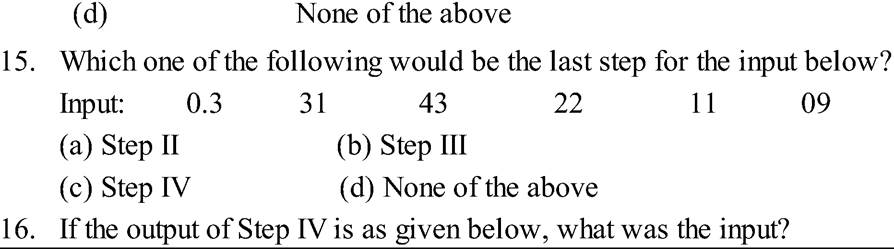
| Step IV: | 92 | 86 | 71 | 69 | 15 | 19 | 06 | 63 | 58 |
| (a) | 86 | 92 | 69 | 71 | 15 | 19 | 06 | 63 | 58 |
| (b) | 15 | 86 | 19 | 92 | 06 | 69 | 63 | 58 | 71 |
Answer Key
| l.(d) | 2. (a) | 3∙(b) | 4. (d) |
| 5. (d) | 6. (c) | 7. (d) | 8. (a) |
| 9. (b) | 10. (c) | 11. (d) | 12. (d) |
| 13. (a) | 14. (a) | 15. (d) | 16. (d) |
| 17.(c) | 18. (b) | ||
Solutions:
1. If you are retaining right, your opponent can either retain upper or retain lower. Your next move would depend on what your opponent has done as he plays to minimize your gain and you play to maximize your own gain.
Since, your next move is retain to right again, it is evident that your opponent would have chosen ‘retain lower’ in his first move.
You can think of this as follows:
If your opponent’s first move is to retain upper, the grid you would get is:
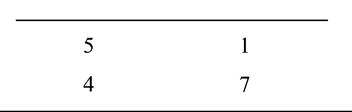
In this case, your next move would logically be to ‘retain left’ as you would then expect a minimum of 4. In case from the above situation you go to retain right, you would then only expect to get a return of ‘ 1 ’ from the game.
Since, it is given that you chose to retain right again, you definitely would not have got the above grid in front of you.
In the other possibility, you can think of the chain of events that would occur in case your opponent chose to ‘retain lower’.
The grid you would get in this case would be:
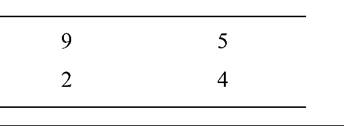
From the above case, your logical next step would be to retain right.
Thus, since we know that your second move is to retain right, it follows that your opponent’s first move is to ‘retain lower’.
After this when you retain right, the numbers left in the grid would be:
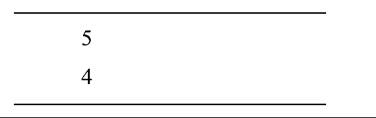
Your opponent would again ‘retain lower’ in this case.
Thus, he must have played ‘retain lower’ & ‘retain lower’. Option (d) is correct.
2. There are two series intertwined in the given series.
F-J-N (skip 3 alphabets)
U-Q-M (skip 3 alphabets in the opposite order).
The next letter would depend on the second series above. After M, the 3 letters to be skipped are L, K, J and hence ‘I’ should be the next letter in the series.
Option (a) is correct.
3. The numbers would be 1, 2, 3, 4, 5, 7, 8, 9, 10, 11, 13, 14, 17, 19, 20, 21, 22,
23, 25, 27, 28, 29,31, 32, 34, 35, 37, 38, 39, 40, 41, 43, 44, 45, 47, 49, 50, 52, 53, 55, 57, 58 and 59.
There are 43 such numbers. Option (b) is correct.
Alternately, you could also have counted the numbers to be left out as: 6, 12, 18,
24, 30,... 60 (10 numbers which are multiples of 6); and 15, 33, 51 (which have a sum of digits of 6); and 16, 26, 46 and 56 (numbers which have 6 in them). There are 17 numbers which have to be left out from the 60 numbers. Hence, 43 numbers have to be counted. Option (b) is correct.
4. The flow would be:
| Trip description | People travelling | Person rowing |
| First forward trip | Nitin & Arun | Nitin |
| First return trip | Arun | Arun |
| Second forward trip | Leena & Arun | Arun |
| Second return trip | Leena | Leena |
| Third forward trip | Leena and Mohan | Mohan |
Thus, Arun would be rowing twice.
Option (d) is correct.
5. Collating the information you would get that the family tree consists of the couples: A (husband and doctor), E (Engineer and A’s wife), D (husband), B (wife ofhusband). G being the child of B-D and being a girl would be B & D’s daughter. Similarly, F (girl) and C (boy) would be A’s and E children. Thus, C is A’s son. Option (d) is correct.
6. The alphabet would be written as: AbcdEfGhljKlMnopQrStUvWxYz.
JULY would then be written as: jUlY.
Option (c) is correct.
7. 
Option (a) is correct.
9. Solve this one through options.
For option (b) 79:
First boy, sees 79 apples eats 1 apple and hides 26 apples and leaves 52 apples; Second boy, sees 52 apples eats 1 apple and hides 17 apples and leaves 34 apples;
Third boy, sees 34 apples eats 1 apple and hides 11 apples and leaves 22 apples;
The final number is still one more than a multiple of 3.
Thus, option (b) satisfies all the conditions of the problem.
If you try the same with option (a) for instance you would get:
First boy, sees 67 apples eats 1 apple and hides 22 apples and leaves 44 apples; This number is not one more than a multiple of 3. Hence, options (a) gets rejected.
If you try the same with option (c) for instance you would get:
Firstboy, sees 85 apples eats 1 apple and hides 28 apples and leaves 56 apples; This number is not one more than a multiple of 3. Hence, options (c) gets rejected.
Option (b) is the correct answer.
Solutions for Questions 10 and 11:
10. Chillies are vegetables and Salt is not a vegetable. The correct figure for this question is the third figure. Option (c) is correct.
11. Some students of law are men (some might be women). Besides, some students of science are men (some might be women). Also, no student of law is a student of science, i.e. they are mutually exclusive categories. The fourth figure exhibits this relationship.
Option (d) is correct.
Solutions for Questions 12 to 16:
From the input to the output it is clear that the electronic device just arranges all the numbers in a decreasing order. It does so by progressively getting the left most numbers in the sequence in the correct order. Based on this understanding you can move on to solve the questions.
12. Input: 09, 25, 16, 30, 32, 18, 17, 06
Step I: 32, 09, 25, 16, 30, 18, 17, 06
Step II: 32, ЗО, 09, 25, 16, 18, 17, 06
Step III: 32, 30, 25, 09, 16, 18, 17, 06
Option (d) matches with this third step.
Hence, option (d) is correct.
13. Input: 16, 09,25,27, 06, 05
Step I: 27, 16, 09, 25, 06, 05
Step II: 27, 25, 16, 09, 06, 05
Option (a) is correct.
14. Input: 25, 08, 35, 11,88, 67,23
Step I: 88, 25, 08,35, 11,67, 23
StepII: 88, 67, 25, 08,35, 11,23
StepIII: 88, 67, 35, 25, 08, 11,23
Step IV: 88, 67, 35, 25, 23, 08, 11
StepV: 88, 67,35,25, 23, 11,08
Option (a) is correct.
15. Input: 03, 31,43,22, 11,09
Step I: 43,03,31,22, 11,09
StepII: 43,31,03,22, 11,09
StepIII: 43,31,22, 03, 11,09
Step IV: 43,31,22, 11,03,09
Step V: 43, 31,22, 11,09, 03
Thus, step V is the final step. Option (d) is the correct answer.
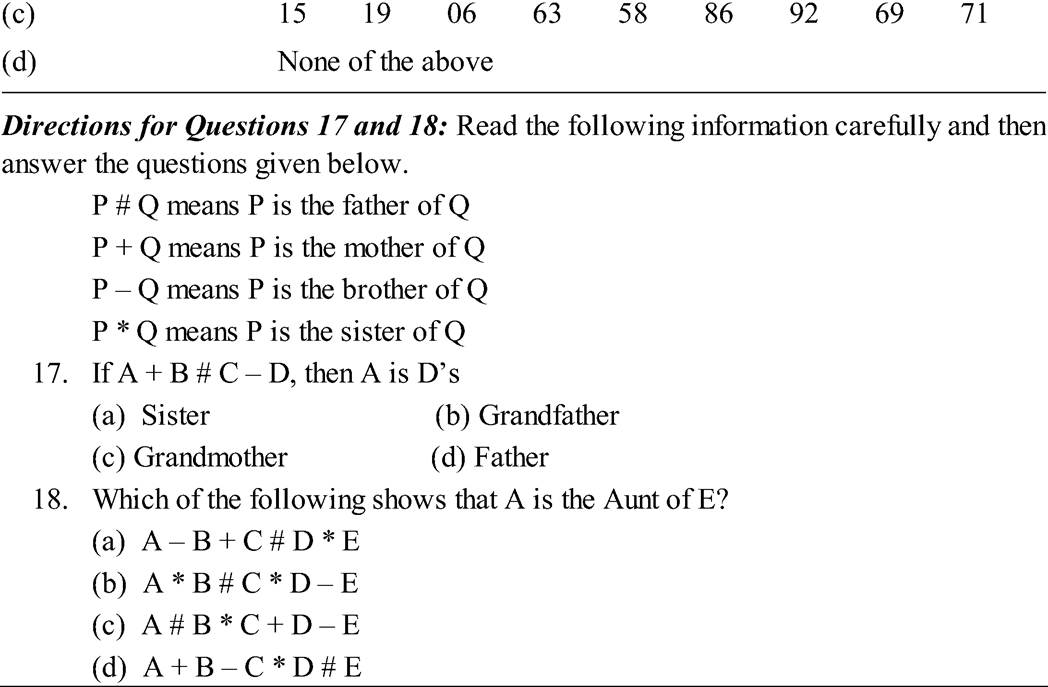
16. It is not possible to determine a unique input in such situations as there are multiple inputs that are possible which can give you Step IV as described. In fact, if you check the options themselves, you can see that both option (b) and option (c) give you Step IV as described by the question.
Hence, option (d) is correct.
Solutions for Questions 17 and 18:
17. A + B#C-D Converts to A is the Mother of B, B is the father of C, C is the brother of D. Thus, A is D’s grandmother. Option (c) is correct.
18. The relationship shown in option (b) converts to: A is the sister of B, B is the father of C, C is the sister of D and D is the brother of E. This means that C, D and E are siblings as they are all children of B. Further, since A is the sister of B (C, D and E’s father), it naturally follows that A is the aunt of E. Thus, option
(b) is the correct answer.