SNAP 2007
1. You have three chests in front of you. The first chest is labeled “GOLD”, the second is labeled “SILVER” and the third is labeled “GOLD OR SILVER”. You have been told that all the labels are on the wrong chests and that one chest contains gold coins, one contains silver coins and one contains bronze coins.
How many chests do you need to open to deduce which label goes on which chest?(a) O (b) 1
(c) 2 (d) Cannot deduce
2. How many minutes before 12 noon is it when it is 27 minutes past 10 am?
(a) 30 (b) 93
(c) 49 (d) 94
Directions for Questions 3 to 5: Read the following passage and answer the questions. An employee has been assigned the task of allotting offices to six of the staff members. The offices are numbered 1-6. The offices are arranged in a row and they are separated from each other by six foot high dividers. Hence voices, sounds and cigarette smoke flow easily from one office to another.
Miss Ruby needs to use the telephone quite often throughout the day. Mr. Minhas and Mr. Brar need adjacent offices as they need to consult each other often while working. Miss Harsha is a senior employee and has to be allotted the office number 5, having the biggest window.
Mr. Dongre requires silence in the offices next to his. Mr. Tanjore, Mr. Minhas and Mr. Dongre are all smokers. Miss Harsha finds tobacco smoke allergic and consequently the
offices next to hers are to be occupied by non-smokers.
Unless specifically stated all the employees maintain an atmosphere of silence during office hours.
3. The ideal candidate to occupy the office furthest from Mr. Brar would be
(a) Miss Harsha (b) Mr. Minhas
(c) Mr. Tanjore (d) Mr. Dongre
4. The three employees who are smokers should be seated in the offices.
(a) 1, 2 and 4 (b) 2, 3 and 6
(c) 1, 2 and 6 (d) 1, 2 and 3
5. In the event of what occurrence, within a period of one month since the assignment of the offices, would a request for a change in office be put forth by one or more employees?
(a) Mr.
Dongre quitting smoking(b) The installation of a noisy teletype machine by Miss Harsha in her office.
(c) Miss Ruby needs silence in the office(s) next to her own.
(d) Mr. Tanjore taking over the duties formerly taken care of by Miss Ruby.
6. Shankar and Jwala are both members of a Youth club, though they do not speaking to each other and refuse to work with each other. Chaya, the club president, is appointing members to the fundraising committee, but she has resolved that she will not appoint anyone without his or her explicit consent. Shankar tells Chaya, “I will not consent to appointment on that committee unless I know whether Jwala is to be a member of it.” And Jwala says, “I will not consent to be a member of that committee unless I know whether Shankar will be appointed to it.”
If all three of these people Stickbythese resolutions, then:
(a) Neither of them can be appointed to the committee.
(b) They must either both be appointed or both be left out.
(c) The committee may finally have one of them, both of them, or neither of them as members.
(d) Either one of them can be appointed, but not both.
7. A bank customer had ' IOO in his account. He then made 6 withdrawals, totaling
100. He kept a record of these withdrawals, and the balance remaining in the
account, as follows:
| Withdrawals | Balance left |
| ' 50 | ' 50 |
| '25 | ' 25 |
| ' 10 | ' 15 |
| ' 8 | ' 7 |
| ' 5 | ' 2 |
| '2 | ' 0 |
| ' 100 | ' 99 |
So, why are the totals not exactly right?
(a) There is a mistake in the total of withdrawals.
(b) There is a mistake in the total of the balance.
(c) The two totals need not be equal.
(d) The bank has cheated the customer.
8. Which image from the bottom row should replace the question mark?
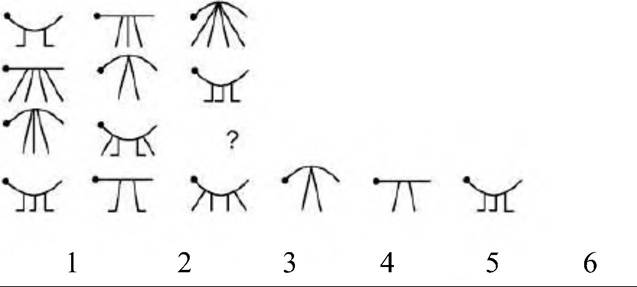
(а) 3 (b) 6
(c) 2 (d) 5
9.
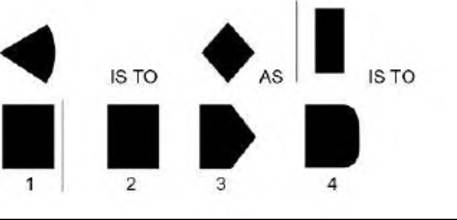
(а) 1 (b) 2
(с) 3 (d) 4
10.
Which pattern from the bottom line (A, B, C, D or E) is missing from the top line?(a) A
(c)D
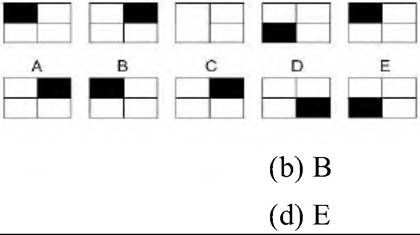
Directions for Questions 11 to 13: These questions are based on the following information.
During their school Silver Jubilee Reunion, four alumni were discussing their starting annual salaries back in 1981. The salaries in question were Rupees 40, 50, 60 and 70 thousand per year. Of course the present MD of a private company earned the most. Arvind earned more than Biswajeet, and the doctor earned more than Dhruv the engineer. Chinmay could not remember what he started on. Biswajeet the lawyer did not start on' 50,000, nor did Dhruv.
11. What is Chinmay’s current profession?
(a) MD
(c) Doctor
12. What was the Lawyer’s starting salary?
(a) 40,000
(c) 60,000
13. Who received the highest starting salary?
(a) Arvind
(c) Chinmay
(b) Lawyer
(d) Engineer
(b) 50,000
(d) 70,000
(b) Biswajeet
(d) Dhruv
14. A man has a job which requires him to work 8 straight days and rest on the ninth day. Ifhe started work on a Monday, the 12th time he rests will be on what day of the week?
(a) Sunday
(c) Tuesday
(b) Wednesday
(d) Friday
15. Fromthe images below (1-7) find 3 odd ones out.
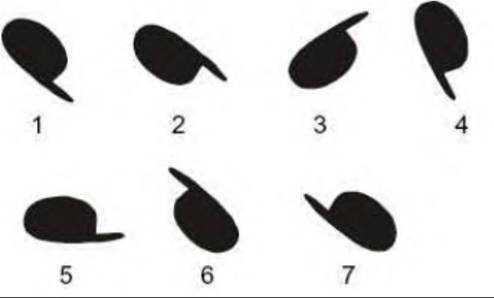
(a) 1,2,3 (b)2,3,7
(c) 3,7, 4 (d)4, 1,6
16. Babloo and Bunty were excitedly describing the result of the First Annual Running Race at Damapur High School. Snehal, Tanmay and Waman had been the three contestants. “Tanmay won the race; Waman was in second place,” reported Babloo. Bunty disagreed. “It was Snehal who won. Tanmay came second.”
In fact, neither Babloo nor Bunty had given a correct version of the result as each had made one true and one false statement.
What was the actual placing of the three contestants?
(a) Snehal, Waman, Tanmay.
(b) Snehal, Tanmay, Waman.
(c) Waman, Snehal, Tanmay.
(d) Tanmay, Waman, Snehal.
17. What is the number of routes from P to Q?
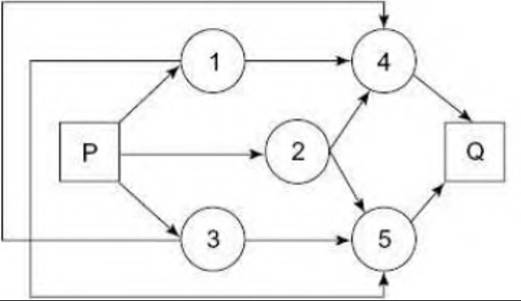
(а) 5 (b) 6
(с) 9 (d) 12
18. Find the circle, which does not include a word using all letters.
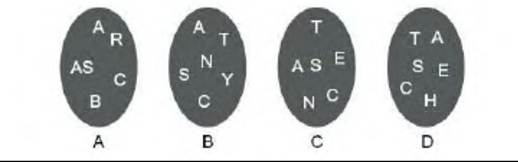
(a) A (b) B
(c) C (d) D
19. It is possible to arrange eight of nine numbers 2, 3, 4, 5, 7, 10, 11, 12, 13 in the vacant squares of the 3 by 4 array shown below so that the arithmetic average of the numbers in each row and column is the same integer.
| 1 | 15 | ||
| 9 | |||
| 14 |
Which of the nine numbers must be left out when completing the array?
(a) 4 (b) 10
(c) 15 (d) 7
20. What number will replace the question mark?

(a) 40 (b) 18
(c) 19 (d) 24
21. Where should the letter ‘W’ be placed? 
(a) Above
(b) Below
(c) Both
(d) None
22. At a family reunion were the following people: one grandfather, one grandmother, two fathers, two mothers, four children, three grandchildren, one brother, two sisters, two sons, two daughters, one father-in-law, one mother-in- law, and one daughter-in-law. But not as many people attended as it sounds. How many persons were there?
(a) 5 (b) 10
(b) 15 (d) 7
23. On the counter are six squares marked 1, 2, 3, 4, 5, 6. Players are invited to place as much money as they wish on any one square. Three dice are then thrown.
X If your number appears on one die only, you get your money back plus the same amount.
X If two dice show your number, you get your money back plus twice the amount you placed on the square.
X If your number appears on all three dice, you get your money back plus three times the amount.
X If the number is not on any of the dice, the operator gets your money.
For example, suppose that you bet one Rupee on square No. 6. If one die shows a 6, you get your Rupee back plus another Rupee. If two dice show 6, you get back your Rupee plus two Rupees. If three dice show 6, you get your Rupee back plus three Rupees.
From a player’s point of view, the chance of his number showing on one die is 1/6, but since there are three dice, the chances must be 3/6 or 1/2, therefore the game is a fair one. Of course this is the way the operator of the game wants everyone to reason, for it is quite fallacious.
What is the probable story?
(a) Operator gets a profit of 6% on each Rupee bet.
(b) Operator suffers a loss of 7.8% on each Rupee bet.
(c) Operator gets a profit of 7.8% on each Rupee bet.
(d) The player suffers a loss of 6% on each Rupee bet.
24. Jaideep was given some money by his mother on his birthday. Jaideep spent all of it in four stores. In each store he spent one rupee more than half of what he
had when he came in. How much did he get from his mother?
(a)' 25 (b)' 30
(c)' 46 (d)' 52
25. Consider the following two statements to be true even if they seem to be at variance from commonly known facts. Then decide which of the given conclusions logically follows from the two given statements. Select the correct alternative.
Statements: All Lawyers are extrovert.
Some wise men are extrovert.
Conclusions:
(ja) All lawyers are wisemen.
(jb) All wisemen are lawyers.
(jc) Some extrovert are wisemen.
(jd) All extrovert are lawyers
(a) Only(ja) follows.
(b) Only (jb) and (jc) follows.
(c) Only (ja) and (jc) follows.
(d) Only (jc) follows.
Directions for Questions 26 to 28: Use the data given below to answer the questions. The following are the results of a survey conducted on a small cross-section of students from Symbiosis Group of institutes, to determine the readership of three magazines.
This survey was conducted in Dec. 2006.X Number of students who read only Business India was 40
X 60 students read only Outlook
X 110 students read only India Today
X 30 students read all the three magazines
X 20 read Business India and India Today, but not Outlook
X 50 read Business India and Outlook, but not India Today
X 40 read Outlook and India Today, but not Business India
26. What was the total no. of students surveyed?
(с) 390 (d) None of these
27. How many students did not read Business India?
(a) 40 (b) 170
(c) 240 (d) None of these
28. When another survey was conducted in May 2007 with the same set of students, their tastes had changed and the findings were different. All of them read India Today. 120 read Outlook, and no one read Business India. Hence, in May 2007, how many students read only India Today?
(a) 60 (b)110
(c) 230 (d) None of these
29. An ingredient in coffee, known as RTC, has been found to inactivate common cold viruses in experiments. In previous experiments, researchers found that inactivated common cold viruses can convert healthy cells into cancer cells. It can be concluded that the use of coffee can cause cancer.
Which one of the following, if true, most seriously weakens the argument?
(a) Several teams of scientists performed the various experiments, and all of the teams had similar results.
(b) The carcinogenic effect of RTC could be neutralized by the other ingredients found in coffee.
(c) When RTC kills common cold viruses it weakens the immune system, and it might thus diminish the body’s ability to fight other viruses, including viruses linked to cancers.
(d) If chemists modify the structure of RTC, RTC can be safely incorporated into medications to prevent the common cold.
30. A census taker approaches a house and asks the woman who answers the door, “How many children do you have, and what are their ages?” Woman: “I have three children, the product of their ages is 36, the sum of their ages is equal to the address of the house next door.”
The census taker walks next door, comes back and says, “I need more information.”
The woman replies, “I have to go, my oldest child is sleeping upstairs.”
Census taker: “Thank you, I now have everything I need.”
What are the ages of each of the three children?
(а) 9, 2, 2
(b) 6, 6, 1
(d) 6, 3, 2
(с) 12, З, 1
Answer Key
| l.(a) | 2. (b) | 3.(d) | 4. (d) | 5. (d) | 6. (d) |
| 7. (c) | 8. (d) | 9. (c) | 10. (c) | H. (c) | 12.(c) |
| 13. (a) | 14. (b) | 15.(b) | 16. (a) | 17.(b) | 18. (a) |
| 19.(b) | 20. (b) | 2L(b) | 22. (d) | 23. (a) | 24. (b) |
| 25. (d) | 26. (b) | 27. (d) | 28. (c) | 29. (b) | 30. (a) |
| Solutions: | |||||
1. Since all labels are wrong, the box labeled GOLD OR SILVER would have neither gold nor silver. Thus, it would have bronze. Consequently, the chest marked GOLD, would have silver in it and the chest marked SILVER, would have gold in it. Thus, we do not need to open any chest in order to find out which chest has which coins. Thus, option (a) is correct.
2. 27 minutes past 10 AM is 93 minutes before 12 noon. Option (b) is correct.
Solutions for Questions 3 to 5:
The starting grid would look as follows:
| 1 | 2 | 3 | 4 | 5 | 6 |
We first place Miss Harsha in the 5th office. The grid would become:
| 1 | 2 | 3 | 4 | 5 | 6 |
| Harsha |
The other people are: Ruby (telephone use throughout the day), Minhas-Brar (together and need to discuss), Dongre (needs silence) and Tanjore.
Also, Tanjore, Minhas and Dongre being smokers they would not occupy the 4th or the 6th cabin. Also, Brar cannot occupy the 6th cabin as he needs to be with Minhas.
This leaves us with only Ruby to occupy the 6th office. Also, Brar being the only other non-smoker he would need to be put into the 4th cabin, and Minhas obviously has to be his neighbor.
The grid would become:
| 1 | 2 | 3 | 4 | 5 | 6 |
| Minhas | Brar | Harsha | Ruby |
We are just left to place Tanjore and Dongre now. Dongre needs to have silence and hence he cannot be put in the 2nd cabin next to Minhas (as Minhas would be continuously discussing with Brar throughout the day).
Thus, Dongre would take the 1st cabin and hence, Tanjore would take the 2nd cabin.
The grid would end up as:
| 1 | 2 | 3 | 4 | 5 | 6 |
| Dongre | Tanjore | Minhas | Brar | Harsha | Ruby |
3. Option (d) is correct.
4. Option (d) is correct.
5. Option (d) is correct.
6. Since Shankar and Jwala both ‘refuse to work with each other’ it obviously means that either one of them can be appointed but not both. Option (d) is correct.
7. The obvious answer in this case is that both the totals need not be equal.
For example, if he had withdrawn' IOO in the first case, the columns would look like:
| Withdrawals | Balance Left | |
| IOO | 0 | |
| TOTAL | IOO | 0 |
Hence, option (c) is the correct answer.
8. In each row, there is one figure with two legs, one with three legs and one with 4 legs. Hence, the third figure in the bottom row should have 2 legs. This leaves us between figures 2 and 5. The other thing you can notice in the first two rows is that of the three figures, only one figure has flat bottom extensions to some or all of their legs. In the third row, the second figure has already used flat bottom extensions to the legs in the second figure of the row. Thus, the figure, which would replace the question mark would not have flat bottom extensions.
Thus, we need figure 5 amongst those shown to replace the question mark. Thus, option (d) is correct.
9. The right side of the first figure in the two-figure analogy is replaced by a two- sided angle kind of structure. The third figure gives us the same relationship. Option (c) is correct.
10. In the pattern of the five figures shown, the dark quarter of the figure is rotating in a clockwise fashion. Thus, in the missing figure the dark quarter should be at the bottom right. Figure (d) gives us that. Hence, option (c) is correct.
Solutions for Questions 11 to 13:
The starting grid in this case would be:
| Starting Salary | Name ofperson | Profession |
| 70000 | MD | |
| 60000 | ||
| 50000 | ||
| 40000 |
The four persons are: Arvind, Biswajeet (lawyer), Chinmay, Dhruv (engineer). This leaves us with two professions, which have not been fixed with the respective persons. BetweenArvind and Chinmaythe professions of doctor and MD are to be shared.
Since, the lawyer and the engineer did not start on 50000 (which is evident from the statement iBiswajeet the lawyer did not start on' 50000 nor did Dhruv) it must be the doctor who started with 50000. The grid becomes:
| Starting Salary | Name ofperson | Profession |
| 70000 | MD | |
| 60000 | ||
| 50000 | Doctor | |
| 40000 |
At this point, the statement “the doctor earned more than Dhruv the engineer”
becomes usable in the grid and can be put into the grid. The engineer would become the person with 40000 starting salary and obviously then the lawyer would be starting with 60000.
The grid would then become
| Starting Salary | Name ofperson | Profession |
| 70000 | MD | |
| 60000 | Biswajeet | Lawyer |
| 50000 | Doctor | |
| 40000 | Dhruv | Engineer |
From this point, if we use that Arivnd > Biswajeet we know that Arvind is the MD. The final solution grid becomes:
| Starting Salary | Name ofperson | Profession |
| Arvind | MD | |
| 60000 | Biswajeet | Lawyer |
| 50000 | Chinmay | Doctor |
| 40000 | Dhruv | Engineer |
The answers can then be read off the above table.
11. Chinmay is a doctor. Option (c) is correct.
12. The Iwayer started at' 60000. Option (c) is correct.
13. Arvind received the highest starting salary. Option (a) is correct.
14. The first rest day would be on the next Tuesday and can be visualised as:
| Monday | Tuesday | Wednesday | Thursday | Friday |
| Day 1 | Day 2 | Day 3 | Day 4 | Day 5 |
| Saturday | Sunday | Monday | Tuesday | |
| Day 6 | Day 7 | Day 8 | Rest Day |
The second round of work would start on Wednesday and end on the next Wednesday and consequently, the next rest day would be on a Thursday.
The respective rest days can be visualised as below:
| Rest Day 1 | Rest Day 2 | Rest Day 3 | Rest Day 4 | Rest Day 5 |
| Tuesday | Thursday | Saturday | Monday | Wednesday |
| Rest Day 6 | Rest Day 7 | Rest Day 8 | Rest Day 9 | Rest Day 10 |
| Friday | Sunday | Tuesday | Thursday | Saturday |
| Rest Day 11 | Rest Day 12 | |||
| Monday | Wednesday |
Option (b) is the correct answer.
15. Figures 2, 3 and 7 are rotated in a opposite direction to the figures 1, 4, 5 and 6. Thus, these figures are the odd ones out. Option (b) is correct.
16. If we consider the two statements that Babloo has made, it is clearly evident that his first statement cannot be true. Because, if his first statement “Tanmay won the race” were true, then Bunty’s second statement “Tanmay came second” is false. Then, Bunty’s first statement “It was Snehal who won” must be correct; but it cannot be correct since, if Bunty won the race, then Snehal cannot come first. In such an event, if we were to consider Babloo ,s first statement to be true, both of Bunty’s statements would be false - which goes against the basic condition of the question.
Hence, Babloo’s second statement “Waman came second” must be true. Then Bunty’s second statement “Tanmay came second” is naturally false and hence Bunty’s first statement “It was Snehal who won” must be true.
So, Snehal came first, Waman came second and Tanmay came third. Option (a) is correct.
17. The routes can be counted as:
P-l-4-Q; P-l-5-Q; P-3-5-Q; P-3-4-Q; P-2-4-Q; P-2-5-Q Thus, there are a total of 6 routes from P to Q.
Option (b) is the correct answer.
18. The word formed by using the letters in the circle B is: SCANTY.
In Circle C: SECANT and in Circle D: CHEATS.
Only the letters of Circle A do not form a complete word if all the six letters are used. Option (a) is correct.
19. The total of all the numbers given to us would be given by:
(Sum of numbers listed separately in the question) + (Numbers already placed in the grid) = (2 + 3 + 4 + 5 + 7 + 10 + 11 + 12 + 13) + (1 + 9 +14 + 15) = 106.
The number that should be left out should be such that after it’s removal, the sum of all other remaining numbers should be divisible by 3 as well as by 4. This is because, we need to have the total sum of the remaining numbers such that it can be divided into three equal integral elements (for the rows). Besides, this number should also be possibly divisible into four equal integral elements (for the columns).
Looking at the options, if we check for option (a):
Leaving out the digit 4, leaves us with a sum of 102 for the remaining 12 numbers. This can be divided into 3 rows summing up to 34 each.
However, we cannot break up 102 into 4 equal integral parts and hence we cannot leave out 4 and achieve the desired result.
If we check for option (b):
Leaving out the number 10, leaves us with a sum of 96 for the remaining 12 numbers. This can be divided into 3 rows summing up to 32 each.
Besides, 96 can also be broken up into 4 equal integral parts of 24 each.
If we check for option (c), it gets rejected based on the following thinking:
Leaving out the number 15, leaves us with a sum of 91 for the remaining 12 numbers. This cannot be divided into 3 equal integral values for each row. Hence, this option is obviously wrong.
If we check for option (d):
Leaving out the number 7, leaves us with a sum of 99 for the remaining 12 numbers. This can be divided into 3 rows summing up to 33 each.
However, we cannot break up 99 into 4 equal integral parts and hence we cannot leave out 7 and achieve the desired result.
Thus, only option (b) is feasible and is the correct answer.
20. In this case, the product of the last two numbers in every set of 4 numbers, is double the product of the first two numbers.
Thus, in the first set: 12 ¥ 8 = 2 ¥ (6 ¥ 8);
In the second set: 6 ¥ 10 = 2 ¥ (5 ¥ 6);
In the third set: 4 ¥ ? = 2 ¥ (3 ¥ 12) /E the number in place of the question mark should be 18. Hence option (b) is correct.
21. The series of alphabets is:
A (below) - BCDE (above) - FGHI (below) - JKLM (above) - NOPQ (below)
- RSTU (above) - VWXY (below)
Hence, W should be placed below. Option (b) is correct.
22. The following family structure would give the required relations:
| First Generation | X (Man) | Y (Woman) | X and Y are a husband wife couple |
| Second Generation | Z(Man) | A (Woman) | Z is X and Y’s Son |
| Third Generation | B (Male), C (Female), D (Female) | B, C and D are the children of A and Z. |
In this case the following holds:
1 Grandfather = X;
1 Grandmother = Y;
Two Fathers = X and Z;
Two Mothers = A and Y;
Four Children = Z, B, C and D;
Three grand children = B, C and D;
One brother = B;
Two Sisters = C and D;
Two Sons = Z and B;
Two daughters = C and D;
One father-in-law = X;
One Mother-in-law = Y
One daughter-in-law = A.
In this case there are only seven people required to fulfill all conditions specified by the problem. These are (X, Y, Z, A, B, C and D) Thus, there are 7 people in the family.
Option (d) is correct.
23. In such cases, the operator always wins and the only option that satisfies this condition is option (a). Options (b) and (c) cannot be correct because they talk about the operator suffering a loss—which would not be true in an operator defined and controlled game. Hence, these options can be rejected. Option (d) is also rejected because whether the player wins or loses will change with every throw of the die and depends on the actual outcome of the throw.
Option (a) is correct.
24. Ifhe got' 30, his spends would be:
First store =16; Money left = 14;
Second store = 8; Money left = 6
Third store = 4; Money left = 2;
Fourth store = 2; Money left = 0.
Thus, option (b) is correct.
25. If some wise men are extrovert, then it necessarily follows that some extrovert are wise men. Thus, (jc) is definitely correct as a conclusion. Conclusion (ja) is not necessarily true and neither is (jb) necessarily true.
Option (d) is correct.
Solutions for Questions 26 to 28:
The following Venn diagram would give us the overall structure of the numbers involved in this situation:
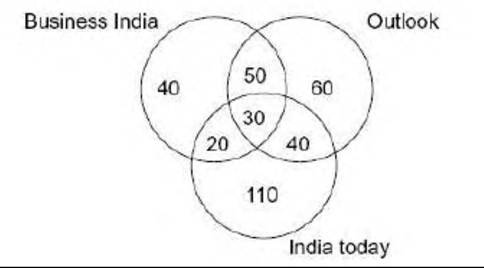
The solutions to the question can be read off from the given diagrams.
26. The total number of students surveyed = 40 + 50 + 60 + 20 + 30 + 40 + 110 =
350.
Option (b) is correct.
27. 110 + 40 + 60 = 210 students did not read Business India. Option (d) is correct.
28. The number of students who read only Business India in May 2007 = 350 - 120 = 230. Option (c) is correct.
29. If the other ingredients in coffee have a neutralising effect on the carcinogenic effects of RTC, then the conclusion “Use of coffee can cause cancer” is most seriously weakened.
Option (b) is the correct answer.
30. In order to visualise the different ways in which 36 can be written as a product of 3 factors, we first need to think of the factors of 36 above and including the square root of 36. These are: 36 itself, 18, 12, 9, 6
The different ways in which a product of 36 can be formed using 3 numbers are
36 ¥ 1 ¥ 1 (sum of the factors = 36+1 + 1=38);
18 ¥ 2 ¥ 1 (sum of the factors =18 + 2+ 1 =21);
12 ¥ 3 ¥ 1 (sum of the factors = 12 + 3 + 1 = 16);
9 ¥ 4 ¥ 1 (sum of the factors = 9 + 4+1 = 14);
9 ¥ 2 ¥ 2 (sum of the factors = 9 + 2 + 2= 13);
6 ¥ 3 ¥ 2 (sum of the factors = 6 + 3+ 2=11);
6 ¥ 6 ¥ 1 (sum of the factors = 6 + 6+1 = 13).
Now the key to this question is to think of why the census taker cannot answer the question even though he knows that the sum of the ages is equal to the house number next door (which he has seen when he takes a walk to the next door).
In order to understand this, suppose the census taker had seen that the house next door was numbered 38. In such a case, he would have no issues identifying 36, 1 and 1 as the three ages.
Similarly, if the house next door was numbered 21,16,14 or 11 the census taker would immediately be able to deduce the three ages. Since, he asks for more information it means that he must be having two solutions for the ages—where the sum of ages were equal. This happens in the case of 9 + 2 + 2= 13 = 6 + 6 +
1. The moment he knows that she has an eldest child, he rules out the possibility of the ages being 6, 6 and 1. Thus, the ages of the three children are 9, 2 and 2. Option (a) is correct.