SNAP 2008
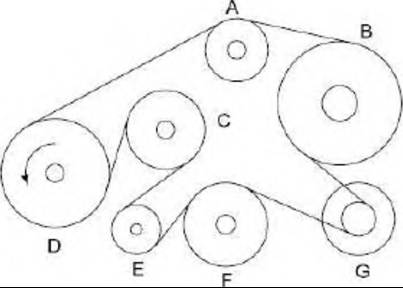
1. A band passes around all the wheels so that they can be turned by the driving wheel when the driving wheel turns in the direction shown. Which way will wheel B turn?
(a) Clockwise
(b) Cannot move
(c) Anticlockwise
(d) Either way
2.
In a certain language, (A) ‘Sun shines brightly’ is written ‘ba Io sul,; (B) ‘Houses are brightly lit’ is written as ‘kado udo ari ba,; and (C) ‘Light comes from sun’ as ‘dapi kup Io nro,. What words will be written for ‘sun’ and ‘brightly’?(a) Lo, ba
(b) ba, Io
(c) sul, Io
(d) ba, sul
3. Given are the following three equations:
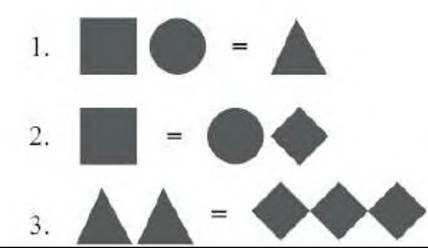
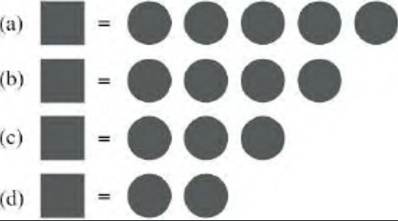
How many circles are equivalent to a square, as per the ratios in the three given equations?
4. Each child in a family has at least 4 brothers and 3 sisters. What is the smallest number of children the family might have?
(a) 7 (b) 8
(c) 9 (d) 10
5. In the following question two statements are followed by two conclusions numbered I and II. Assume the two statements are true even if they are at variance with commonly known facts. Then pick the correct answer from the choices given below.
(A) Only conclusion I follows.
(B) Only conclusion II follows.
(C) Both conclusions I & II follow.
(D) Neither conclusion I nor conclusion II follows.
Statements: Some doctors are fools. Joshi is a doctor.
Conclusions: I. Joshi is a fool.
∏. Some fools are doctors.
(a) A
(c)C
(b) B
(d)D
6. Debu walks towards the east then towards North and turning 135o right walks for a while and lastly turns towards left.
In which direction is he walking now?(a) North (b) East
(c) South-East (d) North-East
Directions for Questions 7 to 9: Read the following instructions and answer.
I. There is a rectangular wooden block of length 4 cm, height 3 cm and breadth 3 cm.
II. The two opposite surfaces of 4 cm ? 3 cm are painted yellow on the outside
III. The other two opposite surfaces of 4 cm ? 3 cm are painted red on the outside.
IV.The remaining two surfaces of 3 cm ? 3 cm are painted green on the outside.
V. Now, the block is cut in such a way that cubes of 1 cm ? 1 cm ? 1 cm are created.
7. How many cubes will have only one colour?
(a) 10 (b) 12
(c) 14 (d) 18
8. How many cubes will have no colour?
(a) 1 (b) 2
(c) 4 (d) 8
9. How many cubes will have any two colours?
(a) 34 (b) 24
(c) 16 (d) 12
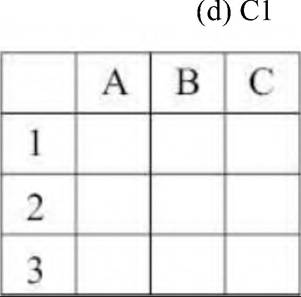
10. Read the following about the grid given below and answer.
X The cells in this grid contain the digits 1 to 9 in random order.
X Column A contains no odd digits.
X Cell C3 minus Cell C2 equals 4.
X The Sumofthree digits in Row 1 is 17.
X Number 7 is in Column B; its left hand neighbour is not 4.
X The digits of Column C add upto 14.
∑ 2 is not in the same horizontal row as 8; and 9 is not immediately below
3.
Which cell holds the number 9?
(a) Bl
(с) C2
(b) B3
11. Replace the question mark with the right option.
4, 32, 288, 7,31680
(a) 25600 (b) 2880
(c) 7420 (d) 10000
12. In the Sunday bazzar, Jamuna sells her lemons at' 0.50 for two. Her neighbour Seema has slightly smaller lemons; she sells hers at' 0.50 for three. After a while, when both ladies have the same number of lemons left, Seema is called away. She asks her neighbour to take care of her goods. To make things simple, Jamuna puts all lemons in one big pile, and starts selling five lemons per one rupee. When Seema returns, at the end of the day, all lemons have been sold.
But when they start dividing the money, there appears to be a shortage of' 3.50. Supposing they divide the money equally, how much does Jamuna lose in this deal?(a) ' 10.50 (b)' 11.50
(c)' 42.00 (d)' 52.50
13. There are two cups, one containing orange juice and one containing an equal amount of lemonade. One teaspoon of the orange juice is taken and mixed with the lemonade. Then a teaspoon of this mixture is mixed back into the orange juice. Is there more lemonade in the orange juice or more orange juice in the lemonade?
(a) More orange juice in the lemonade
(b) More lemonade m the orange juice
(c) Equal amount of each juice between the two cups
(d) None of the above
14. Consider the statement and decide which of the assumptions are implicit.
“In the present period of economic hardships, education and small family norm may lead the nation to progress and prosperity”?
Assumptions: A. Education and small family norms are directly related to nation’s progress.
B. Big families find it difficult to bear the cost of education.
(a) Only A is implicit.
(b) Only B is implicit.
(c) Both A and B are implicit.
(d) Neither A nor B is implicit.
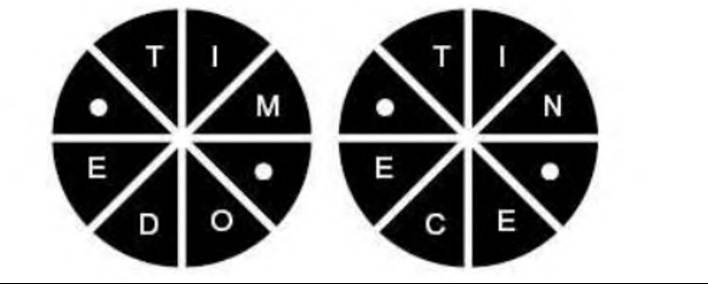
15. Fill in the blanks to find out two words that are synonyms.
(a) KS, ST (b) MS, NT
(c) ST, DN (d) MS,DN
16. Beautiful beaches attract people, no doubt about that. Just look at the city’s most beautiful beaches, which are amongst the most overcrowded places in the state.
Which of the following exhibits a pattern of reasoning similar to the one exhibited in the argument above?
(a) Moose and bear usually appear at the same drinking hole at the same time of the day. Therefore, moose and bear must be feeling thirsty at about the same time.
(b) Children who are scolded severely tend to misbehave more often than other children. Hence if a child is not scolded severely, that child is less
z λ likely to misbehave,,, rc xι,.,
(c) During warm weather my dog suffers more fleas than during cool weather.
Therefore, fleas must thrive in a warm environment.(d) Tally accounting software helps increase the work efficiency of its users. As a result, these users have more time for other activities.
14. Abdul, Mala and Chetan went bird watching. Each of them saw one bird that none of the others did. Each pair saw one bird that the third did not. And one bird was seen by all three. Of the birds Abdul saw, two were yellow. Of the birds Mala saw, three were yellow. Of the birds Chetan saw, four were yellow. How many yellow birds were seen in all? How many non-yellow birds were seen in all?
(a) 7 yellow birds and 3 non-yellow birds
(b) 5 yellow birds and 2 non-yellow birds
(c) 4 yellow birds and 2 non-yellow birds
(d) 3 yellow birds and 2 non-yellow birds
15. In each of the following two sets I & II, find the word or pair of words different from the other three words or pair of words:
I: J. Lake K. Brook L. Stream M. River
II: J. Weighty-Heavy K. Broad-Wide L. Big-Large M. Tiny-Small
(a) I-J, II-J (b) I-K, II-M
(c) I-K, II-J (d) I-J, II-K
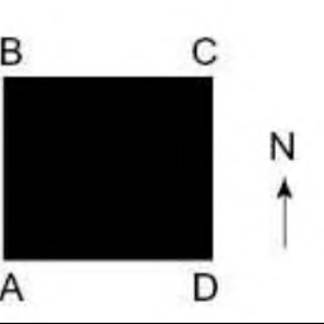
16. A, B, C and D are standing on the four corners of a square field as shown in the figure. From the positions shown in the figure, A walks to North position and B walks to the East position while C decides to walk two sides in anticlockwise direction. B walks to the South and then changes his mind to take the previous position. Identify the choice with correct positions.
(a) A & B occupy the same position.
(b) C & D occupy the same position.
(c) D & B are in their original positions.
(d) B & C occupy diagonally opposite positions.
20. A gambler bet on a horse race, but the bookee wouldn’t tell him the results of the race. The bookee gave clues as to how the five horses finished, which may have included some ties, and wouldnT pay the gambler off unless the gambler could determine how the five horses finished based on the following clues:
X Penn Fe finished before Night Marvel and after Wish Bones.
X Wish Bones tied with Penn Fe if and only IfHallelujah did not tie with Sundae.
X Penn Fe finished as many places after Sundae as Sundae finished after Wish Bones if and only if Wish Bones finished before Night Marvel.
The gambler thought for a moment, then answered correctly. How did the five horses finish the race?
(a) Sundae came in first. Wish Bones and Hallelujah tied for second place. Penn Fe came fourth. Night Marvel came in fifth.
(b) Wish Bones came in first. Sundae and Penn Fe tied for second place. Hallelujah came in fourth. Night Marvel came in fifth.
(c) Wish Bones came in first. Sundae and Hallelujah tied for second place. Penn Fe came in fourth. Night Marvel came in fifth.
(d) Penn Fe came in first. Night Marvel and Hallelujah tied for second place. Wish Bones came in fourth. Sundae came in fifth.
21. In a school drill, a number of children are asked to stand in a circle. They are evenly spaced and the 6th child is diametrically opposite the 16th child. How many children are made to stand in the circle?
(a) 16 (b) 20
(c) 22 (d) None of the above
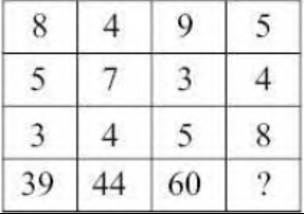
22. In this number grid insert the missing number at the sign of interrogation.
(a) 62
(b) 72
(с) 60
(d)70
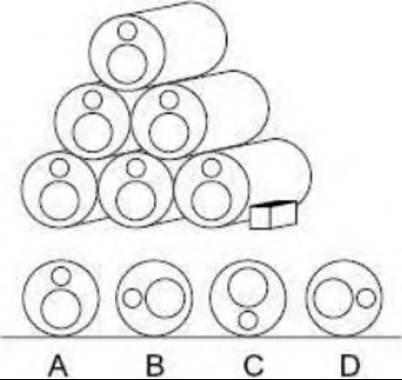
23. Steel cylinders are made so that each one has a large and small hole through the middle. In the drawing six cylinders have been stacked on top of each other. To stop the cylinders from rolling on the smooth floor they are wedged by heavy blocks at each side of bottom row. If the heavy blocks are removed what would be the position of the cylinder when they stopped rolling?
(a) A (b) B
(c) C (d) D
Directions for Questions 24 to 26: Use the information given below to answer.
i. There is a group of 5 persons A, B, C, D and E.
ii. In the group there is one badminton player, one chess player and one tennis player.
iii. A and D are unmarried ladies and they do not play any games.
iv. No lady is a chess player or a badminton player.
V. There is a married couple in the group of which E is the husband.
vi. B is the brother of C and is neither a chess player nor a tennis player.
17. Which of the groups has only ladies?
(a) ABC (b) BCD
(c) CDE (d) None of the above
18. Who is the tennis player?
(a) B (b) C
(c) D (d) E
19. Who is the wife of E?
(a) A (b) B
(c) D (d) None of the above
20. Consider the following statements and answer the question.
M, N, O and P are all different individuals.
M is the daughter of N.
N is the son of O.
O is the father of P.
Which among the following statements is contradictory to the above premises?
(a) P is the father of M.
(b) O has three children.
(c) M has one brother.
(d) M is the grand daughter of O.
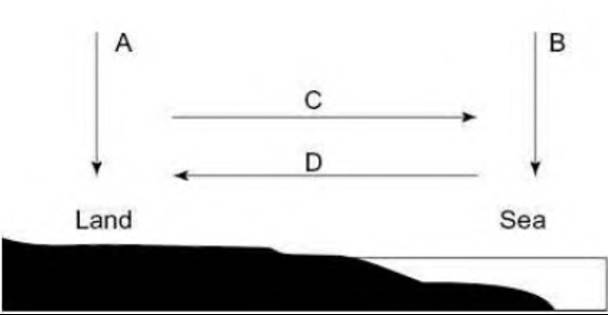
21. The drawing shows a cross section where the land meets the sea. The section covered is 5 kilometers. On a hot day, in which direction, indicated by four arrows, is the wind most likely to blow?
(a) A (b) B
(c) C (d) D
Directions for Questions 29 and 30: In the diagram below, the circle stands for ‘educated’, square stands for ‘hard working’, triangle for ‘urban people’ and rectangle for ‘honest’. The different regions of the diagram are numbered from 1 to 12. Study the diagram carefully and answer the questions:
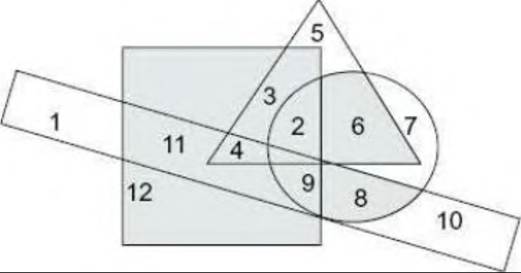
29. Uneducated urban hard-working and honest people are indicated by:
(a) 3 (b) 11
(c) 9 (d) 4
30. Non-urban educated people who are neither hard-working nor honest are indicated by:
(a) 5 (b) 7
(c) 10 (d)ll
Answer Key
l.(b)
5. (b)
9. (c)
2. (a)
6. (d)
10. (b)
3.(a)
7. (a)
ll.(b)
4. (c)
8. (b)
12. (a)
13. (c) 14. (a) 15. (d) 16. (c)
17. (b) 18. (a) 19. (d) 20. (c)
21. (b) 22. (b) 23. (c) 24. (d)
25. (b) 26. (d) 27. (a) 28. (c)
29. (d) 30. (b)
Solutions:
1. If you look at the chain of forces that the pulley at D puts on the wheel B, there are two forces happening.
Through the wheel A, the wheel D is pulling wheel B in an anticlockwise manner. However, through the network of wheels C,E,F,G, the wheel D is pulling the wheel B in a clockwise fashion.
Also, since both the forces originate from wheel D, the clockwise and anticlockwise forces on B would be equal. Thus, the wheel would not move. Hence, option (b) is correct.
2. Sun Shines brightly = ba Io sul
Houses are brightly lit = kado udo ari ba
Light comes from sun = dapi kup Io nro.
From the first and second statements, we can see that the common word in the original phrases is ‘brightly’ and the common word in the codes is ‘ba’.
Thus, we can conclude that brightly means ‘ba’ in the language.
From the first and third statements, we can see that the common word in the original phrases is ‘sun’ and the common word in the codes is ‘lo’.
Thus, we canconclude that ‘sun’ means ‘lo’ in the language.
Thus, option (a) is correct.
3. This question has to be solved using the options to confirm how many circles would a square represent so that all the three equations provided to us are consistent with each other, i.e. there is internal consistency between the three equations.
Checking option (a) we get: One Square = 5 circles.
Putting this value in equation 1: we get: 6 circles = 1 triangle.
Thus, equation 3 which shows two triangles on the LHS, would become 12 circles on the LHS and that would be equivalent to 3 diamonds. Thus, 1 diamond would be equal to 4 circles.
Putting this value in equation 2 we can see that one square would be equal to 5 circles. Hence, there is internal consistency between the three equations if one square is equivalent to 5 circles.
If you check in the same way for the other options, you will see that they would fail the internal consistency check. The equations would not match each other.
For instance, if we check option (d) we get:
One square = 2 circles.
Putting this value in equation 1: we get: 3 circles = 1 triangle.
Thus, equation 3, which shows two triangles on the LHS, would become 6 circles on the LHS and that would be equivalent to 3 diamonds. Thus, 1 diamond would be equal to 2 circles.
Putting this value in equation 2 we can see that one square would be equal to 3 circles. But we started from 1 square = 2 circles. Hence, internal consistency between the equations is not achieved. Option (d) can be rejected.
Checking option (b): One Square = 4 circles.
Putting this value in equation 1, we get: 5 circles = 1 triangle.
Thus, equation 3, which shows two triangles on the LHS, would become 10 circles on the LHS and that would be equivalent to 3 diamonds. Thus, 1 diamond would be equal to 3.33 circles.
Putting this value in equation 2 we can see that one square would be equal to 4.33 circles.
But we started from 1 square = 4 circles. Hence, internal consistency between the equations is not achieved. Option (b) can be rejected.
Checking option (c): One Square = 3 circles.
Putting this value in equation 1: we get: 4 circles = 1 triangle.
Thus, equation 3, which shows two triangles on the LHS, would become 8 circles on the LHS and that would be equivalent to 3 diamonds. Thus, 1 diamond would be equal to 2.66 circles.
Putting this value in equation 2 we can see that one square would be equal to 3.66 circles.
But we started from 1 square = 3 circles. Hence, internal consistency between the equations is not achieved. Option (c) can be rejected.
Thus, option (a) is correct.
4. If the child is a boy, he needs to have at least 4 brothers, means that there are at least 5 boys in the family. By the same reasoning, if the child is a girl, she needs to have at least 3 sisters. This means that there must be at least 4 girls in the family.
The minimum number of children the family might have is 5 boys + 4 girls = 9 children. Option (c) is correct.
5. Only conclusion II follows in this case as if some doctors are fools is true it must be true that some fools are doctors. Joshi is a fool is something that is not necessarily true because if he is a doctor, he might or might not belong to the group of doctors who are fools.
Thus, option (b) is correct.
6. Debu’s movements can be tracked as follows:
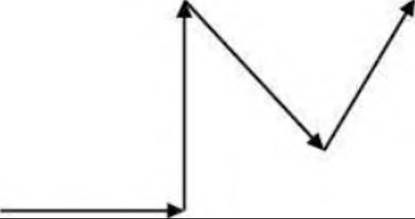
From the figure it is clear that Debu is finally walking towards the North East. Option (d) is correct.
Solutions for Questions 7 to 9:
The following figure would help you visualise the cube and it’s painting.
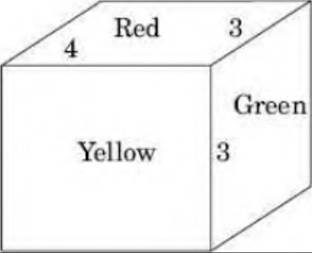
Fromthis Visualisationwe Canvisualise the individual surfaces:
The 4 ¥ 3 surfaces would look something like the table below:
| Three colors | Two colors | Two colors | Three colors |
| Two colors | Single Color | bgcolor=white>Single ColorTwo colors | |
| Three colors | Two colors | Two colors | Three colors |
We also know that there would be 4 of them.
Similarly, the 3 ¥ 3 surfaces would look something like below and there would be two of them:
| Three colors | Two colors | Three colors |
| Two colors | Single Color | Two colors |
| Three colors | Two colors | Three colors |
7. From the above visualisations of the surfaces, it is clear that there would be: 2¥4+l¥2 = 10 cubes with one side painted only.
Option (a) is correct.
8. If you look at the front layer of the original cube, there are three such layers. The front layer (where the front is painted yellow); the middle layer and the back layer.
If the frontal 4 ¥ 3 layer were to be removed the next layer would have two cubes, which have no color:
| No Color | No Color | ||
Thus, there would be two cubes with no color
Option (b) is correct.
9. In order to visualise the cubes having two colors we can do so by using:
All cubes - cubes having 3 colors - cubes having 1 color - cubes having no color- 36- 8- 10 2- 16.
Option (c) is correct.
10. The digits available are 1, 2, 3, 4, 5, 6, 7, 8 and 9. This list has 4 even numbers and 5 odd numbers.
Deduction 1 from clue 2: When we know that column A has no odd numbers, we also know that three of the even numbers from 2/4/6 and 8 have to take the places in column A.
Deduction 2: C3 - C2 - 4 means that both C3 and C2 contain odd numbers and the pair of numbers they might contain might be:
Possibility 1: 9, 5; Possibility 2: 7, 3; Possibility 3: 5, 1
Reading further we know that 7 is in Column B, so we reject the Possibility 2 above and the remaining possibilities for C3 and C2 are 9, 5 and 5,1 respectively.
If you combine this information with the fact that Column C adds up to 14, we see that the 9, 5 possibility for Column C does not exist. Thus, the three numbers in the order Cl, C2, C3 for Column C are: 8, 5, 1
This also then means that the digits in the first column (A) are 2, 4 and 6, but not necessarily in that order.
With these deductions the grid would become:
| A (2, 4, 6) | B (3, 7, 9) | C | |
| 1 | 8 | ||
| 2 | 5 | ||
| 3 | 1 |
Now since we know that the sum of digits in Row 1 is 17, we can definitely conclude that 9 would not be in the first row of Column B. Further, the digit 2 is not in the same row as 8. The grid would become:
| A (2, 4) | B (7, 9) | C | |
| 1 | 6 | 3 | 8 |
| 2 | 5 | ||
| 3 | 1 |
Now since 9, is not Immediatelybelow 3, 9 would necessarily take the B3 cell. Option (b) is the correct answer.
11. The logic ofthe series is 4, 4 ¥ 8 = 32, 32 ¥ 9 = 288, 288 ¥ 10 - 2880, 2880 ¥ 11-31680.
Thus, the missing number is 2880.
Option (b) is correct.
12. The key to the start of the thinking of this question is that the same number of lemons are left at the point of time when Seema is called away.
In order to understand the mathematical situation, suppose we assume that there were 30 lemons left with both women at this point of time.
If they sold the lemons at their original rates, Jamuna would earn' 7.5 while
Seema would have earned ' 5. A total realization of' 12.5
By selling the 60 lemons @ 5 lemons per rupee, the net realization for both would be ' 12.
This would mean a loss of' 0.5.
Since, the loss is ' 3.5, it means that the number of lemons should be 7 times for both people.
Thus, they have 210 lemons each.
Total realization = ' 84. If the money is split half way, Jamuna would have earned ' 42.
Jamuna’s realization on her own would be = 7.5 ¥ 7 = 52.5
Thus, Jamuna ends up losing ' 10.5.
Option (a) is correct.
13. There would be equal amount of each juice in each cup and this can be experimentally verified. If you were to suppose there were 100 ml in each cup to begin with and let’s say we are transferring 10 ml from one cup to the other and back.
| Situation | Orange juice & lemonade in first cup | Orange Juice and Lemonade in second cup | Description of transfer |
| Original | 100,0 | 0,100 | |
| First transfer | 90,0 | 10,100 | 10 ml of orange juice is transferred from the first cup to the second |
| Second transfer | 90 + 10 ¥ 10/110 = 90.90, 10 ¥ 100/110 = 9.09 | 10- 10 ¥ 10/110, 100- 10 ¥ 100/110 /E 9.09, 90.90 | 10 ml of the mixture in the second is transferred back to the first cup |
Thus, option (c) is correct.
14. Only A is an implicit assumption as the statement directly connects education and small family norm to the nation’s progress. Option (a) is correct.
15. The two words are Indecent and Immodest. Thus, MS should fill the blanks of the first figure and DN should fill the second figure. Option (d) is correct.
16. The argument in the question is based on the premise that just because the city’s beaches are the most overcrowded in the state, so it must be true that beautiful beaches attract people. The reasoning is akin to making a generic conclusion about something based on one observation.
Similar reasoning is shown by option (c) because it uses a similar kind of logic to make a conclusion. On one fact, the whole conclusion is based, viz: just because my dog suffers more fleas during hot weather, it follows that fleas must thrive in a warm environment. Option (c) is correct.
17. This can be put into a grid as follows and in fact becomes much easier to execute inside a grid:
Let us say we take 10 birds to start with and we try to see how many are required at the minimum to fulfill all conditions:
Let the birds be A,B,C,D,E,F,G,H,I and J. If we meet all of Abdul’s requirements, the table would look as below.
| A (yellow) | B (non- yeUow) | C | D | E (non-YeUow) | F (yeUow) | G | H | I | J |
| AU three | Abdul alone | Mala alone | Chetan alone | Abdul and Mala | Abdul and Chetan | Mala and Chetan |
From this point we need to think of how Maia’s constraints can be met. If we think of C and G as yellow birds, we will get Mala having seen 3 yellow birds (A, C and G). Besides, at this stage we have also taken care of Abdul’s constraints. The table would look as below.
| A (ye Uow) | B (non- yeUow) | C (yeUow) | D | E (non-YeUow) | F(yeUow) | G (ye Uow) | H | I | J |
| AU three | Abdul alone | Mala alone | Chetan alone | Abdul and Mala | Abdul and Chetan | Mala and Chetan |
Into this scheme of things, if we now try to put Chetan’s constraints into the table we have that since Chetan has seen at least 4 yellow birds, bird D can be put as yellow. In such a case the grid would look as below:
| A (ye Uow) | B (non- yeUow) | C (yeUow) | D (YeUow) | E (non-YeUow) | F(yeUow) | G (ye Uow) | H | I | J |
| AU three | Abdul alone | Mala alone | Chetan alone | Abdul and Mala | Abdul and Chetan | Mala and Chetan |
This situation meets all the constraints in the problem. Birds H, I and J are not required to be considered.
There are 5 yellow birds and 2 non-yellow birds.
Option (b) is correct.
18. A lake is still water, the others are names of flowing water bodies.
In the second list Weighty-Heavy is the odd pair between the options we have of broad-wide versus weighty-heavy.
Option (a) is correct.
19. The final arrangement after the walks would be as shown below:
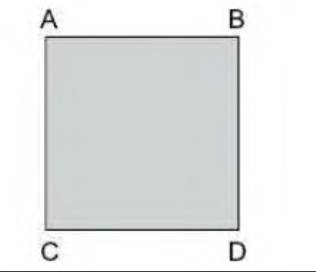
It can be clearly seen that B and C are diagonally opposite. Option (d) is correct.
20. The correct order that satisfies all conditions can be checked from the options. Option (a) is incorrect because it contradicts the clue “Penn Fe finished as many places after Sundae as Sundae finished after Wish Bones” which has to be true because then “Wish Bones finish before Night Marvel”.
Option (b) is incorrect, because it contradicts the same clue, i.e. “Penn Fe finished as many places after Sundae as Sundae finished after Wish Bones” which has to be true because then “Wish Bones finished before Night Marvel”.
Option (d) is also wrong because in that option, Penn Fe finishes before Wish Bones—which contradicts the first clue that Penn Fe finishes after Wish Bones.
Option (c) is correct as it satisfies all the conditions.
21. If the 6th and the 16th are diametrically opposite, it means that between them on one side there would be 7, 8, 9, 10, 11, 12, 13, 14 and 15, which means there are 9 people on either side. Thus, the total number of people is 20.
22. The logic for each column is fixed: So the first column has 39 at the bottom because (8 + 5) ¥ 3 = 39.
Similarly, in the second column we have: (4 + 7) ¥ 4 = 44.
In the third column we have: (9 + 3) ¥ 5 = 60.
In the fourth column we would get: (5 + 4) ¥ 8 = 72.
Option (b) is correct.
23. You have to visualise the rotation of each cylinder when the cyinders on top push the cylinders below to the sides. Each cylinder would roll by 180° and hence, option (c) is correct.
Solutions for Questions 24 to 26:
The following chain of deductions would give us the solution to this question set.
Starting grid:
| Name | Male/Female | Relationship Status | Game Played |
| A | |||
| B | |||
| C | |||
| D | |||
| E |
A and D being unmarried ladies who do not play any game, can be put into the grid as follows:
| Name | Male/Female | Relationship Status | Game Played |
| A | Female | Unmarried | None |
| B | B/C/T | ||
| C | B/C/T | ||
| D | Female | Unmarried | None |
| E | B/C/T |
Note: In the above we have concluded that B, C and E have to each play a game as A and D are not playing any game means that the other three people must be playing a game each.
At this point if we use the information given in clues (v) and (vi) we realise that E and B are males and since there is a married couple in the group there has to be a married lady and that must be C. Also since no lady plays chess or badminton it follows that C must play Tennis. The grid changes to:
| Name | Male/Female | Relationship Status | Game Played |
| A | Female | Unmarried | None |
| B | Male | Brother of C | B/C |
| C | Female | Wife ofE | Tennis |
| D | Female | Unmarried | None |
| E | Male | Husband of C | C/B |
Further, since we know that B is not a chess player, he must be a badminton player. The final pieces fall into place inside the grid.
| Name | Male/Female | Relationship Status | Game Played |
| A | Female | Unmarried | None |
| B | Male | Brother of C | Badminton |
| C | Female | Wife ofE | Tennis |
| D | Female | Unmarried | None |
| E | Male | Husband of C | Chess |
The answers to the questions can now be read off the above grid.
19. ACD is the group of ladies. Option (d) is correct.
20. C is the tennis player. Option (b) is correct.
21. C is the wife of E. Option (d) is correct.
22. The family tree would look like:
| Generation | People | Defined Relationships |
| First generation | O (male) | O is father of N and P, M is granddaughter of O. |
| Second generation | P (sex unknown), N (Male) | N is father of M and son of O. Also, N is brother of P. |
| Third generation | M (female) | M is granddaughter of O and daughter of N. |
Based on this tree:
Option (a): P is the father of M, contradicts the given premises.
Option (b): O has three children can happen as there could be one more sibing for N and P. Thus, option (b) does not contradict the premises.
Option (c): Again, this can happen and hence this option does not contradict the premises.
Option (d): is definitely true and does not contradict the premises.
Thus, the statement in option (a) contradicts the premises.
Option (a) is the correct answer.
23. On a hot day wind would flow from land to sea. Option (c) is correct.
Solutions for Questions 29 and 30:
24. The required area we are looking for should be outside the circle (for ‘uneducated’) but inside the triangle (urban), inside the square (hard working) and inside the diagonal rectangle (honest). Area represented by the digit 4 satisfies this condition.
Option (d) is the correct answer.
25. Non-urban (outside the urban triangle); educated (inside the educated circle); not hard-working (outside the square) and not honest (outside the diagonal rectangle). Area 7 is outside the triangle, the square and the rectangle but inside the circle.
Hence, option (b) is the correct answer.