SNAP 2009
Directions for Questions 1 and 2: Answer the questions based on the information given below
The Venn diagram given below shows the estimated readership of 3 daily newspapers (X, Y & Z) in a city.
The total readership and advertising cost for each of these papers is as below:| Newspapers | Readership (lakhs) | Advertising cost (' per sq. cm) |
| X | 8.7 | 6000 |
| Y | 9.1 | 6500 |
| Z | 5.6 | 5000 |
The total population of the city is estimated to be 14 million. The common readership (in lakhs) is indicated in the given Venn diagram
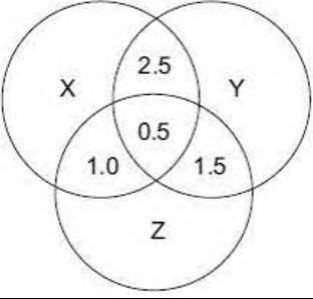
1. The number of people (in lakhs) who read at least one newspaper is
(а) 4.7 (b)11.9
(с) 17.4 (d)23.4
2. The number of people (in lakhs) who read only one newspaper is
(a) 4.7 (b)11.9
(c) 17.4 (d)23.4
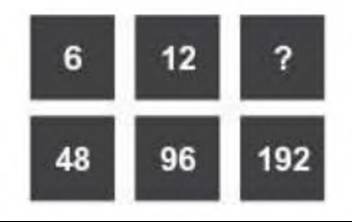
3. What number should replace the question mark in the image below?
(a) 18 (b)20
(c) 22 (d) 24
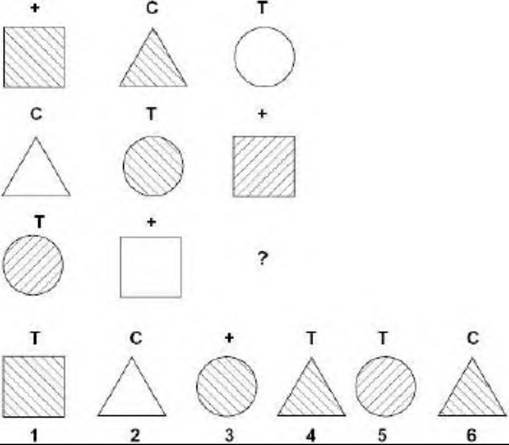
4. What image from bottom row should replace the question mark?
(a) 4
(c)l
(b) 6
(d) none
5. There are 3 societies A, B, C having some tractors each.
A gives B and C as many tractors as they already have.
After some days B gives A and C as many tractors as they have.
After some days C gives A and B as many tractors as they have.
Finally each has 24 tractors.
What is the original number of tractors each had in the beginning?(a) A-29, B-21, C-12 (b) A-39, B-21, C-12
(c) A-21, B-12, C-29 (d) A-21, B-12, C-39
6. Although most of the fastest growing jobs in today’s economy will require a college degree, many of the new jobs being created from home health aide to desktop publisher require knowledge other than gained from earning a degree. For workers in those jobs, good basic skills in reading, communication and mathematics play an important role in getting a job and developing a career.
From the information given above it can be validly concluded that, in today’s economy
(a) skills in reading, communication and mathematics play an important role in developing a career as a desktop publisher.
(b) the majority of the new jobs being created require knowledge other than that gained from earning a college degree.
(c) a job as a home health aide will rely more on communication skills than on basic skills in reading and mathematics.
(d) if a job is one of the fastest growing jobs, it will require a college degree.
7. According to the National Agricultural Aviation Society (NAAS), without the use of crop protection products to control insects, weeds and diseases, crop yields per acre will drop by more than 50 per cent. The first aerial application of insecticide occurred in 1921, and it was a huge success. By contrast, in today’s economy all aircraft that are classified as aerial applicators do more than just apply insecticide; today, they also spread seeds and apply fertiliser.
From the information given above it CANNOT be validly concluded that
(a) according to the NAAS, if crop yields per acre never drop by more than 50 per cent, then crop protection products have been used to control insects, weeds and diseases.
(b) in today’s economy any aircraft that cannot be used to apply fertilizer cannot be classified as an aerial applicator.
(c) in today’s economy, if an aerial applicator is used, then it will be able to spread seeds and apply fertilizer.
(d) according to the NAAS, if crop yields per acre drop by more than 50 per cent, then crop protection products have not been used to control insects, weeds and diseases.
8. Lou observes that if flight 409 is cancelled, then the manager could not possibly arrive in time for the meeting. But the flight was not cancelled. Therefore, Lou concludes that the manager will certainly be on time. Evelyn replies that even if Lou’s premises are true, his argument is fallacious. And therefore, she adds that the manager will not arrive on time after all.
Which of the following is the strongest thing that we can properly say about this discussion?
(a) Evelyn is mistaken in thinking Lou’s argument to be fallacious, and so her own conclusion is unwarranted.
(b) Evelyn is right about Lou’s argument, but nevertheless her own conclusion is unwarranted.
(c) Since Evelyn is right about Lou’s argument, her own conclusion is well supported.
(d) Since Evelyn is mistaken about Lou’s argument, her own conclusion must be false.
9. Cars are safer than planes. Fifty per cent of plane accidents result in death, while only one per cent of car accidents result in death.
Which of the following, if true, would most seriously weaken the argument above?
(a) Planes are inspected more often than cars.
(b) The number of car accidents is several hundred thousand times higher than the number of plane accidents.
(c) Pilots never fly under the influence of alcohol, while car drivers often do.
(d) Plane accidents are usually the fault of air traffic controllers, not pilots.
Directions for Questions IOto 12: Refer to the chart below showing annual production and answer the questions that follow.
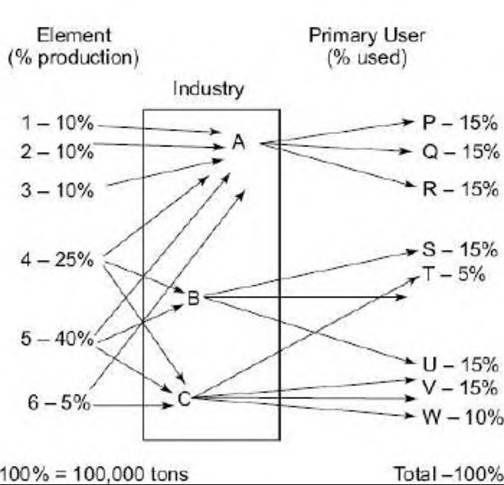
10. Which industry/industries ContributeZcontributes to company S?
(a) Industry A and B only
(b) B and C only
(c) A and C only
(d) B only
11. Industry B processes what percentage of the total production of listed elements?
(a) 25% (b) 65%
(c) 40% (d) Cannot be determined
12.
Of the listed elements processed by Industry A, how many tons are produced annually?(a) 30,000 (b) 45,000
(c) 100,000 (d) 55,000
Directions for Questions 13 to 16: In each of the following questions there are two blanks marked I & II. The words to fill in these blanks are given against I as (A, B, C, D) and II as (P, Q, R, S) respectively.
The right words to fill in these blanks are given as four alternatives. The words on either side of the sign (::) have a similar relationship. That alternative which signifies this relationship is your answer.
13. I: Increase :: Descend : II
I. (A) Grow (B) Ascend
(C) Rise (D) Price
II. (P) Reduce (Q) Down
(R) Decrease (S) Mountain
(a) AR (b) RB
(c) CP (d) DQ
14. Modern: I:: II: Old
I. (A) Ancient (B) Death
(C) Famous (D) Civilization
II. (P) Industrialisation (Q) Young
(R) Fashion (S) Western
(a) AQ (b) AS
(c) BP (d) CR
15. Part :1:: Class : II
I. (A) Section (B) Whole
(C) School (D) Students
II. (P) Student (Q) School
(R) Teachers (S) Room
(a) AR (b) BQ
(c) CP (d) DS
16. Summit: Apex :: I: II
I. (A) Beautiful (B) Picture
(C) Attractive (D) Enhancing
II. (P) Comfortable (Q) Pretty
(R) Healthy (S) Brave
(a) AQ (b) BP
(c) DS (d) CR
17. If in a certain code BEAUTIFUL is coded as 573041208, BUTTER as 504479, how is FUTURE coded in that code?
(a) 201497 (b) 204097
(с) 704092 (d) 204079
18. How many Mondays are there in particular month of a particular year if the month ends on Wednesday?
(a) 4 (b) 5
(c) 3 (d) Cannot be specified
Directions for Questions 19 and 20: There are two rows of numbers in each question. The upper row is complete and in the lower row one number is missing.
Find a suitable number to fill the blank space so that the symmetry with the upper row is maintained.
19.
| 17 | 102 | 12 |
| 15 | ? | 10 |
(a) 211 (b)75
(c) 125 (d) 117
20.
| 12 | 336 | 14 |
| 15 | ? | 16 |
(a) 220 (b) 480
(c) 125 (d) 450
Directions for Questions 21 and 22: Seven People A, B, C, D, E, F, G plan to enjoy boating.
There are only two boats, and the following conditions are to be kept in mind.
(I) A will go in the same boat in which E is to go.
(II) F cannot go in the same boat in which C is, unless D is also accompanying.
(III) Neither B nor C can be given the boat in which G is.
(IV) The maximum number of persons in one boat can be four only.
21. IfF and B are in one boat, which of the following statements is true?
(a) Gis in the other boat.
(b) Dis in the other boat.
(c) C is in the other boat.
(d) E is with F and B in one boat.
22. IfE gets the boat with F, which of the following is the complete and accurate list of the people who must be sitting in the other boat?
(a) F and E (b) G and A
(c) D and A (d) C, D and B
Directions for Questions 23 and 24: A series of figures has been shown on the left. Find the figure in the place of? from the figures on the right.
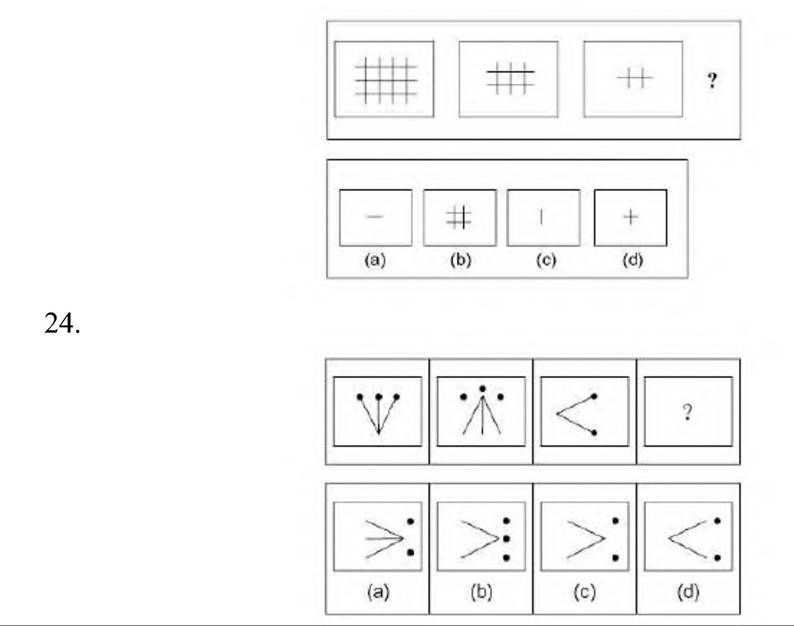
23.
25.
Complete the following series. (GMSY, IOVA, KQWC, ?) (a) MSYE
(c) MYTE
(b) NSYE
(d) MSYF
Answer Key
l.(c)
5. (b)
2. (b)
6. (a)
3.(d)
7. (d)
4. (b)
8. (b)
| 9. (b) | 10. (d) | ll.(d) | 12.(b) |
| 13.(b) | 14. (a) | 15.(b) | 16. (a) |
| 17.(b) | 18. (d) | 19.(b) | 20. (b) |
| 21. (a) | 22. (d) | 23. (c) | 24. (c) |
25. (а)
Solutions:
Solutions for Questions 1 and 2:
The following figure shows the completed Venn diagram based on the information in the table:
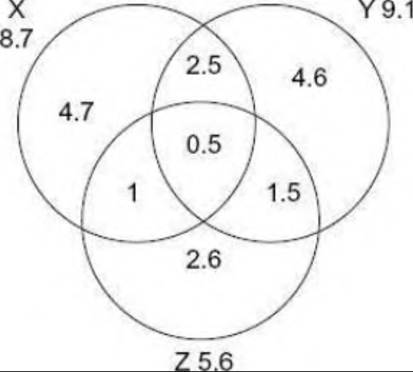
The answers can be easily read off once we know the above figure.
1. The number of people who read at least 1 newspaper is 2.5 + 0.5 + 1 + 4.7 + 4.6 + 1.5 + 2.6 = 17.4. Option (c) is the correct answer.
2. The number of people reading only 1 newspaper would be: 4.7 + 4.6 + 2.6 = 11.9. Option (b) is correct.
3. The numbers in each row progressively double from the previous number to the next as we go from left to right. This can be clearly seen in the numbers in the bottom row, where 48 becomes 96 and 96 becomes 192.
Thus, in the top row, 6 becomes 12 and 12 would become 24 (which is the missing number).
Option (d) is the correct answer.
4. The order of figures keeps rotating between Square-Triangle-Circle-Square- Triangle-Circle and so on. Thus, if the first figure is a triangle, the next figure in the same row would be a circle followed by a square. Thus, the missing figure in the bottom row must be a triangle. The other part of the logic you need to use in this case is that of the three figures one is not shaded, while the other two are shaded. Amongst the two figures which are shaded one is shaded by lines inclined to the right and the other is shaded by lines inclined to the left. In the third row, since the circle has a shading with right inclination, the missing triangle would have left inclined shading.
The 6th figure gives us the required missing figure. Hence, option (b) is the correct answer.
5. The given exchanges can be best tested in the following manner by checking the options. We can see that option (b) fits the given description because of the following:
| A | B | C | |
| Starting situation | 39 | 21 | 12 |
| A doubles numbers with others | 6 | 42 | 24 |
| B doubles numbers with others | 12 | 12 | 48 |
| C doubles numbers with others | 24 | 24 | 24 |
Hence, option (b) is correct.
6. The first conclusion is a valid conclusion as it can be inferred that desktop publishing requires skills in reading, communication and mathematics.
The second option also looks close, but is incorrect because it concludes about ‘the majority of the new jobs’. The information provided in the basic question tells us nothing about the majority of new jobs—it just talks about ‘many of the new jobs’.
Concluding about majority based on many is one of the basic thought errors induced in such questions. Thus, option (b) though it looks close is not the correct answer.
Option (a) is the correct answer.
7. In order to solve something like this where we need to find out the conclusion that cannot be validly made, we need to test each conclusion for it’s validity.
The thinking about option (a) would proceed on the following lines:
The basic information in the question states that if crop protection products are not used, crop yields would drop by more than 50%. This means that if crop yields do not drop by more than 50%, it must be sure that crop protection
products must have been used.
A parallel logic to explain this can be stated in the following manner:
If you do not study hard, you would fail in the exams. If you did not fail, it must be true that you did study hard. Thus, conclusion (a) is a valid conclusion.
However, carrying this logic forward to option (d), it is clear that the conclusion drawn in option (d) is incorrect.
Again the parallel analogy is: If you do not study hard, you will fail in the exams. In case, you failed in the exams, it is not necessarily true that you did not study hard.
The conclusions in options (b) and (c) can be seen to be true.
Hence, option (d) is the correct answer.
8. The conclusion drawn by Lou in this case is erroneous as his argument is based on the following fallacy:
If A happens, B will happen. (Here A = flight is cancelled, B = Manager does not arrive in time).
Lou is concluding that A did not happen, hence B also will not happen. He is overlooking the possibility that the manager could still be late even if his flight is on time. Hence, Lou’s argument is fallacious.
However, even Evelyn’s argument is also half baked—just because Lou is stating the manager would be on time, she is in effect saying that since Lou’s argument is fallacious, the opposite result (i.e. the manager would be late) is definite.
Thus, Evelyn is right about Lou’s argument, but her own conclusion is also unwarranted.
Thus, option (b) is the correct answer.
9. Clearly, if we know that the number of car accidents is much higher than the number of plane accidents, the argument gets weakened. Option (b) tells us exactly that.
Hence, Option (b) is correct.
Solutions for Questions IOto 12:
10. From the figure it can be seen that the only input to S is from industry B. Thus, only industry B contributes to company S.
Option (d) is correct.
11. Industry B processes some elements from elements 4, 5 and 6. However, we do not know the split of these elements (as to how these elements are split between industries A, B and C) so we cannot determine the percentage of the total production of the listed elements that goes to Industry B. Thus, option (d) is correct.
12. The production of industry A goes only to P, Q and R. Since P, Q and R account for 45% of the total production (and they do not get any inputs either from Industry B or Industry C), we can say that Industry A accounts for 45% of the total production = 45000 tons.
Option (b) is correct.
13. Ascend: Increase :: Descend : Decrease shows the same relationship across the two pairs. Option (b) is correct.
14. Modern : Ancient:: Young : Old shows the same relationship across the two pairs. Option (a) is correct.
15. Part: Whole :: Class : School shows the same relationship across the two pairs. Option (b) is correct.
16. Summit: Apex :: Beautiful: Pretty shows the same relationship across the two pairs. Option (a) is correct.
17. Looking at BEAUTIFUL = 573041208 and BUTTER = 504479, one realises that the coding in this question is direct, i.e. the digit code in the code for the word is in the exact same place of the letter it is replacing. This can be seen if we look at B = 5 and T = 4 in the two words.
Thus, for future we realise that F = 2, U=0, T = 4, R = 9 and E = 7 and hence the code for FUTURE = 204097. Option (b) is correct.
18. The number of Mondays in a month having 31 days and ending on Wednesday would be 5, as the Mondays would fall on the 1st, 8 th, 15th, 22nd and 29th of the month.
However, if the month has lower than 31 days the number of Mondays if the month ends on a Wednesday would just be 4.
For example for a 30 day month, the 30th being a Wednesday, the last Monday would be on 28th. Consequently, the Mondays of the month would fall on 7th, 14th, 21st and 28th—a total of 4 Mondays only.
Since, the question does not specify the number of days in the month, we can be sure that we do not have enough data to specify the exact number of Mondays in the month. Option (d) is correct.
19. In the first row, the middle number is got by: 17n = 12m = 102. In this case, n = 6 and m= 8.5.
In the second row if we use: 15 ¥ 5 = 10 ¥ 7.5 = 75 we get the required value of the number. It can be seen that both the multipliers reduce by 1. Option (b) is correct.
20. The logic for the middle number in the first row being 336 is 12 ¥ 14 ¥ 2 = 336. In the second row, on the basis of the same logic, the missing number would be 15 ¥ 16 ¥2-480.
Solutions for Questions 21 and 22:
In order to solve this set of questions, once you read the basic information you should realise that the two clues that give you a handle in order to move your thinking forward in this question are the clues (I) and (III). These state:
A and E have to be together AND
G cannot be with B or C which means that B and C have to be put in one boat and G on the other.
With this basic precondition in place we can look at the following situation:
| One boat | Other Boat |
| B,C | G |
Now the second clue states that F cannot be on the same boat as C unless we put D also in the same boat.
This leads to the following possibilities:
POSSIBILITY 1: IfF is put with CTD would need to be with F.
| One boat | Other Boat |
| B,C,F,D | G,A,E |
POSSIBILITY 2: IfF is not put on the boat with C.
| One boat | Other Boat |
| B,C | G,F |
This leaves us with A, E and D to place Fromthis point we get the following situations:
POSSIBILITY 2A:
One boat
Other Boat
| B,C,A,E | g,f,d |
POSSIBILITY 2 В:
| One boat | Other Boat |
| B,C,D | G,FA,E |
From this point we can move into the questions by looking at the individual situations as led into by the question.
21. IfF and B are on one boat as stated by this option, it means we are looking at possibility 1.
In such a case the arrangement involves putting G on the other boat. Option (a) is correct.
22. If E and F are together, it necessarily means that we are looking at Possibility 2B. In this case, the other boat would have B, C and D on it.
23. In each figure as we move from the left to the right we are deleting one horizontal and one vertical line. Thus the final figure in place of the question mark would have just one vertical line. Option (c) is correct.
24. From the first figure to the next, the dots remain in the same place and the lines are inverted. The same relationship would exist between the third and the fourth figure. In option (c), the dots remain in their place (as in the third figure) and the lines are inverted.
Thus, option (c) is the correct answer.
25. There are four parallel series running in the given series.
The series Ofletters in the Iirstplace: G, I, K√E hence M (skip 1 letter to get the next letter in the series).
The series Ofletters in the second place: M, O, Q √E hence S (skip 1 letter to get the next letter in the series).
At this point if we look at the options we realise that there are only two options, which give us a start of MS. Thus, we have to choose between options (a) and (d). Further, both these options give us Y as the third letter. Hence, we just need to focus on deciding on the last letter.
The series Ofletters in the fourth place: Y, A, C √E hence E (skip 1 letter to get the next letter in the series).
Option (a) is correct.