SNAP 2010
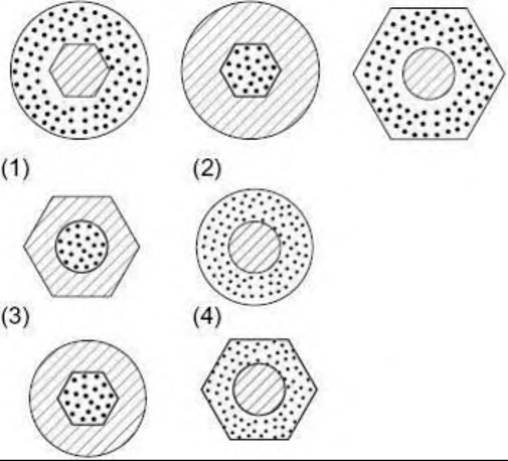
1. Which of the designs best completes the following sequence?
2. Four children A, B, C & D are having some chocolates each.
A gives B as many as he already has, he gives C twice of what C already has and he gives D thrice of what D already has.
Now, D gives (l∕8)thofhis own chocolates to B.
Then A gives 10% chocolates he now owns to C and 20% to B.
Finally, all of them have 35 chocolates each.
What is the original number of chocolates each had in the beginning?
(a) A-110, B-10, C-10, D-10
(b) A-90, В-20, С-20, D-IO
(c) А-70, В-25, С-25, D-20
(d) А-125, В-5, C-5,D-5
3. There are two similar figures below with some numbers. The left one is complete whereas one number is missing in the right one. Find a suitable number to fill in place of the question mark.
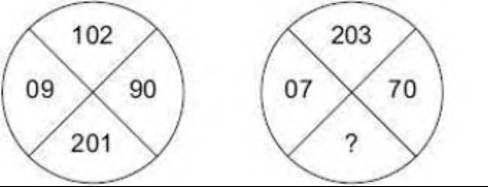
(a) 280 (c) 303
(c) 362 (d) 382
4. Complete the following series by replacing the ?:
(TBLD, VEPI, XHTN, ?)
(a) ZJVP (b) ZVJP
(c) ZKXS (d) ZKXP
5. In a cricket team, three batsmen Ricky, Sachin and Brian are the top three runscorers in any order. Each of them gives two replies to any question, one of which is true and the other is false, again, in any order. When asked about who the top scorer was, following were the replies they gave:
Sachin: I got the top score. Ricky was second.
Brian: I got the top score. Sachin was second.
Ricky: I got the top score. Sachin was third.
Which of the following is the correct order of batsmen who got the top score, second best and third best score respectively?
(a) Brian, Ricky, Sachin
(b) Brian, Sachin, Ricky
(c) Ricky, Sachin, Brian
(d) Sachin, Brian, Ricky
6. 60 employees in an office were asked about their preference for tea and coffee.
It was observed that for every 3 people who prefer tea, there are 2 who prefer coffee. For every 6 people who prefer tea, there are 2 who drink both of tea and coffee. The number of people who drink both is the same as those who drink neither.How many people drink both tea and coffee?
(a) 10 (b) 12
(c) 14 (d) 16
7. A clock strikes once at 1 o’clock, twice at 2 o’clock and so on. If it takes 6 seconds to strike at 3 o’clock, how much time will it take to strike at 9 o’clock?
(a) 24 seconds (b) 18 seconds
(c) 20 seconds (d) None of these
Directions for Questions 8 and 9: E-1, E-2 and E-3 are three engineering students writing their assignments at night. Each of them starts at a different time and completes at a different time. The digit in their name and the order of their starting and completing the assignment is certainly not the same. The last student to start is the first to complete the assignment.
8. Who is the first student to start writing the assignment?
(a) E-I (b)E-2
(c) E-3 (d) Cannot be determined
9. Who is the last student to complete the assignment?
(a) E-I (b)E-2
(c) E-3 (d) Cannot be determined
Directions for Questions 10 and 11: A, B and C are three students from Don School and P, Q and R are three students from Elite School. Q is brighter than R but duller than the Don School student who is brighter than A. The same Don School student is duller than P but is brighter than C.
10. Who is the brightest amongst all?
(a) B (b) P
(c) R (d) Cannot be determined
11. Who is the dullest amongst the three students IfomElite School?
(a) P (b) Q
(с) R (d) Cannot be determined
12. When Rafael entered the class, there were already 10 students in the class. 5 students entered the class between Roger and Rafael. Total 10 students entered after Roger. Exactly how many students are in the class finally?
(a) 15 (b)25
(c) 27 (d) Cannot be determined
Directions for Questions 13 to 15: Arijit, Biplab, Chintan, Debashish, Elangovan, Frederick, Gautam and Himadri are sitting around a circular table.
Some information about the order in which they are sitting is available as follows:(a) Debashish is sitting opposite to Himadri and to the immediate right of Gautam.
(b) Elangovan is sitting to the immediate right of Biplab.
(c) Arijit is sitting opposite Chintan who is not immediately next to Frederick on either side.
13. Who is sitting to the immediate right of Himadri?
(a) Arijit (b) Debashish
(c) Elangovan (d) Frederick
14. Who is sitting opposite Biplab?
(a) Arijit (b) Debashish
(c) Frederick (d) Himadri
15. Who is to the immediate right of Chintan?
(a) Arijit (b) Biplab
(c) Elangovan (d) Himadri
Directions for Questions 16 and 17: A, B, C, D and E sit on a long bench. C does not sit next to A or E. A and E have three persons sitting between them.
16. Who is sitting in the middle of the bench?
(a) B (b) C
(c) D (d) None of these
17. Who are sitting at the extreme ends of the bench?
(а) А & E (b) В & D
(с) C & E (d) None of these
18. Find the Missing Numbers in the following set
| 2 | 4 | 6 | 8 | 10 |
| 2 | 14 | 34 | ?? | 98 |
(a) 30 (b) 62
(c) 42 (d) 78
19. There are 6 volumes of books on a rack kept in order (such as, vol. 1, vol. 2 and so on). After some readers used them, their order got disturbed. The changes showed as follows:
Vol. 5 was directly to the right of vol.2.
Vol.4 has vol.6 to its left and both were not at Vol.3,s place.
Vol. 1 has Vol.3 on right and Vol.5 on left.
An even numbered volume is at Vol.5,s place.
Find the order in which the books are kept now, from the 4 given alternatives:
(a) 6, 3,5, 1,4,2 (b)4,6,3,5, 1,2
(c) 3, 4, 1, 6, 5, 2 (d) 2, 5, 1,3,6,4
20. All German philosophers, except for Marx, are idealists.
From which of the following can the statement above be most properly inferred?(a) Except for Marx, if someone is an idealist philosopher, then he or she is German.
(b) Marx is the only non-German philosopher who is an idealist.
(c) If a German is an idealist, then he or she is a philosopher, as long as he or she is not Marx.
(d) Marx is not an idealist German philosopher.
21. Ramaswami was studying for his examinations and the lights went off. It was around 1:00 a.m.
He lighted two uniform candles of equal length but one thicker than the other. The thick candle is supposed to last six hours and the thin one two hours less. When he finally went to sleep, the thick candle was twice as long as the thin one.
For how long did Ramaswami study in candle light?
(a) 2 hours
(b) 3 hours
(c) 2 hours 45 minutes
(d) 4 hours
22. The numerator and denominator of a fraction is in the ratio 2:3. If 6 is subtracted from the numerator the value of the fraction becomes 2/3 of the original fraction. The numerator of the original fraction is:
(a) 16 (b)21
(c) 18 (d) 30
23. A person wanted to withdraw X rupees and Y paise from the bank. But the cashier made a mistake and gave him Y rupees and X paise. Neither the person nor the cashier noticed that. After spending 20 paise, the person counts the money. To his surprise, he has double the amount he wanted to withdraw.
Find X and Y. (1 Rupee = 100 Paise)
(a) X - 3, Y - 6 (b) X = 26, Y- 53
(с) X = 15, Y = 30 (d) X - 9, Y - 36
24. A drawer contains 10 black and 10 brown socks which are all mixed up. What is the fewest number of socks you can take from the drawer without looking and be sure to get a pair of the same color?
(a) 7 pairs (b) 7 pieces only
(c) 10 pieces only (d) 3 pieces only
25. Aplacement company has to assign 1000 SW personnel who are skilled in Java and Dot Net to a prospective outsourcing company. He finds that 750 are having Dot Net skills and 450 have Java skills.
Some have skills in both Java and Dot Net. Find the numbers who have skills in both Java and Dot Net.(a) 250 (b) 200
(c) 350 (d) 100
26. All good athletes who want to win are disciplined and have a well balanced diet. Therefore, athletes who do not have well balanced diets are bad athletes.
Based on the sentence above which of the statement below strongly supports the view:
(a) No bad athlete wants to win.
(b) No athlete who does not eat a well balanced diet is a good athlete.
(c) Every athlete who eats a well balanced diet is a good athlete.
(d) All athletes who want to win are good athletes.
27. The numbers in these series are arranged in a triangle which has a logic as shown below. Find the missing numbers shown as (?) from the choices given below:
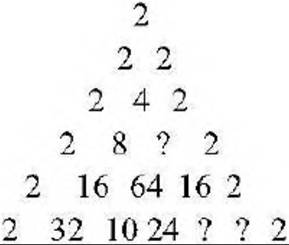
(a) {16, 32, 64} (b) {8, 1024,32}
(c) {24, 1024, 64} (d) {16, 32, 64}
28. If for a particular value of the variable x, the following holds good, 17 = 17x∕(l - x), then compute the value of (2x)*x.
(a) 17 (b) 1
(c) 2 (d) 1/2
Answer Key
| l∙(a) | 2. (a) | 3∙(a) | 4. (c) |
| 5. (a) | 6. (b) | 7. (a) | 8. (c) |
| 9. (a) | 10. (b) | H. (c) | 12.(c) |
| 13. (a) | 14. (c) | 15.(b) | 16. (b) |
| 17. (a) | 18. (b) | 19. (d) | 20. (d) |
| 21∙(b) | 22. (b) | 23. (b) | 24. (d) |
| 25. (b) | 26. (b) | 27. (b) | 28. (d) |
Solutions:
1. The structure of the diagram remains the same from the first to the second figures, the only difference between the two being that the dots come inside the inner figure and the diagonal shading goes outside.
The same change would be seen from the third to the fourth figure.
Thus, option (a) is the correct answer.2. Solve this one through options:
For option (a) the numbers would move in this fashion:
| A | B | C | D | |
| Start | 110 | 10 | 10 | 10 |
| Round 1: A gives to others | 50 | 20 | 30 | 40 |
| Round 2: D gives | 50 | 25 | 30 | 35 |
| Round 3 = Final situation: A gives | 35 | 35 | 35 | 35 |
Thus, the numbers in the first option match the conditions in the question. Option (a) is correct.
3. In the first figure the number at the bottom is the addition of the other three numbers in the circle. 102 + 9 + 90 = 201.
Thus, the missing number in the second case would be: 203 + 7 + 70 = 280. Option (a) is correct.
4. The four series that are running in the words are:
1. First letter of every word: T, Y X. So the missing letter is Z (as there is one letter missing between T and Y so also between V and X). Thus, after X we would skip Y and use Z as the first letter of the last word.
2. Second letter of every word: B, E, H. So the missing letter is K (as there are two letters missing between B and E, so also between E and H). Thus, after H we would skip I and J and use K as the second letter of the last word.
3. Third letter of every word: L, P, T. So the missing letter is X (as there are three letters missing between L and P, so also between P and T). Thus, after T we would skip U, V and W and use X as the third letter of the last word.)
4. SimilarlyD-I-N-S. (skip 4 letters).
Thus, the correct answer would be ZKXS. Option (c) is correct.
5. Option (b) can be rejected because if that is the correct order of finishing both of Brian’s statements would be true which is not possible as per the conditions stated in the question, as one statement has to be true and the other has to be false for each of the three.
Similarly option (c) can be rejected because, if that order were true both of Sachin’s statements would turn out to be false.
Option (d) is also rejected as if that order were true, both of Brian’s statements would end up being false.
Option (a) is true as it gives 1 true and 1 false statement for each of the three. Thus, option (a) is the correct answer.
6. The following Venn diagram would make things clear in this case:
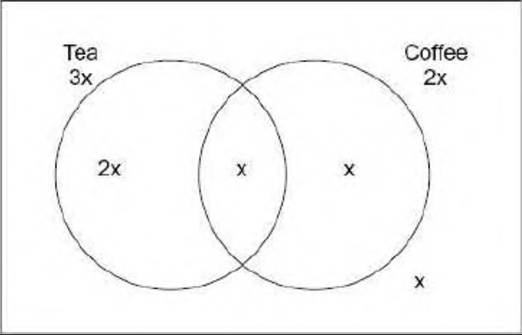
The above Venn diagram shows that 5x = 60 √zE x = 12.
Hence, the number of people who drink both tea and coffee is 12.
7. The clock strikes thrice at 3 o’clock and the time it would take to strike 3 o’clock would essentially be due to two time periods between strikes of the clock. If the clock takes 6 seconds to strike 3 o’clock it means that the time period between 2 strikes of the clock is 3 seconds. Thus, to strike 9, it would take 8 strikes of the clock - which means that it would take 24 seconds to strike 9.
Option (a) is correct.
Solutions for Questions 8 and 9:
The last to start is the first to complete and this cannot be either E-1 or E-3 as the digit in their names is certainly not the same as the order of their starting or ending the assignment. Thus, the last to start and the first to finish has to be E-2. Naturally then, E-3 would be the first to start and since he cannot complete the assignment last, he would be completing the assignment second last. E-1 would be the second to start and the last to finish.
Thus, the following would give us the final grid about the starting and finishing orders:
| Name | Starting position | Ending position |
| E-I | 2nd | 3rd |
| E-2 | 3rd | 1st |
| E-3 | 1st | 2nd |
The answers would then be:
8. E-3 would be the first to start. Option (c) is correct.
9. E-1 is the last to complete the assignment. Option (a) is correct.
Solutions for Questions 10 and 11:
Reading the basic conditions should make you string a few logics together as follows:
1. Since Q is brighter than R, but is duller than the Don School student who is duller than P, we have the order P > Q > R in terms of brightness of the Elite school students.
2. There is one Don school student who is brighter than A. Thus, A must be the second brightest Don School student. Also, since the same Don School student is brighter than C, we are talking about B. Thus, the Don School students in terms Ofbrightness would be: B > A > C.
It is also known that B is duller than P. Thus we can move to answer the questions.
10. P is the brightest as he is brighter than B (hence brighter than A and C) as well as brighter than Q and R. Option (b) is correct.
11. R is the dullest amongst the Elite school students and the logic is explained in the explanation above.
12. There are two scenarios possible as follows:
Scenario 1: Order between Roger and Rafael is Roger then Rafael. In this case the thought process is as follows:
Since, Rafael is 1 ltlι, Roger would be the 5th person to enter the class. Also, since there are 10 people who enter the class after Roger, there would be a total of 15 people in the class finally.
Scenario 2: Order between Roger and Rafael is Rafael then Roger. In this case the thought process is as follows:
Since, Rafael is llth, Roger would be the 17th person to enter the class. Also, since there are 10 people who enter the class after Roger, there would be a total of 27 people in the class finally.
Option (c) is correct.
Solutions for Questions 13 to 15:
The following logical thinking would help you reach the final figure. Using the first clue we get the following figure:
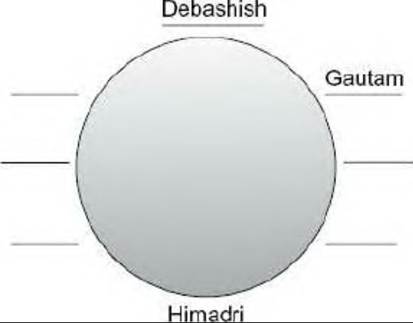
At this point we use the third clue which gives us the following possible diagrams: Possibility 1:
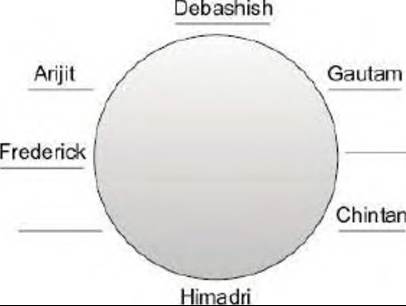
This possibility is rejected as Elangovan has to be to the immediate right of Biplab, but the two places left are not together.
Possibility 2:
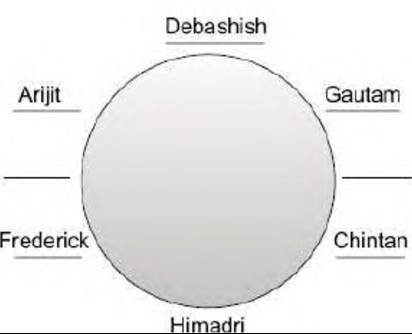
This possibility is also rejected as we cannot place Elangovan and Biplab next to each other in this case. So we move to the next possibility of placing Chintan, Arijit and Frederick.
Possibility 3:
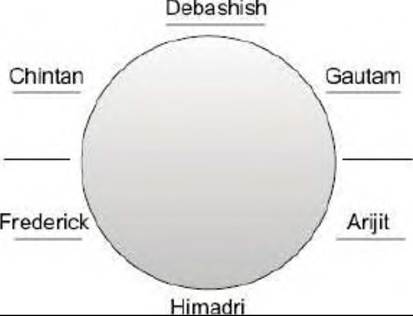
Again this possibility is not possible as we do not have two adjacent places for Biplab and Elangovan.
Possibility 4:
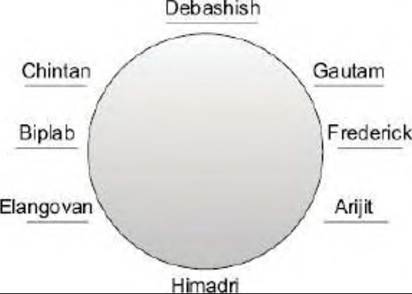
This is the only possibility of meeting all the three conditions of seating arrangements for the 8 people around the circle and hence is the correct arrangement. This is because any arrangement where Chintan and Arijit occupy the opposite positions as shown in the figure below by “X” would not give us 2 adjacent seats for Biplab and Elangovan.
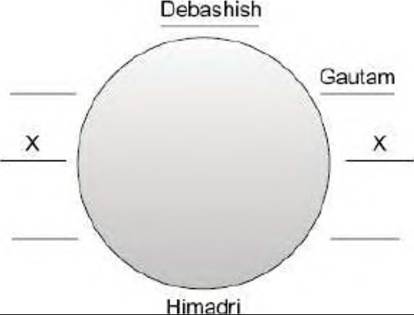
Thus the final arrangement is the one we got in possibility 4.
The answers can be read off this arrangement.
13. Arijit is sitting to Himadri’s immediate right. Option (a) is correct.
14. Frederick is sitting opposite Biplab. Option (c) is correct.
15. Biplab is to Chintan’s immediate right. Option (b) is correct.
Solutions for Questions 16 and 17:
The arrangement of the 5 people would be as below:

The answers are:
16. C is sitting in the middle of the bench. Option (b) is correct.
17. A and E are at the extreme ends of the bench. Option (a) is correct.
18. The logic of the second row is:
[Square of the number immediately above it - 2]
Thus, 22 - 2 - 2; 42 - 2 -14; 62 - 2 - 34;
Hence, 82 - 2 - 62.
Option (b) is correct.
19. Check the options to see which one fits all the conditions. If we check for adherence to the first condition itself we can see that only option (d) satisfies the first condition, viz: Vol 5 is directly to the right of Vol 2. Option (d) is correct.
20. If you were to look at the logic of the statements, none of the four statements perfectly leads to the conclusion: All German philosophers except for Marx are idealists. In this context, only option (d) to some extent justifies the conclusion, if we were to know further that he is the only one amongst the German philosophers who is not an idealist. The other options do not lead to this conclusion by any stretch of IogicZimagination.
In the light of there not being a better answer to the question, option (d) is to be chosen as the correct answer.
13. Option (b) is correct. Assume that, the candles had a length of 6 inches each. In 3 hours, the thicker candle would be half as long as it’s original length. Thus, the thicker candle would be 3 inches long. The thinner candle in the same time would be only l∕4th as long as it’s original length. Thus, the thinner candle would be 1.5 inches long after 3 hours. Thus, if both candles burn for 3 hours, the thicker candle is double the length of the thinner candle. Option (b) is the correct answer.
14. Trial and error gives us that in case the original ratio is 18/27, the new ratio would be 12/27 - a value of 0.4444. Option (b) is correct.
15. Use trial and error with the values in the options.
Option (a) fails the test because if X and Y are 3 and 6 respectively he would get 6 Rupees 3 paise instead of 3 Rupees 6 paise. After spending 20 paise he has ' 5.83 which is not the double of 3.06. Option (a) is hence, rejected.
Checking option (b). He gets ' 53.26 and after spending 20 paise he is left with' 53.06. The original amount he wanted to withdraw was ' 26.53. Thus, the amount he has left with him after spending 20 paise is double the amount he had wanted to withdraw. This is the condition in the problem that needs to be satisfied. Hence, option (b) is the correct answer.
16. If you were to take out 3 pieces, you would be sure to get a pair of the same color in all cases. Option (d) is correct.
17. 1000 people are counted 1200 times in this case. The only explanation for this is that there is an overlap of 200 people who have both Dot Net and Java skills. Option (b) is correct.
18. The statement in option (b) best supports the sentence most strongly. The original sentence basically tells us that any athlete who does not have a well balanced diet is a bad athlete. The statement “No athlete who does not eat a well balanced diet, is a good athlete” essentially says the same thing by using a double negative.
Note that option (c) is also close here, but the reason we can reject it is that it means something to the effect that—any athlete who eats a well balanced diet is a good athlete. This means that “eating a balanced diet” is a necessary and
sufficient condition to being a good athlete.
However, the condition “eating a well balanced diet” is a necessary but not a sufficient condition for being a “good athlete”.
19. The balance of the grid would be maintained only by using the numbers - 8, 1024 and 32 in the missing places.
| 2 | ||||||||
| 2 | 2 | |||||||
| 2 | 4 | 2 | ||||||
| 2 | 8 | 8 | 2 | |||||
| 2 | 16 | 64 | 16 | 2 | ||||
| 2 | 32 | 1024 | 1024 | 32 | 2 |
Option (b) is correct.
20. 17 = 17x∕(l -x) ДЇ 17- 17x= 17xτT 34x= 17τT x = 0.5
Thus, (2x)*x = ½. Option (d) is correct.