SNAP 2011
Directions for Questions 1 and 2: Each question consists of a set of numbered statements. Assume that each one of these statements is individually true. Each of the four choices consists of a subset of these statements.
Choose the subset as your answer where the statements therein are logically consistent among themselves:1. A. Only if the water level in the coastal areas rises, then the people change
their lifestyle.
B. People change their lifestyle only if they are rewarded.
C. If people are rewarded, then they will not change their lifestyle.
D. If the temperature rises, then the water level in the coastal areas rises.
E. Whenever the water level in the coastal area rises, then the temperature rises.
F. Unless the people change their lifestyle, temperature rises.
G. People are rewarded.
H. Water level in the coastal areas does not rise.
(a) C, D, F, GandH
(b) G, F, D, B and H
(c) E, F, G, H and B
(d) None of the above
2. A. IfKumar sings, then the audiences sleep.
B. IfKumar sings, then the audiences dance.
C. Unless audience do not dance, the concert will be successful.
D. Only if the audience dance, the concert will be successful.
E. IfVina dances, then Kumar sings.
F. Kumar sings only if Vina dances.
G. Vina dances
H. The concert is successful.
(a) C, F, G, B and H
(b) A, C, F, GandH
(c) E, C, G, B and H
(d) Both (b) and (c)
Directions for Questions 3 to 5: These questions are based on the data given below.
There are only four members of a family viz., A, B, C and D and there is only one couple among them. When asked about their relationships, following were their replies:
a. A: B is my son. D is my mother.
b. B: C is my wife. D is my father.
c. C: D is my mother-in-law. A is my daughter.
d. D: A is my grand-daughter. B is my daughter-in- law.
3. Who always speaks the truth?
(a) A (b) B
(c) C (d) D
4. How is B related to C?
(a) Father (b) Mother
(c) Wife (d) Husband
5. Which of the following statements must be true?
(a) A’s grandmother alternates between the truth and lie.
(b) C’s wife always speaks the truth.
(c) A’s grandfather always speaks the truth.
(d) B’s daughter always tells lies.
Directions for Questions 6 to 8: These questions are based on the following information.
A cube of 7 cm¥ 7 cm¥ 7 cm is kept in the corner of a room and painted in three different colours, each face in one colour. The cube is cut into 343 smaller but identical cubes.
6. How many smaller cubes do not have any face painted?
(a) 125 (b) 180
(c) 144 (d)216
7. How many smaller cubes have exactly one colour on them?
(a) 108 (b) 72
(c) 36 (d) 24
8. How many smaller cubes have at the most two faces painted?
(a) 343 (b) 342
(c) 256 (d) 282
Directions for Questions 9 and 10: Amit was driving in New Town, where all roads run either north-south or east-west form a grid. Roads were at a distance of 1 km from each other and parallel to each other.
9. Amit started at the intersection of streets no. 7 and 8. He drove 3 km north, 3 km west and 4 km south. Which further route could bring him back to his starting point?
I. 3 km east, then 2 km south
II. 1 km north, then 3 km east
III. 1 km north, then 2 km west
(a) I only
(c) I and II only
(b) II only
(d) II and III only
10. After driving as stated in question no. 9 above, Amit did not return to his starting point, but instead drove 4 km east and 1 km north. How far is he from his starting point?
(a) 5 km
(c) 1 km
(b) 4 km
(d) 7 km
Directions for Questions 11 to 15: Refer to the following data and answer the questions that follow:
A numerical machine accepts two values X and Y. Then it updates these values as X = XY and Y = Y + 1 in every step. The machine stops at X = N.
11. For X = 3, Y = 2 and N = 100. How many steps are performed before the machine stops?
(а) 2 (b) З
(c) 4 (d) 5
12. In the above question, what is the final value of X?
(a) 6 (b) 20
(c) 72 (d) 360
13. In the above question, what is the final value of Y?
(a) 4 (b) 5
(c) 6 (d) 20
14. If the value of N is changed to 500, what would be the final value of X?
(a) 360 (b) 500
(c) 560 (d)2160
15. If X - 2 and Y - 3, what should be the minimum value of N such that final value ofY is 7?
(a) 300 (b) 360
(c) 720 (d) 860
Directions for Questions 16 to 20: Refer to the following statements and answer the questions:
Seven students Priya, Ankit, Raman, Sunil, Tony, Deepak and Vicky take a series of tests. No two students get similar marks. Vicky always scores more than Priya. Priya always scores more than Ankit. Each time either Raman scores the highest and Tony gets the least, or alternatively Sunil scores the highest and Deepak or Ankit scores the least.
16. If Sunil is ranked sixth and Ankit is ranked fifth, which of the following can be true?
(a) Vicky is ranked first or fourth.
(b) Raman is ranked second or third.
(c) Tony is ranked fourth or fifth.
(d) Deepak is ranked third or fourth.
17. IfRaman gets the highest, Vicky should be ranked not lower than:
(a) Second (b) Third
(c) Fourth (d) Fifth
18. IfRaman is ranked second and Ankit is ranked first, which of the following must
be true?
(a) Sunil is ranked third.
(b) Tony is ranked third.
(c) Priya is ranked sixth.
(d) None of these.
19. If Sunil is ranked second, which of the following can be true?
(a) Deepak gets more than Vicky.
(b) Vicky gets more than Sunil.
(c) Priya gets more than Raman.
(d) Priya gets more than Vicky.
20. IfVicky is ranked fifth, which of the following must be true?
(a) Sunil scores the highest.
(b) Raman is ranked second.
(c) Tony is ranked third.
(d) Ankit is ranked second.
21.
In 2002, according to a news poll, 36% of the voters had leaning towards party “Y”. In 2004, this figure rose to 46%. But in another survey the percentage was down to 40%. Therefore, the party “Z” is likely to win the next election. Which of the following, if true, would seriously weaken the above conclusion?(a) People tend to switch their votes at the last minute.
(b) It has been showed that 85% of the voters belonging to party “Y” vote in an election as compared to 80% of the voters belonging to party “Z”.
(c) 35% of people favour party “Z”.
(d) No one can predict how people will vote.
22. Inflation rose by 5% over the second quarter, by 4% during the first quarter and higher than 3% recorded during the same time last year. However, the higher price index did not seem to alarm National Stock Index as stock prices remain steady.
Which of the following, if true, could explain the reaction of National Stock Index?
(a) RBI announced that it will take necessary corrective measures.
(b) Stock prices were steady because of a fear that inflation would continue.
(c) Economists warned that inflation would continue.
(d) Much of the quarterly increase in the price level was due to a summer drought effect on food price.
Direction for Question 23: Pick up the appropriate analogy.
23. Birth : Dirge
(a) Sunset: sunrise
(b) security check: arrival
(c) marriage : alimony
(d) welcome address : vote of thanks
24. Beautiful beaches attract people, no doubt about it. Just look at this city’s beautiful beaches, which are among the most overcrowded beaches in the state. Which of the following exhibits a pattern of reasoning most similar to the one exhibited in the argument above?
(a) Moose and bear usually appear at the same drinking hole at the same time of day. Therefore, moose and bear must grow thirsty at about the same time.
(b) Children who are scolded severely tend to misbehave more often than other children. Hence if a child is not scolded severely that child is less likely to misbehave.
(c) This software programme helps increase the work efficiency of its users. As a result, these users have more free time for other activities.
(d) During weather my dog suffers from fleas more than during cooler weather. Therefore, fleas must thrive in a warm environment.
25. No national productivity measures are available for underground industries that may exist but remain unreported. On the other hand, at least some industries that are run entirely by self-employed industrialists are included in national productivity measures.
From the information given above, it can be validly concluded that
(a) there are at least some industries run entirely by self-employed industrialists that are underground industries
(b) no industries that are run entirely by self-employed industrialists operate underground.
(c) there are at least some industries other than those run entirely by self- employed industrialists that are underground industries.
(d) there are at least some industries run entirely by self-employed industrialists that are not underground industries.
26. Nilu has never received a violation from the Federal Aviation Administration during her 16-year flying career. Nilu must be a great pilot.
Which of the following can be said about the reasoning above?
(a) The definitions of the terms create ambiguity.
(b) The argument uses circular reasoning.
(c) The argument is built upon hidden assumptions.
(d) The argument works by analogy.
27. Many people argue that the death penalty deters murder. However, the notorious killer Tom Hanks deliberately moved to a state that imposes the death penalty just before embarking on a series of ferocious murders. Thus, it seems clear that the existence of the death penalty does not serve as a deterrent to murder.
The argument above may best be characterised as:
(a) an appeal to emotion.
(b) a flawed analogy.
(c) a general conclusion based on a specific example.
(d) circular reasoning.
28. What number should replace the question mark?
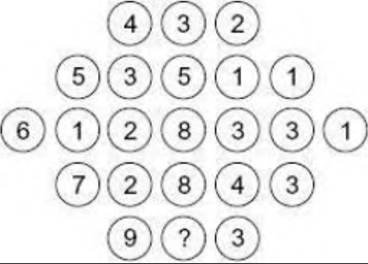
(a) 1 (b) 4
(c) 1 (d) 6
29. The fewer restrictions there are on the advertising of legal services, the more lawyers there are who advertise their services, and the lawyers who advertise a specific service usually charge less for that service than lawyers who do not advertise. Therefore if the state removes any of its current restrictions, such as the one against advertisements that do not specify fee arrangements, overall consumer legal costs will be lower than if the state retains its current restrictions.
If the statements above are true, which of the following must be true?
(a) Some lawyers who now advertise will charge more for specific services if they do not have to specify fee arrangements in the advertisements.
(b) More consumers will use legal services if there are fewer restrictions on the advertising of legal services.
(c) If the restrictions against advertisements that do not specify fee arrangements is removed, more lawyers will advertise their services.
(d) If more lawyers advertise lower prices for specific services, some lawyers who do not advertise will also charge less than they currently charge for those services.
30. Which of the following, if true, would most seriously weaken the argument concerning overall consumer legal costs?
(a) The state is unlikely to remove all of the restrictions that apply solely to the advertising of legal services.
(b) Lawyers who do not advertise generally provide legal services of the same quality as those provided by lawyers who do advertise.
(c) Most lawyers who now specify fee arrangements in their advertisements would continue to do so even in the specification were not required.
(d) Most lawyers who advertise specific services do not lower their fees for those services when they begin to advertise.
Answer Key
| l.(d) | 2. (c) | 3∙(d) | 4. (c) |
| 5. (d) | 6. (d) | 7. (a) | 8. (b) |
| 9. (b) | 10. (c) | H. (c) | 12. (d) |
| 13.(c) | 14. (d) | 15. (a) | 16. (d) |
| 17.(b) | 18. (d) | 19. (a) | 20. (a) |
| 21. (c) | 22. (d) | 23. (c) | 24. (d) |
| 25. (d) | 26. (c) | 27. (c) | 28. (d) |
| 29. (c) | 30. (d) |
Solutions:
Solutions for Questions 1 and 2:
1. The first thing you should notice in this question, is that out of the given 8 statements in this question, only statements G and H are event based statements.
All other statements specify conditions and are in the following formats:
(i) If A then B—which means that if A occurs then B occurs;
(ii) Whenever A then B (which essentially means the same thing as ‘If A then
b,);
(iii) A only if B; which means that A can occur only if B occurs but A is not sure to occur if B occurs.
(iv) Only if A then B—which means that A causes B and also that A is the only cause that leads to B.
(v) If A then Not B—which means that if A happens B would not happen.
(vi) Unless A, B—which means that B would happen unless A happens.
Once you realize this you can move onto evaluate the options in the question.
For instance option (a) gives us the combination C, D, F, G and H. Since G and H are events, we need to evaluate if G leads to H given that C, D and F are true.
C states: If people are rewarded then they will not change their lifestyle.
F states: Unless people change their lifestyle, temperature rises.
D states: If the temperature rises, then the water level in the coastal areas rises.
With these conditions if we know from G that people are rewarded, our thinking in order to check the logical consistency of the statements in this group would go as under:
People are rewarded √zE Hence they would not change their lifestyle (From C) √zE Since, people do not change their lifestyle, the temperature would rise (from F) √zE If the temperature rises, the water level in the coastal areas rises (From D).
But the cause effect relationship given between G and H is:
People are rewarded √zE Water level in the coastal areas does not rise.
This cause-effect relationship is opposite to what would happen if we consider the logic chain of C-F-D as shown above. Thus, the statements in option (a) are inconsistent among themselves.
You will need to think of the logical consistency of the statements in options (b) and (c) similarly.
The following checking structure would work for option (b).
The statements in option (b) are: G, F, D, B and H. Amongst these, G and H are again the cause and effect statements as they are the only events amongst the statements given.
Hence, the cause-effect relationship we need to test is:
People are rewarded (leading to) JE Water level in the coastal areas does not rise; under the conditions specified by the statements B, D, F.
B states: People change their lifestyle only if they are rewarded.
Note here that this means that in case people are rewarded, they may change their lifestyle but it is not sure whether they would change their lifestyle if they are rewarded. What is sure is that if they are not rewarded they would not change their lifestyle. It is similar to the statement we often hear: “ You would succeed only if you work hard” does not mean that if you worked hard you would necessarily succeed. You may or may not succeed in case you work hard, but what is sure is that if you do not work hard, you would not succeed.
F states: Unless people change their lifestyle, temperature rises.
D states: If the temperature rises, then the water level in the coastal areas rises.
The logic string in this case would go like this:
People are rewarded √zE People change their lifestyle (might or might not happen —as we do not know for certain that people would change their lifestyle if they are rewarded.) We cannot conclude anything about whether the temperature rises or does not as we do not know whether people changed their lifestyle, since we do not know about the temperature’s movement we can conclude nothing about the rise in water level in coastal areas.
Thus, the conclusion given in H is uncertain in this case, and it is not something we can definitely conclude. Thus, this option is also rejected.
The following checking structure would work for option (c).
The statements in option (c) are: E, F, G, H and B. Amongst these, G and H are again the cause and effect statements as they are the only events amongst the statements given.
Hence, the cause-effect relationship we need to test is:
People are rewarded (leading to) √zE Water level in the coastal areas does not rise, under the conditions specified by the statements E, F, B.
B states: People change their lifestyle only if they are rewarded.
Note here that this means that in case people are rewarded, they may change their lifestyle but it is not sure whether they would change their lifestyle if they are rewarded. What is sure is that if they are not rewarded they would not change their lifestyle (as explained above).
F states: Unless people change their lifestyle, temperature rises.
E states: Whenever the water level in the coastal areas rises, the temperature rises.
The logic string in this case would go like this:
People are rewarded √zE Statement B—People change their lifestyle (might or might not happen—as we do not know for certain that people would change their lifestyle if they are rewarded.) √zE Statement F—We cannot conclude anything about whether the temperature rises or does not as we do not know whether people changed their lifestyle.
√zE Statement E is totally irrelevant in this case and does not fit into the logic string.
Thus, the conclusion given in H is uncertain in this case, and it is not something we can definitely conclude. Thus, this option is also rejected.
Hence, option (d) is the correct answer.
2. Like the previous question, the first thing you should notice in this question, is that out of the given 8 statements in this question, only statements G and H are event based statements. The other statements specify conditions and are in the following formats:
(i) If A then B- which means that if A occurs then B occurs;
(iv) Only if A then B—which means that A causes B and also that A is the only cause that leads to B.
(vi) Unless not A, B—which means that B would happen unless A does not happen.
From this point we can move into the options and check the logical consistency of the statements in each option in much the same way as we did it in the previous question.
Checking option (a): The statements which are part of this option: C, F, G, B and H. Again since G and H are the only events in this list we will essentially test the cause-effect relationship:
Vina Dances √E (results in) the concert is successful.
And we need to see if this turns out to be a logical conclusion under the conditions specified by B, C and F.
B states: IfKumar sings, then the audiences dance.
C states: Unless the audience do not dance, the concert will be successful.
F states: Kumar sings only if Vina dances.
Now the logic string that can be built based on these conditions is:
Vina Dances √E Statement F—Whether Kumar sings is uncertain (check the logic of the statement: You will succeed only if you work hard.)√E Statement B— Thus, whether audience would dance is uncertain because they dance if Kumar sings √zE Statement C—The concert being successful is not something we can definitely say.
Thus, this option is rejected.
We would check options (b) and (c) similarly.
Checking option (b), the events described in this option give us the logic:
Vina dances √zE (leads to) The concert is successful and we need to test whether statements A, C, F justify this conclusion.
A states: IfKumar sings, then the audience sleep.
C states: Unless the audience do not dance, the concert will be successful.
F states: Kumar sings only if Vina dances.
Now the logic string that can be built based on these conditions is:
Vina Dances √zE Statement F—Whether Kumar sings is uncertain (check the logic of the statement: You will succeed only if you work hard)∕E Statement A—Thus, whether audience would sleep or dance or do not dance is uncertain because they sleep if Kumar sings √zE Statement C—The concert being successful is not something we can definitely say.
Thus, this option is rejected.
Checking option (c), the events described in this option give us the logic:
Vina dances √zE (leads to) The concert is successful and we need to test whether statements B, C, Ejustifythis conclusion.
B states: IfKumar sings, then the audience dance.
C states: Unless the audience do not dance, the concert will be successful.
E states: IfVina dances, Kumar sings.
Now the logic string that can be built based on these conditions is:
Vina Dances √E Statement E—Kumar sings is certain √E Statement B—IfKumar sings, then the audiences dance, so the audience would dance, since Kumar is singing /E Since the audience is dancing, the Concertwould be successful. Thus, this option is correct.
Option (c) is the correct answer.
Solutions for Questions 3 to 5:
The mapping of the 4 statements can be shown as follows:
A’s Statement:
D (mother of A, so female)
В (son of A, so male)
B’s Statement:
D (father of B, so male)
B (male)
C (wife of B, so C is female)
C’s Statement:
D (mother-in-law of C, so female)
B-C is a couple but their sex is unknown
A (daughter of C, so female)
D’s statement
D (sex unknown)
B (daughter-in-law of D, so female)
C (B’s husband and D’s son)
A (grand-daughter of D, so female)
In order to find out who is always speaking the truth you need to think of a couple of things. The first one is that, the relationship between B and C has to be clearly established, otherwise the answer to the second question in this set would become ‘cannot be determined’—an option that does not exist in this question.
If you were to use the relationship grids drawn above, it is clear that only B’s or D’s statements could both be true as they are the only ones defining a clear relationship between B and C. By a similar logic we need information about the relationships of each of the 4 people, from the statements of the person who speaks both statements true in order to test the truth of the options in the third question in the set. If we look at the statements of B, it is clear that although we do get a relationship between B, C and D in this case, we are not able to place A. Thus, we cannot assume both statements of B to be true.
This can only mean that both the statements of D must be true, as D’s statements clearly identify the relationships between A, B, C and D.
3. D always speaks the truth. Option (d) is correct.
4. B is the wife of C. Option (c) is correct.
5. Once we realise that D is always true, we also realise that both of A’s statements must be false. Also, if D’s statements are true, A is B’s daughter. Option (d) is hence the correct answer.
Solutions for Questions 6 to 8:
The basic figure for this situation would look as shown below with the two lateral sides and the front face exposed for painting, while the other three surfaces would be covered by the wall or the ground, and hence would not be accessible for painting.
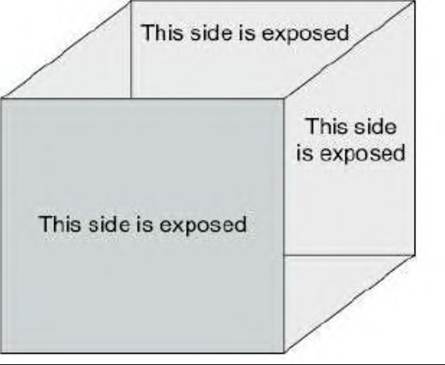
6. There would be a total of 49 smaller cubes on each of the three exposed surfaces which would be painted. Out of these, if we count 49 smaller cubes on the top exposed surface, then in the lateral surfaces we would get an additional 42 and 36 cubes respectively which would be painted. Thus a total of 127 smaller cubes would be painted and hence, 216 cubes out of 342 would not be painted even on one side.
Alternately, you can think of this as 6 ¥ 6 ¥ 6 = 216 as if we remove the top layer on all three lateral surfaces, we would get a total of 216 smaller cubes which would get uncovered.
Option (d) is the correct answer.
7. The cubes on the three edges of the intersection of the exposed surfaces would be painted on two or more surfaces.
Thus, on each of the exposed surfaces there would be 36 cubes, which would be painted only on one side. Thus, the total number of cubes, which would be painted only on one side would be equal to 36 + 36 + 36 = 108.
Option (a) is correct.
8. At most two faces painted means we need to exclude the smaller cube/s which have three faces painted. In this situation there would be only 1 cube which would have 3 faces painted. Hence the correct answer would be 343 - 1 = 342.
Option (b) is correct.
Solutions for Questions 9 and 10:
9. The movement, which would occur in this case, would look as follows:
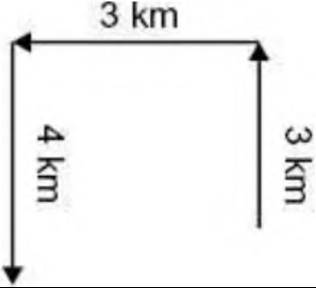
From the figure it is clear that if he wants to go back to the starting point he needs to travel 1 km north and 3 km east. Thus, the route described in II gets him back to his starting point. The other routes specified in (I) and (III) do not get him back to the starting point.
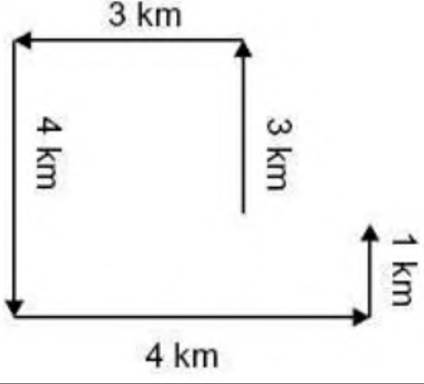
10. In this case his movement would be as follows:
From the figure it is clear that he would be 1 km from his starting point.
Solutions for Questions 11 to 15:
In order to solve this set of questions you need to build a table showing how the values of X and Y move in every iteration. Questions 51 to 54 will be solved based on the following table:
| Value of X | Value ofY | ||
| Startmg point | 3 | 2 | |
| First iteration (X = XY and Y = Y + 1) | 6 | 3 | |
| Second iteration | 18 | 4 | |
| Third iteration | 72 | 5 | |
| Fourth iteration | 360 | 6 | Stop here when N = 100 |
| Fifth iteration | 2160 | 7 | Stop here when N = 500 |
The answers can then be interpreted Iromthis table:
11. The machine would stop after 4 iterations. Option (c) is correct.
12. The final value of X is 360. Option (d) is correct.
13. The final value of Y (after the fourth iteration when X crosses 100) is 6. Option (c) is correct.
14. There would be an additional iteration in this case (the fifth one) and the value of X would land at 2160. Option (d) is correct.
15. The following table would define the iterations in this case:
| Value of X | Value ofY | ||
| Starting point | 2 | 3 | |
| First iteration (X = XY and Y = Y + 1) | 6 | 4 | |
| Second iteration | 24 | 5 | |
| Third iteration | 120 | 6 | Stop here when N S120 |
| Fourth iteration | 720 | 7 | Stop here when N > 120 |
From the above table it is clear that the fourth iteration would be necessitated only if the value of N is 121 or more than that. From amongst the options the minimum value of N possible is 300 for the fourth iteration to take place and the value of Y to end at 7.
Solutions for Questions 16 to 20:
The following are the basic possibilities that emerge in this case based on the possible outcomes given for who comes first and who comes last:
Possibility 1
| Position | Person |
| 1 | Raman |
| 2 | |
| 3 | |
| 4 | |
| 5 | |
| 6 | |
| 7 | Tony |
OR POSSIBILITY 2:
| Position | Person |
| 1 | Sunil |
| 2 | |
| 3 | |
| 4 | |
| 5 | |
| 6 | |
| 7 | Deepak or Ankit |
Besides we also know that Vicky > Priya > Ankit.
Based on this initial thought we can move into the questions and the process for solving from this point would be to add the information given in the question to the respective possibilities and see what cases emerge, and hence what conclusions emerge.
16. If Sunil is ranked sixth, it is clear that we are moving to Possibility 1:
The table structure becomes:
| Position | Person |
| 1 | bgcolor=white>Raman|
| 2 | |
| 3 | |
| 4 | |
| 5 | Ankit |
| 6 | Sunil |
| 7 | Tony |
This leaves us with Vicky > Priya and also Deepak to place in the above grid. Now clearly, the first three options can be rejected because Vicky has to be placed 2nd or 3rd and hence saying he finished fourth or fifth cannot be true. Thus, option (a) is rejected. Similarly, Raman has to be first in this scenario and thus option (b) is also not true. Option (c) is also not true as Tony is compulsorily ranked 7th in this case. Thus, option (d) is correct —as Deepak can be ranked 3rd or 4th.
Option (d) is the correct answer.
17. From the above analysis it is clear that if Raman is ranked first we are clearly talking about the first possibility and hence, Vicky cannot be ranked lower than 3rd as he has to be ranked either 2nd or 3rd.
Option (b) is correct.
18. In this case we are told that Ankit is ranked 2nd. However looking at the original possibilities given to us we can clearly realise that this is not possible. Hence, the ideal answer would be that this is not possible.
However, none of the options tells us that. Hence, option (d) is the correct answer.
19. If Sunil is ranked second we are moving to possibility 1: The table structure becomes:
Possibility 1
| Position | Person |
| 1 | Raman |
| 2 | Sunil |
| 3 | |
| 4 | |
| 5 | |
| 6 | |
| 7 | Tony |
We also know that Vicky > Priya > Ankit.
In this scenario,
Option (b): Vicky > Sunil is not possible (option (b) is rejected).
Option (c): Priya > Raman is also not possible, (option (c) is rejected).
Option (d): Priya > Vicky is also not possible as it is given clearly that Vicky gets more than Priya.
Only the first option is possible as we can have the following arrangement:
| Position | Person |
| 1 | Raman |
| 2 | Sunil |
| 3 | Deepak |
| 4 | Vicky |
| 5 | Priya |
| 6 | Ankit |
| 7 | Tony |
20. IfVicky is ranked fifth, since we need to compulsorily fit Priya and Ankit below Vicky in that order we will have to move to the second possibility table:
Possibility 2
| Position | Person |
| 1 | Sunil |
| 2 | |
| 3 | |
| 4 | |
| 5 | Vicky |
| 6 | Priya |
| 7 | Ankit |
In this situation, the only ‘must true’ option is the one which states that Sunil scores the highest.
Option (a) is correct.
21. The conclusion drawn in the passage talks about Party Z being likely to win the election. Obviously if we know that only 35% of the people favour party Z (as stated in option (c)), party Y would be expected to win the election—as the estimates for how many people support party Y varies from 40% (at worst) to 46% (at best). Even, in the worst case scenario for PartyY, Party Z would still not be likely to win the next election.
Thus, option (c) seriously weakens the conclusion.
22. The stock markets find their levels based on long term expectations of results of businesses in the economy. Obviously, if it is known that much of the inflation was the result of the rise in food prices due to a summer drought (which in essence is a short term effect), the stock markets would not need to panic and change their levels drastically, thereby being steady in the short run.
Thus, option (d) is the best explanation for the reaction of the stock market.
23. The original relationship between birth: dirge signifies the beginning and the end of life. Birth being the start of life, dirge which means a funeral hymn or lament signifies the end of life.
The same relationship is exhibited in the pair Marriage: alimony, where marriage signifies the start of a relationship and alimony is something that signals the end of the relationship.
24. The argument in the question is based on the premise that just because the city’s beaches are the most overcrowded in the state, so it must be true that beautiful beaches attract people. The reasoning is akin to making a generic conclusion about something based on one observation.
Similar reasoning is shown by option (d) because it uses a similar kind of logic to make a conclusion. The whole conclusion is based on one fact, viz: just because my dog suffers more fleas during hot weather, it follows that fleas must thrive in a warm environment.
25. The conclusion in option (d) is the most valid in this case because the question clearly states that all underground industries are not included in national productivity measures—and that there are some industries run by self-employed industrialists, which are included in national productivity measures. Obviously this means that there are at least some industries run entirely by self-employed industrialists that are not underground industries (as they are included in national productivity measures).
26. The argument is directly linking ‘Not receiving a violation from the Federal Aviation’ to being a good pilot. Thus, it is based on a hidden assumption which can be stated as—not receiving a violation from Federal Aviation means the
pilot is a good pilot.
27. The argument is a general conclusion (about a large topic) based on a specific example of 1 individual. Thus, option (c) is correct.
28. The value of the middle number in every row is equal to half the sum of the other numbers in the row. This can be verified by looking at any of the first four rows. In the first row (4+2)/2 = 3; a similar logic exists for the other rows. The missing number is (9+3)/2 = 6.
29. The cause-effect relationship specified in the question, tells us that:
Fewer restrictions on advertising of legal services √zE More lawyers advertise their services √zE Lawyers who specify a specific service generally charge less for the service.
Based on this reasoning, the author is concluding that:
If restrictions on advertising specifying fee arrangements are removed √zE lower legal costs.
If this were true, it would happen only if more lawyers end up advertising their services. Option (c) states exactly that and hence is the correct answer.
30. If the condition stated in option (d) were to be true; that the lawyers who begin to advertise do not lower their fees, naturally the conclusion that there would be a drop in legal costs would be weakened most seriously.
Hence, option (d) is the correct answer.