PROOF STRATEGY
We have seen that in a predicate logic proof you must do any EIs that are required before any UIs. But you may not know whether any EIs are required until after you have worked out whether you are going to need any suppositions, as in the proof of the “Muon-Quark” argument above.
Remember, if you try to do EI late in a proof, it must be an instance involving an arbitrary individual (i, j, or k), one that has not already been used; and now, this may no longer work. With this in mind, it may be useful to have a set of guidelines on how to proceed in a predicate logic proof:I. Write down the premises as the first lines of your proof.
II. Work out whether you need to make any supposition involving a quantification: in particular, if your conclusion is the negation of a quantification, this suggests supposing the quantification and trying a reductio.
III. If you have an existential quantification, apply EI with arbitrary individual i.
IV. If you have universal quantifications, apply UI with an appropriate individual: і if you already have it above; a particular name if that occurs in the premises or conclusion of the argument; u if you are aiming to prove a universal quantification with a UG at the end.
V. Now you are in statement logic territory! Work out your strategy accordingly.
VI. Finally, if your conclusion is a universal quantification, apply UG to your instance of u; if it is an existential quantification, apply EG. If your proof is a reductio, apply RA to derive the negation of your supposition.
SUMMARY
• The rule of inference Existential Instantiation (EI) is
From an existential quantification infer a suitably arbitrary instance of it.
From 3xΦx derive Φi, where і is an arbitrary individual name, i.e., one that has not occurred either in the symbolization of the argument or on any previous line of the proof).
• The rule of inference Existential Generalization (EG) is
Infer an existential quantification from any instance of it.
From Φn, where n is any individual name, derive 3xΦx.
EXERCISES 17.2
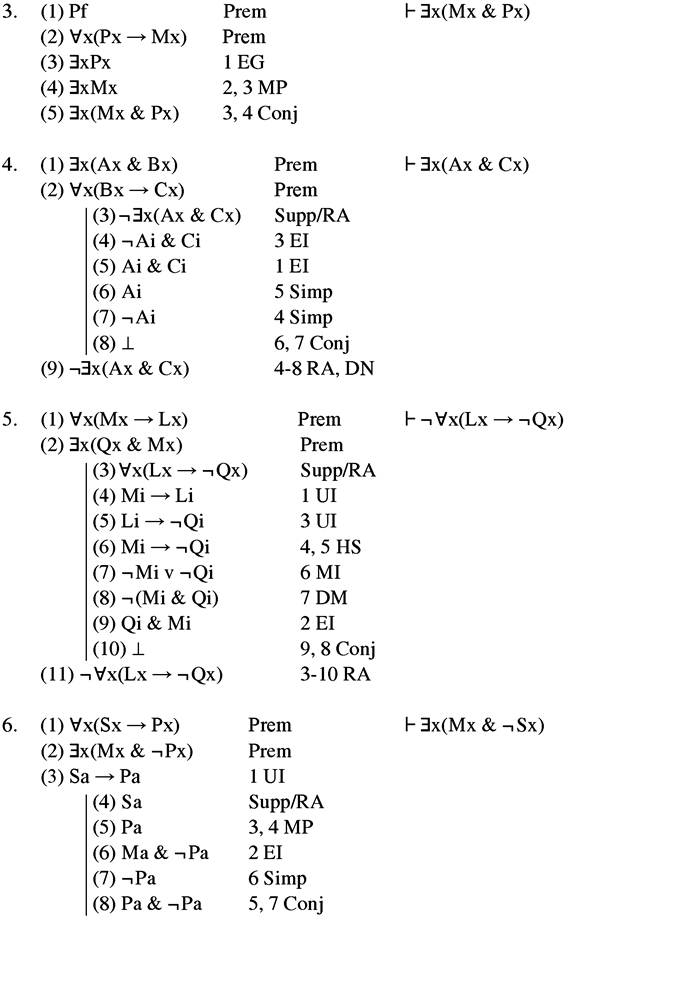
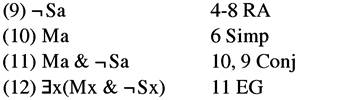
In each of the following incorrect proofs, there are two errors in applying rules of inference (we are not counting strategic errors), (i) Identify and describe the errors, (ii) Give a correct proofofvalidity of the sequent.
Prove the validity of each Ofarguments 7-13 using predicate logic.
7. At least some WALLOONS are BILINGUAL, since Isabel is a Walloon who is bilingual. [UD: people]
8. All KAZAKHS are Central ASIAN. Borat is morally RETARDED, although he is not really a Central Asian. So at least some moral retards are not Kazakhs.
9. Some DINOSAURS have FEATHERS. But only BIRDS have feathers. Therefore some dinosaurs are birds. [UD: creatures]
10. No FAT creatures RUN well. Some GREYHOUNDS run well. Therefore some greyhounds are not fat. [UD: creatures]
11. All POLITICIANS tell LIES. So there’s no such thing as a politician who does not tell lies.
12. Whoever engages in INTERCOURSE is EVIL. MINISTERS are not evil. Some ministers have CHILDREN. Therefore some who have children have never had intercourse. [UD: people]
13. PARTICULAR statements have EXISTENTIAL import. But the CONTRADICTORIES of particular statements do not have existential import. Now UNIVERSAL statements are contradictories of particular statements. Therefore universal statements do not have existential import. [UD: statements; Cx := x is the contradictory of a particular statement, Ex := x has existential import]
Using Carroll diagrams, determine whether each of arguments 14-18 is valid. For each that is, prove its validity using predicate logic.
14.
Borat is a KAZAKH who often SLEEPS with his sister. Anyone who sleeps with his sister commits INCEST. So all Kazakhs commit incest.15. No FROGS are POETICAL. Some DUCKS are unpoetical. Therefore some ducks are not frogs.
16. No EMPERORS are DENTISTS. All dentists are dreaded by CHILDREN. Therefore no emperors are dreaded by children.1
17. Some VALID arguments have FALSE premises. Therefore some valid arguments are not SOUND, because no sound argument has false premises. [UD: arguments]
18. No arguments with a FALSE conclusion are SOUND. But some VALID arguments are not sound. Therefore some arguments with a false conclusion are not valid. [UD: arguments]
19. A clever Englishman, on learning that British law prohibits taxes being collected from animals, avoided paying taxes by investing in stocks in his dog’s name.[67] [68] A syllogism based on this case: No ANIMALS may be TAXED. So, since some animals may INVEST in stocks, some individuals who may invest in stocks cannot be taxed. [UD: individuals] Give a formal proof of the validity of this argument. 20. Prove that I- and E-statements are logically inconsistent by deriving a contradiction from their conjunction 21. (CHALLENGE) Afillerinthe Washington Star-News goes: Not all of TODAY’S women DEVOTE all their waking thoughts to pleasing men. Some are MARRIED. [UD: women; Tx := x is one of today’s women] (a) Supply what seems to be the intended implicit premise. (b) Symbolize the resulting argument, and prove its validity by a formal proof. 22. (CHALLENGE) In Being and Time, Martin Heidegger argues: Every reference is a relation, but not every relation is a reference. Every ‘indication’ is a reference, but not every referring is an indicating. This implies at the same time that every ‘indication’ is a relation, but not every relation is an indicating. The formally general character of relation is thus brought to light.[69] Use a Carroll diagram to determine whether Heidegger’s inference is valid. [LetE := is a reference or a referring, A := is a relation, I := is an indication or indicating.] 23. (CHALLENGE) Symbolize Heidegger’s argument in #22, and demonstrate its validity by a formal proof in predicate logic.
