RELATIONS
Consider the argument:
(1) Earth is bigger than Venus, but Venus is bigger than Mars. So Earth is certainly bigger than Mars.
Assuming the premises are true, there is no way for the conclusion to be false.
Thus the argument is definitely valid. But how could we represent this using predicate logic? If we represent ‘Earth’ by the individual name e, and ‘bigger than Venus’ by the predicate V, then the first premise is Ve. Similarly, in the second premise, v can denote ‘Venus,’ but now ‘bigger than Mars’ is a different predicate than in the first premise, which we must represent with a different letter, M, giving Mv. But now the conclusion comes out as Me, yielding the symbolization:
The problem is, of course, that what accounts for the validity of the inference is not the repetition of the predicate M, but that of the phrase “is bigger than,” occurring in all three statements, linking together different pairs of individuals. Predicates of this kind that link two or more individuals are called relations. In this case, then, we can symbolize “is bigger than” by B, a predicate relating two names, and our two premises become eBv, vBm, and the argument is symbolized as: 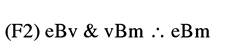
This appears to capture the form. If we substitute another relation for B, say “is the brother of,” and interpret e, v, and m as Harpo, Chico, and Groucho respectively, we get the valid argument:
(2) Harpo is Chico’s brother, but Chico is Groucho’s brother. Therefore Harpo is Groucho’s brother.
But here’s a problem: what if we interpret B as “is the son of’? Then we would get, applying this to the Darwins: Charles, Robert, and Erasmus:
(3) Charles Darwin is Robert Darwin’s son, but Robert Darwin is Erasmus Darwin’s son.
Therefore Charles is Erasmus Darwin’s son.But this is invalid! The premises are true, but the conclusion is false: Charles should be (and was) Erasmus’s grandson, not his son. What’s gone wrong? The problem is this. The Marx brothers[LXXXIV] argument’s validity depends on a property of the relation “is bigger than,” a property it shares with the relation “is the brother of’: namely that if the relation holds between x and y, and between у and z, then it must hold between x and z. This is the property of transitivity. Formally, we may represent it by:

It is this property that is not shared by the relation “is the son of.” So the validity of the arguments (1) and (2) depends on this property implicitly, and it has to be made explicit in the formalization of the argument:

The validity of this argument may now be proved without having to add any new rules of inference to those we have learned so far, but simply by extending predicate logic to apply also to relations. (Our formalization of wffs in chapter 19 already anticipated this extension.) Here is the proof:


20.1.2