SYMBOLIZING RELATIONS
The above relations were each between two individuals, and indeed these are the most common kind. Such relations are called dyadic predicates, from the Greek for two, or binary relations (from the Latin for two), in contrast to the ones we have been dealing with up till now, monadic or unary predicates involving one individual.
Symbolizations of such predicates will be suggested by capitalizing as usual, but by adding a suffixed subscript2 to denote that they are dyadic (binary), thus:Abbie is TALLER2 than Duncan. aTd
There are relations among more than two individuals, such as something’s being between two things. We denote a tryadic relation with a subscript3 and so on:
Montreal is BETWEEn3 Quebec City and Toronto. mBqt
Also, we adopt the convention that all relations in the passive mood are re-expressed in the active mood before symbolizing. Thus
Maria is LOVED2 by Carlos.
is interpreted as the equivalent statement in active mood:
Carlos LOVES2 Maria. cLm
Here’s a less boring example from Groucho Marx (Horse Feathers, 1932):
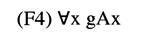
(4) Whatever it is, Γm AGAINST2 it.
Taking g = Groucho, we have in “Loglish” that for all x, g is against x, giving
Noam Chomsky seems to be giving a variant on this joke when he tells John Horgan

20.1.3