NESTED QUANTIFIERS
Even though the order of the quantifiers is not significant in a statement like (F3) above, which begins with three universal quantifiers, it can be. In fact, when we have a mix of existential and universal quantifications, their order is crucial.
For example, suppose we have the statement(6) Everyone NEEDS2 someone. (UD: people)
We can take the process of symbolization in two steps: “x needs someone” is “there is a y such that x needs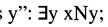 and this is so for all x:
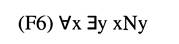
Thus here the universal quantifier has a scope of the propositional function to its right,  there is someone x needs. The existential quantifier iny has as its scope “x needs y.” On the other hand, the abstract statement
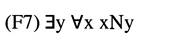
although it differs from (F6) only in the order of the quantifiers, it symbolizes a very different statement. Here Ξy has as its scope the propositional function Vx xNy, “everyone needs y.” So the whole statement back-translates as “there is a y such that everyone needs y,” i e.,
(7) There is someone everyone NEEDS2.
Whereas in (6) who the ‘someone’ is will generally differ in each case, (7) asserts the existence of some uniquely useful person whom everyone needs! And while (6) is possibly true, (7) is surely by contrast false. Make sure you understand why.
20.1.4 RELATIONAL PROOFS
Returning to our proof of the planet/brother argument with which we began this section, it would have been shorter (by two lines) had we been allowed to instantiate all three of the quantifiers (over x, y, and z) in one fell swoop: 
This is generally the case with proofs involving relational properties.
So in applying proofs involving quantifiers, we allow a telescoping of successive applications of UI, so that they may be performed all in one go on one line. This is licensed byTelescoped UI:
For any abstract statement beginning with several consecutive universal quantifiers  successive applications of UI may be performed in order on a single line of proof.
In fact, it will prove convenient to telescope all the rules involving quantifiers for relational proofs in the same way:
Telescoped EI:
For any abstract statement beginning with several consecutive existential quantifiers Ξx Ξy Ξz... Φxyz..., successive applications of EI to distinct arbitrary names i, j, к respectively may be performed in order in a single line of proof.
Telescoped EG:
For any abstract statement involving several individual names i, j, k, successive applications of EG may be performed in order in a single line of proof.
Telescoped UG:
For any abstract statement involving several distinct arbitrary names u, v, w, successive applications of UG may be performed in order in a single line of proof.
Finally there is also the QuantifierNegation rule:
Telescoped QN:
For the negation of any abstract statement beginning with several consecutive quantifiers successive applications of QN may be performed in order on a single line of proof.
E.g., from and vice versa.
I call these rules “telescoped” to signify that you are applying them as usual (e.g., with all the usual restrictions on EI and UG), but one within the other. Here is an example of a proof using some of these telescoped rules:

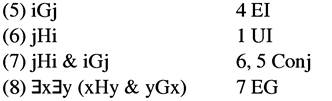
Notice that in applying EI on line 5, we had to take two different names, і and j, just as we would if we had done the rule on 2 separate lines.
On line 6 I can choose any names for instances of UI, so I choose j and і in that order just because I have looked ahead to the conclusion and see that I need an instance like jHi & iGj in order to get the conclusion by EG.SUMMARY
• Relations are predicates linking together more than one individual, polyadic predicates. Most relations are dyadic or binary, linking together two individuals. An example is “is greater than” in the statement “Four is GREATER2 than three,” symbolized fGt. (The subscript 2 indicates that it is a binary relation.)
• We adopt the convention that all relations in the passive mood are re-expressed in the active mood before symbolizing: “Maria is LOVED2 by Carlos” becomes “Carlos LOVES2 Maria,” symbolized cLm.

• The telescoped rules of inference allow successive applications of the predicate logic rules UI, EI, EG, UG, and QN to be performed in order in a single line of proof.
EXERCISES 20.1
!.Symbolize the following statements [UD: planets].·
(a) Jupiter is BIGGER2 than Saturn.
(b) There is a planet BIGGER2 than Saturn.
(c) Jupiter is BIGGER2 than at least one planet.
(d) No planet is BIGGER2 than itself.
(e) Not all planets are BIGGER2 than Mars.
(f) If Mars is BIGGER2 than Pluto, then not all planets are BIGGER2 than Mars.
2. Using the symbolizations suggested, translate (a) through (c) from English into Relational Logic, and then use the same interpretations of the symbols to render (d) through (f) from Relational Logic into colloquial English :
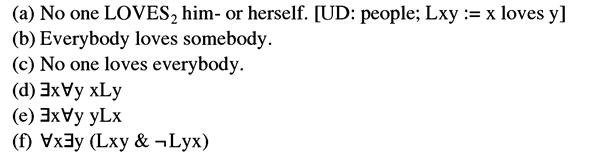
3. “One morning, I shot an elephant in my pajamas. How an elephant got into my pajamas I’ll never know.” (Groucho Marx in Animal Crackers, 1930) (Another problem in the “ruin a joke by analyzing it” series.) Show how Groucho fs joke trades on an amphiboly (a sentence ambiguous because of its construction) by giving the two alternative symbolizations of the first sentence on which the joke depends, [g : = Groucho (i.e., T), xSy: = x shot у, Ex :=x is an elephant, Px : = x is in my pajamas; ignorethe “one morning”]
Use the telescoped quantification rules Ofinference to prove the following sequents: 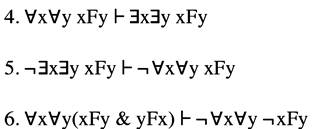
20.2