TRANSITIVITY, SYMMETRY, AND REFLEXIVITY
We saw in the previous section that the relations of ‘being BIGGER2 than’ and of ‘being a BROTHEr2 of’ have the property of transitivity. ‘Being FATHER2 of,’ on the other hand, lacked this property.
In fact, if Erasmus is the father of Robert and Robert is the father of Charles, we are able to infer that Erasmus is NOT the father of Charles. A relation having this property is said to be intransitive. Symbolically:
Using this fact of the intransitivity of the relation of ‘being FATHER2 of,’ we can symbolize and prove the inference as follows: 

Not all binary relations are either transitive or intransitive, however. Consider the relation of ‘being EAST2 of,’ applied to cities. IfMoscow is to the east of Reykjavik, and Reykjavik is east of Montreal, then Moscow is east of Montreal. But Tokyo lies east of Paris, and Paris is east of Seattle, yet Tokyo is west (by our usual conventions), not east, of Seattle. So for some triples of cities ‘being east of’ appears to be transitive, for other triples it is not. A relation of this kind is said to be nontransitive on its domain or UD:

It is the same with the relations “is afraid of’ and “seeks advice from” on people, “is four miles away from” applied to places, and a host of others. There are, however, no other possibilities. A binary relation is either transitive, intransitive, or neither, and in that case nontransitive. We may represent this family of properties in a table:

A second property of the relation “is the brother of’ is that it is symmetric: if Harpo is the brother of Gummo, then Gummo is the brother of Harpo, and so for all brothers:
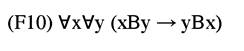
Again, this is not shared by “is the father of,” nor “is the mother of.” Minnie Schoenberg Marx is the mother of Chico, but if that is so, Chico is not Minnie’s mother; and so for any other pair of individuals:

This is called asymmetry. Other examples of asymmetric relations are “is earlier than” on events, “is greater than,” and “is to the north of’ for places on the Earth’s surface.
But again, there are relations that are neither: e.g., “is less than or equal to” on the domain of rational numbers: 3/3 ≤ 1 and 1 ≤ 3/3, whereas 1/2 ≤ 1 but it’s not the case that 1 ≤ 1/2. Here is the symmetry family:
Some relations are such that every individual in the domain bears the relation to itself: such a relation is said to be reflexive. Examples are mostly relations of identity and equality: “is the same height as,” “is equal to,” “is as smart as,” “is simultaneous with” (on events in classical physics), “implication” on the domain of statements. Many others are irreflexive on their domain: “is the brother of’ on male siblings, and “is the sister of’ on female siblings, are both examples, since no one is his own brother or her own sister. Others still are neither: some doctors may treat themselves, and some may not. This gives us a third family of relational properties, the reflexivity family:
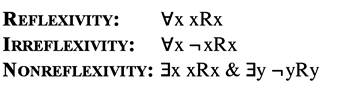
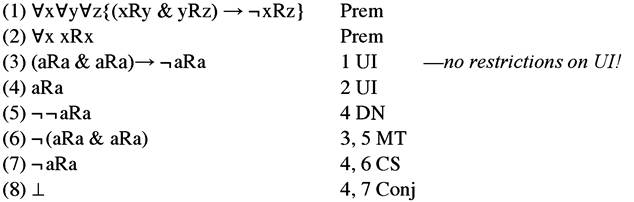
Every binary relation can be classified according to these families, since it must have (at least) one property from each table. Not all these properties are independent, though. For example, every asymmetric relation is irreflexive, as you will prove in the exercises, and no relation can be intransitive and reflexive. The latter can be proved by showing that simultaneously asserting the two properties of a relation leads to contradiction. The proof will give us another example of the use of our telescoped UI:
20.2.2
More on the topic TRANSITIVITY, SYMMETRY, AND REFLEXIVITY:
- TRANSITIVITY, SYMMETRY, AND REFLEXIVITY
- EQUIVALENCE RELATIONS
- PROPERTIES OF IDENTITY
- Arthur R.T.W.. An Introduction to Logic: Using Natural Deduction, Real Arguments, a Little History, and Some Humour. Broadview Press,2016. — 456 p., 2016
- Contents