Solutions
SET 1 Questions 1 to 5 For this question, start by using the direct clues first. We know that there are six cards P, Q, R, S, T, U; six colours—blue, red, green, grey, yellow and brown and, six pictures—King, Princess, Queen, Palace, Joker and Prince.
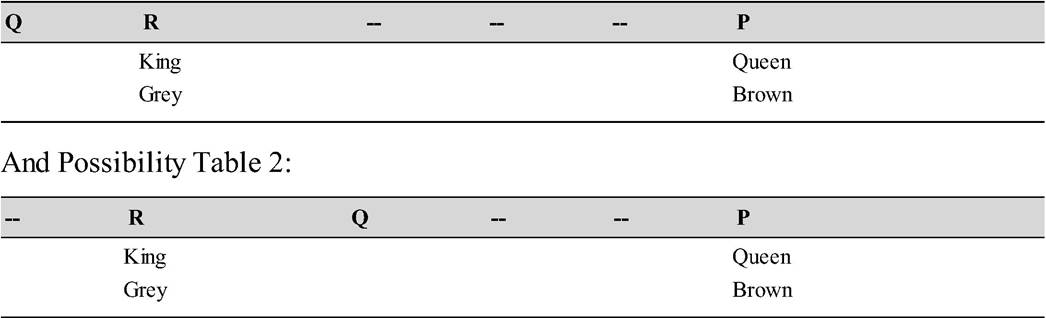
The following set of deductions gives us the entire solution of the problem.The second part of the third statement is the most directly usable → P-Brown-Queen- Extreme right. We also know that R-King-Grey-Fifth from Right (ivth statement).
Also Q being next to R, the following arrangements are possible PossibilityTable 1:
From this point we start using the indirect clues.
From statement (iii), Palace-Blue-Not S → Hence T or U Further, from statement (iv), Princess — Not S and not T, → Not Green or Yellow → Hence, Red and U. This further gives us Palace —T-Blue.
Hence, S must be the joker (only pair left). Also, green and yellow must be shared between Q and S.
Thus, the following pairings emerge:
P — Brown — Queen
Q — GreenZYellow — Prince
R — Grey — King
S — YellowZGreen—Joker
T — Blue —Palace
U — Red — Princess
At this point we have used all the statements. Hence go straight into the questions.
For Question 1: for the Princess card (U) to be immediately between the Palace (T) and the Prince (Q), Possibility Table 2 must emerge to be the correct one. In such a case, the arrangement of cards becomes:
SRQUTP.
Hence the Joker’s cards must be at the extreme left. Option (c) is correct.
The remaining 4 questions can be directly answered from what is available.
2. U-Red is correct. Option (b) is correct.
3. Data inadequate since we don’t know whether the Joker is yellow or green. Option (d) is correct.
4.
The Palace is on Card T. Option (b) is correct.5. Data remains inadequate since we do not know which colour is for which card. Option (d) is correct.
SET 2 Questions 6 to 8: Given that A, C and D have to be separate and that A is Quants, and C cannot be on the last day. Also that there are 3 lectures (at least) on day 1, the order of A, C and D must be

Further B cannot be clubbed with A or D, hence must be on the second day. Thus F must also be on the same day. This gives us the following table.
-Z
This leaves us with G, H and E. Since, Day 1 has to have at least 3 lectures, G and H must be on day 1. This leaves us with E, which can be placed on either day 1 or 2 or 3. Thus, the final table is: 
Hence the answers are:
6. G, H. Option (b) is correct.
7. The data is inadequate since we do not know whether E was on Day 2 or not. Option (d) is correct.
8. Again, the data is inadequate since we do not know for sure which the last 2 lectures were. Option (d) is correct.
SET 3 Questions 9 to 11: Using the three clues we get the following pairings:
P — В — Not April or May
Q — A — March
R—Not C or D — January
Put them together to get the following table.

This leaves S and T to be teaching either C or D and either in April or May.
9. We do not know who teaches C or D (between S & T). Hence Option (c) is correct.
10. Course B occurs in February. Hence, we need to look for who is teaching in March. The answer to the question is Lecturer Q. Option (a) is correct.
11. In January, Course E is taught. Option (c) is correct.
SET 4 Questions 12 to 15: The first two statements are just introductions to the situation. Going ahead from third statement onwards, the following chain of thoughts should arise.