EXERCISE ON ARRANGEMENTS
Directions for Questions 1-5: (Question Category: Matching Puzzle) Study the following information and answer the questions that follow:
i. Six picture cards P, Q, R, S, T and U are framed in six different colours - blue, red green, grey yellow and brown and are arranged from left to right (not
necessarily in the same order).
ii. The pictures are of king, princess, queen, palace, joker and prince.
iii. The picture of the palace is in the blue colour frame but is not on card S and card P which is of the queen, is in the brown frame and is placed at the extreme right.
iv. The picture of the princess is neither on card S nor on card T and is not in either the green or the yellow frame. Card R has a picture of the king in a grey frame and it is fifth from right and next to card Q having the picture of the prince.
1. If the princess’s card is immediately between the cards of the palace and the prince, then at what number is the joker’s card placed from left?
(a) Fifth (b) Second
(c) First (d) Data inadequate
2. Which is the correct combination of card and frame colours?
(a) T-Yellow (b) U-Red
(c) Q-Green (d) Data inadequate
3. The picture of the joker is in which colour frame?
(a) Yellow (b) Green
(c) Blue (d) Data inadequate
4. The picture of the palace is printed on which card?
(a) S (b) T
(c) U (d) None of these
5. If the photo frame of the prince and joker is interchanged, then the colour of frame of the prince is:
(a) Green (b) Yellow
(c) Blue (d) Data inadequate
Directions for Questions 6 to 8: Study the following information and answer the questions that follow:
A company is planning to organise 8 lectures—A, B, C, D, E, F, G and H for 3 subjects —Quants, D.I. and English.
The lectures are spread over three days.
Quants is to be covered first in 3 lectures followed by English and then D.I.
in 2 lectures. Lectures A, C and D have to be different days. (Lectures B and F have to be on the same day), but lecture B cannot be clubbed with A or G or D. Lecture G and H should come on the same day. Lecture A is a lecture on Quants and Lecture C cannot be on the last day. It is also known that there are at least 3 lectures on day 1.6. Which of the following pairs of lectures can go along with lecture ‘A’ on Quants?
(a) B, C (b) G, H
(c) D, E (d) Data inadequate
7. Which combination of lectures was arranged on the second day of the series?
(a) D, E, F (b) B, C, E
(c) C, G, H (d) Data inadequate
8. Which of the following lectures were for D.I.?
(a) D, F (b) B, C
(c) G, H (d) Data inadequate
Directions for Questions 9 to 11: Five courses — A, B, C, D and E, each of one month duration are to be taught from January to May one after the other though not necessarily in the same order by lecturers P, Q, R, S and T. P teaches course ‘B’ but not in the month of April or May. Q teaches course ‘A’ in the month of March. R teaches in the month of January but does not teach course ‘C’ or ‘D’.
9. Which course is taught by S?
(a) C (b) E
(c) Either C or D (d) D
10. Which lecturer’s course immediately follows course B?
(a) Q (b) P
(c) S (d) T
11. Which course is taught in the month of January?
(a) C (b) D
(c) E (d) Data inadequate
Directions for Questions 12 to 15: The annual gathering of a college was organised on a day. Six different programmes—drama, singing, mimicry, speech, story-telling and dance are to be performed by six students A, B, C, D, E and F, not necessarily in the same order. The programme begins with a song not sung by B and ends with a dance. C performs mimicry immediately after the speech. E performs drama just before the dance. D or F are not available for the last performance. The speech is not given by A. An interval of 30 minutes is given immediately after mimicry with three more items remaining to be performed.
D performs immediately after the interval.12. Which item is performed by F?
(a) Song (b) Dance
(c) Speech (d) Data inadequate
13. Who performed the dance?
(a) A (b) B
(c) Either A or B (d) F
14. Who was the first performer?
(a) D (b) E
(c) A (d) Data inadequate
15. Who was the last performer?
(a) A (b) B
(c) F (d) Data inadequate
Directions for Questions 16 to 18: Six persons—Akshay Bobby, Celina, Dimple, Esha and Faisal took up a job with XYZ Consultants in a week from Monday to Saturday. Each of them joined for different posts on different days. The posts were of Clerk, Officer, Technician, Manager, Supervisor and Sales Executive, though not in the same order.
Faisal joined as a Manager on the first day. Bobbyjoined as a Supervisor but neither on Wednesday nor Friday. Dimple joined as a Technician on Thursday. The Officerjoined the firm on Wednesday. Esha joined as a clerk on Tuesday. Akshayjoined as a Sales Executive.
16. Who j oined the firm on Wednesday?
(a) Bobby (b) Celina
(c) Esha (d) Data inadequate
17. Who was the last to join the firm?
(a) Esha (b) Faisal
(c) Bobby (d) Akshay
18. On which of the following days did the Sales Executive join?
(a) Thursday (b) Friday
(c) Saturday (d) None of these
Directions for Questions 19 to 21:
i. Six friends A, B, C, D, E and F are sitting along the sides of a hexagonal table for playing a game, though not necessarily in the same order.
ii. F, who is sitting exactly opposite A, is to the immediate right of B.
iii. D is between A and B and is exactly opposite to C.
19. Who are the people sitting next to A?
(a) D & E (b) D & F
(c) C & E (d) B & D
20. Who is sitting opposite B?
(a) E (b) F
(c) A (d) C
21. Three of the following are alike in a certain way on the basis of sitting positions and so form a group. Which is the one that does not belong to the group?
(a) B, C (b) A, D
(c) B, F (d) E, A
Directions for Questions 22 to 25: A group of five boys—Abdul, Bony, Chandan, Devdas and Eram, and a group of five girls—Paro, Queen, Reena, Saifali and Tulika are standing in rows facing each other (not in the same order).
The group of girls is facing north.Eram is not at any of the ends. Chandan is to the immediate right of Bony and Devdas is to the immediate left of Abdul, who is facing Paro. There are as many girls between Paro and Queen as between Reena and Saifali. Abdul is second to the left of Bony. Saifali and Reena are not facing either Bony or Devdas.
22. Which pair of boys is standing at the ends of the row?
(a) Chandan & Devdas
(b) Chandan & Bony
(c) Devdas & Bony
(d) Data inadequate
23. Which of the following is definitely true?
(a) Chandan is third to the right of Devdas.
(b) Devdas is facing Paro.
(c) Chandan is facing Saifali.
(d) None of these
24. Who is standing to the immediate right of Abdul?
(a) Eram (b) Chandan
(c) Devdas (d) Data inadequate
25. Who is facing Bony?
(a) Reena (b) Saifali
(c) Queen (d) Data inadequate
Directions for Questions 26 to 29:
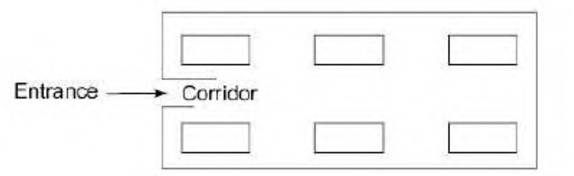
The plan above shows an office block for six officers—A, B, C, D, E and F. Both B and C occupy offices to the right of the corridor (as one enters the office block) and A occupies an office to the left of the corridor. E and F occupy offices on opposite sides of the corridor but their offices do not face each other. The offices of C and D face each other. E does not have a corner office. F’s office is further down the corridor than A’s, on the same side.
26. IfE sits in his office and faces the corridor, whose office is to his left?
(a) A (b) B
(c) C (d) D
27. Whose office faces A’s office?
(a) B (b) C
(c) (e) D
28. Who is/are F’s neighbour(s)?
(a) A only (b) A & D
(с) C (d) В & C
29. D was heard telling someone to go further down the corridor to the last office on the right. To whose room was he trying to direct that person?
(a) A (b) B
(c) C (d) F
Directions for Questions 30 to 34: Four families decided to go for a picnic to Jhumri Talaiya and agreed to meet at a place called Rani ka Talab before moving for the picnic.
One family has no kid, while the others have at least one kid each. Amongst each family with kids, at least one kid goes to the picnic. Following is the information about the families.i. The family with two kids came just before the family with no kids.
ii. D who does not have any kids reached just before C’s family.
iii. P and his wife reached last with their only kid.
iv. Q is not B’s husband.
V. Q and S are fathers.
vi. C’s and A’s daughters go to the same school.
vii. B came before D and met A when she reached the fixed place.
viii. R stays farthest from the place and he is a good singer.
ix. S explained that his son could not come because of exams.
30. Who amongst the females arrived third?
(a) A (b) B
(c) C (d) D
31. Which is the correct pair of husband and wife?
(a) S and D (b) P and C
(c) Q and C (d) S and A
32. Whose daughters go to the same school?
(a) Q and R (b) P and R
(c) P and Q (d) Q and S
33. Whose family has definitely more than one kid?
(a)R’s (b)S’s
34. Among the males, who arrived second?
(a) P (b) Q
(c) R (d) S
Directions for Questions 35 to 38: In a bar, there are seven frequent visitors who visit the bar daily. On being asked about their visit to the bar the preceding Sunday, the following were the answers:
Jai Chand: I came in first and the next two persons to enter were Sohan Singh and Shail Munshi. When I left the bar, Jai Prakash and Vinod Rai were present in the bar. Deepak Garg left with me.
Jai Prakash: When I entered the bar with Vinod Rai, Jai Chand was sitting there. There was someone else also, but I was not in a position to recognise him
Shail Munshi; I went to the bar for a short while last Sunday and met Jai Chand, Sohan Singh and Deepak Garg there.
Sohan Singh: I left immediately after Shail Munshi left.
Deepak Garg: I met Jai Chand, Sohan Singh, Shail Munshi, Jai Prakash and Vinod Rai during my first visit to the bar. But I got an urgent call and came out of the bar with Jai Chand.
When I went to the bar the second time, Jai Prakash and Vinod Rai were there.Pradeep Kumar: I had some urgent work, so I did not sit in the bar for a long time. Jai Prakash and Deepak Garg were the only people in the bar while I was there.
Vinod Rai: I was drunk and I don’t remember anything.
35. Who among Jai Prakash and Deepak Garg, entered the bar first?
(a) Jai Prakash (b) Deepak Garg
(c) Both entered (d) Cannot be determined
36. Who was sitting with Jai Chand when Jai Prakash entered the bar?
(a) Sohan Singh (b) Shail Munshi
(c) Deepak Garg (d) Pradeep Kumar
37. How many of the seven members did Vinod Rai meet on Sunday in the bar?
(a) 2 (b) 3
(c) 4 (d) 5
38. Who were the last two persons to leave the bar?
(a) Jai Chand & Deepak Garg
(b) Pradeep Kumar & Deepak Garg
(c) Jai Prakash & Pradeep Kumar
(d) Jai Prakash & Deepak Garg
Directions for Questions 39 to 42: Seven sports awardees—A, B, C, D, E, F and G are to be honoured at a special luncheon. The players will be seated on the dias in a row. A and G have to catch the flight for their One Day International cricket match and so must be seated at the extreme right. B, the Rajiv Gandhi Khel Ratna recipient must be in the centre. C and D are bitter rivals and therefore must be seated as far apart as possible.
39. Which of the following cannot be seated at either end?
(a) C (b) D
(с) F (d) Cannot be determined
40. Which of the following pairs cannot be seated together?
(a) B & D (b) C & F
(c) D & G (d) E & A
41. Which of the following pairs cannot occupy the seats on either side of B?
(a) F & D (b) E & G
(c) D & E (d) None of these
42. What can be the position of C from the right side?
(a) Third (b) Seventh
(c) Third or Seventh (d) Cannot be determined
Directions for Questions 43 to 47: Study the following information carefully and answer the questions that follow:
Six friends—Alok, Bheem, Chandar, Devdas, Earl and Ferguson are sitting on a bench facing in the same direction. Chandar is sitting between Alok and Earl;. Devdas is not at the end. Bheem is sitting to the immediate right of Earl. Ferguson is not at the right end.
43. Who is to the immediate right of Ferguson?
(a) Devdas (b) Alok
(c) Either Devdas or Alok
(d) Cannot be determined
44. How many persons are there to the left of Chandar?
(a) One (b) Two
(c) Three (d) Four
45. Who is fourth from the left end?
(a) Alok (b) Chandar
(c) Bheem (d) Cannot be determined
46. Who is at the left end?
(a) Ferguson (b) Alok
(c) Bheem (d) Cannot be determined
47. Which of the following is sitting to one side of Devdas?
(a) Ferguson-Earl (b) Ferguson-Bheem
(c) Ferguson-Chandar (d) None of these
Answer Key
| l.(c) | 2. (b) | 3∙(d) | 4. (b) |
| 5. (d) | 6. (b) | 7. (d) | 8. (d) |
| 9. (c) | 10. (a) | H. (c) | 12. (d) |
| 13.(c) | 14. (d) | 15. (d) | 16. (b) |
| 17.(c) | 18. (b) | 19. (a) | 20. (a) |
| 21. (a) | 22. (a) | 23. (d) | 24. (a) |
| 25. (c) | 26. (c) | 27. (d) | 28. (a) |
| 29. (b) | 30. (d) | 31∙(b) | 32. (c) |
| 33.(b) | 34. (d) | 35. (b) | 36. (c) |
| 37. (b) | 38. (d) | 39. (c) | 40. (d) |
| 41∙(b) | 42. (c) | 43. (a) | 44. (c) |
| 45. (b) | 46. (a) | 47. (d) |
More on the topic EXERCISE ON ARRANGEMENTS:
- EXERCISE ON ARRANGEMENTS
- ‘Accountability’ is one of the more frequently used terms in today's constitutional vocabulary, whether in the United Kingdom, the European Union more broadly, the United States, or other liberal democracies.
- The variety of institutional arrangements
- Ideals of Deliberative Democratic Constitutionalism
- EXERCISE
- The Transition to Democracy and Rule of Lawin Central and Eastern Europe
- Four Themes
- The Process of Repurposing a Constitution
- AN OVERVIEW OF THE GERMAN FEDERAL SYSTEM
- Constitutional Justice, Rule of Law and Dialogue between the Courts