J0, the Simplest Justification Logic
As we will see, there are Somejustification logics having a version of a neces- sitation rule; there are others that do not. Some justification logics are closed under substitution of formulas for propositional variables, others are not.
Allowing such a range of behavior is essential to enable us to capture and study the interactions of important features of modal logics that are sometimes hidden from us. But one consequence is, there is no good justification analog of the family of normal modal logics. Still, all justification logics have a common core, which we call J0, and it is a kind of analog of the weakest normal modal logic, K, even though there is nothing structural we can point to as determining a “normal” justification logic apart from giving an axiomatization. In this section we present J0 axiomatically; subsequently we discuss what must be added to get the general family of justification logics.Definition 2.3 (Justification logic J0) The language of J0 has no justification function symbols beyond the basic two binary ones + and ■. The axiom schemes are as follows.
Classical: All tautologies (or enough of them)
Application: All formulas of the form s:(X → Y) → (t:X → [s ■ t]: Y)
Sum: All formulas of the forms s:X → [s + t]:X and t:X → [s + t]:X

J0 is a very weak justification logic. It is, for instance, incapable of proving that any formula has a justification, see Section 3.2. Reasoning in J0 is analogous to reasoning in the modal logic K without a necessitation rule! What we can do in J0 is derive interesting facts about justifications provided we make explicit what Otherformulas we would need to have justifications for. We give an example to illustrate this. To help bring out the points we want to make, if 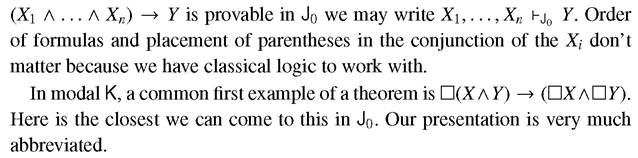
Example 2.4 Assume u, v, and w are justification variables.
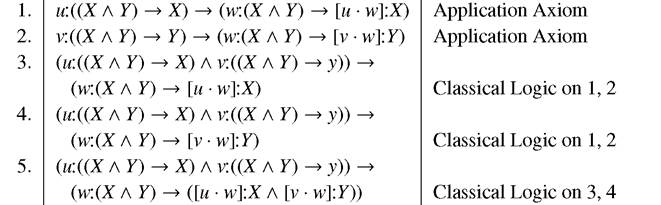
So we have shown that
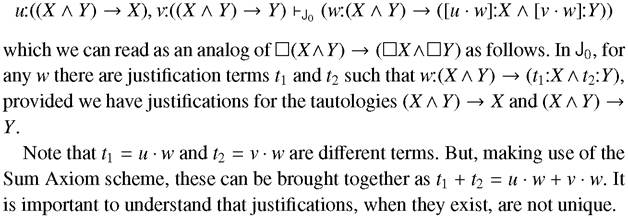
2.4
More on the topic J0, the Simplest Justification Logic:
- Artemov S., Fitting M.. Justification Logic: Reasoning with Reasons. Cambridge: Cambridge University Press,2019. — 271 p., 2019
- Appiah Kwame Anthony. Thinking It Through: An Introduction to Contemporary Philosophy. Oxford University Press,2003. — 425 p., 2003
- Twelver usul
- Integrity as dissonance reduction
- Empirical studies of the effects of social capital
- Chapter 79 A New Macroeconomic Architecture for the Stock Market: A General-System and Cybernetic Approach