THINKING IN STEPS
The basis of all logical thinking is sequential thought. This process involves taking the important ideas, facts, and conclusions involved in a problem and arranging them in a chain-like progression that takes on a meaning in and of itself.
To think logically is to think in steps. People who have difficulty with logical thinking usually have very little patience with these intricate, step-wise processes. This is especially true for those who consider themselves highly intuitive, for example, and who shudder at the mere idea of having to balance a checkbook or write out a plan for some project.If you feel you need to improve your logical skills, the best place to start is in improving your ability to handle sequential thinking processes. You must not only Ieam to tolerate the process of thinking in deliberate, discrete steps, but you must actually develop a certain preference for it. Sequential thinking should be a first resort in those situations that call for it, not a last resort. There are times when an intuitive, flashtype thought process is called for, and other times when a carefully reasoned, linear process is necessary. The mentally versatile person is the one who can do both, and who feels equally comfortable with these two valuable kinds of thinking processes.
In this chapter, I will show you how you can increase your skills in sequential thinking. We will go through a series of thinking exercises, all of which require you to put your ideas into carefully constructed sequences, or progressions of thought. The more of these exercises you perform, the more you will find yourself becoming comfortable with step-wise thinking. Ready? Here we go.
I want you to figure out the ten-letter name of a famous person by constructing the name letter by letter, according to a sequence of clues. Write the individual letters of the name beside the following ten numbers, so as to form a column of letters that spell the name from top to bottom.
Work with a pencil, not a pen. As you do this, pay close attention to how this process feels to you. Get familiar and intimate with your brain’s sequential thought processes, and begin to value and enjoy them.Practice Problem 4-1 (Stepping)
Letters of the Name
1.
2.
3.
4. ∙.
5.
6.
7.
8.
5. '
10.
Here are the clues you need to deduce the name of the famous person.
S
1. Letters 1,2, 3, and 4 mean “to clean.”
2. Letters 3,4, 5, and 6 are a part of the body.
3. Letters 1,5,6, and 7 are found on a bird.
4. Letters 8, 9, and 10 are a unit of measurement.
What is the IO-Ietter name of this famous person?
You probably found this exercise fairly easy. If you were careful to check what you were doing at each step, and you avoided the temptation to jump to conclusions, you probably wound up with the solution: Washington. Did you check all four of the specifications to make sure you had the right answer? This is a very important part of logical thinking— double-checking and assuring that you have put the elements of information together in a reliable way.
Well, so much for your first exercise in sequential thought, or stepping, as we will call it here. Now let’s try some more exercises. For the next round, let’s use a very interesting kind of puzzle called a word ladder. A word ladder is simply a series of words, in which each successive word is constructed by changing only one letter in the preceding word, keeping the arrangement of the letters exactly the same. Here is a classic example, in which we transform the word lose into the word find, by shifting one letter at a time.
EXAMPLE PROBLEM 4-1 (STEPPING)
LOSE '
LONE
LINE
FINE
FIND
Get the idea? It’s fairly simple and it provides an excellent form of exercise in step-wise thinking. While this exercise may be a little too elementary for the veteran puzzle fan, it is ideal for the person who needs to develop sequential thinking skills.
Now, you try it.
Here are some pairs of words for you to practice on. In each case, approach the problem systematically, keeping your work organized and easy to follow. Don’t be reluctant to use paper extravagantly; it’s important to get the problem down clearly and understandably. Use a clean sheet of paper for each problem, and give yourself plenty of room to work. Check the solutions given at the end of the chapter only after you’ve given each of them a good try.Practice Problem 4-2 (Stepping)
1. ChangeEASTtoWEST
2. Change HEAT to COLD
3. Change LION to BEAR
4. Change HATE to LOVE
You probably found that a little concentration and patience took you a long way. If you’ve previously had difficulty with sequential thinking, you’re probably getting more and more comfortable with it.
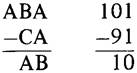
Now, let’s move onto some other forms of step-wise thinking, this time slightly more demanding. We’re going to do some “alphabet” arithmetic. In the following addition problem, each digit has been replaced by a letter of the alphabet. Any one letter always represents the same number whenever it appears. By using your logic, and applying the principles of addition, can you determine what the original numbers were? Try to work it out yourself before you read the expert thinker’s version.
EXAMPLE PROBLEM 4-2 (STEPPING)
Y
Y
+Y BY
Did you work it out all right? In any case, let’s review the expert thinker’s internal monologue.
“Let me see... (!)Y plus Y plus Y equals a two-digit number (rephrasing). Fkst, I’ll try to figure out what Y is—or, on the other hand, what Y is not. Because 3 times Y is more than 9, i.e. a two-digit number, then (!)Y has to be higher than 3 (logical conclusion). Now I notice that the last digit of the answer is the same as each of the three numbers being added up. I can check by multiplication to see which numbers can give that result... let’s see (!)only the number 5 meets that condition (fencing). Three times 5 equals 15, so Y must be 5 and B must be 1.
Got it!”Notice how the if-then reasoning process goes along in the expert thinker’s mind. He or she takes a fact which is given, and makes a logical conclusion based upon that fact. This then becomes the basis for other conclusions, until he or she arrives at the ultimate answer.
Let’s try another, similar problem.
EXAMPLE PROBLEM 4-3 (STEPPING) 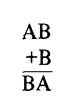
Once again, try to work it out before reading the solution.
Ready for the solution? Here goes.
“Let me see... it’s kind of simple—only two digits to work with. Do I have enough information to solve it? Well... (!)Γ11 look at the ‘carry’ part of the sum, and see if it tells me anything (look at ‘trees’). The first digit of the answer is different from the first digit of the top number, so (!)that tells me that adding B and B produced a ‘carry’ (logical conclusion). That means that B has to be 5 or higher, and it can’t be 5 because that would make A equal to zero, which can’t be true because A is the first digit of the top number. So I’ve narrowed it down a bit... let me see... I know now that A can only be a 6, a 7, an 8, or a 9—one of those.
“Can I (!)check all four of those numbers to see what happens (try all possibilities)? Let me see... if B equals 6, then B plus B equals 12, so A would be 2; does that work? No, because the problem would be ‘26 plus 6 equals 62,’ which is incorrect. Then, let me try ‘B equals 7.’ This would give me 7 plus 7, or 14; if B equals 7, then A equals 4, so the problem would be ‘47 plus 7 equals 74,’ which is also wrong. So B can’t be 7. Let me (!)try the next one—‘B equals 8’ (persistence). Eight plus 8 gives 16, so it would be ‘68 plus 8 equals 86’— nope, wrong again. Well, 9 is the only remaining choice for B. Let me (!)check to make sure (double-checking). IfB equals 9, I have 9 plus 9 equals 18, which makes A equal to 8. So the problem becomes ‘89 plus 9 equals 98.’ That’s correct.
So the answer is ‘A equals 8 and B equals 9.’ Wish I had tried 9 first, but that’s life.”Get the idea? Again, you needn’t feel discouraged if you didn’t get this one exactly, so long as you can follow the form of the logical attack made by the thinker. Once you’ve read a certain number of these kinds of examples and tried your hand at them, you’ll find it starts to soak into your brain more and more.
Now, here are some alphabet-math problems for you to practice on. Keep the following points in mind as you go
1. Make sure you are physically relaxed as you approach each one.
2. Focus your concentration and don’t let that apprehensive feeling set in. Approach the problem confidently and matter-of-factly, and don’t worry about not getting the answer. Concentrate on going through the logical steps to get the solution.
3. Don’t hesitate to use a little trial and error as you go; make a preliminary guess and check to see if it will work. You can always back up and start again.
4. Use a clean sheet of paper for each problem.
5. The letter-number assignments are different for each of the problems.
You’ll find solutions for each at the end of the chapter.
Practice Problem 4-3 (Stepping)
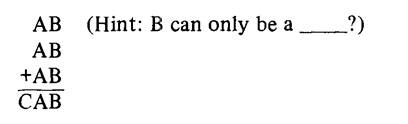
Practice Problem 4-4 (Stepping)

I hope you found these exercises fairly easy, although some of them may have taken you a little time. I also hope you’re becoming more comfortable with the technique of stepping, and that you’re more aware of the value of proceeding in small, measured steps in many problem-solving situations. Train yourself to recognize the need for a step-wise attack as you confront problems that are broader and more practical in their nature. What works for these little thinking puzzles can work equally as well for larger problems involving work, dealings with other people, or the practical business of living.
Solutions to Problems
Practice Problem 4-2 (Stepping)
1. EAST, LAST, LEST, WEST.
2. HEAT, HEAD, HELD, HOLD, COLD.
3. LION, LOON, LOAN, LEAN, BEAN, BEAR.
4. HATE, LATE, LANE, LONE, LOVE.
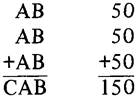
Practice Problem 4-3 (Stepping)
Practice Problem 4-4 (Stepping)