DRAWING PICTURES
The most useful weapon you have for attacking just about any kind of a problem is a pen or a pencil. By drawing a picture, a sketch, a diagram, or some kind of visual representation of the problem, you immediately force it to hold still.
You gain a certain degree of mastery over it.This one factor is probably the most important difference between people who think clearly and logically and those who do not. The skilled logical thinker realizes the value of conceptualizing the problem graphically, putting the various factors down on paper, and organizing what he or she knows so far. The unskilled or inefficient thinker tends to simply sit and muse, without embarking on any particular course of mental action, as if waiting for some inspiration to strike. I call this the syndrome of waiting for the cosmic ray. Many unskilled thinkers seem to believe that logical thinkers simply “get” the solution to a problem in a flash—that it somehow pops into their heads fully formed. They have no idea that the logical thinker actually moves into the problem in small, clearly defined steps and develops an organized picture of it.
Very few logical problem solvers neglect the tremendous benefits of pen and paper. The skilled thinker can seldom be found without a pen somewhere on his or her person. Conversely, the fuzzy-thinking person seldom has a very high regard for those two useful implements. He or she will often encounter situations where a pen is needed and will simply shrug helplessly, and be forced to do without, or try to borrow one from someone else. I have even had people show up in one of my seminars without so much as a pen or paper, presumably expecting to spend all day learning something.
Drawing pictures to help you think logically is fairly simple. It is more of an attitude and a habit than a skill. It has nothing to do with artistic ability—it simply involves taking information and putting it down in a concrete form for further study and thought.
As before, we will listen in (and, in this case, look in) on the thoughts of a skilled thinker, to discover how he or she uses graphic techniques to get control of problems and solve them.Here is a simple problem to think about. Try drawing some kind of a diagram or sketch to help you understand and analyze it. Think carefully about how you might arrange the available information graphically, and what kind of a picture might contribute the most to your understanding.
EXAMPLE PROBLEM 5-1 (PICTURING)
Three playing cards lie face down on the table, arranged in a row from left to right. We know the following things about them.
1. The Jack is to the left of the Queen.
2. The Diamond is to the left of the Spade.
3. The King is to the right of the Heart.
4. The Spade is to the right of the King.
By representing these facts in picture form, determine the face and suit of the card in each position—left, middle, and right. As you work on it, be conscious of the process of thinking visually; make it a familiar and comfortable process. Don’t read further until you have given it a good try.
Ready to see and hear how the skilled thinker might approach this problem? Tum to the end of the chapter to see the sketch he or she drew. If you like, fill in the ,Xs, as you follow along.
Here is the internal monologue: “Well! A playing-card problem. Let me see... first, I need a reliable picture of what’s going on. I’ll just (!)draw three little rectangles in a row from left to right, to represent the left, middle, and right positions (picturing). Now, I have to start associating any facts I have with those positions. Let me see... it’s kind of hard to decide where to begin because none of the facts tells me exactly where any one card goes. I can work by trial and error, but I might have to backtrack lots of times. I know—I’ll make a checklist of all three faces and all three suits in a column to the left of my diagram, just below the sketch of the three cards (picturing).
On the line running across from each face and each suit, I’ll (!)put an ‘X’ below any position that I can rule out (fencing). By a process of elimination, I’ll have a grid of ‘Xs,’ and the empty spaces should tell me which ones go where.“Let me see,... the first fact—‘the Jack is to the left of Queen’—tells me that the Jack can’t be on the right, since it can’t be on the left of anything else (stepping). So I’ll put an ‘X’ under the right position, on the line across from the Jack. The Jack can only be on the left or in the center. Proceeding in the same way, fact number 2 tells me that the Spade can’t be on the left. Number 3 tells me that the Heart can’t be on the right. Number 4 tells me that the King can’t be on the right. Now I see two ‘Xs’ under the right position for the faces. The King and the Jack are ruled out for the right position, so it must be the Queen. Now back to the list of facts. The first two facts aren’t specific enough, because ‘left’ can mean either of two positions. But the third fact, ‘the King is to the right of the Heart’ tells me that the King has to be in the center because the extreme right position is already occupied by the Queen. That also means that the Heart must be in the first position. Now we have the Queen on the right and the King in the center, so that puts the Jack of Hearts on the left. So the King of Diamonds must be in the center. Going from left to right, we have the Jack of Hearts, King of Diamonds, and the Queen must be a Spade. Let me go back and double-check this against the four facts I started with... yep—that’s the solution.”
You might have found a shorter way to do it, either by trial and error, or by just filling in your diagram and drawing certain Conclusionsto fence it down quickly. Either way, I think you’ll agree that a graphic version of the problem is enormously helpful in solving it. I hope you’ll also agree that training yourself to pull out your pen at the slightest indication of the need for logical thinking would be a useful habit to form.
Let’s try another problem.
EXAMPLE PROBLEM 5-2 (PICTURING)
We want to cook some vegetables for a period of 9 minutes, with no breaks. However, the only timepieces available are a 4minute egg timer and a 7-minute egg timer. Neither timer has any markings on it, so they can only be used for starting and stopping. How is it possible to measure a continuous 9-minute period by combining these two timers? Try to work it out before reading further.
Ready to see and hear the expert thinker’s approach? Here is a simple solution, with the diagram given at the end of the chapter. Advanced puzzle solvers will recognize that there is a more clever solution th^Γ the one given, but I’ve chosen this one because it makes it easier to illustrate the skill of picturing without introducing too many other techniques that might be confusing.
Here goes: “Let me see... two egg timers—a 4-minute one and a 7-minute one. How to time a 9-minute period? Think I’ll (!)draw a sketch of this (picturing). I’ll represent the 4minute timer by a bar that’s 4 units long. Next to that, I’ll draw another bar that’s 7 units long, to represent the 7-minute timer. Now I can draw, or visualize, various combinations of these bars, until I find a combination that adds up to 9 minutes. Let’s see... if I run the 4-minute timer twice in a row, starting it together with the 7-minute timer, there’s a 1-minute difference I can take advantage of. One minute before the second 4-minute period is over, the 7-minute timer runs out. Hmm... let me see... I know—I’ll (!)start cooking the vegetables when the 7minute timer runs out (stepping). That will be at the point where there is only 1 minute to go in the second round of the 4-minute timer. After that 1-minute period is up, I’ll immediately turn over the 4-minute timer and start it again. When it runs out—after 5 minutes have elapsed—I’ll turn it over once more for another 4 minutes. That will give me 1 minute plus 4 minutes plus 4 minutes, for a total of 9.
All this thinking about food is making me hungry. Think I’ll have lunch.”(Note to advanced puzzle fans: of course, the problem can be solved without having to wait 7 minutes for the 7-minute timer to finish. Just start the vegetables at the same time you start both timers; when the 7-minute timer is finished, there is 1 minute to go on the 4-minute timer. Just restart the 7-minute timer immediately and let it run until the 4-minute timer’s 1minute period is up. At that time, the 7-minute timer will have 1 minute’s worth of sand at one end, and 8 minutes will have gone by. By reversing the 7-minute timer again and letting the 1 minute’s worth of sand run out, you will have timed two 4minute periods followed immediately by a 1-minute period.)
So there you have it. Two examples of how a diagram, sketch, or other graphic representation of a problem can help you think logically. Now try your hand at these practice problems. Use paper freely, and don’t hesitate to backtrack or start fresh if you feel blocked. Try different kinds of diagrams until you find one that seems to support your thinking process effectively. You’ll find solutions at the end of the chapter.
Practice Problem 5-1 (Picturing)
A bookworm decided to have lunch on a four-volume set of Mark Twain’s works. The books were arranged on the shelf in volume order, going from left to right—i.e. Volume 1, Volume 2, Volume 3, and Volume 4. He started at the first page of Volume 1 and ate all the way through to the last page of Volume 4. The front and back covers of the books were each one- sixteenth of an inch thick, and the pages in each book took up exactly one inch. Question: how many inches did he cover in his eating binge? NOTE: be careful! Draw your diagram carefully, and reread the statement of the problem. Good luck!
Practice Problem 5-2 (Picturing)
This item appeared in a newspaper:
The District Court today overturned the injunction forbidding police to enforce the mayor’s directive to halt construction of X-rated theaters near churches.
Question: Would the leaders of the churches be happy about this, or not? Note: Try drawing a “ladder” diagram showing the precedence of each action in a hierarchy.
These simple problems have given you an opportunity to develop your skills at representing problems in visual form. If you don’t already carry a pen with you wherever you go, make it a habit immediately. Train yourself to draw pictures whenever you confront a new problem, and use diagrams to explain your ideas to others. You’ll soon find picturing to be such a worthwhile process that it will become a fundamental part of your logical problem-solving bag of tricks.
Solutions to Problems
Example Problem 5-1 (Picturing)
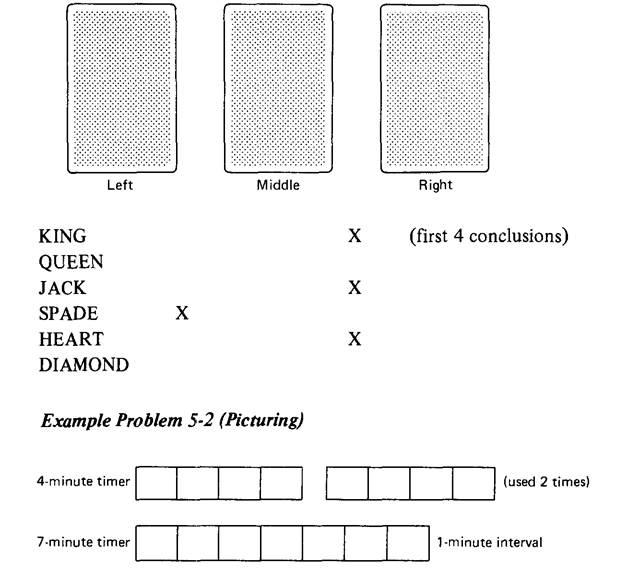
Practice Problem 5-1 (Picturing)
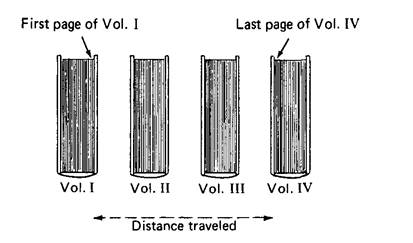
He ate through 6 covers (one-sixteenth inch each), and 2 stacks of pages (1 inch each), for a total of 2 and three-eighths inches.
PracticeProblem 5-2 (Picturing):
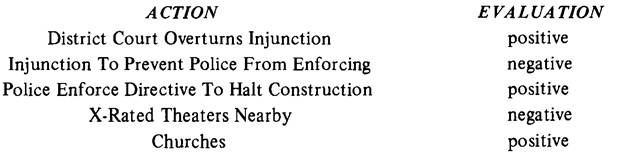
The action would be positive for the churches.
More on the topic DRAWING PICTURES:
- THE SHADOW BOX EXPERIMENTS
- Many Interpretations or One?
- Out of the Shadows (1870s-1910)
- Yakiv de Balmen
- INDIVIDUAL WORK AND COLLABORATION
- §32. Nominal Knowledge
- Legal Advice in Crisis Training for Government Lawyers
- 9.5 SUMMARY
- Youth as a Conveyer of Discomforting Memories
- Until relatively recently, historians of psychiatry were inclined to view the Christian Middle Ages as a medically primitive era, and the period before 1200 was considered particularly bleak.[646]