THE SHADOW BOX EXPERIMENTS
In Plato’s parable of the cave, the prisoners are chained to a single station and see nothing but shadows on the wall. They have no way of distancing or decentering themselves from this one limited view of the world.
Limited and distorted as it may be, it is their reality. Plato’s point is that this is the normal situation of ordinary mortals, leaving them vulnerable to the distortions of group pressure. Sherif’s work on the formation of social norms and Asch’s work on group pressures have important points in common with the prisoners in Plato’s cave. The subjects in the experiments of both researchers are all looking at the scene to be judged in essentially the same way and from the same point of view. Thus, a difference in reports of what is seen must mean a disagreement. There is no opportunity for dialogue among the observers. The subjects are limited to looking and listening; they have no chance for an active exploratory or manipulative approach. Finally, the situation invites only judgment on a single variable, not the construction of a complex idea or object.Under such conditions, intersubjective differences become disagreements that can be solved only by yielding, domination, and compromise—all of which occur.
In contrast, it is possible to imagine conditions in which observers have different information about the same reality but no need to disagree with each other. They may even be able to transcend their individual limitations and together arrive at a deeper grasp of the reality in question than would be possible for each alone. Our research grew out of the conviction that people can be vigorously truthful.
We have embodied this possibility in the microcosm of a shadow box. (See Figure 17.1.) In this arrangement, an object concealed in a box casts two differing shadows on two screens at right angles to each other.
The subjects’ task is to discover the shape of the hidden object by discussing and synthesizing the two shadows of which each sees only one. Although our main interest was the process of collaboration of subjects with different viewpoints, to study that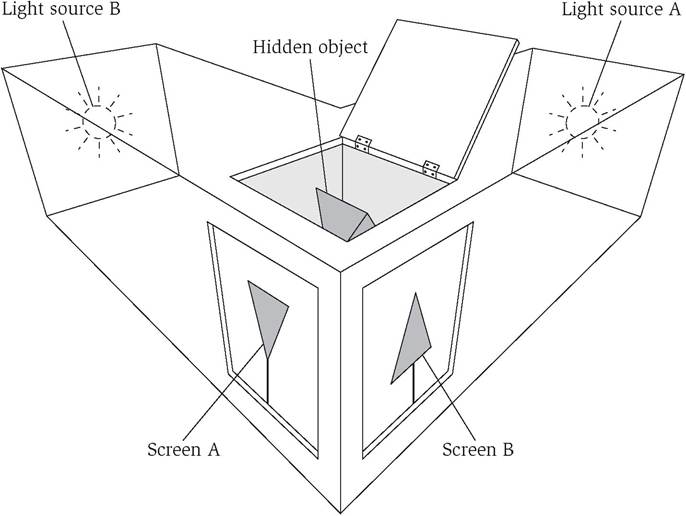
Figure 17.1 The Shadow Box.
Note: The task is to use the two shadows to work out the shape of the hidden object.
Source: Gruber, H. E. “The Cooperative Synthesis of Disparate Points of View.” In I. Rock (Ed.), The Legacy of Solomon Asch: Essays in Cognition and Social Psychology. Mahwah, N.J.: Erlbaum, 1990. Reprinted with permission. we also looked at the performance of single subjects shuttling back and forth between two screens.
Cooperative synthesis of such disparate points of view in the shadow box situation is not a simple matter. Each subject is asked to make an a priori assumption that the other participant’s observations represent the same entity. Each participant must convey what he or she sees clearly and correctly to the other. This may require inventing a suitable scheme for representing the information in question. When difficulties of communication arise, the problem of trusting the other must be dealt with. Often, too, the subjects must overcome a common tendency to ignore or underemphasize the other person’s contribution and to center attention on one’s own point of view.
When we compare one person shuttling between two station points with a pair of people, each of whom sees only one screen, sometimes the single person is superior, and sometimes the pair. Over a wide range of situations, the individual perceptual apparatus is admirably organized for synthesizing disparate inputs: binocular vision, the kinetic depth effect, and all sorts of inter- modal phenomena testify to the capability. On the other hand, there are at least some situations in which two heads are better than one.
From a practical point of view, the question of one head or two may not always be germane.
There are real-world situations in which shuttling back and forth between station points is not feasible, so there must be an observer at each point. In negotiating situations, the number of heads is determined by sociopolitical realities. Going beyond the shadow box, the processes involved in cooperative synthesis of points of view are interesting in their own right.Experiment One: Interaction of Social and Cognitive Factors
The subjects were first shown how the setup worked: two lamps, two screens, and a stalk on which to mount the object. (See Figure 17.1.) They were shown how two shadows could be generated, one on each screen, and it was suggested to them that they could figure out what the object was by talking to each other or drawing pictures (material supplied). We compared subjects working in pairs with subjects working alone. In the pair situation, they were asked not to look at the other person’s screen. The subjects were children (ages seven to nine), adolescents (fourteen to sixteen), and adults (twenty to fifty-three). The pairs were asked to communicate with each other about what they saw, and to work together to come to an agreement as to the shape of the concealed object that would account for the two shadows. Each single subject or each pair of subjects worked on two Lego® objects and two geometrical objects, as shown in Figure 17.2.
The subjects almost invariably found the task challenging and interesting and worked on it for as long as an hour. Among children, the majority failed to solve (correctly synthesize) any of the objects, and among the adolescents and adults there were a few who failed completely.
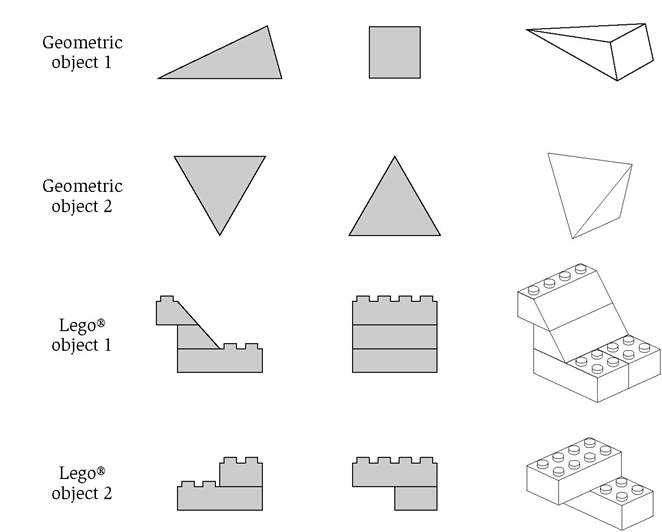
Figure 17.2 Objects and Shadows in Experiment One: Geometrical Objects and Lego® Objects.
Source: Gruber, H. E. “The Cooperative Synthesis of Disparate Points of View.” In I. Rock (Ed.), The Legacy of Solomon Asch: Essays in Cognition and Social Psychology.
Mahwah, N.J.: Erlbaum, 1990. Reprinted with permission.The main difference between adolescents and adults was that the latter often hit spontaneously on the idea that there might be more than one solution to a problem, sometimes even recognizing the possibility of an unlimited number of solutions. To our surprise, in a number of experiments, there was little difference in problem-solving success between singles and pairs. In only one respect was the pair condition clearly superior to the single: frequency of multiple solutions. This superiority was more pronounced in adult pairs than in adolescents.
Experiment Two: Comparison of Cooperative and Individualistic Orientations
Our goal was to examine the effect of social orientations within pairs on the synthesis of points of view. We used three kinds of instruction to the pairs. The cooperative instruction encouraged the pair to work together throughout the experiment, indicating that their performance would be evaluated as a pair compared with other pairs. The individualistic instruction asked the subjects to exchange information as to their respective shadows and then to work alone in solving the problem, indicating that their performance would be evaluated as individuals. The neutral instruction did not specify any mode of working together and did not mention evaluation. The subjects were twenty-four pairs of adolescents (ages fourteen to sixteen) and twenty-four pairs of adults (twenty-three to fiftyeight). There were no consistent or striking differences between the sexes, so that variable is ignored in this discussion.
Each pair was given a single problem, a tetrahedron fixed on an edge in such a position that each subject saw a triangular shadow, one with apex up, the other with apex down (see Figure 17.1). We chose this rather difficult task to avoid the possibility that most subjects would solve the problem easily and to keep the subjects working long enough for us to make the observations we were interested in.
The resulting patterns of social behavior could be classified as individualistic, cooperative, or competitive. Subjects by no means followed the instructions we gave them. Surprisingly, among the adults the predominant behavior was cooperative, even when the instructions were neutral. Furthermore, even in the group given individualistic instructions, almost half the subjects were cooperative. It seemed as though the structure of the shadow box situation, presenting two perspectives bearing on a single object, naturally evoked cooperation as the appropriate response mode.
Most of the successful adult pairs were ones in which both members were cooperative. Moreover, in six of eight such pairs, the partners had different problem-solving strategies, one working mainly by adding planes and the other by constructing volumes. In exchanging information, the adults were more precise and detailed than the adolescents, giving information not only about shape but also about orientation, size, and position on the screen. The adults gave equal weight to both shadows, while the adolescents tended to focus on their own viewpoint. Adults were attentive to their partner’s suggestion, and they duly profited from their differences by improving the quality of their solutions and their comprehension of the tasks. The adolescents were less interested in the other’s ideas. They were also more concerned about whose solution was correct, as if only one were possible.