XAT 2011
Answer Questions 1 and 2 on the basis of the paragraph below.
We are not only afraid of being in the dark; we are also suspicious of being kept in the dark. We often feel that the universe has a hidden order that we cannot quite comprehend.
In ancient times, this order was attributed to the gods—omnipotent beings who controlled humans’ fates. Greekmyths in particular portrayed humans as pawns in the great games played by the gods. More recently, there are suspicions of global conspiracies. These conspiracies are cited for events that are too important to be random. We no longer describe them as ‘Acts of God’, so they must be the work of other people—people who are hiding their influence over us, covering up their involvement. They are keeping the rest of us in the dark. Among the events attributed to these people are political assassinations and UFO sightings. Examining these events in minute detail results in a long list of ‘coincidences’ which, in the minds of the conspiracy buffs, are too numerous to be truly random. There must be a central planner who is at the hub of a sinister form of order. No one admits to the conspiracy, so there must be a cover-up. Better to think that we are all being kept in the dark by sinister forces than to admit that there is no order.1. Which of the following statements, if true, would weaken the underlying logic of the above passage? (2 marks)
I. The human need for order is a highly exaggerated notion. It more often than not leads to creation of theories about the universe. The more sensational the theory, the more prevalent it becomes.
II. The universe is less guided by pure randomness than by well-defined natural processes which are subjected to randomness at varying intervals of time and space.
III. To strengthen their case for a variety of conspiracies, the conspiracy buffs are extrapolating from a very small set of observed ‘coincidences’
IV.The persons propounding the different conspiracy theories are usually novelists who use these theories as a backdrop during the construction of the plots of the novels.
V. The human fear of being kept in the dark is much stronger than the fear of lack of order in the working of the universe.
(a) I, II, and III
(b) I, IIandIV
(c) I, IIIandIV
(d) I, IVandV
(e) II, IVandV
2. Which of the following statements would, if true, strengthen the case for belief in sinister forces and conspiracies being at work in the above paragraph? (3 marks)
I. Though science has progressed a lot in the last two centuries or so, it is still unable to explain/account for more than 80% of the phenomena in the universe.
II. There is now the existence of photographic evidence of presence of UFOs and a growing number of parallel studies showing that the human mind can easily be manipulated to do someone else’s will through various events that manipulate the ‘perceived reality’.
III. The fear of our actions and thoughts being controlled by someone else has intensified with the widespread popularity of the depiction of its gory outcomes by different novelists and movie makers.
ΓV. There is a strong movement to reintroduce the teachings of the biblical evolutionary process and the presence of God in schools around the world.
V. The Darwinian study of evolution of species, the cornerstone of beliefs in fathomable randomness of the workings of the universe has come under a scathing attack for its inaccurate depiction of the causes and process of evolution.
(a) I and IV
(b) I and V
(c) II, IIIandV
(d) I, IIandV
(е) II, III, and IV
3. Impressions are direct, vivid, and forceful products of immediate experience; ideas are merely feeble copies of these original impressions.
Assuming the above statement is true, which of the statements logically follow from it? (3 marks)
I. Every impression leads to an idea.
II. Ideas must follow an antecedent impression.
III. The colour of the 2011 XAT test booklet right in front of a candidate is an impression to her, whereas the memory of the colour of her television set is an idea.
IV.If one was interested in origin of the idea of the colour of a television set, then one needs to understand the impressions from which this idea was derived.
(a) I&III
(b) II & III
(c) II&IV
(d) II, III & IV
(e) I, II, III & IV
4. Media are not just passive channels of information. Not only do they supply the stuff of thought, but they also shape the process of thought. And what the internet seems to be doing is chipping away our capacity for concentration.
Which of the following, if true, would most strengthen the argument presented above? (1 mark)
(a) Nietzsche was forced to use a typewriter when he started losing his vision. After he mastered the machine, he could type with his eyes closed. It was later found that under the effect of the machine, Nietzsche’s prose “changed from arguments to aphorisms, from thoughts to puns, from rhetoric to telegram style”.
(b) One of the effects of the timekeeping instruments has been that we have started deciding on our daily activities based on the clock and not based on our senses.
(c) Studies have shown that the essay writing skills of an average 15-20 year old, who spends a lot of time browsing the internet, is comparable to what it was among the average 15-20 year olds, throughout the 1980s and the 1990s.
(d) A recent study has shown that the number of people who fall asleep while reading a printed book has increased in the last five years.
(e) The ability of the younger judges, who have grown up with ready access to internet, to judge complex and intricate cases, has, on an average, become better as compared to what it was for judges of comparable age profile during the 1920s.
5. Which of the following, if true, would most weaken the argument presented in the previous question? (1 mark}
(a) Nietzsche was forced to use a typewriter when he started losing his vision. After he mastered the machine, he could type with his eyes closed. It was later found that under the effect of the machine, Nietzsche’s prose “changed from arguments to aphorisms, from thoughts to puns, from rhetoric to telegram style”.
(b) One of the effects of the timekeeping instruments has been that we have started deciding on our daily activities based on the clock and not based on our senses.
(c) Studies have shown that the essay writing skills of an average 15-20 year old, who spends a lot of time browsing the internet, is comparable to what it was among the average 15-20 year olds, throughout the 1980s and the 1990s.
(d) A recent study has shown that the number of people who fall asleep while reading a printed book has increased in the last five years.
(e) The ability of the younger judges, who have grown up with ready access to internet, to judge complex and intricate cases, has, on an average, become better as compared to what it was during the 1920s.
6. Randomness has to be dealt with successfully to ensure a better control over one’s life. Before one can deal effectively with randomness, one must acknowledge its existence.
The above statement implies the following except'. (3 marks}
(a) Randomness can be dealt with effectively.
(b) If one acknowledges the existence of randomness, one will be able to deal with it effectively.
(c) One can deal effectively with randomness if and only if one acknowledges its existence.
(d) Everyone lives in a random world.
(e) If one does not acknowledge the existence of randomness, one cannot deal with it effectively.
7. Perhaps this war will pass like the others which divided us, leaving us dead, killing us along with the killers but the shame of this time puts its burning fingers to our faces.
Who will erase the ruthlessness hidden in innocent blood?
Which of the following is certainly not implied in the above verse? (1 mark}
(a) Killers also get killed in war.
(b) Humanity gets divided by war and reunites afterwards in peace.
(c) This war is especially ruthless.
(d) This war is shameful to the entire humanity.
(e) None can obliterate the ruthlessness of this war.
8. As the information on air warfare tasks and stressors was being gathered and scenarios were being developed, a parallel effort ensued to identify a test bed simulation for air warfare teams.
To maintain experimental control, it was determined by the designers that choosing a low physical fidelity simulation was acceptable as long as cognitive fidelity in a team simulation was maintained by subjecting soldiers to pressure situations in a simulated combat setting and attempting to ensure that naturalistic decision-making of soldiers would not be compromised.Which of the following statements, if true, weakens the logic of the above passage? (2 marks}
I. A number of studies have shown that high levels of physical stress lead to a weakening of the decision-making capabilities Ofhumanbeings.
II. It has been convincingly demonstrated by various studies that human beings by nature are not designed to adapt to high levels of mental stress.
III. Numerous studies have shown that simulated environments can be designed to be good substitutes for real-life combat situations.
IV.Studies have shown that simulated exercises for armed forces personnel tend to induce a systematic type of ‘correct’ and common behaviour among the trainees.
V. Officers, when short-listing soldiers for critical operations, pick up battle- hardened soldiers rather than those who have been trained through simulations.
(a) I and II
(b) IIandIII
(c) I and IV
(d) I, II, IV, and V
(e) II, III, IV, and V
9. The motivation of human beings towards their work is a subject matter that is at once a simple as well as an extremely complicated matter. For a long time, economists, sociologists, as well as psychologists believed that a carrot and stick approach, with monetary incentives playing the role of the carrot, would be sufficient to goad employees towards achieving higher levels of performance. However, a number of recent studies and observations, especially dealing with the open source revolution are placing on the table strong evidence suggesting that monetary incentives are only one part of the entire story of motivation through incentives. In a study conducted by a group of researchers at MIT, it was found that monetary incentives work well only in respect of tasks requiring mechanical skills, i.e.
those tasks not requiring much use of higher level cognitive abilities (such as memorising or problem solving). In fact their study showed that setting high monetary incentives for tasks requiring cognitive abilities were more likely than not to produce adverse outcomes. Since this result flew straight in the face of the widely accepted body of knowledge on employee motivation, they conducted multiple experiments in different settings and countries to ensure that it was not a one-off result. The findings were the same in all repetitions of the experiment. These studies appear to suggest that monetary incentives need to be provided only to such an extent as to take the minds of employees off the issue of money and focus on other issues that are necessary to get the job done right. For instance, some experiments have shown that greater autonomy to employees and lowered interference from management (and bosses) is successful in driving the performance of employees working in cognitive skill intensivejobs.Identify the statements) that is (are) logically consistent with the content of the paragraph. (2 marks)
I. The carrot-stick approach essentially requires the use of rewards to get more of a desired behaviour whereas penalties lead to increased undesirable behaviour.
II. Expending time and effort on the design of monetary incentives is a wasteful exercise.
III. The study by the group of MIT researchers was a flawed exercise from the start.
IV. There appears to be a need to reorient the existing paradigm prevalent in incentive design.
V. During the process of designing incentives, one should clearly delineate activities into those requiring mechanical skills and those requiring higher- level cognitive skills and design with separate sets of incentives and penalties for each.
(a) I and IV
(b) I and V
(c) IIandIII
(d) IIandIV
(e) IVandV
Answer Questions 10 and 11 on the basis of the following conversation between two friends, Paradox (P) and Herodox (H).
P: The human body is but the tomb of the soul and the visible world of matter is appearance that must be overcome if we are to know reality. The former is an integral part of ‘being’, that which can neither come into existence nor cease to exist for it always is. ‘Being’ is unmoved and undistributed. Motion and disturbance belong to the realm of ‘becoming’, the changing world of unreality rather than of ‘being’ in which true reality resides. Further, motion & change by belonging to the realm of ‘becoming’ by having no separate existence of their own are logically inconsistent with reality and hence, unworthy of serious study.
H: All things are in a state of perpetual flux. Permanence, and by extension, the concept of ‘being’ is only an illusion. This change and continual transformation, through an often disorderly process of conflict and survival of the fittest, is the underlying principle at work in the universe. It is from this principle that all things come into existence, and forms the basis for the morals and governance patterns that attempt to preserve the social thread of societies. By extension, the study of human activity through the lens of an idealised state of ‘being’ and as a basis for formulating moral codes of conduct is inappropriate at best.
10. Which of the following statements could be considered as logically consistent with the views of paradox in the above paragraphs? (3 marks)
I. A fly travelling on a flying arrow perceives it to be at rest. Therefore the flying arrow belongs to the realm of being.
II. The activities of the day to day life are concerned with the unreal part of human existence and hence, should not be subject to moral standards.
III. Maintaining a balance among the various constituents of society is essential to the well-being and the continuing existence of the soul.
IV.Conflicts and the coming of spontaneous order do not have any underlying causes that are relevant for study as the notion of perpetual flux itself is erroneous.
V. The real is and cannot be non-existent. Further, reality is one and unique.
(a) I only
(b) IIandIV
(c) IVandV
(d) I, II, and III
(e) I, IV, and V
11. Which of the following statements best represents an implication of Herodox’s ideas? (2 marks)
(a) Religion and other approaches that stress on maintaining and developing the purity of the human soul are subjects that do not merit serious attention.
(b) The setting of moral standards and codes of governance have to be more procedure-oriented with a focus on the way humans conduct themselves in their interactions with each other.
(c) Maintaining a balance between various constituents of the society and conflict prevention is essential to the maintenance of social order and a pre-requisite for governance.
(d) As the real world relevant to the existence of human beings is in a state of perpetual flux, attempting to study the same in a systematic manner would be meaningful despite reality Itselfhaving changed by then.
(e) There is no notion of time-space-invariant reality. There can be numerous realities both across times and across human cultures and civilisations.
Answer Questions 12 to 14 on the basis of the information below.
Five reviews of the recently published novel, Caught in a Blizzard, are reproduced below. The reviews and the reviewers are identified as indicated by the alphabets.
(a) This novel can change your life—for the good, as it has changed mine. It has made me reflect critically about my life.
(b) The novel has become a popular piece of literature, more among the youth than among the older population.
(c) The author uses the plot in her novel to present her philosophy about life in a positive light, rather than relying on the merits of the philosophy per se.
(d) The author is known to be a writer of great power. The intricate and captivating plots in her novels show that she has a subtle and ingenious mind.
(e) People have been jolted out of their beliefs about love and other different aspects of life after reading this novel.
The options to the questions 12-14 are same as the reviews/reviewers indicated above.
12. There has been criticism about reviewers that they write reviews after having a cursory reading of the book in question. Based on the analysis of the different reviews, which reviewer is most likely to have read the book in greater detail as compared to the other reviewers? (1 mark}
13. Out the five reviews given, which one can be most objectively validated? (1 mark}
14. Which reviewer eulogises the author rather than critically reviews the novels? (1 mark}
15. Indian government may hold top executives responsible if state-run power companies fail to meet performance targets and punish them with fines and transfers. The strict performance parameters are aimed at ensuring that at least the reduced target for 62,000 MW of generation capacity addition is achieved before the end of the Ilth Plan, said a power ministry official. The performance of chairman and managing directors of the power Public Sector Units (PSUs) in project implementation will be assessed as per the terms and conditions stipulated in the company’s memorandum of understanding (MoU) with the power ministry, he said, requesting anonymity. Performance parameters of executives had came under strict scrutiny due to a lack of progress in capacity addition program. While the target for the Ilth five year plan has already been scaled down by the government from 78,500 MW, in the first three years of the plan yielded only 22,302 MW of fresh capacity.
If you were the chairman of one of these power PSU’s, which of the following statements (all of which are assumed to be true) could best be used in order to strengthen your case against the government holding top executives responsible? (3 marks}
I. The labour unions, owing allegiance to the ruling party at the Center, are not allowing work to progress with their demands for wage hikes that are untenable.
II. The actions of the mid-level management are not in line with the objectives laid down by the top management.
III. The delays have been due to difficulties in obtaining funds at reasonable interest rates on account of the recessionary conditions.
IV.We are not to blame. The government is not doing enough to ensure availability of sufficient fuel to power the existing plants, let alone the new plants.
V. The government had ignored the infrastructure availability like roads etc., and environmental clearances required for such projects and therefore set an unrealistic target to begin with, and the revised target is also unrealistic as well.
(a) I and II (b) I and III
(c) I, III and IV (d) II, IV and V
(e) I, II, III, IVandV
Answer Questions 16 and 17 on the basis of the paragraph below
The CEO of ABC Telecom Ltd. (ABC) is in a quandary since he received the telephone call in the morning from his counterpart at LMN Telecom Ltd. (LMN). Both companies were engaged in a bitter experience a couple of years ago when they had attempted to merge with the intention of creating a behemoth telecom company, possibly the largest in the world. The merger had fallen through due to the opportunistic behaviour on the part of Mr. Das, then CEO of LMN. During the time the merger talks were taking place, Mr. Das had also approached a few other suitors for LMN in an attempt to force ABC to pay a higher price. Eurther, there were reports of attempts by management of LMN to scuttle the deal. Back then, ABC had also faced stiff opposition to the deal from one of its large shareholders.
Since then, a lot has changed for both companies. The bleak economic conditions due to recession had led to a drastic fall in the market value of both companies, with ABC comparatively losing much more in terms of market value. Raising money has become more difficult for both companies, especially for LMN. On the brighter side for ABC, the opposing shareholder had recently sold off his stake to another investor who earlier had supported the original merger deal with LMN a couple of years ago.
16. Which of the following would be the most appropriate line(s) of thought for the CEO of ABC to adopt in response to the offer by LMN?(3 marks)
I. Once bitten twice shy There is simply no way
I can think of resuming talks with LMN after their unethical behaviour the previous time around. I would rather spend my time on merger discussions with other companies.
II.
The deal may make less business sense this time around. However, if it goes through, I will become the CEO of the world’s largest telecom company. So let us try our luck once more.
III. I will resume talks only if they provide guarantees as to the reimbursement of our expenses incurred, in the event of the deal not materialising.
IV.Let me not be biased against dealing with LMN, if we can secure the deal at a reasonably low price, benefiting our shareholders, let us go ahead with it.
V. I am not sure if we can raise the money now. In any event, they are the ones facing greater financial problems. So let’s not hurry now. We might have an opportunity to buy them out at a cheaper price later.
(a) I and III (b) II and IV
(с) II and III (d) I and IV
(e)IVandV
17. The merger of ABC and LMN has been confirmed after detailed negotiation with LMN holding the majority share of the resultant entity. LMN has financed the merger by taking debt at higher-than-market interest rates from its bankers, in the hope that it would be able to streamline operations and reduce costs in the resultant entity which will allow it to repay the loan. If you were an investor looking to invest in telecom companies, which of the following could be the strongest reasons for staying away from investing in the resultant entity? (3 marks)
(a) The new entrants in the telecom market were coming with better offers for the customers.
(b) The market would be as competitive as ever for the resultant entity, thus providing no guarantee for success.
(c) The combined management did not present any grand strategies to the investors.
(d) ABC’s management was giving in to Mr. Das who was a known opportunist.
(e) LMN was using high cost debt to purchase another company in the same industry facing similar problems with no visible advantage for the combined entity over competitors.
18. Wind turbine maker Leone Energy posted a net loss of' 250 crore for the fourth quarter ended March 31, 2010 as against a net profit of' 350 crore in the same quarter a year ago. In the financial year 2009-10, the company clocked a gross income of' 6,517 crore, as against' 9,778 crore in the previous year. Leone Energy clocked a loss of' 1,100 crore in 2009-10, as against a net profit of' 320 crore in 2008-09. The sales revenues stood at' 22,400 crore for the year, approximately 21 per cent less against' 28,350 crore last year. For the financial year ending March 31, 2010, Leone Energy’s sales volume (in terms of capacity of projects executed) was 4,560 MW from 2,935 MW a year ago. The CEO of Leone Energy in his message to shareholders suggested that the poor performance of the company was the result of adverse economic conditions during the year ended March 31, 2010.
You are a shareholder owning 5% of the shares of Leone Energy, have seen the stock price decline by more than 50% during the year 2009-10, and are quite upset with the way the management has been handling the business. You have decided to confront the management at the next shareholders’ meeting and have chosen the following 5 points to argue against the CEO’s version of the story. In light of the above paragraph, select the most appropriate order of these 5 statements that you, as a disappointed shareholder, should adopt as a stinging and robust preface in your case against the management in front of the management and other shareholders. (3 marks)
I. The management is not doing its best to maintain the profitability of the company.
II. The company has actually increased its sales volume during the year under consideration.
III. The adverse economic conditions have led to a worldwide increase in the adoption of alternative energy sources, reflecting in all- time highest profits for wind turbine makers in both developed and developing countries.
IV.The management has been lax with its employees as the management enjoys a large set of benefits from the company that they would have to forgo if they became strict with employees.
V. The company is trying to increase sales by
charging lower, unprofitable prices.
(a) II, III, I (b) I, III, II
(b) II, V, III (c) III, II, V
(e) V, II, III
19. On 1st March, Timon arrived in a new city and was looking for a place to stay.
He met a landlady who offered to rent her apartment at a reasonable price but wanted him to pay the rent on a daily basis. Timon had a silver bar of 31 inches, and an inch of the silver bar was exactly equal to a day’s rent. He agreed to pay an inch of the silver bar towards the daily rent. Timon wanted to make minimum number of pieces of the silver bar but did not want to pay any advance rent. How many pieces did he make7(3 marks)
(a) 5 (b) 8
(c) 16 (d) 20
(e)31
Readthe following case and choose the best alternative (Questions 20-23):
Chetan Textile Mills (CTM) has initiated various employee welfare schemes for its employees since the day the mill began its operations. Due to its various welfare initiatives and socially responsible business practices, the organisation has developed an impeccable reputation. Majority of the regular workers in CTM had membership of Chetan Mills Mazdoor Sangh (CMMS), a non-political trade union. CMMS had the welfare of its members as its guiding principle. Both CTM and CMMS addressed various worker related issues on a proactive basis. As a result no industrial dispute had been reported from the organisation in the recent past.
These days majority of the employers deploy large number of contract labourers in their production processes. In an open economy survival of an organisation depends on its competitiveness. In order to become competitive, an organisation must be able to reduce cost and have flexibility in employment of resources. Engaging workers through contractors (contract labourer) reduces the overall labour cost by almost 50%. Indian labour legislations make reduction of regular workers almost impossible, but organisations can overcome this limitation by employing contract labourers. Contract labourers neither get the same benefit as regular employees nor do they have any job security. According to various recent surveys, government owned public sector units and other departments are the biggest employers of contract labourers in the country. Contractors, as middle-men, often exploit the contract labourers, and these government organisations have failed to stop the exploitation.
Over time CTM started engaging a large number of contract labourers. At present, more than 35% of CTM’s workers (total 5,000 in number) are contract labourers. CMMS leadership was wary about the slow erosion of its support base as regular workers slowly got replaced by contract workers and feared the day when regular workers would become a minority in the mill. So far, CMMS has refused to take contract labourers as members.
Recently, based on rumours, CTM management started to investigate the alleged exploitation of contract labourers by certain contractors. Some contractors felt that such investigations may expose them and reduce their profit margin. They instigated contract labourers to demand for better wages. Some of the contract labourers engaged in material handling and cleaning work started provoking CTM management by adopting violent tactics.
Today’s newspaper reports that police and CTM security guards fired two or three rounds in air to quell the mob. The trouble started while a security guard allegedly slapped one of the contract labourers following a heated argument. Angry labourers set fire to several vehicles parked inside the premises, and to police jeeps.
20. In the wake of recent happenings, what decision is expected from the CTM management? From the combinations given below, choose the best sequence of action. (4 marks)
I. Stop the current investigation against the contractors to ensure industrial peace; after all allegations were based on rumours.
II. Continue investigation to expose exploitation and take strong actions against trouble makers.
III. Get in direct touch with all contract labourers through all possible means, communicate the need for current investigation to stop their exploitation, and convince them regarding CTM’s situation due to competition. Also expose those contractors who are creating problems.
IV. Promise strong action against the security guards who are guilty.
V. Increase the wages of contract labourers.
(a)I, V (b) I, II
(c)II, V (d) III, IV
(e)∏I, V
21. In the current context, which among the following represent the most suitable
reaction from the CMMS leadership? (5 marks)
(a) Distance CMMS from the episode and explain that CMMS is not involved in the fiasco through a press conference.
(b) Offer membership to contract labourers, which would put the contract worker at par with the regular workers in CMMS.
(c) Do not offer membership to contract labourers, but represent their interests during negotitation in order to prevent the formation of another union in CTM.
(d) Start another union exclusively for contract labourers of CTM.
(e) Adopt a neutral stand in public, and pass on information related to problem creators to the CTM management.
22. Out of the options given below, which one would be the best policy decision by the government at the national level? (2 marks)
(a) Asking the CTM management to pay same wages to both regular and contract workers.
(b) Income tax raids in offices of contractors under investigation.
(c) Setting up a new labour welfare office within CTM premises.
(d) Setting up a new committee to make recommendations for changes in labour legislations with an objective to reduce exploitation of contract labourers.
(e) Use entire government machinery to support CTM, which has an impeccable track record.
23. The criminals in the surrounding area often took their cue from the situation in the mill, creating law and order problems outside the mill which would later make it difficult for workers to come to the mill safely. Given the circumstances, identify the stakeholder that should be the immediate priority of the CTM management. (1 mark)
(a) Contract labourers who were allegedly beaten by the security guard of the company.
(b) District administration that is concerned about the spread of violence.
(c) CMMS that prefers an immediate settlement of the issue.
(d) Customers who are concerned about prices and regular supplies.
(e) Contract labourers who are demanding job security and same wages as regular employees.
Answer question numbers 24-26 based on the following information.
Alex Company has its office at the third floor of a multi-storied building in Mumbai.
There are 5 rooms to be allotted to 5 managers (designated Ml to M5), each of whom will occupy one room. Each room has its own advantages and disadvantages. Some have the sea view, while others are closer to either the lift or the dining room, while some are more spacious. Each of the five managers was asked to rank the room preferences amongst the rooms 301, 302, 303, 304 and 305. Their preferences were recorded as follows:
| Preference | Ml | М2 | М3 | M4 | M5 |
| 1st | 302 | 302 | 303 | 302 | 301 |
| 2nd | 303 | 304 | 301 | 305 | 302 |
| 3rd | 304 | 305 | 304 | 304 | 305 |
| 4th | 301 | 305 | 303 | ||
| 5th | 302 |
Some managers did not indicate any preference for some rooms, as they did want to be there under any condition. The company decided to allot rooms to managers in such a way that the managers get rooms as per their best preference or close to that.
24. How many managers would get the rooms as per their best preference? (2 marks)
(a) 1 (b) 2
(c) 3 (d) 4
(e) 5
25. If manager X gets his/her 1st choice, then his/her preference ranking is 1 and so on. Management decided to allot rooms so that the sum of the preference ranking of all the managers is minimised. What is the total preference ranking for the rooms allotted to all the managers? (3 marks)
(a) 5 (b) 6
(c) 7 (d) 8
(e)9
26. Suppose that Manager М2 decides not to join the new zonal office and Manager M6 takes his place. Manager M6 has the following preference ranking in decreasing order: 301, 302, 303, 304. In this case what would be the sum of the preference ranking allotted to all five managers? (2 marks)
(e)9
Answer question numbers 27 and 28 based on the following information:
Every Saturday, the members of Raja Harish Chandra Club meet in the evening. All the members of the club are honest and never lie. Last Saturday, the following conversation was heard at one of the tables with five members sitting around it.
Satya Sadhan: In this club not all members are friends with each other.
Satyabrata: None of the pair of friends in this club has any common friend.
Satyajit: Every pair of members who are not friends has exactly two common friends in this club.
Satya Pramod: There are fewer than 22 people in this club.
| 27. How many members are there in the club? (5 marks) | |
| (a) 5 | (b)7 |
| (c) 15 | (e)16 |
| (e) 20 | |
| 28. How many friends does Satya Sadhan have in the club? (3 marks) | |
| (a) 2 | (b)3 |
| (b)5 | (d)7 |
| (e)8 | |
Answer question numbers 29-32 based on the following information:
In the country of Gagan, air travellers can buy their tickets either directly from the airlines or from three websites that are licensed to offer ticketing services online. In Gagan most of the commercial transactions are done electronically, and all citizens have an account with its national bank CeeCee. As a result the three websites have become popular and each transaction through these websites carries a surcharge of Gs. 250 (Gs. refers to Guppes, currency of Gagan). Given below are four post new-year (January 2, 2011 to February 28, 2011) offers Ifomthree Competingwebsites:
Cozy travel Offer. Make a confirmed booking for any service (fight ticket, hotel or rail tickets) through Cozy_travel.com from December 5, 2010 to February 8, 2011 and become eligible for two free air tickets (offer is limited to the base fare). Free tickets have to be booked through online request from January 1, 2011 to February 28, 2011. The request for free tickets should be submitted at least twenty-one days in advance. Free tickets are non-amendable (except the passenger name) and cannot be cancelled. Free ticket cannot be exchanged for cash or kind with anybody. Cozy travel will try its best to secure the free ticket as per the request. However, ticket confirmation is subject to airline schedule and seat availability in airlines selected and finalised by Cozy travel from specific available airlines.
Cooljyatra Offer. Book any air ticket of any airline on Cool_yatra.com on or after December 21, 2010 and get your next ticket free. Under this offer, only the base fare of free ticket will be refunded by Cool_Yatra.com. The customer will have to bear the rest of the charges (other fees and surcharges). The value of the base fare will be refunded to passenger on/after March 1 or fifteen days after completion of travel on the free ticket (whichever is later). The free ticket can be booked only on Gaga Air flights. The free ticket must be booked within fifteen days of booking the original ticket and the travel date of free ticket must be fifteen days after the booking date of free ticket. There must be a seven day gap between the travel date of main/original ticket and the free ticket. The travel date of free ticket should be on or before February 28, 2011. The free ticket cannot be transferred. On cancellation of the original ticket(s), you no longer remain eligible for the free ticket(s).
Easy travel Cash Back Offer Easy travel offers 25% cash back on all air ticket bookings between December 5, 2010 and February 28, 2011 using CeeCee net banking service or its debit/credit card. The cash back amount will be credited back to customers account within twenty-one days from making the transaction. Maximum cash back during the period is Gs. 400 per person per ticket and total amount that can be claimed by the customer is Gs. 2,400
Ek Ke Sath Ek Offer from Easy travel·. Book an Air Spice ticket with Easy travel using any credit/debit card, and get another ticket absolutely free. The free tickets will be issued on Air Spice on its entire network. The offer is valid for sale from January 11, 2011 to January 31, 2011. The free ticket must be booked at least fifteen days prior to the date of travel and need to be completed within the offer period. The promotion code for the free ticket will get activated only seven days after booking the main ticket. Easy travel will charge a handling fee of Gs. 1000/- per person for any amendments made on the main ticket. Cancellations of tickets purchased under this offer are not permitted. The free ticket obtained under this offer cannot be exchanged for cash and cannot be re-routed.
29. Which offer has got the maximum chance for becoming the most popular among the air travellers of Gagan during the post new-year period? Among the following options, choose the best offer-explanation combination. (3 marks)
(a) Cozy travel, because the customers will get twice the number of flights and offer is applicable for all services provided by Cozy travel.
(b) Cozy travel, because it allows any customer to transfer the free ticket to any one if they are not interested in using it.
(c) Ek ke sath ek offer from Easy travel, because it offers absolutely free tickets to all customers.
(d) Cash Back offer from Easy travel, because all other offers are restricted either in terms of airlines to choose or the period of offer.
(e) Cozy travel, because it allows customers to use free tickets even after post new-year period.
30. Suppose the offer from Cool yatra became the most popular, and the other two agencies seek help from business consultants to make their offers more attractive. Identify the best recommendation among the following. (3 marks)
(a) Recommendation for the Ek Ke Sath Ek Offer of Easy travel: Negotiate with Gaga Air to come up with an offer that provides one free ticket for every main ticket booked in Air Spice.
(b) Recommendation for the Cash Back Offer of Easy travel: Ensure that cash back amount will be credited back to the customer’s account within fifteen days.
(c) Recommendation for the offer from Cozy travel: Reduce the number of free tickets to one and applicable only for air ticket booking (not for other service), but allow customers to book their free ticket from Cozy_travel.com in Gaga Air or comparable airlines without any date restrictions.
(d) Recommendation for the Ek Ke Sath Ek Offer of Easy travel: Negotiate with Gaga Air to come up with an offer that provides one free ticket for every main ticket booked in Gaga Air and run both offers simultaneously.
(e) Recommendation for the offer from Cozy travel: Do not allow customers to transfer tickets to others, but disclose that Cozy travel will consider both Gaga Air and Air Spice flights that connect all cities in Gagan for issuing free tickets.
31. Jagan is appearing for MAAT exam on January 2, 2011, in a city which is not his home town and he is yet to book the air ticket to reach his hometown from MAAT center. Based on his MAAT performance, he is confident about getting an interview call from the institute of his choice located in Akashpur. All institutes associated with MAAT will contact the short-listed candidates within the next two weeks with the venue details and date of interview. Interviews will be scheduled within fifteen days from the date of announcement of shortlist, and will be held at the respective institutes. Jagan’s hometown, MAAT centre, and Akashpur are connected by all airlines and the base fares start at Gs. 1,000. While visting Akashpur for the interview, Jagan will have to put up in a hotel. The minimum charge for booking a hotel in Akashpur through Cozy travel is Gs. 2,400. Equally good hotels which are not listed in the Cozy travel website charge Gs. 1,000. All the three travel websites assure a minimum of one free air ticket for every booking. If Jagan has no other reason to fly, which of the following offers should Jagan go for? (3 marks)
(a) Ek Ke Sath Ek Offer of Easy travel.
(b) Get the flight ticket and hotel booking from Cozy travel. He should use confirmed free ticket for return journey and exchange extra ticket (if any) on barter basis.
(c) Get the flight ticket through Cozy travel, and use the second ticket if available for the return journey.
(d) Get the flight ticket from Cool yatra.
(e) Get the flight ticket and hotel booking through Cozy travel, and use the free tickets for return journey.
32. Janaki needs to reach Khilli on January 28 to visit her uncle, and will return after fifteen days. Janaki found that the minimum fare for both the to and fro journeys is Gs. 5,000 which includes Gs. 1,200 base fare. If all airlines connect Janaki,s city to Khilli, and all three offers (except the Cash Back Offer) ensure minimum of one free air ticket, which of the following should Janaki opt for? (3 marks)
(a) Ek Ke Sath Ek Offer of Easy travel
(b) Cash Back Offer of Easy travel
(c) The Cozy travel offer
(d) The Cool yatra offer
(e) Buy air tickets directly from airline websites
Answer question numbers 33-35 based on the following information:
On a certain day six passengers from Chennai, Benguluru, Kochi, Kolkata, Mumbai and Hyderabad boarded the New Delhi bound Rajdhani Express from Tata Nagar. The following facts are known about these six passengers:
• The persons from Kochi and Chennai are less than 36 years of age.
• Person Z, the youngest among all is a doctor.
• The oldest person is from Kolkata and his/her profession is same as that of the person who got down at Mughal Sarai.
• The persons from Bengaluru, Chennai, Hyderabad and Mumbai got down at four different stations. The eldest among these four got down at Koderma and the youngest at Kanpur. The person who got down at New Delhi is older than the person who got down at Mughal Sarai.
• The engineer from Bengaluru is older than the engineer from Chennai.
• While arranging the teachers in increasing order of age it was observed that the middle person is as old as the engineer from Chennai.
• Person Y who got down at Mughal Sarai is less than 34 year old.
• The teacher from Kochi is four years older than the 31 year old doctor who is not from Mumbai.
• In the past, three of the travellers have served in the Indian Army.
33. Which of the following options is true? (2 marks)
(a) The person from Chennai is older than the person from Kochi.
(b) The oldest teacher is from Mumbai.
(c) The person from Mumbai is older than at least one of the engineers.
(d) The person from Kochi got down at Mughal Sarai, and was an engineer.
(e) The person who got down at New Delhi is older than Y, who in turn is older than the person from Hyderabad.
34. All six travellers are working in the same organisation for at least one year. The organisation recruits two categories of employees—fresh graduates and those who have at least five years of experience in the Indian Army. In both cases a new recruit should be less than 30 years of age. Among the travellers from the same profession, those with military background are at least five years older than the travellers who joined as fresh graduates. Identify the travellers who joined the organisation as fresh graduate(s). (2 marks)
(a) Only Y.
(b) The person Y and the traveller from Chennai.
(c) The person Y and the travellers from Kochi and Hyderabad.
(d) The travellers from Kochi and Hyderabad.
(e) The teacher from Mumbai, the traveller from Kochi and the younger engineer.
35. If W is neither the youngest nor the oldest among the travellers from her profession, which of the following is true about her? (2 marks)
(a) She got down at Koderma.
(b) She is 36 years old.
(c) She got down at Mughal Sarai.
(d) She is from Kochi.
(e) None of the above
Answer Questions 36-38 based on the following information:
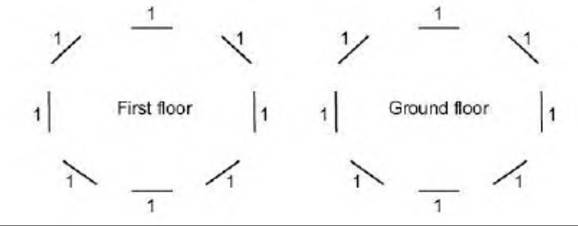
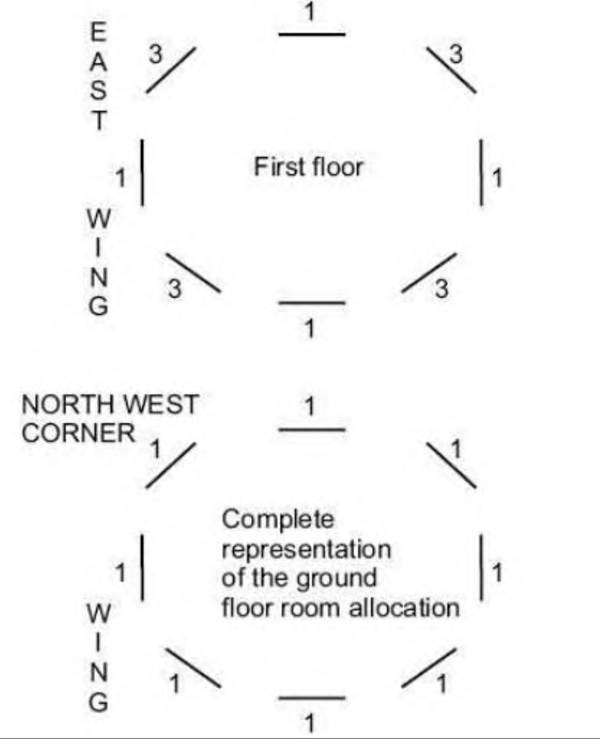
Mrs. Sharma has a house which she wants to convert to a hostel and rent it out to students of a nearby women’s college. The house is a two storey building and each floor has eight rooms. When one looks from the outside, three rooms are found facing North, three found facing East, three found facing West and three found facing South. Expecting a certain number of students, Mrs. Sharma wanted to follow certain rules while giving the sixteen rooms on rent:
All sixteen rooms must be occupied.
No room can be occupied by more than three students.
The Six rooms facing the north are called the north wing. Similarly, six rooms facing east, west and south are called as east wing, west wing and south wing respectively. Each corner room would be in more than one wing respectively. Each of the wings must have exactly 11 students. The first floor must have twice as many students as the ground floor.
However Mrs. Sharma found that three fewer students have come to rent the rooms. Still Mrs. Sharma could manage to allocate the rooms according to the rules.
36. How many students turned up for renting the rooms? (3 marks)
(a) 24 (b) 27
(c) 30 (d) 33
(e) None of these
37. If Mrs. Sharma allocates the north-west corner room on the ground floor to 2 students, then the number of students in the corresponding room on the first floor, and the number of students in the middle room in the first floor of the east wing are: (2 marks)
(a) 2 and 1 respectively
(b) 3 and 1 respectively
(c) 3 and 2 respectively
(d) Each should have 3 students
(e) Such an arrangement is not possible.
38. If all the students that Mrs. Sharma expected initially had come to rent the rooms, and if Mrs. Sharma had allocated the north-west corner room in the ground floor to 1 student, then the number of students in the corresponding room on the first floor, and the number of students in the middle room on the first floor of the east wing would have been: (2 marks)
(a) 1 and 2 respectively
(b) 2 and 3 respectively
(c) 3 and 1 respectively
(d) Each should have 2 students.
(e) Such an arrangement is not possible.
Answer Key
| l.(b) | 2. (d) | 3.(d) | 4. (d) |
| 5. (e) | 6. (b) | 7. (b) | 8. (c) |
| 9. (e) | 10.(C) | ll.(e) | 12. (a) |
| 13.(b) | 14. (d) | 15. (b) | 16. (e) |
| 17. (e) | 18. (c) | 19. (a) | 20. (d) |
| 21. (c) | 22. (d) | 23. (e) | 24. (c) |
| 25. (c) | 26. (e) | 27. (d) | 28. (c) |
| 29. (c) | 30. (d) | 31. (a) | 32. (b) |
| 33. (e) | 34. (c) and (e) | 35. (d) | 36. (b) |
| 37. (b) | 38. (b) | ||
| Solutions: | |||
1. The human need for order is a very strong argument being portrayed in the paragraph. In order to weaken it we need to undermine this logic. Statements I, II and IV undermine this need of order and also as these being false notions propagated by people. Thus option (b) which contains statements I, II and IV is the right answer.
2. To strengthen the case for sinister beliefs we have to find points which lessen the rationality about order and also those which show that there is some tangible proof or sightings of such situations. These points are mentioned in statements I, II and V. Thus option (d) containing these points is the right option.
3. Every idea must have an impression before it hence statements 2, 3, 4 are correct but every impression may or may not lead to an idea. Hence statement 1 is not correct always. Thus leaving out statement 1, option (d) is the correct answer.
4. Here we have to strengthen the argument. The argument is anti media and internet so whichever option shows some negative effect especially in the concentration levels is the correct option. Option (d) which mentions the declining concentration in reading levels is clearly the best option to strengthen the argument.
5. To weaken the above argument, we have to find an option which shows an improvement in the ability of people after getting exposed to some form of media and internet. Option (e) shows an improvement in the ability of judges when they had internet in comparison to those who did not have it. Hence option (e) is the best option.
6. Here the argument talks about acknowledging randomness, but the 2nd option provides finality as those who acknowledge it will be in a position to deal with it. This might or might not be true. Acknowledging randomness is the prerequisite for dealing with it but it gives no finality about the effectiveness of dealing with it. Hence option (b) is the correct choice.
7. The verse mentions war time and its ruthlessness. What happens after war, during peace times is neither mentioned nor hinted at, so any statement mentioning about peace times certainly cannot be implied. Hence option (b) is correct.
8. In order to weaken the argument, we have to prove that cognitive simulation alone is not enough to train the minds of the soldiers. In this context, statement I, which talks about physical stress is an important weakening argument; also statement (d) which talks about artificial simulation creating generic responses among trainees is also a possible argument that would weaken the logic. Statement (c) strengthens the argument, so any option with statement (III) cannot be correct.
Thus option (c) is the correct response.
9. The underlying argument of the paragraph is that just monetary incentives are not enough to motivate a person to work, especially in cases where the work involves more than physical skills. Thus a review of the current incentive methods is needed. These points are very well covered in statements Iλζ and V which is included in option (e). Statement I includes the punishment aspect which is not part of the facts mentioned, thus statement I is partially correct and cannot be included in the right option. Thus option (e) is the answer.
10. According to P, the real being is always there regardless of the unreal or the becoming which is not important to study because it is illusionary and not real. Statements IV and V are consistent with the logic of P. Thus option (c) is correct.
11. According to H, the reality is itself in a state of flux and this is what is the real being, so there is no question of there being permanence, the notion of different realities is possible. Thus option (e) is the correct answer.
12. The reviewer of the first option tells how the book has impacted his life. This clearly shows he had read the book in great detail and tried to implement its teachings. Thus option (a) is correct.
13. Objectivity of anything can be checked most accurately if the given information can be broken down into data or facts, else if the information is more subjective, i.e based on emotions or experiences, then the objective evaluation becomes difficult. Here, the 2nd reviewer tells us in what age segment the book is more popular and this can be ratified, or checked. Thus an objective evaluation is possible. So option (b) is correct.
14. The 4th reviewer talks more about the author than about the book. He praises the author and does not mention much about the actual contents of the book. Thus option (d) is correct.
15. As a chairman of one of these power PSU’s your argument would only be tenable in case you talk about something that points out to issues/problems which are beyond your reasonable control. Statement (II) clearly does not stand as a valid argument because as the top management of a power PSU, you are expected to deal effectively with your middle management. This statement makes your position weaker by pointing out your own inability to deal with your middle management; hence instead of strengthening your argument it actually weakens it. Similarly, statement (IV) does not strengthen your argument as it is vaguely blaming the government—without being specific about what exactly you need from it.
Statement (V) also does not strengthen your argument, because any target setting of this nature is normally done in consultation with all stake holders. Thus, blaming the targets as unrealistic will effectively mark you out as a ‘cry baby’ rather than strengthen your argument.
Statement (I) strengthens your argument as it talk about ruling party controlled trade unions delaying work—something that is clearly outside your control.
Similarly, Statement (III) also strengthens your argument as your inability to get funds at reasonable interest rates is something that has been caused by events outside your domain of control.
Thus, option (b) is correct.
16. As the CEO of a company one would be expected to behave in a mature and logical manner, keeping aside personal IikesZdislikes and biases. Also, the CEO would be expected to keep the best interests of his company in place. Maximising the value for the shareholders is the most important objective for the CEO of ABC. With this in mind if you were to think about the lines of action given, the following thought process would help you get to the correct answer: Statement (I) talks about an emotional response to what could be a good opportunity to increase shareholder value. The focus is on personal feelings and the CEO’s thinking is inclined towards his own personal bias against the company based on his past experiences. Hence, this line of thought is not appropriate for the CEO (especially since the scenario has now changed).
Statement (II) focuses on ‘I will become the CEO of the world’s largest telecom company’ which is a reaction focused too much on T and ‘me’. The consideration does not seem to be about what would happen to the company and whether that would be good or bad for the company but on what benefits T would get out of the deal. Hence, this line of thought is not appropriate for the CEO.
The line of thought in (III) focuses on a trivial issue. Reimbursement of expenses incurred—where the expenses might be running into a few lacs of rupees, in the context of a deal which is likely to be a few hundred or even a few thousand crores is too small an issue for a CEO to focus on. Hence, this line of thought is not appropriate for the CEO.
Statement (IV) focuses on the opportunity for maximising shareholder wealth and value. It is keeping personal biases apart. Hence, this line of thought is appropriate for the CEO.
On evaluating the options, we find that there is only one option that does not include any of (I), (II) or (III) as appropriate and obviously the option talking about (IV) and (V) as appropriate would be the correct answer.
If we consider the line of thought in option (V): It is also appropriate for the CEO because it focuses on logical issues of raising finance and tries to figure out an opportune time to buy them.
Hence, option (e) is correct.
17. Investment decisions are made on the basis of the returns the investment is likely to make. That would depend on how profitable the company you are investing in is likely to be. The logic presented in option (e) is the correct option as the merged entity really has no visible competitive advantage (apart from it’s size— which is actually debatable as a competitive advantage in an industry like telecom). On the other hand it also talks about the big disadvantage for the merged entity, viz: the high cost debt that the company has taken, thus making it an unattractive investment.
Option (e) is the correct answer.
18. The best way to string the argument against the management is to talk about the global scenario being favorable for wind turbine makers (making them more profitable in both developed and developing countries), followed by pointing out that the company has actually increased sales before finally attacking them with the logic that ‘they are trying to increase sales by charging lower prices’. Hence, option (c) is correct.
19. The minimum pieces can be made if he makes pieces of 1,2,4, 8 and 16 inches. With these five pieces, he would be able to pay any amount of gold from 1 inch to 31 inches. Thus, 5 pieces would be the minimum number of pieces. Option (a) is the correct answer.
20. In solving such questions you should first understand what each of the courses of action actually suggests. You should also try to make up your mind about what the principal focus of the course of action you are looking for should be. In this case, there is clearly a situation of distrust that has been created by the scrupulous contractors. Hence, the problem you are trying to solve is to soothe the frayed tempers, especially of the contract labourers who are a substantial part of company’s work force.
A quick reading of the five courses of action would give you that the third one is the most promising—as it tackles the core issue at hand. Also, once you communicate to the contract labourers, you would also need to promise strong action against the security guard guilty of crossing the line. He should not have slapped anyone, no matter what the provocation was.
From amongst the given options, III followed by IV is the best way to deal with the situation.
The other courses of action can be thought of and eliminated as below:
!.This option suggests stopping investigation which does not help the company in any manner. It would tantamount to laying down of arms against the erring contractors who are the root of the problem
ILThis option suggests taking strong action against the trouble makers—which means taking action against some people from the contract labour community. This is likely to instigate a further law and order issue and instead of cooling down matters is likely to make things worse. As a company running production operations, your objective would always be to smoothen out industrial relations so that your production is not affected.
!!.Increasing the wages of contract labour, is an unnecessary reaction in the given situation as that is not what the labourers are currently asking for. Hence, taking on additional financial burden is unnecessary.
Thus, option (d) is correct.
21. It is clearly written in the question, that CMMS’s guiding principle is ‘the welfare of it’s members’. The main interest of CMMS for it’s own good will be to remain the only union within the company. At the same time, CMMS has not offered membership to contract labourers till date. Offering membership to them at this point might be detrimental to existing CMMS members as the entry of the huge workforce of contract labourers into CMMS would drastically alter the power equations within CMMS. The current members would find it difficult to control the union as the contract labourers would have too much say in matters.
At the same time, CMMS cannot remain outside the imbroglio claiming that it has got nothing to do with the matter.
Under these considerations, the best course of action would be to represent the contract labourers interest in order to prevent the formation of another union, without offering them membership to CMMS.
Option (c) is the correct answer.
22. The question is asking for the best ‘policy decision’ by the government at the national level. If we evaluate each of the options we get the following thought process:
Option (a): Rejected as it involves the government getting into micro management of a small issue. It is not a policy decision—as asked by the question.
Option (b): Rejected as it is again a reaction to the situation in one part of the country. Income tax raids in the premises of contractors under investigation might be ordered but it is not the correct answer for a ‘policy decision at the national level’ as it is simply not a policy decision.
Option (c): Rejected as setting up a new labour welfare office inside the CTM premises is again not a national level policy decision.
Option (e): Rejected as it is again not a national level policy decision.
Option (d) is the best ‘national level policy decision’ as it deals with a national level issue—that of exploitation of contract labourers—and what has happened could happen again as far as the core issue of lack of a proper framework in the existing labour legislations remains unattended to.
Hence, option (d) is the correct answer.
23. The immediate priority for the CTM management obviously has to be the stakeholder who is most affected by the current situation. Contract labourers who are demanding job security and wages at par with regular employees should be the immediate priority of the CTM management. Option (e) is correct.
Solutions for Questions 24 to 26:
If you take a close look at the table of preferences give to us:
| Preference | Ml | М2 | М3 | M4 | M5 |
| 1st | 302 | 302 | 303 | 302 | 301 |
| 2nd | 303 | 304 | 301 | 305 | 302 |
| 3rd | 304 | 305 | 304 | 304 | 305 |
| 4th | 301 | 305 | 303 | ||
| 5th | 302 |
Yourealise that 301 and 303 are Ml’s and M3,s Istpreference rooms respectively. No other manager has put these rooms in their first preference. Hence, these two rooms should definitely be allotted to them as it does not shift any other manager from his 1st preference.
The other thing you realise is that room 302 is top preference for Ml, М2 as well as M4. Thus, three different managers are asking for that room but you can give it to only one of them. While doing so, you also need to remember that you should reduce the inconvenience of not getting the first choice room to the other two managers, by at least giving each of them the second choice, if possible.
From this point you can do the following thinking:
Giving 302 to M4, means Ml would get his third choice room (as his second choice room #303 has already been allotted to М3) and М2 would get his third choice room (# 305).
Giving 302 to М2, means Ml would get his third choice room (as his second choice room #303 has already been allotted to М3) and M4 would get his second choice room.
Giving 302 to Ml, means М2 and М3 would get their third choice room. Thus the following allocation, gives us the best way to allocate the rooms:
| Manager | Ml | М2 | М3 | M4 | M5 |
| Room Allotted | 302 | 304 | bgcolor=white>303305 | 301 | |
| Preference got | 1st | 2nd | 1st | 2nd | 1st |
The answers to 24 and 25 are now clear:
24. 3 managers get their first choice rooms and hence option (c) is correct.
25. The sum of the preference rankings would be 1+2+1+2+1 = 7. Option (c) is correct.
26. The new table of managers and their preferences would look as below:
| Preference | Ml | M6 | М3 | M4 | M5 |
| 1st | 302 | 301 | 303 | 302 | 301 |
| 2nd | 303 | 302 | 301 | 305 | 302 |
| 3rd | 304 | 303 | 304 | 304 | 305 |
| 4th | 304 | 305 | 303 | ||
| 5th | 302 |
In such a case, M6 has to be allotted room number 304 which is his 4th preference room. The following allotment would minimise the sum of preference ranking for all 5 managers:
| Manager | Ml | М2 | М3 | M4 | M5 |
| Room Allotted | 302 | 304 | 303 | 305 | 301 |
| Preference got | 1st | 4th | 1st | 2nd | 1st |
The new sum of all preference rankings would be 9. Option (e) is correct.
Solutions for Questions 27 and 28:
You need to solve this question by picking up a pair of options for the two questions. Obviously, this question is way too tough and impractical to solve as the minimum solving time, even if you take every pair of options from the two questions, will be very high. The problem is that as you try to fit in things into the framework, you would find that you really do not know what you are looking for, at least in a 2-3 minute time frame. Hence, inside an examination my recommendation is to skip this question altogether.
However, the analysis with the correct pair of options for the two questions would go as follows (first question has an answer of 16 members in the club while the second one has an answer of 5 friends for every individual in the club):
Let us say that the 16 members are numbered 1 to 16. Also let Satya Sadhan be member 1, Satyabrata be member 2, Satyaji be member 3 and Satya Pramod be member 4. Also, let l,s friends be 2,3,4,5 and 6. Then 2,s remaining 4 friends cannot be common to l,s other 4 friends apart from 2. This is because of Satyabrata’s statement ‘None of the pair of friends in this club has any common friend.’ Thus, we can list 2,s friends as (1,7,8,9 and 10). Then, when we think of 3,s friends, it is evident that 3 is not friends with 2. Hence, 2 and 3 would need to have 2 mutual friends between them. Also 1 is already known to be a friend with both 2 and 3. Thus, we can add 7 as a common friend between 2 and 3. (Note: This is necessary due to Satyajit’s statement ‘Every pair of member who are not friends has exactly two common friends in this club.’)
This means that 3’s friends are 1 and 7. The other 3 friends for 3 would be 11,12 and 13 (as they need to be other than 4,5,6 as well as 8,9,10). At this point the solution grid would look as follows:
| I(SS) | 2, 3, 4, 5, 6 | |
| 2 (S) | 1,7, 8, 9, 10 | 2 and 3 are not friends with each other and have 2 common friends 1 and 7. |
| 3 (Satyajit) | 1,7, 11, 12, 13 | |
| 4 (SP) | 1 | |
| 5 | 1, | |
| 6 | 1 | |
| 7 | 2,3 | |
| 8 | 2 | |
| 9 | 2 | |
| 10 | 2 | |
| 11 | 3 | |
| 12 | 3 | |
| 13 | 3 |
| 14 | ||
| 15 | ||
| 16 |
We now need to think of 4,s five friends. The following thought process would help you think about 4,s friends.
1 is already known as one of 4,s friends.
4 is not a friend of either 2 or 3. Thus, he needs to have two common friends with both of them. Suppose we fix 7 as a common friend for 4 and 2. Then 4 and 3 also have 7 as a common friend. Hence, the other three friends of 4 would be outside of 5,6 (as 4 cannot have a mutual friend with his friend 1) and outside of 8,9,10,11,12 and 13 (as 4 cannot have more than two common friends with either of 2 and 3). 4,s friend list hence becomes: (1,7,14,15,16)
The table then becomes:
| I(SS) | 2, 3, 4, 5, 6 |
| 2 (S) | 1, 7, 8, 9, 10 |
| 3 (Satyajit) | 1,7, 11, 12, 13 |
| 4 (SP) | 1, 7, 14, 15, 16 |
| 5 | 1, |
| 6 | 1 |
| 7 | 2, 3,4 |
| 8 | 2 |
| 9 | 2 |
| 10 | 2 |
| 11 | 3 |
| 12 | 3 |
| 13 | 3 |
| 14 | 4 |
| 15 | 4 |
From this point, think about 16,s friends. 16 already has 4 as a friend and hence since 14 and 15 too have 4 as their friends, the friend list of 16 cannot have 14 and 15 (Satyabrata’s statement). Thus, 16,s friends can be 4,10,11,12 and 13. The solution grid would now look as below:
| 2, 3, 4, 5, 6 | |
| 2 (S) | 1, 7, 8, 9, 10 |
| 3 (Satyajit) | 1,7, 11, 12, 13 |
| 4 (SP) | 1,7, 14, 15, 16 |
| 5 | 1, |
| 6 | 1 |
| 7 | 2, 3,4 |
| 8 | 2 |
| 9 | 2 |
| 10 | 2, 16 |
| 11 | 3, 16 |
| 12 | 3, 16 |
| 13 | 3, 16 |
| 14 | 4, |
| 15 | 4, |
| 16 | 4, 10, 11, 12, 13 |
Further 2 mutual friends are required between the pairs 14 & 16 ; 14 and 15; And the pair 15 and 16. 4 is already a friend of 14, 15 and 16. So if we think of 13 as another friend of 14, 15 and 16 we would get that the friends of 13 are (3, 14, 15, 16). The remaining friend of 13 cannot come from 10, 11 and 12 (as they have common friends with 13). Thus, we can keep 9 as 13,s 5th friend. The solution grid would now look as follows:
| I(SS) | 2, 3, 4, 5, 6 |
| 2 (S) | 1, 7, 8, 9, 10 |
| 3 (Satyajit) | 1,7, 11, 12, 13 |
| 4 (SP) | 1,7, 14, 15, 16 |
| 5 | 1, |
| 6 | 1 |
| 7 | 2, 3,4 |
| 8 | 2 |
| 9 | 2, 13 |
| 10 | 2, 16 |
| 11 | 3, 16 |
| 12 | 3, 16 |
| 13 | 3, 16, 14, 15, 9 |
| 14 | 4, 13 |
| 15 | 4, 13 |
| 16 | 4, 10, 11, 12, 13 |
Now think of 15. 15,s friends already identified are 4 and 13. Also, since 15 has common friends with 14 he cannot be 14,s friend. Further since 15 and 16 are not friends, we already know the two friends they have in common as 4 and 13. (Satyajit’s condition). Thus, 15 cannot be friends with any of 16,s other friends (viz: 10, 11 and 12). Hence, we can put 15,s friends as 7,8 and 9 and his friend list would become (4, 7, 8, 9, 13).
The solution grid would now look as follows:
| I(SS) | 2, 3, 4, 5, 6 |
| 2 (S) | 1, 7, 8, 9, 10 |
| 3 (Satyajit) | 1,7, 11, 12, 13 |
| 4 (SP) | 1,7, 14, 15, 16 |
| 5 | 1, |
| 6 | 1 |
| 7 | 2, 3, 4, 15 |
| 8 | 2, 15 |
| 9 | 2, 13, 15 |
| 10 | 2, 16 |
| 11 | 3, 16 |
| 12 | 3, 16 |
| 13 | 3, 16, 14, 15, 9 |
| 14 | 4, 13 |
| 15 | 4, 7, 8, 9, 13 |
| 16 | 4, 10, 11, 12, 13 |
From this point thinking about 14 would tell you that 14 already has 2 mutual friends with 15 and 16 (both 4 and 13). Thus he cannot be friends with any other friend of either 15 or 16. This rules out his friendship with 7,8,9,10,11 and 12. Thus, 14 must be friends with 5 and 6. 14,s friend list becomes 4, 5, 6, 13. But we cannot have any possibility for his 5th friend (as 7, 8, 9, 10, 11, 12, 1, 2, 3 and 4 cannot be 14,s friends). Hence, we would need to retrace our steps to the point where we fixed 13 as a mutual friend for 14, 15 and 16. The grid just before that looked as follows:
| I(SS) | 2, 3, 4, 5, 6 |
| 2 (S) | 1, 7, 8, 9, 10 |
| 3 (Satyajit) | 1,7, 11, 12, 13 |
| 4 (SP) | 1,7, 14, 15, 16 |
| 5 | 1, |
| 6 | 1 |
| 7 | 2, 3,4 |
| 8 | 2 |
| 9 | 2 |
| 10 | 2, 16 |
| 11 | 3, 16 |
| 12 | 3, 16 |
| 13 | 3, 16 |
| 14 | 4 |
| 15 | 4, |
| 16 | 4, 10, 11, 12, 13 |
Now 2 mutual friends are required between the pairs 14 & 16 ; 14 and 15; And the pair 15 and 16. 4 is already a friend of 14, 15 and 16. So if we think of 13 as another friend of 14,15 and 16 we would get that the friends of 13 are (3, 14, 15, 16). However, we have seen that this reasoning gets us to a point where it is not possible to move further. Hence, let us take 4 and 13 as common friends for 15 and 16. Then first try to complete the friend list of 15 with 7, 8, 9
The solution grid would now look as follows:
| I(SS) | 2, 3, 4, 5, 6 |
| 2 (S) | 1, 7, 8, 9, 10 |
| 3 (Satyajit) | 1,7, 11, 12, 13 |
| 4 (SP) | 1,7, 14, 15, 16 |
| 5 | 1, |
| 6 | 1 |
| 7 | 2, 3, 4, 15 |
| 8 | 2, 15 |
| 9 | 2, 13, 15 |
| 10 | 2, 16 |
| 11 | 3, 16 |
| 12 | 3, 16 |
| 13 | 3, 15, 16 |
| 14 | 4 |
| 15 | 4, 7, 8, 9, 13 |
| 16 | 4, 10, 11, 12, 13 |
Now think of 14. 14 needs to have 2 mutual friends with 15 and 2 mutual friends with 16. However, we have seen earlier that we cannot fill this slot with 13 as that does not allow us to complete the 5 friends for 14. Thus, we try to take two different sets of 2 mutual friends for 14 with 15 and 14 with 16 respectively. This can be done by making 7,10,5 and 6 as friends of 14.
The solution grid would now look as follows:
| I(SS) | 2, 3, 4, 5, 6 |
| 2 (S) | 1, 7, 8, 9, 10 |
| 3 (Satyajit) | 1,7, 11, 12, 13 |
| 4 (SP) | 1,7, 14, 15, 16 |
| 5 | 1,14 |
| 6 | 1,14 |
| 7 | 2, 3, 4, 14, 15 |
| 8 | 2, 14,15 |
| 9 | 2, 13, 15 |
| 10 | 2, 14, 16 |
| 11 | 3, 16 |
| 12 | 3, 16 |
| 13 | 3, 15, 16 |
| 14 | 4, 5, 6, 7, 10 |
| 15 | 4, 7, 8, 9, 13 |
| 16 | 4, 10, 11, 12, 13 |
Now think of 13. 13 cannot have any mutual friends with 15 or 16 or 3. Thus, 7, 8, 9, 10, 11, 12 cannot be friends with 13. Also, 14, 1, 2 and 4,s friends are already fixed. Thus, only 5 and 6 can be friends with 13. But this creates the following Situationwhere 5 and 6 cannot be friends with each other. So you would need to retrace your steps again and try a different combination.
As you can see, this question is too complex to handle in the context of an aptitude exam where you would need to do this within 2 to 3 minutes.
The correct answers are:
27. Option (d) is correct.
28. Option (c) is correct.
29. The offers on Cozy Travel are limited to only the base fare. Normally, in airlines bookings the substantial part of the cost of a ticket that a passenger has to bear is in the form of surcharges and taxes. There are instances where the base fare for a ticket costing 3000 is as low as 1.
Thus, the offer of free base fare does not make too much sense. Hence, none of the options with Cozy Travel are likely to become popular.
Between the cash back offer from Easy Travel (option d) and the Ek ke saath ek offer from Easy Travel, the Ek ke saath ek offer is more attractive as it neither has any hidden costs nor does it have any conditions. The only restriction is that this offer is only for Air Spice—which might not be too much of a restriction as in any economy most airlines have a similar kind of network and coverage.
The cash back offer—although it gives 25% cash back, is limited to Gs. 400. Thus, for tickets costing over Gs. 2000, the cash back percentage wise would be lower than Gs. 400.
Hence, option (c) is the correct answer.
30. Clearly, if the offer from Cool Yatra is the most successful, it means that the clincher for the offer is the tie up with Gaga Air—as apart from that the other offers are better in terms of the freebies on offer. Looking into the options at this stage, let us look for the options which can be easily removed.
Option (b) is removed as the issue does not seem to be the number of days in which the refund is going to be credited to the customer. Hence, tweaking with that issue is unlikely to make a difference to the fortunes of the offer.
Option (e) is rejected because it is clearly mentioned in the scheme details of Cozy Travel that the free ticket is available on any airline. Thus, Gaga Air is also likely to be already a part of the Cozy Travel offer. Hence, this recommendation is not likely to make customers sit up and notice it.
Option (c) has the same problem as option (e). The Cozy Travel offer is already allowing the customer to choose any airline and hence it is already allowing customers to choose Gaga Air also. Hence, making this change in the offer is unlikely to have any positive impact on the fortunes of the scheme.
Between options (a) and (d), Option (d) is the best answer—as it takes care to target all the customers of Gaga Air. Option (a) is forcing people to buy an Air Spice ticket to get one free in Gaga Air; while option (d) gets people to buy a ticket from Gaga Air and get another one absolutely free. The impact this recommendation would have would be the maximum in terms of making the ΈΚ Ke Saath Ek offer’ more attractive.
Hence, option (d) is the correct answer.
31. He needs to get two tickets—one from the MAAT center to his hometown, the other from his hometown to Akashpur. The Ek ke Saath Ek offer is the best offer for him as he has to pay the full fare for the first ticket and will get the second ticket absolutely free.
The other options, if compared with this offer, do not make much sense for him. Options (b) and (e) can be removed as getting a hotel booking through Cozy Travels is unnecessarily expensive. Similarly, for Jagan option (a) is more attractive than options (c) and (d).
Hence, option (a) is correct.
32. The Ek Ke Saath Ek offer is not available on Janaki,s travel dates, hence she cannot opt for the same.
The Cash Back offer of Easy Travel would give her back Gs. 800. Hence, it would cost Gs. 4200.
The Cozy Travel and the Cool Yatra offers only offer a free ticket (base fare only). Thus, for each of these she would get 1 free ticket where the Gs. 600 value of base fare is waived off. Thus, the total cost would be 4400 which is higher than what she has to spend if she uses the Cash Back offer.
In order to think about the Cozy Travel offer you have to assume that the second free ticket has no value for her as nothing is mentioned about the same in the question.
Thus, for her the cheapest option is to take the Cash Back offer from Easy travels. Option (b) is correct.
Solutions for Questions 33 to 35:
By reading the information provided in the clues, the following grid structure would be created. Note: The following clues have been used in this grid:
The six cities where each of them is from are identified as: Chennai, Bengaluru, Kochi, Kolkata, Mumbai and Hyderabad (from the opening statement of the problem).
From clues throughout the question, we get that the professions are Engineer, Teacher and Doctor.
From the clue: The Engineer from Bengaluru is older than the Engineer from Chennai— we realise that the engineers are from Chennai and Bengaluru.
Fromthe clue: ‘While arranging the teachers in increasing order of age, it was observed that the middle person’ we realise that there were 3 teachers.
The oldest person is from Kolkata can be used directly into the grid. We now have the following grid:
| Place | Person | Destination | Age | Qualification | |||
| Chennai |
From this point we need to think of who the three teachers are and who the doctor is: At this point we know that since the doctor (Z) is the youngest, he cannot be from Kolkata. Hence, the person from Kolkata is a teacher.
Fromthe clue: ‘The teacher from Kochi is four years older than the 31 year old doctor, who is not from Mumbai.’ We realise that the person from Kochi and Mumbai must be teachers and that the doctor must be from Hyderabad. The grid now becomes:
| Place | Person | Destination | Age | Qualification | |||||||||||||||||||||||||||||||||||||||||||||||||||||||||||||||||||||||||||||||||||||||||||||||||||||||||||||||||||||||||||
| Chennai | have been mentioned for the placement of individuals in the 16 rooms: i. Each room has to be occupied by a minimum of 1 to a maximum of 3 students. ii. Each of the wings should have 11 people. Hence, the total of the number of people in all four wings should be 44. {Note: we have already realised that every student who is put in a corner room would be counted twice when the count for the number of people in every wing is being done. Hence, the number of students who actually come to rent the rooms would be lower than this number of 44). iii. The first floor has twice as many students as on the ground floor. Note: Apart from the obvious interpretation of this statement, it also means that the number of people who came to rent rooms from Mrs. Sharma must be a multiple of 3. iv. 3 people less than what she had expected turned up to rent the rooms. She was still able to allocate the rooms according to the rules means that it is possible to allocate the rooms according to the rules for the number of students she expected as well as for the number of students who actually came (when 3 students less than what she expected turned up). From this point and with these realisations we can now move on to make sense of the questions. 36. The question asks us to find out the number of people who came to rent the rooms. The number as we already realise must be a multiple of 3. (Interpretation (iii) above) Looking at the options, all multiples of 3 from 24 to 33 have been covered and we also have a none of these option. Let us try to see each one of these options one by one to check their fit with the given conditions. Thought process to check for option (a): If 24 students had turned up for renting The count for the number of students in the wings is 44. This, in essence means that 24 students have to be counted 44 times. Thus, there must be a double count of 20 students which means that there must be 20 students placed in the corner rooms. However, we already have the interpretation (i) above which tells us that each room should have a minimum of 1 person. This means that there must be at least 8 students who would not be in the corner rooms. With the other 16 people all placed in the corner rooms we can never achieve a total count of 44 for the number of total number of people in the wings. Note: This is because, when we put a person in a corner room, he is counted in both the wings that the corner room is a part of. Thus, 1 person is counted twice (when the count is taken for the number of people in each wing). This is what can be described also as a double count. This is the only mechanism through which the gap between the actual number of students who rented with Mrs. Sharma and the 44 students (the head count of how many students were there in total in each wing) can be bridged. In this case, if 24 people rented out her rooms, it obviously means that the gap between 24 and 44 being 20, we need exactly 20 people to be double counted as a part of two wings and 4 people to be single counted as a member of only 1 wing. With 8 students to be placed compulsorily in the 8 rooms which are part of only 1 wing, the maximum number of people who can be double counted is 16. Thus, 24 students can be counted a maximum of 40 times, but we cannot reach a total of 44. Thus, this option can be rejected. Thought process to check for option (d): If 33 students had turned up for renting—this means that if the original number she had expected had actually turned up for renting she would get a total of 36 students for renting. Since, the problem clearly points out to the fact that she would have been able to allocate the rooms with the actual as well as the expected number of students while obeying all the rules, we can check for 36 students and see whether we can allocate rooms according to the rules. (We do this because it is obviously easier to check for 36 than checking for 33). Let us check whether we can have 36 as a feasible situation for the number of students she expected. 36 students would need to be counted 44 times, which means that there would be a double count of exactly 8 of the 36 people. Thus, the 8 corner rooms should have exactly 8 students—one in each. The other 28 students would necessarily be allocated the 8 rooms which are not the corner rooms - and hence are part of only 1 wing. However, you should realise immediately that this cannot be done because of the constraint that no room has more than 3 students. Thus, option (d) is also rejected. Thought process to check for option (c): If 30 students had turned up for renting—this means that if the original number she had expected had actually turned up for renting she would get a total of 33 students for renting. Since, the problem clearly points out to the fact that she would have been able to allocate the rooms with the actual as well as the expected number of students while obeying all the rules—we can check for 33 students and see whether we can allocate rooms according to the rules. (We do this because it is obviously easier to check for 33 than checking for 30). Let us check whether we can have 33 as a feasible situation for the number of students she expected. 33 students for renting would mean that 22 are on the first floor and 11 on the ground floor. Also, 33 students would need to be counted 44 times, which means that there would be a double count of exactly 11 of the 33 people. Thus, the 8 corner rooms should have exactly 11 students. Before you start thinking about this, first think about placing the minimum requirements of 1 in each room. When you do so both the floors would look the same as follows:
At this point, if you analyse the situation you would realise that we have placed 8 students on each floor and there are 17 more students who need to be put on the two floors combined. With the constraint that the number of students on the first floor is double the number of students on the ground floor it follows that we can place exactly 3 more students on the ground floor and exactly 14 more students on the first floor —so as to make a total of 11 students on the ground floor and 22 students on the first floor. Also, you have already double counted the 8 students who are in the 8 corner rooms of the two floors. This means you need to place 3 more students in the corner rooms and 14 more students in the non-corner rooms which belong to only one wing. The situation we are at in this thought process can be represented through the following table:
From the above table you should be able to visualise that we simply cannot complete this allocation by obeying all the rules. That is because, even if you were to put 3 students in the ground floor middle rooms you would still be left with the following situation:
The problem with this allocation is that we are trying to put 11 more students into 4 first floor middle rooms (which are already occupied by 4 students placed there initially). The maximum capacity available for the 4 middle rooms of the first floor is 8 (if we put two students more in each of these rooms, there would be 3 students in each of these rooms). This means that we really cannot make this allocation without disturbing the rules. Hence, option (c) also gets rejected. This leaves us with only 1 option, viz. option (b) —which we need not check. Note that option (e) none of these is rejected because if 24 was not possible nothing below 24 would be possible as a number, and so also if 33 is not possible nothing above 33 would be possible. Hence, option (b) is correct. 37. Before we start solving this question, we already realise that there were 27 students who rented out the rooms (from the answer to the previous question). 27 students counted 44 times, means that 17 students must be double counted (hence should be placed in the corner rooms) and 10 students must be single counted (hence, placed in the middle rooms. Besides, there should be 18 students on the first floor and 9 on the ground floor (in order to maintain a 2:1 ratio for the number of students to be placed on the first floor to the number of students to be placed on the ground floor). Also, the minimum requirement is to place 1 person in every room. The starting thought in this situation would look as below:
Now, if we use the condition given in the question, i.e. the north-west corner room on the ground floor goes to 2 students, the grid would change to:
This would further mean that the remaining 10 students to be placed should all go the first floor. Thus, the student allocation would look like:
Comer Rooms Middle Rooms In Comer Rooms In Middle Rooms
This obviously means that each of the first floor corner rooms must have 3 students. Thus, the north -west corner room on the first floor would also have 3 students. Option (a) is Clearlyrejected at this point. For thinking about the number of students in the east wing middle room on the first floor we would need to consider the current sure allocation of students. The following figures would make things clear: 2 people still need to be placed in the middle r∞ms of the first floor
If you look at the above two figures, you see that we already have a count of 11 for the number of people in the east wing (as well as the south wing). Hence, the remaining 2 students who have to go to the middle rooms of the first floor should go to the north wing (wing facing north) and the west wing (wing facing west). Thus, the number of students in the middle room of the east wing on the first floor is 1. Hence, option (b) is the correct answer. 38. In order to solve this question you would need to think of 30 students coming to rent the rooms. Continuing in the fashion described above, you would be able to reach a point where you realise that only the situation given in option (b) would match the given situation. Hence, option (b) is the correct answer.
More on the topic XAT 2011:
-
Contemporary philosophical research -
Fundamentals of philosophy -
Logic -
Philosophy of Science and Technology -
Political philosophy -
Social philosophy -
-
Conflictology -
Ecology -
Economy -
Finance -
History -
Law -
Medicine -
Philosophy -
Religious studies -
| ||||||||||||||||||||||||||||||||||||||||||||||||||||||||||||||||||||||||||||||||||||||||||||||||||||||||||||||||||||||||||||||