XAT 2009
Directions for Questions 1 and 2: Please go through the following passage.
The Yoga system is divided into two principal parts—Hatha and Raja Yoga. Hatha Yoga deals principally with the physiological part of man with a view to establish his health and train his will.
The processes prescribed to arrive at this end are so difficult that only a few resolute souls go through all the stages of its practice. Many have failed and some have died in the attempt. It is therefore strongly denounced by all the philosophers. The most illustrious Shankaracharya has remarked in his treatise called Aparokshanubhuti that “the system of Hatha Yoga was intended for those whose worldly desires are not pacified or uprooted.”1. Which one of the following, if true, most substantially strengthens the idea given in the passage?
(a) The number of Yoga schools teaching Raja Yoga is more than the number of Yoga schools teaching Hatha Yoga.
(b) The percentage of people in a given ashram practicing Raja Yoga is more than the percentage of people practicing Hatha Yoga.
(c) The number of people in a given ashram practicing Raja Yoga is more than the number of people practicing Hatha Yoga.
(d) The number of teachers teaching Raja Yoga is more than the number of teachers teaching Hatha Yoga.
(e) The percentage of students who have successfully learnt Raja Yoga is more than the percentage of students who have successfully learnt Hatha Yoga.
2. Which of the following option best reflects the Shankaracharya5S comments on Hatha Yoga?
(a) Hatha Yoga is for those whose worldly desires are not placated.
(b) Hatha Yoga has disastrous consequences for Yoga practitioners.
(c) Hatha Yoga is ill-suited for people with strong worldly desires.
(d) Practiced under the guidance of experts, Hatha Yoga is better than Raja Yoga for some people.
(e) Raja Yoga gives better results and in a shorter time period for most people, and therefore it should be encouraged.
Directions for Questions 3-16: Go through the questions below and answer them.
3. As man casts off worn-out garments and puts on others which are new, similarly the embodied soul, casting off worn-out bodies, enters into others which are new. Of the following, which one best typifies the argument?
(a) Argument from authority
(b) Inductive generalisation
(c) Predictive argument
(d) Causal argument
(e) Argument from analogy
4. All the parliamentarians whom the reporter interviewed told that they had voted as per their conscience. Therefore, probably all the parliamentarians voted as per their conscience. This argument is an example of:
(a) Inductive generalisation
(b) Predictive argument
(c) Argument from analogy
(d) Generalisation based on authority
(e) Deduction generalisation
5. Nature lovers are attracted to forests and nature parks. Just look at the number of people visiting the Corbett National Park. Which of the following exhibits a pattern of reasoning least dissimilar to the one exhibited in the argument above?
(a) Defence personnel who are trained in extremely rigorous procedures often end up as dysfunctional members of the society. Hence if an officer is not trained rigorously, such an officer is more likely to be useful to the society.
(b) This machinery has increased the work efficiency of the workers. As a result, some of these workers are surplus to the company.
(c) Fleas must thrive in a warm environment. During warm weather my dog suffers from fleas more so than during cooler weather.
(d) Cigarette smoking is known to cause lung cancer in some people. However, most victims of lung cancer live in regions where smoking is uncommon.
(e) Alcoholics and teetotalers usually appear at the same restaurant at the same time of the day. Therefore, alcoholics and teetotalers must be hungry at the same time.
6. In this era of global capital flows, so much money is now flowing throughout the world that no single country can fight the problem of inflation effectively by tightening its monetary policy.
If the above is true, which of the following could be most logically concluded?
(a) Changes in cash reserve ratio by Reserve Bank of India will control the rate inflation in India.
(b) Countries’ finance ministers have sufficient control over their respective economies.
(c) Countries’ finance ministers have insufficient control over their respective economies.
(d) Citizens should limit their consumption which will reduce the demand of products, thus reducing inflation.
(e) Inflation does not matter as long as incomes increase.
7. Many entrepreneurs try to control the composition of their boards of directors, but more experienced entrepreneurs tend to share control, inviting participation from institutional investors and outside directors.
Which option best summarises the idea that might be guiding experienced entrepreneurs behaviour?
(a) The experienced entrepreneurs expect experienced directors to monitor the performance of the enterprise and be a sounding board.
(b) The experienced entrepreneurs expect the institutional investors to support the opinion of entrepreneurs on all major decisions.
(c) More the number of influential people on board, the easier it is to raise finances.
(d) The experienced entrepreneurs expect the institutional investors and outside directors to agree to higher remuneration for the board members.
(e) Experienced entrepreneurs expect the experienced directors to engage in day-to-day management of the company.
8. ‘There is nothing so stupid as an educated man, if you can get him off the thing he was educated in. ’
Which of the following, if true, most seriously undermines the author’s contention?
(a) True education implies a well-rounded exposure to major subjects.
(b) Stupidity, like intelligence, is relative and therefore depends on the intelligence of the persons’ peers.
(c) The cost of a general education has led to the unfortunate fact that a person’s education is confined to one field.
(d) An educated man will not discuss things which he does not understand.
(e) Education is one of the main causes of people recognising their capabilities and developing them further.
9. Ram, an economist, and Ramesh, an astrologer, had a debate. Ram said ‘Astrology does not work. Itjust cannot predict.’ ‘It can predict better than your subject’ rebutted Ramesh.
The evidence that best resolves the above debate will be:
(a) Conduct a survey among economists asking their opinion regarding the ability of economic theory to predict economic phenomena.
(b) Compare past performance of astrologers and economists in terms of number of predictions which have come true.
(c) Conduct a survey among scientists asking which one of the two should be considered as a science.
(d) Conduct an experiment where both astrologers and economists would be asked to predict the future. Compare the number of predictions that come true.
(e) Conduct an experiment where both astrologers and economists would be asked to predict the future. Compare the percentage of predictions that come true.
10. Which of the following sentences draws a metaphor?
(a) Karl Marx argued that the interests of two classes—the proletariat and the bourgeois are always in conflict and irreconcilable.
(b) Karl Marx labelled the capitalist a parasite on the back of labour because the whole value or produce created by the labouring man was expropriated by the capitalist.
(c) Schumpeter argued that changes in economy are brought about by creative destruction.
(d) Weber held that the protestant ethic was responsible for the rise of capitalism in medieval Europe.
(e) Galbraith argued for a better balance between private affluence and public poverty, including measures to protect the environment against the excesses of private companies.
11. Which sentence includes an example of personification?
(a) Take airline pilots for example; they do not need to be graduates to qualify for this job and most pilots are on a salary of' 300,000 per month or more.
(b) Banjaras OfRajasthan are the human equivalent of an endangered species and have no defence against the encroachment of farmers onto their ancestral lands.
(c) Recent research provided stark evidence that in education money still plays an important role; it was found that children from poor households could not perform as well as children from rich households.
(d) Girls in the family should have a share in the ancestral property as a matter of right whether the will includes it explicitly or not.
(e) Democracy does not help the common citizen and it ultimately degenerates into an oligarchy.
12. Which sentence suffers most from hyperbole?
(a) Most collectors of coins would give the Earth to own one of the copper coins issued by Mohammad Bin Tughlaq.
(b) It is thought that eating raw tomatoes would greatly reduce the risk of cancer, but tomato sauce can have a greater effect since it is made from many raw tomatoes.
(c) Nuclear fusion has potential to solve the energy crisis of not only our country, but that of the entire world.
(d) Cricket has a great following in India, but the twenty-twenty format took the game to every nook and corner of the world.
(e) We face an imminent drinking water crisis in India as the population growth is accompanied by a general decrease in rainfall.
13. Which sentence includes a euphemism?
(a) Bottled water is reputed to be safe for drinking under all circumstances.
(b) Cell phone network signals are weak in the hilly regions.
(c) A cemetery is a place where people are buried when they pass away.
(d) It is stupid to cry over split milk.
(e) Criminal court arbitrates between the parties to the case.
14. Which of the following contains a non-sequitur?
(a) If statisticians are made judges, they will accept or reject arguments based on probability analyses.
(b) Public trust in politicians is at an all time low and we can’t insist that the politicians go back to school.
(c) Ordinary citizens do not have sufficient grasp of economic indicators to validate published inflation data.
(d) Before preparing the annual budget, the CEO of XYZ Steel Limited takes opinion of all the stakeholders.
(e) In cricket, the batting average does not always reflect a batsman’s ability because it does not reflect how many wins he was instrumental for.
15. Recommence is to suspend as: nonchalant is to:
(a) carefree
(b) beleaguered
(c) disagreement
(d) agreement
(e) tirade
16. Which sentence includes an oxymoron?
(a) Media reported the attack on media-persons.
(b) On weekend we ate and drank a lot.
(c) Meena corrected me by pointing out that she wanted pizza instead of burger.
(d) He loved his aunt but found her kindness suffocating.
(e) One should not compare apples and oranges.
Directions for Questions 17-28: Each group of questions in this section is based on a set of conditions. In answering some of the questions, it may be useful to draw a rough diagram. Choose the response that most accurately and completely answers each question.
Directions for Questions 17-19: Four married couples competed in a singing competition. Each couple had a unique team name. Points scored by the teams were 2, 4, 6 and 8. The ‘Sweet Couple’ won 2 points. The ‘Bindas Singers’ won two more points than Laxman’s team. Mukesh’s team won four points more than Linas’s team, but Lina’s team didn’t score the least amount of points. ‘Just Singing’ won 6 points. Waheda wasn’t on the team called ‘New Singers’. Sanjeev’s team won 4 points. Divya wasn’t on the ‘Bindas Singers’ team. Tapas and Sania were on the same team, but it wasn’t the
‘Sweet Couple’.
17. Laxman’s teammate and team’s name were:
(a) Divya and Sweet Couple
(b) Divya and Just Singing
(c) Waheda and Bindas Singers
(d) Lina and Just Singing
(e) Waheda and Sweet couple
18. The teams arranged in the ascending order of points are:
(a) Bindas Singers, Just Singing, New Singers, Sweet Couple
(b) Sweet Couple, New Singers, Just Singing, Bindas Singers
(c) New Singers, Sweet Couple, Bindas Singers, Just Singing
(d) Sweet Couple, Bindas Singers, Just Singing, New Singers
(e) Just Singing, Bindas Singers, Sweet Couple, New Singers
19. The Combination which has the couples rightly paired is:
(a) Mukesh, Lina
(b) Mukesh, Waheda
(c) Sanjeev, Divya
(d) Sanjeev, Lina
(e) Sanjeev, Waheda
Directions for Questions 20-23: The regular mathematics faculty could not teach because of being sick. As a stop gap arrangement, different visiting faculty taught different topics on 4 different days in a week. The scheduled time for class was 7:00 am with maximum permissible delay of 20 minutes. The monsoon made the city bus schedules erratic and therefore the classes started on different times on different days. Mr. Singh didn’t teach on Thursday. Calculus was taught in the class that started at 7:20 am. Mr. Chatterjee took the class on Wednesday, but he didn’t teach Probability. The class on Monday started at 7:00 am, but Mr. Singh didn’t teach it. Mr. Dutta didn’t teach Ratio and Proportion. Mr. Banerjee, who didn’t teach set theory, taught a class that started five minutes later than the class featuring the teacher who taught Probability. The teacher in Friday’s class taught Set Theory. Wednesday’s class didn’t start at 7:10 am. No two classes started at the same time.
20. The class on Wednesday started at:
(a) 7:05 am and the topic was Ratio and Proportion.
(b) 7:20 am and the topic was Calculus.
(c) 7:20 am and the topic was Ratio and Proportion.
(d) 7:05 am and the topic was Probability.
(e) 7:00 am and the topic was Calculus.
21. The option which gives the correct teacher-subj ect combination is:
(a) Mr. Chatterjee-Set Theory
(b) Mr. Chatterjee-Ratio and Proportion
(c) Mr. Banerjee-Calculus
(d) Mr. Singh-Calculus
(e) Mr. Singh-Set Theory
22. Probability was taught by:
(a) Mr. Dutta on Monday
(b) Mr. Singh on Monday
(c) Mr. Dutta on Thursday
(d) Mr. Singh on Wednesday
(e) None of the above
23. The option which gives a possible correct class time-week day combination is:
(a) Wednesday-7:05 am, Thursday-7:20 am, Friday-7:10 am
(b) Wednesday-7:10 am, Thursday-7:20 am, Friday-7:05 am
(c) Wednesday-7:20 am, Thursday-7:15 am, Friday-7:20 am
(d) Wednesday-7:10 am, Thursday-7:15 am, Friday-7:05 am
(e) Wednesday-7:20 am, Thursday-7:05 am, Friday-7:10 am
Directions for Questions 24-28: Five people joined different engineering colleges. Their first names were Sarah (Ms.), Swati (Ms.), Jackie, Mohan and Priya (Ms.). The surnames were Reddy, Gupta, Sanyal, Kumar and Chatterjee. Except for one college which was rated as 3 star, all other colleges were rated either 4 star or 5 star.
The ‘Techno Institute’ had a higher rating than the college where Priya studied. The three star college was not ‘Deccan College’. Mohan’s last name was Gupta but he didn’t study at ‘Baria College’. Sarah, whose last name wasn’t Sanyal, joined ‘Techno Institute’. Ms. Kumar and Jackie both studied at four-star colleges. Ms. Reddy studied at the ‘Anipal Institute’, which wasn’t a five-star college. The ‘Baria College’ was a five- star college. Swati’s last name wasn’t Chatterjee. The ‘Chemical College’ was rated with one star less than the college where Sanyal studied. Only one college was rated five star.
24. Which is the correct combination of first names and surnames?
(a) Jackie Sanyal, Swati Reddy, Mohan Gupta
(b) Mohan Gupta, Sarah Kumar, Priya Chatterjee
(c) Priya Chatterjee, Sarah Sanyal, Jackie Kumar
(d) Mohan Gupta, Jackie Sanyal, Sarah Reddy
(e) Jackie Chatterjee, Priya Reddy, Swati Sanyal
25. Which option gives a possible student-institute combination?
(a) Priya-Anipal, Swati-Deccan, Mohan-Chemical
(b) Swati-Barla, Priya-Anipal, Jackie-Deccan
(c) Swati-Deccan, Priya-Anipal, Sarah-Techno
(d) Joydeep-Chemical, Priya-Techno, Mohan-Barla
(e) Priya-Anipal, Joydeep-Techno, Sarah-Barla
26. Mohan Gupta may have joined:
(a) Anipal Institute which had 4 star rating
(b) Techno Institute which had 5 star rating
(c) Deccan College which had 5 star rating
(d) Chemical College which had 4 star rating
(e) Techno Institute which had 4 star rating
27. In which college did Priya study?
(a) Anipal Institute
(b) Deccan College
(c) Chemical Institute
(d) Barla College
(e) Techno Institute
28. The person with surname Sanyal was:
(a) Sarah studying in Chemical College
(b) Swati studying in Barla College
(c) Sarah studying in Techno- Institute
(d) Priya studying in Deccan College
(e) Jackie studying in Deccan College
Directions for Questions 29-32: Read the following and choose the best alternative. Decisions are often risky in the sense that their outcomes are not known with certainty. Presented with a choice between a risky prospect that offers a 50 per cent chance to win $200 (otherwise nothing) and an alternative of receiving $100 for sure, most people prefer the sure gain over the gamble, although the two prospects have the same expected value. (Expected value is the sum of possible outcomes weighted by their probability of occurrence.) Preference for a sure outcome over risky prospect of equal expected value is called risk averse; indeed, people tend to be risk averse when choosing between prospects Withpositive outcomes.
The tendency towards risk aversion can be explained by the notion of diminishing sensitivity, first formalised by Daniel Bernoulli in 1738. Just as the impact of a candle is greater when it is brought into a dark room than into a room that is well lit so, suggested Bernoulli, the utility resulting from a small increase in wealth will be inversely proportional to the amount of wealth already in one’s possession. It has since been assumed that people have a subjective utility function, and that preferences should be described using expected utility instead of expected value. According to expected utility, the worth of a gamble offering a 50 per cent chance to win $200 (otherwise nothing) is 0.50 * u(S200), where u is the person’s concave utility function. (A function is concave or convex if a line joining two points on the curve lies entirely below or above the curves, respectively). It follows from a concave function that the subjective value attached to a gain of $100 is more than 50 per cent of the value attached to a gain of $200, which entails preference for the sure $100 gain and hence, risk aversion.
Consider now a choice between losses. When asked to choose between a prospect that offers a 50 per cent chance to lose $200 (otherwise nothing) and the alternative of losing $100 for sure, most people prefer to take an even chance at losing $200 or nothing over a sure $100 loss. This is because diminishing sensitivity applies to negative as well as to positive outcomes—the impact of an initial $100 loss is greater than that of the next $100. This results in a convex function for losses and a preference for risky prospects over sure outcomes of equal expected value, called risk seeking. With the exception of prospects that involve very small probabilities, risk aversion is generally observed in choices involving gains, whereas risk seeking tends to hold in choices involving losses.
Based on the above logic, analyse the decision situations faced by three persons: Babu, Babitha and Bablu.
29. Suppose instant and further utility of each unit of gain is same for Babu. Babu has decided to play as many times as possible, before he dies. He expected to live for another 50 years. A game does not last more than ten seconds. Babu is confused which theory to trust for making decision and seeks help of a renowned decision making consultant: Roy Associates. What should be Roy Associates’ advice to Babu?
(a) Babu can decide on the basis OfExpected Value hypothesis.
(b) Babu should decide on the basis OfExpected Utility hypothesis.
(c) “Mr. Babu, Tmredundanf
(d) A and B
(e) A, B and C
30. Babitha played a game wherein she had three options with the following probalilities: 0.4, 0.5 and 0.8. The gains from three outcomes are likely to be $100, $80 and $50. An expert has pointed out that Babitha is a risk taking person. According to expected utility hypothesis, which option is Babitha most likely to favour?
(a) First
(b) Second
(c) Third
(d) Babitha would be indifferent to all three actions.
(e) None of the above.
31. Continuing with previous question, suppose Babitha can only play one more game, which theory would help in arriving at a better decision?
(a) Expected Value.
(b) Expected Utility.
(c) Both theories will give same results.
(d) None of the two.
(e) Data is insufficient to answer the question.
32. Bablu had four options with probability of 0.1, 0.25, 0.5 and 1. The gains associated with each options are: $1000, $400, $200 and $100 respectively. Bablu chose the first option. As per expected value hypothesis:
(a) Bablu is risk taking.
(b) Expected value function is concave.
(c) Expected value function is convex.
(d) It does not matter which option should Babu choose.
(e) None of above.
Directions for Questions 33-37: This group of questions is based on a set of conditions. In answering some of the questions, it may be useful to draw a rough diagram. Choose a response that most accurately and completely answers each question. A circular field, with inner radius of 10 meters and outer radius of 20 meters, was divided into five successive stages for ploughing. The ploughing of each stage was handed over to a different farmer.
1. Farmers are referred to by following symbols: Fl, F2, F3, F4, F5.
2. The points between different stages of the project are referred to by the following symbols: Pl, P2, P3, P4, P5, not necessarily in that order.
3. Farmer F5 was given the work of ploughing stage starting at point P4.
4. The stage from point P5 to point P3 was not the first stage.
5. Farmer F4 was given the work of the fourth stage.
6. Stage 3 finished at point P1, and the work of which was not given to farmer Fl.
7. Farmer F3 was given work of stage ending at point P5.
33. Which was the finish point for farmer F2?
(a) Pl (b) P2
(c) P3 (d) P4
(e) P5
34. Which stage was ploughed by farmer F5?
(a) First (b) Second
(c) Third (d) Fourth
(e) Fifth
35. Which were the starting and finishing points for stage 2?
(a) P2 and P5 (b) P5 and P3
(c) P3 and Pl (d) P5 and P4
(e) P3 and P2
36. For which farmer was P2 a finishing point?
(a) Fl (b)F2
(c) F3 (d) F4
(e) F5
37. Which was the starting point for farmer F3?
(a) P2 (b) P3
(c)P4 (d)Pl
(e) None of the Above
38. Children are in pursuit of a dog whose leash has broken. Krishnarajan is directly behind the dog. Rangarajan is behind Krishnarajan. Natrajan is behind Rangarajan. Premrajan is ahead of the dog walking down the street in the opposite direction. As the children and dog pass, Premrajan turns around and joins the pursuit. He runs in behind Rangarajan. Krishnarajan runs faster and is alongside the dog on the left. Rangarajan runs faster and is alongside the dog on the right. Which child is directly behind the dog?
(a) Rangarajan (b) Natrajan
(c) Krishnarajan (d) Premrajan
(e) None of above
39.
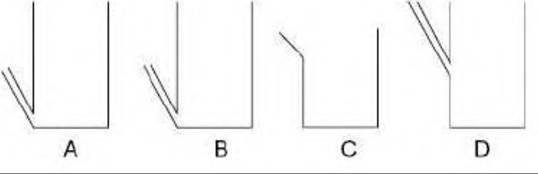
The jars A to D are of equal radius. The option which gives the correct relationship among capacity of jars is:
(a) A B < C < D (b) D > B A C
(c) B D > A < C (d) B - D > A > C
(e) D>ΛB>C
Directions for Questions 40-43: Read the following caselet and choose the best alternative.
Om Chowdhury was one of the supervisors in the Fire and Safety (F&S) department of Maqsood Textile Mills. He was distant cousin to Mr. Bhiwani, General Manager (Personal & Administration). Personal & Administration department was given the responsibility of all personnel related decisions. It was often rumored that Om had obtained the job due to his cousin’s influence. However, Om was meticulous in the performance of his duties and didn’t give anyone reason for complaint. It was known that Omwas not much given to talking and kept to himself and to his duties.
All F&S supervisors reported to Mr. Rabindra, the shop-floor manager. The mill operated on a three-shift basis and Rabindra allocated the supervisors to different shifts. They were required to be present at all times during the shift operation and carry out scheduled checks on all machinery and firefighting equipments. For some reasons, Om was allocated the night shifts more often than other supervisors. Om accepted these allocations without any objection, while it was known that other supervisors would often plead and bargain with Rabindra to be allocated the day shifts. During the night shift, keeping awake and remaining mentally alert were some of the major challenges faced by the supervisors.
Of late, Rabindra observed signs of indifference from Om. On two occasions he found Om absent from his cabin. Rabindra heard from others that Om was often found in different part of the shop-floor talking. Rabindra called him to his office and reminded Om of his responsibilities. Om did not counter Rabindra. He promised that he would not lax in his duties again. Rabindra also broached the subject with Mr. Bhiwani. Mr. Bhiwani called Om to his office and talked on a very personal basis. He reminded Om that their family relations made it uncomfortable to all concerned. Om nodded and agreed to do better. Soon his performance became that of a model supervisor. It was often found he went beyond his official duties to sort out problems of employees.
About three months later, Rabindra happened to visit the plant during the night. As he looked into the F&S office, he found Om playing Solitaire on the office computer. Mr. Rabindra immediately fired Om.
The next morning Mr. Bhiwani called Mr. Rabindra and asked how he can fire an employee. He suggested that Mr. Rabindra reconsider Om’s dismissal. ‘This decision has already been made. There will be no turning back’ replied Rabindra.
38. The options below give combinations of possible root cause of the problem and the justifications thereof. Given the details in the case, which one can be inferred to be the best option?
(a) Hiring of Om. Reason: That ensured Om was perpetually casual towards his duties.
(b) Om favouring to work during night shift. Reason: Absence of Rabindra ensured that Om could relax.
(c) Rabindra’s bias against Om. Reason: Rabindra had been assigning too many night shifts to Omwhile for other supervisors he was lenient.
(d) Rabindra jumping to conclusions. Reason: He should have investigated whether Omhad carried out his duties.
(e) Rabindra’s firing of Om. Reason: It led to clash between Rabindra and Mr. Bhiwani.
39. The details of the entire episode have become common knowledge among all the employees of the company. Out of the following options, which one presents the best way for the top management to resolve the issue so as to benefit the organisation as a whole?
(a) Revoke Rabindra’s order. It can be communicated to others that firing was too severe a punishment for such a small incident of indiscipline.
(b) Ask Om for clarification. It can be communicated that since Om had clarified regarding his duties, the order has been taken back.
(c) Declare Rabindra’s order as void. Reiterate officially the disciplinary processes that need to be followed by managers along with their scope of authority.
(d) Ask feedback from other employees on the shop-floor regarding Om5s performance. This can be used to revoke Rabindra5S order.
(e) Take the feedback of other F&S supervisors as to the work involved during night shift. This would better explain Om5 s behaviour.
40. Out of the options below, which one best summarises the learning from the solitaire incident!
(a) Managers often do not take any responsibility towards training juniors.
(b) People tend to become relaxed during the night shift and require surprise checks to keep them on their toes.
(c) Certain roles would have different ways of carrying out their duties.
(d) Having relatives in the same organisation can be a source of potential problems.
(e) Managers tend to allocate silent people to different positions.
41. Of the options below, which could have been a better response from Mr. Rabindra when he saw Om playing?
(a) He should have clarified about his authority to fire employees.
(b) He should have informed Mr. Bhiwani about the incident and asked him to take the necessary action.
(c) He should have asked the employees of the shift regarding Om5s performance of his duties.
(d) He should have checked if Om had done his duties or not.
(e) He should have checked the production levels in the shift to see if it was as required.
Directions for Questions 44-47: Read the following caselet and choose the best alternative.
Shekhar, an MBA from Singapore returned to his hometown Jamshedpur. Jamshedpur had a population of 10 lacs with one of the highest per capita income among Indian cities. Shekhar loved music. While listening to his favourite song on ‘satellite radio5, he
wondered if he could mix his passion with business. Incidentally, a few weeks later, while browsing the internet, he came across an advertisement from Music world, which called for expression of interest from potential franchisees. Jamshedpur did not have a single good music outlet, where its residents could buy quality, variety and the latest from the world of music.
Music world wanted the potential franchisees to own minimum 1200 square feet space and invest' 30 lacs. Profits were to be shared in the ratio of 3:7 between Music World and the franchisee. While Shekhar was excited about working with a renowned brand, he was worried if' 30 lacs was too high an amount to shell out. He did not have the entire amount with him and was thinking of borrowing from the bank. He made enquiries with other Music World franchisees located in towns like Patna and Ranchi, as he expected similar footfall in Jamshedpur. A franchisee in Patna had sales revenue varying from 1-2 lacs rupees per month with profit margin in the range of 25-30%. Satisfied, Shekhar decided to proceed.
Soon, he was on a look out for the space. Jamshedpur had three main areas—Bistupur, Sakchi and Sonari. All areas were inter-connected by good roads. Bistupur was a business area where most of the high-end retail formats were located. Most upper middle class and higher class customers shopped there. It was also the education hub of the city. On the other hand, Sakchi was a growing lower middle class business area and Sonari had mostly residential population.
Shekhar was in favour of choosing Bistupur as it was the place where he shopped. However, he soon stumbled across problems. Not only was it difficult to obtain space in Bistupur but property rentals touched 30^40 rupees per square feet per month. Rentals at Sakchi and Sonari were in the Range of 15-20 rupees per square feet per month. Also, Shekhar’s friend, who stayed in Sakchi, told him that a few branded outlets were opening in Sakchi and it seemed to be the fastest growing market in Jamshedpur, with highest ratio of teenagers. But, Shekhar was not in favour of Sakchi due to its low image. He expected to target college going crowd in Bistupur.
High real estate prices in Bistupur and his low assessment of Sakchi market created confusion in Shekhar’s mind. To give the decision a serious and fresh thought, he decided to hit Jamshedpur-Ranchi highway in his newly acquired car.
44. How best should Shekhar resolve his confusion?
(a) By investing in the franchise
(b) Do not invest in the franchise and look for different brand name.
(c) Go back to Singapore and start to find the drivers and potential of the business.
(d) Do a further in-depth study to find the drivers and potential of the business.
(e) Approach another music company for setting up a franchise.
45. Suppose sales in Patna ad Bistupur are likely to be same, how many years would it take for Shekhar to recoup the investment (consider zero inflation)?
(a) Less than five years
(b) Less than seven years
(c) Less than eight years
(d) Less than nine years
(e) May be never
46. What could be the most likely reason for Shekhar’s bias in favour of Bistupur?
(a) Presence of college-going crowd, as he felt they were the customers for the latest music.
(b) Crowded (hoi poloi) image of Sakchi.
(c) It was difficult for Shekhar to associate non-Bistupur areas with good quality products.
(d) Higher rentals in Bistupur.
(e) Patronage OfBistupur shops by executive and their families.
47. Which one of the following is the most important decision criterion is such a business situation?
(a) Financial capability of entrepreneur
(b) Changes in music industry
(c) Future market growth
(d) Profitability of business in first couple of years
(e) Real Estate prices
Answer Key
| l.(e) | 2. (a) | 3.(e) | 4. (a) |
| 5. (c) | 6. (c) | 7. (a) | 8. (a) |
| 9. (e) | 10. (b) | 11. (c) | 12. (a) |
| 13.(c) | 14. (b) | 15.(b) | 16. (d) |
| 17. (e) | 18. (d) | 19. (d) | 20. (b) |
| 2L(e) | 22. (a) | 23. (e) | 24. (e) |
| 25. (b) | 26. (d) | 27. (a) | 28. (b) |
| 29. (e) | 30. (a) | 31∙(e) | 32. (a) |
| 33. (a) | 34. (e) | 35. (b) | 36. (e) |
| 37. (a) | 38. (d) | 39. (e) | 40. (d) |
| 41∙(b) | 42. (c) | 43. (d) | 44. (d) |
| 45. (e) | 46. (c) | 47. (c) | |
Solutions:
1. Since Hatha Yoga is more difficult, the number of people having successfully learnt it has to be lesser than the number of people who have learnt Raja Yoga. Thus option (e) which says that the percentage of people who have successfully learnt Hatha Yoga is much lesser than the percentage of people who have successfully Raja Yoga is the correct option.
Option (e) is correct.
2. Shankaracharya said that Hatha Yoga is for people whose worldly desires are not pacified. Thus option (a) is the correct answer as pacified and placated mean the same thing.
Option (a) is correct.
3. Since a comparison is made here between a person casting off his worn out clothes and the soul casting off the body, this is clearly an analogy. Thus option (e) is correct.
4. Since there is a generalisation made and that too from a specific data, it is an inductive generalisation as it is from specific to general. Thus option (a) is correct.
5. Since we have to find the least dissimilar option, means we have to find the most similar option. Here the argument is from a general conclusion supported by a specific example, similarly in option (c) the general conclusion is supported by a specific example. Thus option (c) is correct.
6. As the question mentions that ‘no single country’ has control, we cannot conclude about any specific, or individual country. Hence option (c) which talks about lack of control of any finance minister seems to be the most logical conclusion. Thus option (c) is correct.
7. An experienced board will definitely bring in a positive outlook and monitoring, thus option (a) seems to be the most logical reason.
8. The educated man is being labeled as stupid in the statement—once you take him
off the subject in which he is educated. Obviously, the best counter to this criticism would be any logic which would talk about the educated man being able to think about and reason about subjects in which he has not been supposedly educated in.
Option (c) clearly supports the contention of the author and hence can be rejected. Options (b) and (d) is irrelevant in the context of the author’s contention as it is not related to what the author is saying.
Option (a) best fits the required logic that would undermine the given logic since, if true education means a well-rounded exposure to major subjects, we can clearly say that the author’s contention, that the educated man is stupid in anything other than his subject, is undermined
Hence, option (a) is correct.
9. The question is clearly asking as to what evidence best resolves the debate. Options (a) and (c) can be rejected as they are both talking about taking opinions of people. Opinions are always subjective and always have counter opinions. Hence they would never help you create evidence for or against anything.
Option (b) talks about comparing number of predictions that have come true— which is not a valid measure as it depends on how many predictions were made by both; percentage of predictions which have come true might be a much better logic than simply comparing the number of predictions.
Similarly, option (d) can be rejected because it talks about the number of predictions. Option (e) is much better than option (d) because it talks about comparing the percentage of predictions which come true.
Hence, option (e) is the correct answer.
10. A metaphor shows a comparison or a similarity between two things, without using the word....like, similarly, etc. Here the only similarity is shown in option
(b), calling the capitalist as a parasite. Thus option (b) is correct.
11. Personification is giving a non-living or inanimate thing a role or action performed by a human/animate being. Here in one of the options money is said to be playing [money plays]. This is a case of personification as money is inanimate and play is definitely an action by a human living being. Thus option
(c) is correct.
12. Here the concept of ‘hyperbole’ means a wild exaggeration of something or a kind of a blabbering or bragging that is completely off the cuff. In one of the options the example of the coin collectors ready to ‘give the earth’ is a huge exaggeration. The earth does not belong to anybody, so no one can give it. Thus option (a) is correct.
13. An euphemism is a mild way to say something. It generally tends to give a softened tone or manner and uses words which are mild forms of something. Here in option (c) referring to the people who have died as people who have ‘passes away’ is a clear example of euphemism. Option (c) is correct.
14. A fallacy where the conclusion is unrelated or totally contrary to the main statement is a non-sequitur. In the given options (a), (d) and (e) clearly had logical conclusions and (c) did not have a conclusion, thus all these four options were eliminated. Option (b) talked about lack of trust in politicians, but the conclusion about sending them back to school did not make any sense. Thus option (b) is correct.
15. Suspend means to stop or delay something and recommence means to start something again. Here the relationship in the analogy question is of opposites. The option (b) offers ‘beleaguered’ which means troubled is exactly opposite to ‘nonchalant’ which means apathetic. Thus option (b) is correct.
16. Two words which are contradictory or opposite or which have both a positive and a negative element constitute an oxymoron. Here in option (d) it is mentioned in the sentence about ‘kindness suffocating’. Kindness is positive, whereas suffocating is negative, hence both together would constitute an oxymoron. Hence option (d) is correct.
Solutions for Questions 17-19:
After the first reading of the information in the question, you should be able to realise that the variables in the question are:
(i) Team name; (ii) Husband’s name; (iii) Wife’s name; (iv) Points scored. Further, the collated information should be:
Team names are: Sweet Couple; Bindas Singers; Just Singing; New Singers Husband names are: Laxman, Mukesh, Sanjeev, Tapas
Wife names are: Lina, Waheda, Divya and Sania
Points scored: 2,4,6,8
Based on this initial information and based on using the two direct clues given in the paragraph (saying that the Sweet Couple won 2 points and Just Singing won 6 points), your starting grid should be as follows:
STARTING GRID
| Team Name | Husband | Wife | Points |
| 8 | |||
| Just Singmg | 6 | ||
| 4 | |||
| Sweet Couple | 2 |
At this point, the next clue that becomes usable is the one about: “Mukesh’s team won 4 more points than Lina’s team, but Lina’s team didn’t score the least amount of points” √zE Lina’s team could only have scored 4 points and Mukesh’s team must have scored 8 points.
We also know that ‘ Sanj eev’s team won 4 points.’
Placing all this information into the above grid, the grid would transform into the one below:
GRID 2
| Team Name | Husband | Wife | Points |
| Mukesh | 8 | ||
| Just Singing | Tapas | Sania | 6 |
| Sanjeev | Lina | 4 | |
| Sweet Couple | 2 |
The above grid has only one place to be filled for a husband name and hence Laxman would be the Husband in the Sweet Couple team.
We also know that: “Bindas Singers scored 2 points more than Laxman’s team” which in effect now means that Bindas singers must have scored 4 points √zE New singers scored 8 points.
Also, since Waheda was not on the New Singers team, she must have been on the Sweet Couple team and consequently Divya would be on the New Singers team.
The grid now becomes complete with this analysis placed inside the grid.
FINAL GRID
| Team Name | Husband | Wife | Points |
| New Singers | Mukesh | Divya | 8 |
| Just Singing | Tapas | Sania | 6 |
| Bindas Singers | Sanjeev | Lina | 4 |
| Sweet Couple | Laxman | Waheda | 2 |
The answers can be read off the above table:
17. Waheda and Sweet couple. Option (e) is correct.
18. The ascending order arrangement of the teams’ based on the points they scored was: Sweet Couple - Bindas Singers - Just Singing - New Singers.
Option (d) is correct.
19. Sanjeev-Lina is the only pair which is correctly matched. Hence, option (d) is correct.
Solutions for Questions 20-23:
From an initial reading of the information, you can clearly see that the variables in the problem are: The day of the lecture, the time the lecture started, the person who took the class and the topic of the class. Further we can see that the values for the variables are:
(i) Days: Monday, Wednesday, Thursday, Friday;
(ii) Time: 7 AM, 7:10 AM, 7:20 AM, One Unknown time (either 7:05 or 7:15);
(iii) People: Mr. Singh, Mr. Chatterjee, Mr. Dutta, Mr. Banerjee
(iv) Topics: Calculus, Probability, Ratio and Proportion & Set Theory
It might be best to anchor the table around the days - Monday to Thursday as there is the natural advantage of these days being in chronological order. The starting solution grid after using the direct clues given in the question (viz: ‘The class on Monday started at 7 AM, Mr. Chatterjee took the class on Wednesday & the teacher in Friday’s class taught Set Theory) would look like this:
STARTING GRID:
| Day | Time | Person | Topic |
| Monday | 7 AM | ||
| Wednesday | Mr. Chatterjee | ||
| Thursday | |||
| Friday | Set Theory |
Deductions from this point:
(i) Using the two clues about when Mr. Singh taught, we can first place Mr. Singh on the appropriate day. The clues are: ‘Mr. Singh did not teach on Thursday’ and ‘The class on Monday started at 7 AM, but Mr. Singh did not teach it’. Together if applied to the above grid, we can see that since Mr. Chatterjee is on Wednesday and Mr. Singh cannot be on Thursday and he cannot be on Monday, he must have taught on Friday.
(ii) At this point we are left with Mr. Banerjee and Mr. Dutta to be placed between Monday and Thursday. Also, since we have already seen that Monday’s lecture started at 7:00 AM, we can use the information about Mr. Banerjee ‘taught a class that started five minutes later than the class ’ to understand that Mr.
Banerjee’s class could not have started at 7:00 AM. Consequently, Mr. Banerjee must have taught on Thursday and Mr. Dutta must have taught on Monday.
After placing all the people on their respective days, the solution grid at this stage starts looking like this:
| Day | Time | Person | Topic |
| Monday | 7 AM | Mr. Dutta | |
| Wednesday | Mr. Chatterjee | ||
| Thursday | Mr. Banerjee | ||
| Friday | Mr. Singh | Set Theory |
The focus now shifts to finding out the exact topics on each day and also correlating the information about the starting time for each class to the appropriate day. The following deductions help you move ahead in your solution.
(i) It is given that Calculus was taught in the class that started at 7:20 AM. This means that the combination of 7:20 AM-Calculus should come together in the same row; further it can only be fit together on either Wednesday or Thursday. If to this we add the information that Mr. Banerjee’s class (Thursday’s class) started 5 minutes later than some other class, we can eliminate the possibility of Calculus and a 7:20 AM class starting on Thursday.
Hence, Wednesday’s class started at 7:20 AM and was a class on Calculus.
(ii) Once we fix that, we also know then that the class on Friday must have started at 7:10 AM.
With these deductions, the solution grid becomes:
| Day | Time | Person | Topic |
| Monday | 7 AM | Mr. Dutta | |
| Wednesday | 7:20 AM | Mr. Chatterjee | Calculus |
| Thursday | Mr. Banerjee | ||
| Friday | 7:10 AM | Mr. Singh | Set Theory |
We then look for the remaining information to fill the table. The following deductions applied at this stage of our solution help us do the same:
(i) For the remaining topics: Mr. Dutta didn’t teach Ratio and Proportion means that he must have taught Probability and consequently Mr. Banerjee must have taught Ratio and Proportion.
(ii) For the remaining time: Mr. Banerjee’s class started five minutes later than the probability class, means that Mr. Banerjee’s class must have started at 7:05 AM.
The final solution grid then becomes:
FINAL SOLUTION GRID:
| Day | Time | Person | Topic |
| Monday | 7 AM | Mr. Dutta | Probability |
| Wednesday | 7:20 AM | Mr. Chatterjee | Calculus |
| Thursday | 7:05 AM | Mr. Banerjee | Ratio and Proportion |
| Friday | 7:10 AM | Mr. Singh | Set Theory |
The answers to the questions can then be read off the above grid.
20. Wednesday’s class started at 7:20 AM and the topic was Calculus. Option (b) is correct.
21. The only pair which is correctly matched is Mr. Singh-Set Theory. Option (e) is correct.
22. Probability was taught by Mr. Dutta on Monday. Option (a) is correct.
23. The combination given in option (e) is correct.
Solutions for Questions 24-28:
From an initial reading of the information in the question, we can see that there are 4 variables in the question, viz: Name of person; Surname of person; College Name and college rating.
The first thing we should do is to list down the values for each of the variables.
Names: Ms. Sarah, Ms. Swati, Jackie, Mohan, Ms. Priya;
Surnames: Reddy, Gupta, Sanyal, Kumar and Chatterjee;
College names: Techno Institute, Deccan College, Barla College, Anipal Institute, Chemical College;
StarRatings: 5 Star (one college), 4 star (three colleges), 3 star (one college)
The starting solution grid would look as follows (anchoring it on college name):
Note: This is after placing the three direct clues into the grid - viz: Sarah joined Techno Institute; Barla college was a 5 star college; Ms. Reddy studied at the Anipal Institute.
| College Name | Name Ofstudent | Surname | College Rating |
| Tectmo Institute | Sarah | ||
| Deccan College | |||
| Barla College | 5 star | ||
| Anipal Institute | Ms. Reddy | ||
| Chemical College |
The following deductions would help us move ahead from this situation in the solution grid:
(i) ‘The 3 star college was not Deccan College’ means that Deccan College has to be one of the 4 star colleges.
(ii) Since the Techno Institute had a higher rating than the college where Priya studied, it means that Techno Institute must be a 4 star college.
(iii) Sarah’s last name wasn’t Sanyal gives us that her last name is either Kumar or Chatterjee as she cannot be Reddy or Gupta.
Withthese deductions the solution grid changes to:
SOLUTION GRID
| College Name | Name Ofstudent | Surname | College Rating |
| Techno Institute | Sarah | Kumar/Chatterje e | 4 star |
| Deccan College | 4 star | ||
| Barla College | 5 star | ||
| Anipal Institute | Ms. Reddy | ||
| Chemical College |
At this point if you evaluate each clue given in the question, you would realise that none of the clues help you to place values for the variables directly in the above table. The only clue that helps you think further is: Mohan’s last name was Gupta but he didn’t study at Barla College.
This clue used in the above grid gives you a two-way fork based on the fact that Mohan Gupta can only be placed in Deccan College or in Chemical College. Since, there are no direct deductions possible at this stage we would need to move with both these possibilities:
Possibility 1: Placing Mohan Gupta in Deccan College
| College Name | Name Ofstudent | Surname | College Rating |
| Techno Institute | Sarah | Kumar/Chatterje e | 4 star |
| Deccan College | Mohan | Gupta | 4 star |
| Barla College | 5 star | ||
| Anipal Institute | Ms. Reddy | ||
| Chemical College |
From this situation in the grid, the logic string for the remaining information would go as follows:
(i) Since Ms. Kumar and Jackie both studied at 4 star colleges √zE Jackie cannot be placed in Barla College and he cannot also be in Anipal Institute (as he is a male). This can only mean that Jackie must be in Chemical college (4 star) and consequently Ms. Kumar must be in Techno Institute and must be Sarah Kumar.
(ii) Anipal Institute then must be a 3 star college.The grid becomes:
| College Name | Name Ofstudent | Surname | College Rating |
| Techno Institute | Sarah | Kumar | 4 star |
| Deccan College | Mohan | Gupta | 4 star |
| Barla College | 5 star | ||
| Anipal Institute | Ms. Reddy | 3 star | |
| Chemical College | Jackie | 4 star |
(i) Now, since we know that Priya’s college had a lower rating than Techno Insitute, Priya must be in Anipal Institute;
(ii) Also since Chemical college was rated 1 star less than the college where Sanyal studied, we get that Sanyal must have been studying in a 5 star college.
With this we now have one possible solution to the given situation:
FINAL SOLUTION GRID—POSSIBILITY 1 WITH MOHAN GUPTA IN
DECCAN COLLEGE
| College Name | Name Ofstudent | Surname | College Rating |
| Tectmo Institute | Sarah | Kumar | 4 star |
| Deccan College | Mohan | Gupta | 4 star |
| Barla College | Swati | Sanyal | 5 star |
| Anipal Institute | Priya | Ms. Reddy | 3 star |
| Chemical College | Jackie | Chatterjee | 4 star |
THEORY POINT:
Remember that this is a solution which we got by assuming Mohan Gupta to be in Deccan College which was one of the possibilities. For a complete analysis of the situation, we need to see what the other possibility (viz: Mohan Gupta in Chemical College) leads us to. Remember that in multiple possibility solutions, one of two things might occur with the possibilities:
(a) All possibilities except one contradict some information contained in the text and hence get rejected, leaving us with one possibility which would give us definite solutions for the entire grid;
(b) All possibilities lead to different outcomes, which do not contradict any basic information - hence, there are multiple solutions possible to the question and you have to answer questions based on a reading of these possibilities. (The question we are solving here belongs to this category as you will see when we check for Possibility 2—Mohan Gupta studies in Chemical College.)
Possibility 2: Placing Mohan Gupta in Chemical College
| College Name | Name Ofstudent | Surname | College Rating |
| Techno Institute | Sarah | Kumar/Chatterje e | 4 star |
| Deccan College | 4 star | ||
| Barla College | 5 star | ||
| Anipal Institute | Ms. Reddy | ||
| Chemical College | Mohan | Gupta |
From this situation in the grid, the logic string for the remaining information would go as follows:
(i) Since Ms. Kumar and Jackie both studied at 4 star colleges √zE Jackie cannot be placed in Barla College and he cannot also be in Anipal Institute (as he is a male). This can only mean that Jackie must be in Deccan college (4 star) and consequently Ms. Kumar must be in Techno Institute and must be Sarah Kumar.
(ii) Since Priya studies in a college whose rating is 1 star less than Techno Institute, she cannot be studying in Barla College (which is 5 star) and she must be studying in Anipal Institute which must be 3 star.
(iii) Chemical College should then be a 4 star college.
(iv) With Sarah, Jackie, Mohan and Priya already placed in the grid, Swati can only be studying in Barla College.
The grid becomes:
| College Name | Name Ofstudent | Surname | College Rating |
| Techno Institute | Sarah | Kumar | 4 star |
| Deccan College | Jackie | 4 star | |
| Barla College | Swati | 5 star | |
| Anipal Institute | Priya | Ms. Reddy | 3 star |
| Chemical College | Mohan | Gupta | 4 star |
Finally, since Chemical College is 1 star less then the college where Sanyal studied, we can say that Sanyal studied in Barla College and the final grid for possibility 2 looks like:
FINAL SOLUTION GRID—POSSIBILITY 2 WITH MOHAN GUPTA IN CHEMICAL COLLEGE:
| College Name | Name Ofstudent | Surname | College Rating |
| Techno Institute | Sarah | Kumar | 4 star |
| Deccan College | Jackie | Chatterjee | 4 star |
| Barla College | Swati | Sanyal | 5 star |
| Anipal Institute | Priya | Ms. Reddy | 3 star |
| Chemical College | Mohan | Gupta | 4 star |
For solving the questions in the set, we would need to consider both the possible solutions. Scenarios may be definitely true if they occur in both the possibilities. Probably true/ Can be true scenarios would mean scenarios occurring in one of the two possibilities (even if they are not true in the second one). Definitely false scenarios would be those which are not possible in either of the two possibilities. With this understanding we can now move to the questions in the set.
24. Since this question asks for a definitive answer, we need to look for the combination, which is true in both the possibility scenarios. It can be seen that the combination Jackie Chatterjee, Priya Reddy and Swati Sanyal given under option (e) is true in both the possibilities and hence is the correct combination of first names and surnames.
Option (e) is correct.
25. This question asks us for a possible student-institute combination. Hence, if we can spot the given combination in an option, even in one of our two possible solution scenarios, we can conclude that the option is correct.
Checking the options in the question we see that the combination given under option (b) (Swati- Baria; Priya-Anipal; Jackie-Deccan) is possible under possibility 2.
Hence, Option (b) is the correct answer.
26. This question asks us for a possible student-institute combination. Hence, if we can spot the given combination in an option, even in one of our two possible solution scenarios, we can conclude that the option is correct.
Under possibility 2, Mohan Gupta is in Chemical College and it is a 4 star college. Option (d) is correct.
27. Under both the possibilities, Priya was in Anipal Institute. Option (a) is correct.
28. Under both possibilities Swati Sanyal was in Barla College. Option (b) is correct.
Solutions for Questions 29-32:
29. Since, it is given that for Babu, instant and further utility of each unit of gain is same, it follows that he has a straight line function of Utility. Hence, Babu’s choice can be either based on expected value or on expected utility. Hence, it also follows that Roy associates’ final advice would be redundant.
Hence, option (e) is correct.
30. It can be seen that Babitha’s expected value in each of the three cases would be the same. Since Babitha is defined as a risk taking person, it follows that Babitha would go for maximising her return even at the cost of taking a higher risk. This would be achieved if she took the first option.
Hence, option (a) is correct.
31. Babitha would go for expected value with a risk taking approach in case she has lost the previous game. However, if she had won the previous game, expected utility might be a better option to decide her behaviour. Since, we do not know the outcome of the previous game, we do not have sufficient information to answer the question.
Hence, option (e) is correct.
32. Since Bablu is going for maximum return (even at the cost of taking a bigger risk) his decision making is that of a risk taker. Hence, option (a) is correct.
Solutions for Questions 33-37:
The following grid needs to be created in order to encapsulate the information:
| Stage | Farmer | Starting Point | End Point |
| 1 | |||
| 2 | |||
| 3 | |||
| 4 | |||
| 5 |
The first objective for us should be to place the direct information into the grid. There are two direct pieces of information we have:
From Clue 6: Stage 3 finished at Pl (and hence we deduce that stage 4 would have begun at Pl);
Also from clue 5, we have that F4 was given the work of the fourth stage.
Withthis information, the grid looks as below:
| Stage | Farmer | Starting Point | End Point |
| 1 | |||
| 2 | |||
| 3 | Pl | ||
| 4 | F4 | Pl | |
| 5 |
Now we have clue 4, which tells us that some stage started at P5 and ended at P3. Looking at our solution grid above we see that this stage can either be Stage 5 or Stage 2 (as it is given that it is not stage 1).
If we try to place the P5-P3 stage as stage 5, it would mean that Stage 4 ends at P5. In this case, F4 would be getting a stage ending at P5. This is something that contradicts clue 7. Hence, P5-P3 can only be placed in stage 2.
Consequently the grid starts looking as below:
| Stage | Farmer | Starting Point | End Point |
| 1 | P5 | ||
| 2 | P5 | P3 | |
| 3 | P3 | Pl | |
| 4 | F4 | Pl | |
| 5 |
The following deductions help you complete the grid from this point:
(i) Clue 7 τzE F3 = Stage 1
(ii) This means that F5 cannot be doing stage 1 or stage 2 and from clue 3 he does the stage starting at P4. Since, Stages 2 and 3 start at P5 and P3 respectively, it means that F5 can only be placed in Stage 5.
(iii) From the above deduction we know that the starting point P4 should be for Stage 5 and hence Stage 1 should have a starting point of P2.
The grid would change to:
| Stage | Farmer | Starting Point | End Point |
| 1 | F3 | P2 | P5 |
| 2 | P5 | P3 | |
| 3 | P3 | Pl | |
| 4 | F4 | Pl | P4 |
| 5 | F5 | P4 | P2 |
From this point we can use clue 6 to deduce that Fl should be doing stage 2 and F2 would be doing Stage 3.
The final Solutionwould Iookas below:
| Stage | Farmer | Starting Point | End Point |
| 1 | F3 | P2 | P5 |
| 2 | Fl | P5 | P3 |
| 3 | F2 | P3 | Pl |
| 4 | F4 | Pl | P4 |
| 5 | F5 | P4 | P2 |
The answers can then be read off this solution grid:
33. Farmer F2 finished at Pl. Option (a) is correct.
34. Farmer F5 ploughed Stage 5. Option (e) is correct.
35. P5 and P3 were respectively the starting and ending points for Stage 2. Option (b) is correct.
36. P2 was a finishing point for F5. Option (e) is correct.
37. P2 was the starting point for farmer F3. Option (a) is correct.
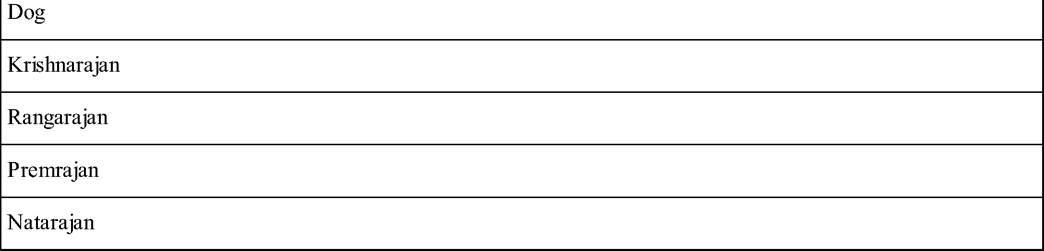
38. The initial order of the people can be seen as follows:
| Running in the dog’s direction | Running in the opposite direction |
| Premrajan | |
| Krishnarajan | |
| Rangarajan | |
| Natarajan |
After Premrajan turns around the order would be:
Running in the dog’s direction
Now, it is given that Krishnarajan and Rangarajan come in direct line with the dog. With this the file would look like:
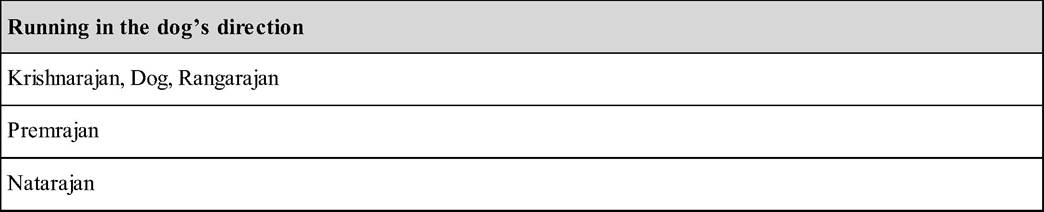
It can be clearly seen that Premrajan is behind the dog.
Option (d) is correct.
39. The jars A and B have the same capacity. Even though jar B has a greater height than jar A, the capacity of jar B would get restricted by the small pipe attached to it’s outside. This is because water finds it’s own level and even if you fill Jar B with more water than the height of the external pipe, the water in jar B would come down to the level of the external pipe.
Thus, A=B. Jar C is obviously the lowest capacity because it has the least height, while Jar D has the maximum height and the external pipe attached to Jar D does not reduce the effective height of Jar D as it extends to the same height as the internal height of the jar. Thus we have D > A = B > C.
Hence, option (e) is correct.
Solutions for Questions 40-43:
40. The root cause of the problem in the caselet is obviously related to the firing of Om by Rabindra. However, option (e) can be eliminated as the reason given that it led to a clash between Rabindra and Bhiwani is not valid.
It is evident that a mistake in the conclusion Rabindra made that Om was neglecting his duties. It is given clearly in the caselet that once he was talked to, Om’s performance was that of a ‘model supervisor’ and he even went beyond his official duties to sort out problems of employees.
Thus, it is evident that Rabindra’s jumping to conclusions is the root cause of the problem & obviously he should have investigated whether Om had carried out his duties before deciding on an action as drastic as firing Om.
Option (c) also seems close, but we do not have enough information to say that Rabindra was biased against Om.
Option (a) is rejected because it is not true that Om was perpetually casual towards his duties.
Option (b) also does not seem to be correct as it is not known that Om was relaxing on his job all the time.
Hence, option (d) is the correct answer.
41. The correct course of action obviously involves hiring Om back ( as he was a good employee and his firing was definitely not warranted). However, at the same time the top management should ensure that Rabindra should also have a face saving solution—as undermining his authority openly would make it difficult for Rabindra to perform his duties further.
Options (a) and (c) are rejected because in these options the management would end up directly undermining Rabindra’s action.
Options (d) and (e) are incorrect because asking others would unnecessarily open up the issue further, and prolong it. Whereas the management should focus on closing the issue as fast as possible, ensuring least exposure to people who are not directly involved in the incident. Besides, if the opinion of other employees is sought in the issue, and they rule against Om it would end up making matters worse.
Hence, the best course of action is to ask an explanation from Om and take the order back communicating to others that Om had clarified. Given his kind of personality explained in the caselet it is likely that Om would not react too drastically in his explanations.
Hence, option (b) is correct.
42. It is evident that playing Solitaire is not necessarily going to affect the role Om was playing. It is quite likely that over the past three months when he was emerging as an ideal employee, he could have been playing Solitaire regularly while on duty. Hence, the learning is that certain roles might have different ways of carrying out their duties.
Option (b) is also a learning that can be derived out of the incident but it is not the main learning arising out of the incident.
The other options can be logically eliminated.
Hence, option (с) is the correct answer.
43. The obvious thing for Mr. Rabindra to have done before blowing his fuse and reacting in this incident is that he should have checked whether Om had done his duties or not. An employee relaxing on the job after ensuring that his duties are done is a totally different scenario for a manager to handle than the employee relaxing on the job without having done his duties. Hence, option (d) is correct.
Solutions for Questions 44-47:
44. The situation is clearly one in which Shekhar does not have enough information about the drivers and potential of the business. He is making too many assumptions here—like the footfall he expects is similar to Patna and Ranchi etc. Thus, taking a concrete decision either for or against the franchise would be the wrong thing to do. This rejects options (a) and (b). Option (c) is rejected because the drivers and potential of his business cannot be studied in Singapore and Option (e) is rejected because going to another Music company would just get him an offer on similar lines. Hence, he should go ahead and do a further study of the business potential and the business drivers for his proposed business in Jamshedpur.
Hence, option (d) is the correct answer.
45. Again in this case, we are not sure of what rental values the Patna franchisee is paying. In the scenario that the revenues are likely to be in the range of 1 to 2 lacs with 25-30% profit margin (for the Patna franchisee) it is clear that the Patna franchisee makes somewhere between 25 to 60 thousand profit per month. In the event that Shekhar opens his shop in Bistupur, he would end up paying close to 36000^18000 as rent.
In such a scenario his profit is likely to dip drastically and might not even be able to cover his interest costs.
Hence, he might never recover his investment.
Option (e) is the correct answer.
46. The question is asking us to reason out why Shekhar has a bias for Bistupur. From the first line of the second last paragraph “Shekhar was in favour of choosing Bistupur as it was the place where he shopped”, it seems that the reason for his bias is that it was difficult for Shekhar to associate non-Bistupur areas with good quality products. However, a closer look at the options shows us that it is also said that Shekhar expected to target college going crowd in Bistupur. This clearly shows that he must feel that they are the customers for the latest music and hence an important component for the success of the shop.
Option (a) talks about the same logic and hence is the likely answer at this point. If you were to consider the other options, they get rejected because:
Option (b) cannot be the answer as we cannot infer that he has a crowded image of Sakchi.
Option (d) would tend to take him away from Bistupur rather than creating a bias for Bistupur.
Option (e) is also not an apparent reason because the passage does not talk about executives and their families shopping in Bistupur.
Hence, option (c) is the correct answer.
47. The most important decision criterion in such a scenario depends on the likely long term success for the business. If the business has long term viabililty short term costs and risks can be justified.
Looking through the options, it is option (c) that mirrors this thought. Future market growth is likely to have maximum impact on the future viability of the business. Although Real estate prices seem to be an important criterion in this case, it cannot be the main criterion as if the business is viable, real estate prices would automatically get accommodated through the profitability of the business.
Hence, option (c) is the correct answer.