Correlates of Economic Growth
The discussion of conditional convergence in the previous section emphasized the importance of certain country characteristics that might be related to the process of economic growth.
What types of countries grow more rapidly? Ideally, we would like to answer this 18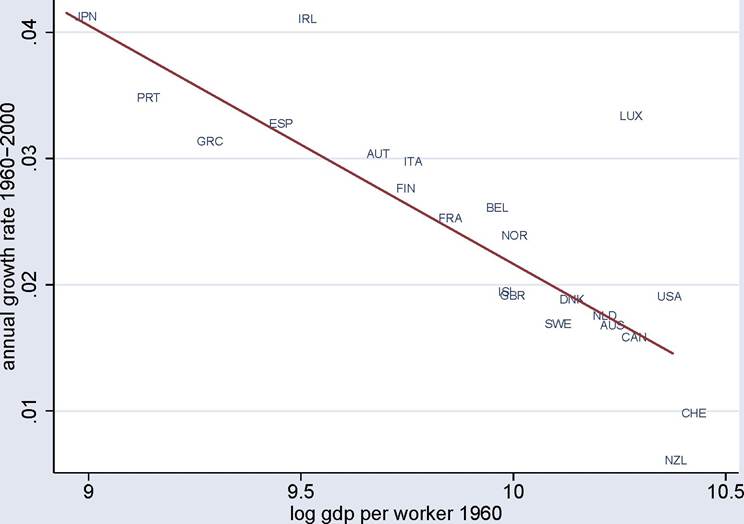
Figure 1.14. Annual growth rate of GDP per worker between 1960 and 2000 versus log GDP per worker in 1960 for core OECD countries.
question at a “causal” level. In other words, we would like to know which specific characteristics of countries (including their policies and institutions) have a causal effect on growth. A causal effect here refers to the answer to the following counterfactual thought experiment: if, all else equal, a particular characteristic of the country were changed “exogenously” (that is, not as part of equilibrium dynamics or in response to a change in other observable or unobservable variables), what would be the effect on equilibrium growth? Answering such causal questions is quite challenging, however, precisely because it is difficult to isolate changes in endogenous variables that are not driven by equilibrium dynamics or by some other potentially omitted factors.
For this reason, let us start with the more modest question of what factors correlate with post-war economic growth. With an eye to the theories that will come in the next two chapters, the two obvious candidates to look at are investments in physical capital and in human capital.
Figure 1.15 shows a strong positive association between the average growth of investment to GDP ratio and economic growth. Figure 1.16 shows a positive correlation between average years of schooling and economic growth. These figures therefore suggest that the countries that have grown faster are typically those that have invested more in physical capital and those that had greater human capital at the beginning of the postwar era.
It has to be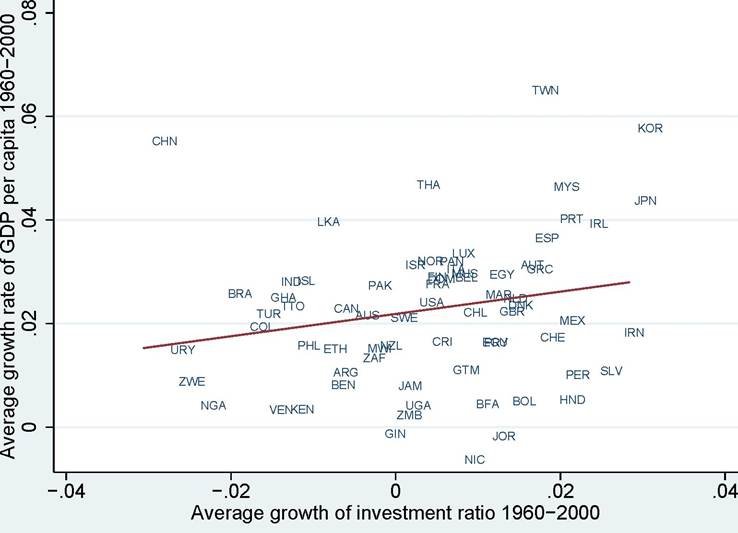
Figure 1.15. The relationship between average growth of GDP per capita and average growth of investments to GDP ratio, 1960-2000.
stressed that these figures do not imply that physical or human capital investment are the causes of economic growth (even though we expect from basic economic theory that they should contribute to output growth). So far these are simply correlations, and they are likely driven, at least in part, by omitted factors affecting both investment and schooling on the one hand and economic growth on the other.
We will investigate the role of physical and human capital in economic growth further in Chapter 3. One of the major points that will emerge from our analysis there is that focusing only on physical and human capital is not sufficient. Both to understand the process of sustained economic growth and to account for large cross-country differences in income, we also need to understand why societies differ in the efficiency with which they use their physical and human capital. Economists normally use the shorthand expression “technology” to capture factors other than physical and human capital that affect economic growth and performance. It is therefore important to remember that technology differences across countries include not only genuine differences in production techniques and in the quality of machines used in production, but also differences in productive efficiency resulting from differences in the organization of production, from differences in the way that markets are organized and from potential market failures (see in particular Chapter 21 on differences in productive efficiency resulting from the organization of markets and from market failures). A
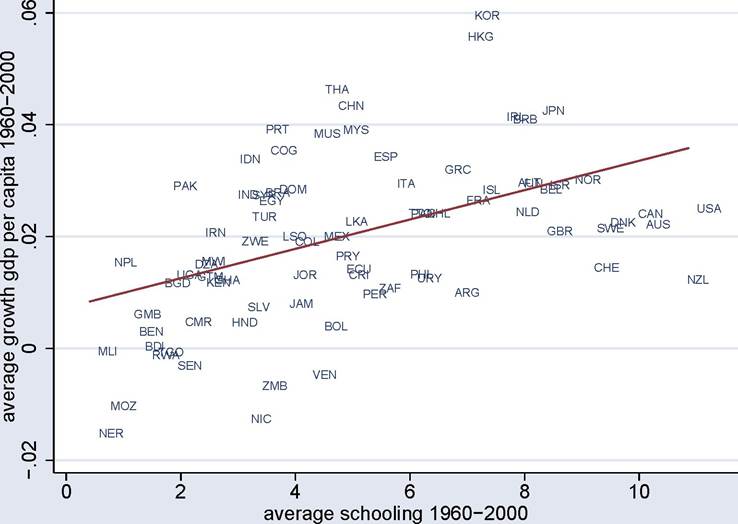
Figure 1.16. The relationship between average growth of GDP per capita and average years of schooling, 1960-2000.
detailed study of “technology” (broadly construed) is necessary for understanding both the world-wide process of economic growth and cross-country differences. The role of technology in economic growth will be investigated in Chapter 3 and in later chapters.
1.7.