Conditional Convergence
We have so far documented the large differences in income per capita across nations, the slight divergence in economic fortunes over the postwar era and the much larger divergence since the early 1800s.
The analysis focused on the “unconditional” distribution of income per capita (or per worker). In particular, we looked at whether the income gap between two countries increases or decreases regardless of these countries’ “characteristics” (e.g., institutions, policies, technology or even investments). Barro and Sala-i-Martin argue that it is instead more informative to look at the “conditional” distribution. Here the question is whether the income gap between two countries that are similar in observable characteristics is becoming narrower or wider over time. In this case, the picture is one of conditional convergence: in 16the postwar period, the income gap between countries that share the same characteristics typically closes over time (though it does so quite slowly). This is important both for understanding the statistical properties of the world income distribution and also as an input into the types of theories that we would like to develop.
How do we capture conditional convergence? Consider a typical “Barro growth regression”:

where gty-ι is the annual growth rate between dates t — 1 and t, yt-ι is output per worker (or income per capita) is a vector of variables that the regression
is conditioning on with coefficient vector α (and Xt denotes the transpose of this vector, see Appendix Chapters A and B). These variables are included because they are potential determinants of steady state income and/or growth.
First note that without covariates eq. (1.1) is quite similar to the relationship shown in Figure 1.9 above. In particular, since can be written as
Figure 1.9 showed that the relationship between log GDP per worker in 2000 and log GDP per worker in 1960 can be approximated by the 45o line, so that in terms of this equation, β should be approximately equal to 0. This is confirmed by Figure 1.13, which depicts the relationship between the (geometric) average growth rate between 1960 and 2000 and log GDP per worker in 1960. This figure reiterates that there is no “unconditional” convergence for the entire world over the postwar period.
While there is no convergence for the entire world, when we look among the “OECD” nations,2 we see a different pattern. Figure 1.14 shows that there is a strong negative relationship between log GDP per worker in 1960 and the annual growth rate between 1960 and 2000 among the OECD countries. What distinguishes this sample from the entire world sample is the relative homogeneity of the OECD countries, which have much more similar institutions, policies and initial conditions than the entire world. This suggests that there might be a type of conditional convergence when we control for certain country characteristics potentially affecting economic growth.
This is what the vector captures in eq. (1.1). In particular, when this vector includes variables such as years of schooling or life expectancy, using cross-sectional regressions Barro and Sala-i-Martin estimate β to be approximately -0.02, indicating that the income gap between countries that have the same human capital endowment has been narrowing over the postwar period on average at about 2 percent a year.
2
“OECD” here refers to the initial members of the OECD club and excludes the more recent OECD members such as Turkey, Mexico and Korea.
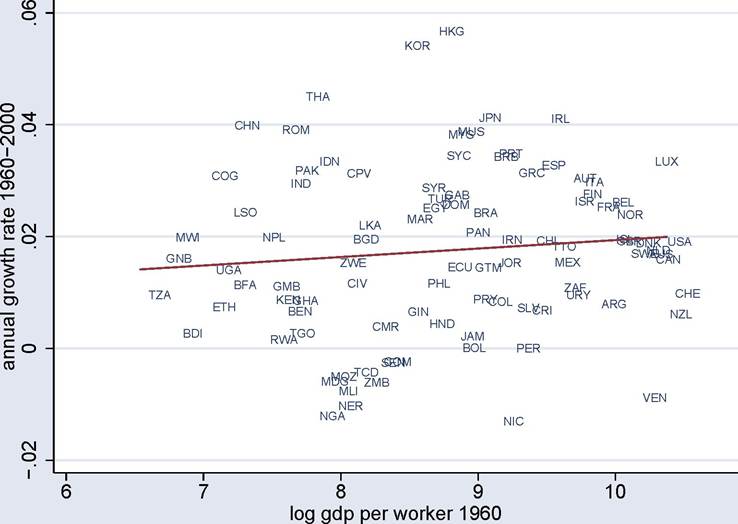
Figure 1.13. Annual growth rate of GDP per worker between 1960 and 2000 versus log GDP per worker in 1960 for the entire world.
In summary, there is no evidence of (unconditional) convergence in the world income distribution over the postwar era (in fact, the evidence suggests some amount of divergence in incomes across nations). But, there is some evidence for conditional convergence, meaning that the income gap between countries that are similar in observable characteristics appears to narrow over time. This last observation is relevant both for understanding among which countries the economic divergence has occurred and for determining what types of models we should consider for understanding the process of economic growth and the differences in economic performance across nations. For example, we will see that many growth models, including the basic Solow and the neoclassical growth models, suggest that there should be “transitional dynamics” as economies below their steady-state (target) level of income per capita grow towards that level. Conditional convergence is consistent with this type of transitional dynamics.
1.6.