Economies of Scale, Population, Technology and World Growth
As we have emphasized in Chapter 1, cross-country income differences result from the differential growth experiences of countries over the past two centuries. This makes it important for us to understand the process of economic growth.
Equally remarkable is the fact that world economic growth is, by and large, a phenomenon of the past 200 years or so. Thus another major question concerns why economic growth started so recently and why there was little economic growth before. The growth literature has provided a variety of interesting answers to this question. Many of them focus on the role of economies of scale and population. The argument goes as follows: in the presence of economies of scale (or increasing returns to scale), population needs to have reached a certain critical level so that technological progress can gather speed. Alternatively, some natural (steady) progress of technology that may have 133been going on in the background needs to reach a critical threshold for the process of growth to begin. These stories are quite plausible. World population has indeed increased tremendously over the past one million years and the world’s inhabitants today have access to a pool of knowledge and technology unimaginable to our ancestors. Could these long-run developments of the world economy also account for cross-country differences? Is the increase in world population a good explanation for the take off of the world economy?
Let us focus on population to give a preliminary answer to these questions. The simplest way of thinking of the relationship between population and technological change is the Simon- Kremer model (after the demographer Julian Simon and the economist Michael Kremer). This model is implicitly one of the entire world economy, since there are no cross-country differences and proponents of this model do not try to explain differences across countries by their populations.
Imagine that there is a small probability that each individual will discover a new idea that will contribute to the knowledge pool of the society. Crucially, these random discoveries are independent across individuals, so that a larger pool of individuals implies discovery of more new ideas, increasing aggregate productivity. Let output be determined simply by technology (this can be generalized so that technology and capital determine output as in the Solow model, but this does not affect the point we would like to make here):
where α ∈ (0,1), Y (t) is world output, A (t) is the world stock of technology, L (t) is world population, and Z is some other fixed factor of production, for example, land, which we normalized to Z = 1 without loss of any generality. Imagine we are in a continuous time world and suppose that

where λ represents the rate at which random individuals make discoveries improving the knowledge pool of the society, and the initial level of world knowledge A (0) > 0 is taken as given. Population, in turn, is a function of output, for example because of the Malthusian channels discussed in Chapter 21 below. For example, we could assume that

Combining these three equations, we obtain (see Exercise 4.1):

The solution to this differential equation involves

134
This shows how a model of economies of scale (increasing returns) in population can generate a steady increase in technology. It is also straightforward to verify that

so that aggregate income also grows at the constant level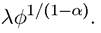 Such a model would
generate steady growth but no acceleration.
Simon and Kremer, instead, assume that there are stronger externalities to population than in (4.1). They impose the following equation governing the accumulation of ideas:
This implies that the law of motion of technology is given by (see Exercise 4.2):

In contrast to (4.4), this equation implies an accelerating output level. Starting from a low- level of A (0) (or L (0)), this model would generate a long period of low output, followed by an acceleration or a take off, reminiscent to the modern economic growth experience discussed in Chapter 1. Therefore, a model with significant economies of scale is capable of generating the pattern of take off we see in the data.
While such a story, which has been proposed by many economists, may have some appeal for accounting for world growth, it is important to emphasize that it has little to say about cross-country income differences or why modern economic growth started in some countries (Western Europe) and not others (Asia, South America, Africa). In fact, if we take Western Europe and Asia as the economic units, European population has consistently been less than that of Asia over the past 2000 years, thus it is unlikely that simple economies of scale to population are responsible for the economic takeoff in Western Europe while Asia stagnated. We will return to an explanation for why economic growth might have taken off in Western Europe in Chapter 24.
We conclude from this discussion that models based on economies of scale of one sort or another do not provide us with fundamental causes of cross-country income differences. At best, they are theories of world growth (the world taken as a whole). Moreover, once we recognize that the modern economic growth process was uneven, meaning that it took place in some parts of the world and not others, the appeal of such theories diminishes further. If economies of scale were responsible for modern economic growth, it should also be able to explain when and where this process of economic growth started. Existing models based on economies of scale do not. In this sense, they are unlikely to provide the fundamental causes of modern economic growth. Does this mean that these types of economies of scale and increasing returns to population are unimportant? Certainly not. They may well be 135
part of the proximate causes of the growth process (for example, the part lying in the black box of technology). But this discussion suggests that these models need to be augmented by fundamental causes in order to explain why, when and where the takeoff occurred. This further motivates our investigation of the fundamental causes.
4.3.