Exercises
Exercise 21.1. Analyze the equilibrium of the economy in Section 21.1 relaxing the assumption that each individual has to invest either all or none of their wealth in the risky saving technology.
Does this generalization affect the qualitative results derived in the text? Exercise 21.2. Consider the economy in Section 21.1.(1) Show that in equation (21.5), K (t + 1) is everywhere increasing in K (t) and that there exists some K such that the capital stock will grow over time when K (t) > K.
(2) Can there be more than one steady state level of capital stock in this economy? If so provide an intuition for this type of multiplicity.
(3) Provide sufficient conditions for the steady state level of capital stock, K*, to be unique. Show that in this case K (t + 1) > K (t) whenever K (t) > K*.
Exercise 21.3. In the model of subsection 21.2.1, suppose that the population growth equation takes the form

instead of (21.8), where ε (t) is a random variable that takes one of two values, 1 — ε or 1+ ε, reflecting random factors affecting population growth. Characterize the stochastic equilibrium. In particular, plot the stochastic correspondence representing the dynamic equilibrium behavior and analyze how shocks affect population growth and income dynamics.
EXERCISE 21.4. Characterize the full dynamics of migration, urban capital-labor ratio and wages in the the model of subsection 21.3.1 (that is, consider the cases in which conditions 1, 2 and 3 in that subsection do not all hold together).
Exercise 21.5. Consider the model of subsection 21.3.2 and suppose that all individuals have utility given by the standard CRRA preferences, i.e.,

Taking the equilibrium path in that subsection is given, find a level of community enforcement advantage ξ that would maximize U (0).
What happens if the actual comparative advantage of community enforcement of villages is greater than this level?Exercise 21.6. Consider the maximization problem given in (21.30).
(1) Explain why this maximization problem characterizes the equilibrium allocation of workers to tasks. What kind of price system will support this allocation?
(2) Derive the first-order conditions given in (21.31).
(3) Provide sufficient conditions such that the solution to this problem involves all skilled workers employed at technology
(4) Provide an example in which no worker will be employed at technology h even though

(5) Can there be a solution where more than two technologies are being used in equilibrium? If so, explain the conditions for such an equilibrium to arise.
Exercise 21.7. Consider a variant of the model in Section 21.4, where firms have an organizational form decision, in particular, they decide whether or not to vertically integrate. For this purpose, consider a slight modification of equation (21.37) where

with

Suppose that entrepreneurial effort increases θ (ν,t), and the internal organization of the firm affects how much effort the entrepreneur devotes to innovation activities. In particular, suppose that θ (ν, t) = O if there is vertical integration, because the entrepreneur is overloaded and has limited time for innovation activities. In contrast, with outsourcing θ (ν,t) = θ > 0. However, when there is outsourcing, the entrepreneur has to share a fraction β > 0 of the 917
profits with the manager (owner) of the firm to which certain tasks have been outsourced (whereas in a vertically integrated structure, he can keep the entire revenue).
(1) Determine the profit-maximizing outsourcing decision for an entrepreneur as a function of the (inverse) distance to frontier a (t). In particular, show that there exists a threshold a such that there will be vertical integration for all a (t) ≤ a and outsourcing for all a (t) > a.
(2) Contrast this equilibrium behavior with the growth-maximizing internal organization of the firm.
Exercise 21.8. Show that when multiple equilibria exist in the model of Section 21.5, the equilibrium with investment Pareto dominates the one without.
Exercise 21.9. Consider the model of subsection 21.6.1 and remove the nonconvexity in the accumulation equation, (21.52), so that the human capital of the offspring of individual i is given by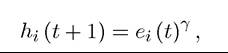
for any level of et (t) and Show that there exists a unique level of human capital to
which each dynasty will converge to. Based on this result, explain the role of nonconvexities in generating multiple steady states.
Exercise 21.10. Consider the model of subsection 21.6.1 and suppose that initial inequality is given by a uniform distribution with mean human capital of h (0) and support over [h (0) — ψ,h (0) + ψ]. Clearly an increase in ψ corresponds to greater inequality.
(1) Show that when h (0) is sufficiently small, an increase in ψ will increase long-run average human capital and income, whereas when h (0) is sufficiently large, an increase in ψ will reduce long run human capital and income. [Hint: use Figure 21.8 or Figure 21.9].
(2) What other types of distributions (instead of uniform) would lead to the same result?
(3) Show that the same result generalizes to the model of 21.6.2.
(4) On the basis of this result, discuss whether we should expect greater inequality to lead to higher income in poor societies and lower income in rich societies.
(If your answer is no, then sketch an environment in which this will not be the case).Exercise 21.11. Consider the model presented in subsection 21.6.2. Make the following two modifications. First, the utility function is now

and second, unskilled agents receive a wage of wu + ε where ε is a mean-zero random shock.
(1) Suppose that ε is distributed with support [—ψ, ψ], and show that if ψ is sufficiently close to 0, then the multiple steady states characterized in 21.6.2 “survive” in the
sense that depending on their initial conditions some dynasties become high skilled and others become low skilled.
(2) Now suppose that ε is distributed with support [—ψ, ∞), where ψ ≤ wu. Show that in this case there is a unique ergodic distribution of wealth and no poverty trap (in the sense that every dynasty will become skilled at some point with probabability 1). Explain why the results here are different from those presented in subsection 21.6.2?
(3) Why was it convenient to change the utility function from the log form used in the text to (21.68)?
Exercise 21.12. We now discuss potential microfoundations for the borrowing constraints in the model of subsection 21.6.2.
(1) Suppose that each individual can run away without paying his debts, and if he does so, he will never be caught. However, a bank that lends to the individual can make sure that the individual is unable to run away by paying a monitoring cost per unit of borrowing equal to m. Suppose that there are many banks competing for lending opportunities, so that Bertrand competition among them will drive them to zero profits. Under these assumptions, show that all bank lending will be accompanied with monitoring, and the lending rate will satisfy i = r + m. Show that in this case all of the results in the text apply.
(2) Next suppose that the bank can prevent individual from running away by paying a fixed monitoring cost of M.
Under the same assumptions as in part 1 above show that in this case the interest rate charged to an individual that borrows an amount x — h will be i (x — h) = r + M/ (x — h). Given this assumption, characterize the equilibrium of the model in subsection 21.6.2. How do the conclusions change in this case?(3) Next suppose that there is no way of preventing running away by individuals, but if an individual runs away, he will be caught with probability p, and in this case, a fraction λ ∈ (0,1) of his income will be confiscated. Given this assumption, characterize the equilibrium of the model in subsection 21.6.2. How do the conclusions change in this case?
(4) Now consider an increase in ws (for a given level of wu) so that the skill premium in the economy increases. In which on the three scenarios outlined above will this have the largest effect on human capital investments?
Exercise 21.13. In this exercise, we study Banerjee and Newman’s (1994) model of occupational choice, which leads to similar results to the Galor-Zeira model, though with richer 919
dynamics. The utility of each individual again depends on consumption and bequest, with  where z denotes whether the individual is exerting effort, with cost of effort normalized to 1. Each agent chooses one of four possible occupations. These are (1) subsistence and no work, which leads to no labor income and has a rate of return on assets equal to ^ < 1∕δ;
(2) work for a wage v; (3) self-employment, which requires investment I plus the labor of the individual; and (4) entrepreneurship, which requires investment μI plus the employment of μ workers, and individual himself becomes the boss, monitoring the workers (and does not take part in production). All occupations other than subsistence involve effort. Let us assume that both entrepreneurship and self-employment generate a rate of return greater than subsistence, i.e., the mean return for both activities is r > r.
(1) Derive the indirect utility function associated with the preferences above. Show that no individual will work as a worker for a wage less than 1.
(2) Assume that Interpret this assumption.
[Hint: it relates the private profitability of entrepreneurship and self-employment at the minimum possible wage of 1].
(3) Suppose that only agents that have wealth w ≥ w* can borrow enough to become self-employed and only agents that have wealth w ≥ w** > w* can borrow μI to become an entrepreneur. Explain why this type of borrowing constraints may be present.
(4) Now compute the expected indirect utility from the for occupations. Show that if 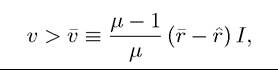 than self-employment is preferred to entrepreneurship.
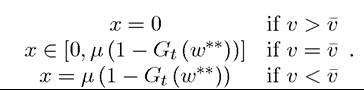
(5) Suppose wealth distribution of time t is given by Gt (w). On the basis of the results in part 4, showed that the demand for labor in this economy is given by
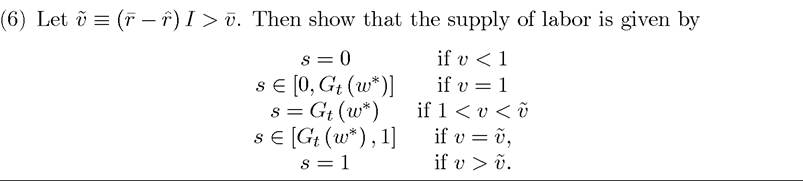
(7) Show that there will be an excess supply of labor and
the equilibrium wage rate will be v = 1.
920
(12) Is the comparison of the steady states in terms of output in this model plausible? Is it consistent with historical evidence? What are the pros and cons of this model relative to the Galor-Zeira model we studied in subsection 21.6.2?
Exercise 21.14. Explain why the aggregator in (21.57) could not be the production function of a final good producer, with each h (t) corresponding to intermediates, but it can be used as an aggregator of the human capital levels of different individuals in the society.
Exercise 21.15. Given (21.59), derive (21.60). [Hint: take logs in (21.61) and (21.62)]. Exercise 21.16. Derive equations (21.63) and (21.64).
Exercise 21.17. In the model of subsection 21.6.3, determine conditions under which the long run income level is higher under full integration than full segregation.
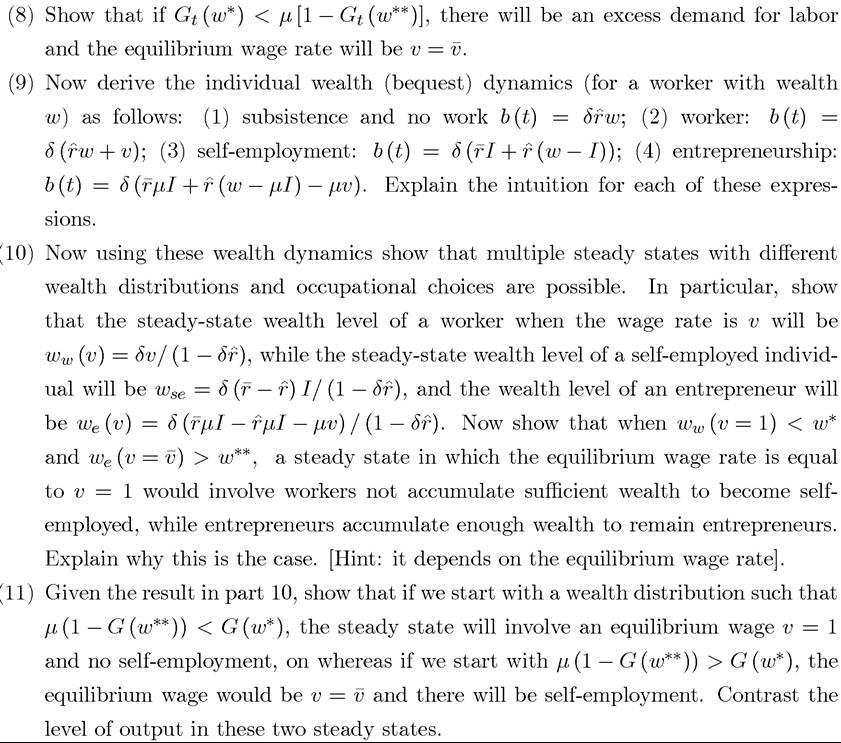
Exercise 21.18. Consider the following non-overlapping generations model, with population normalized 1, where each individual i lives for one period and then begets an offspring. Each individual has has preferences given by
(
(

921

Introduction to Modern Economic Growth
where Ci (t) is the consumption of the individual and et (t + 1) is educational investment in the human capital of the offspring. Each individual has some earned income Wi (t) and is subject to the budget constraint The human capital of the offspring,
hi (t + 1), is given by equation (21.52) in subsection 21.6.1 with h = 1 and There is
also to continue 1 of firms, each with the production function

where worker i has been matched with firm j. Firms choose the level of physical capital investment at some cost R before matching with workers. Let us also assume that matching is random, so that any worker has the same likelihood of matching any firm, and in particular, there is no selective process of high human capital workers being allocated to high physical capital firms. If the firm is not happy with the worker that it matches with, it can fire the worker and resample another worker from the remaining (potentially unmatched) distribution of workers. If it does so, it will have lost a fraction 1 — η of the time devoted for production, so its output will be only a fraction η of the expression given above. Conditional on matching, workers and firms bargain on the wage. Let us suppose that when the distribution of human capital is given by μt (h) and the distribution of physical capital is given by vt (k), the wage of a worker of human capital hi matched with a firm of physical capital kj is given by
(1) Interpret this wage equation. Could you derive it from Nash bargaining? If so, be specific about what assumptions are necessary, particularly concerning what type of worker the worker will match with if it separates from its first partner and vice versa.
(2) In view of this wage equation, show that there exists some η* so that for all η < η*, all firms will choose the same level of physical capital investment at time t given
 Show that in this case, a mean-preserving spread of the human capital distribution will reduce aggregate output. Provide an intuition for this result.
(3) Suppose that η < η* as determined in part 2 and that the economy starts at time
t = 0 with two groups of workers, a fraction λ with human capital hi (0) and a fraction 1 — λ with human capital h2 (0) > hι (0) > h = 1, where is the
minimum human capital level defined in (21.52). Let φ (t) ? hi (t) /h2 (t). Show that the economy will always have two groups of workers and thus its low of motion can be summarized by φ (t).
(4) Derive a difference equation for φ (t) using the optimal capital investment level of
firms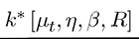 derived in part 2 and the preferences of individuals regarding
investments in their offspring’s human capital.
(5) Prove that there exists some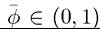 , such that if
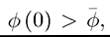 then the dynamic
equilibrium involves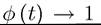 and the economy achieves a constant growth rate.
In contrast, if φ (0) and the
economy converges to no growth. Explain the intuition for this result.
(6) Compare the model here with the model in subsection 21.6.3. What are its pros and cons? How would you generalize or make this model more realistic?
Exercise 21.19. This exercise asks you to analyze the dynamics of the reduced-form model in Section 21.7 more formally.
(1) Show that when fx > 0, the locus for implied by (21.66) is an upward
sloping curve.
(2) Consider the differential equations (21.66) and (21.67), and a steady state (k*,x*). By linearizing the two differential equations around (k*,x*), show that if fx (k*,x*) is sufficiently small, the steady state is locally stable.
(3) Provide a bound on fx (k, x) over the entire domain so that there exists a unique steady state. Show that when this bound applies, the unique steady state is globally stable.
(4) Construct a parameterized example where there are multiple steady states. Interpret the conditions necessary for this example. Do you find them economically likely?