In this part of the book, I turn from the mechanics of economic growth to an investigation of potential causes of economic growth.
Almost all of the models we have studied so far take economic institutions (such as whether property rights are enforced and what types of contracts can be written), policies (such as tax rates, distortions, subsidies) and often the market structure as given.
They then derive implications for economic growth and crosscountry income differences. While these models constitute the core of growth theory, they leave some of the central questions raised in Chapters 1 and 4 unanswered: why do some societies choose institutions and policies that discourage growth, while others choose growthenhancing social arrangements? In this part of the book, I will make a first attempt to provide some answers to these questions based on political economy—that is, on differences in institutions and policies arising from different ways of aggregating individual preferences across societies and on differences in the type and nature of social conflict. In particular, I will emphasize a number of key themes and attempt to provide a tractable and informative formalization of these issues. The main themes are:(1) Different institutions and policies almost always generate winners and losers. In other words, there are a few economic or political reforms that would benefit all members of the society. Consequently, there will be social conflict concerning the types of policies and institutions that a society should adopt.
(2) Aggregating the preferences of different individuals to arrive to collective choices is nontrivial in the presence of social conflict. Two interrelated factors will be central for the aggregation of these preferences: the form of political institutions and the political power of different groups. Individuals and groups with significant political power are more likely to be influential and sway policies towards their preferences. Exactly how political power is distributed within the society and how individuals can exercise their political power (resulting from their votes, connections or brute force) will depend on political institutions.
For example, a dictatorship that concentrates political power in the hands of a small group will imply a different distribution of political power in the society than a democracy, which corresponds to a society with a greater degree of political equality. We expect that these different political regimes will induce different sets of economic institutions and policies, and thus lead to different economic outcomes. The purpose of the next two chapters is to investigate this process of collective decision-making and the implications of different choices of institutions and policies on economic growth.(3) The technology, the nature of the endowments and the distribution of income and endowments in the economy will influence both the preferences of different individuals and groups towards policies (or specific institutions) and also their political powers. For example, the nature of political conflict and the resulting political economy equilibrium is likely to be different in a society where much of the land and the capital stock is concentrated in the hands of a few individuals and families than one in which there is a more equitable distribution of resources. We would also expect politics to function differently in a society where the major assets are in the form of human capital vested in individuals than in a society where natural resources, such as diamonds or oil, are the major assets.
The issues raised and addressed in this part of the book are central to the field of political economy. Since this is a book on economic growth not on political economy, I will not try to do justice to the large and growing literature in this area. Instead, I will focus on topics and models that I deem to be most important for the questions posed above. I will also save space and time by focusing, whenever possible, on the neoclassical growth model rather than some of the richer models we have seen so far. This might at first appear as an odd choice. Why should we focus on the neoclassical growth model, which does not generate growth (other than via exogenous technological change), to study the political economy of growth? My answer is that the neoclassical growth model offers two significant advantages: first, it provides the most tractable framework to analyze the main political economy conflicts.
Second, because the competitive equilibrium in the neoclassical growth model is Pareto optimal, it will make the role of political economy distortions more transparent. Naturally, once the basic forces are understood, it is relatively straightforward to incorporate them into endogenous growth models or other richer structures. Some of the exercises will consider these extensions.I have organized the material on political economy of growth into two chapters. The first chapter takes political institutions as given and focuses on the implications of distributional conflict under different scenarios. In this chapter, I try to highlight why and when distributional conflict can lead to distortionary policies retarding growth. I will also offer various complementary frameworks for the analysis of these questions. Chapter 23 then turns to the implications of different political regimes for economic growth and also includes a brief discussion of how political institutions themselves are determined endogenously.
Before presenting this material, it is useful to start with an abstract discussion of the relationship between economic institutions, political institutions, and economic outcomes, and individual preferences over economic and political institutions. The distinction between economic and political institutions has already been highlighted in Chapter 4 and will be discussed again below. For now I take this distinction as given. The political science literature often posits that individuals have (direct) preferences over political institutions (and perhaps also over economic institutions). For example, individuals might derive utility from living under a democratic system. While this is plausible, the approach we have developed so far in this book emphasizes another, potentially equally important, reason for individuals to 927
have preferences over political institutions. However, economic institutions and policies also have a direct effect on economic outcomes (for example, as illustrated by the effects of tax policies, regulation and contracting institutions in previous chapters). Thus we may plausibly expect that the major determinant of individual preferences on economic institutions (and policies) will be the allocations that result from these arrangements.
Based on this viewpoint, throughout I will focus on these induced preferences on economic institutions.The same applies to political institutions. These determine the political rules under which individuals interact. In direct democracy, for example, key decisions are made by ma joritarian voting. In representative democracy, majorities choose representatives who then make the policy choices and face the risk of being removed from office if they pursue policies that are not in line with the preferences of the electorate. In contrast, in nondemocratic regimes, such as dictatorships or autocracies, a small clique, an oligarchy of rich individuals, or a junta of generals make the key decisions. These differences in political rules imply that different political institutions lead to the different distributions of de jure political power, meaning that the institutionally-sanctioned distribution of political power, and thus the decision-making capacity, is distributed differently within the society. As a result, we would expect different policies and economic institutions to emerge in different political systems. For example, democracies are more likely to choose redistributive policies as we have already seen in the previous chapter, whereas a society that is dominated by the elite or by a small group of individuals is likely to choose policies, that will further the economic interests of this narrow group. This reasoning suggests that since different political institutions will lead to different economic institutions and policies and via this channel to different economic allocations, individuals will similarly have induced preferences over political institutions.
To emphasize this point, let us represent the chain of causation described above by a set of mappings. Let P denote the set of political regimes or institutions, R be the set of feasible economic institutions (or policies), and X denote the set of feasible allocations (which include different levels of consumption of all goods and services by all individuals in the society).
Ignoring any stochasticity in outcomes for simplicity, we can think of each political institution in the set P leading to some specific set of economic institutions in the set E. Let this be represented by the mapping π (∙). Similarly, each different set of economic institutions will lead to a different allocation (ignoring again stochastic elements and multiple equilibria), and let this be represented by the mapping ρ (∙). Schematically, we can write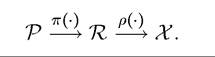
Now suppose that each individual i has a utility function Ui : X → R, representing his preferences over possible allocations in X. Suppose also that individuals do not care about economic or political institutions beyond these institutions’ influences on allocations. In other 928
words, we presume that individuals are purely Consequentialist (and thus ignore any direct benefits they may obtain from institutions). Then their preferences over some economic institution R ∈ R is simply given by This mapping therefore
captures their induced preferences over economic institutions (as a function of the economic allocations that these institutions will lead to). Preferences on political institutions are also induced in the same manner. The utility that individual i will derive from some political institution P ∈ P is simply given by Ui (ρ (π (P))), where clearly Ui о ρ о π : P → R. These preferences on institutions are important, since an equilibrium framework must, at least to some degree, explain the emergence and change of political institutions as a function of the preferences of the members of the society over these objects.
Throughout, the next two chapters, I will adopt this consequentialist view and define individual political preferences, over economic institutions or political institutions, purely in terms of these induced preferences—that is, preferences according to economic allocations that will ultimately result from these institutions.
The interesting part of the analysis is to understand how economic institutions affect economic outcomes, how this shapes individual attitudes towards different economic institutions and policies, and which political institutions will lead to what types of economic institutions. We have already seen in Chapter 4 some empirical approaches to howthe cluster of economic and political institutions affect economic outcomes (including growth and distribution of resources). Much on my focus in the next two chapters will be to investigate the same linkages theoretically.This brief section has therefore laid two types of foundations for the rest of this part of the book. (1) Our first task will be to understand how different types of economic institutions (and policies) affect economic outcomes, including economic performance and distribution of resources, which, here, is summarized by the mapping ρ (∙). Then based on this, we should analyze the preferences of different groups over these economic institutions (policies) and determine the conditions under which different groups will have a preference for distortionary, non-growth-enhancing economic arrangements. This will be the topic of the next chapter. (2) In order to understand political change and how it interacts with economic decisions and economic growth, we next need to understand induced preferences over political institutions, that is, understand the mapping π (∙) and combine it with our insights about ρ (∙). This will inform us on how political institutions affect economic arrangements, how economic arrangements influence economic allocations, and on the basis of this, how different groups value different sets of political institutions.
More on the topic In this part of the book, I turn from the mechanics of economic growth to an investigation of potential causes of economic growth.:
- Preliminaries
- References
- THE THEORY AND PRACTICE OF EMPIRE-BUILDING
- Oetzel John, Ting-Toomey Stella. The SAGE Handbook of Conflict Communication: Integrating Theory, Research and Practice. SAGE Publications,2013. — 912 p., 2013
- FIVE COMPONENTS OF LEGAL COMPETENCIES
- REVIEW OF FORENSIC ASSESSMENT INSTRUMENTS
- Mesoamerica’s Priests, Farmers and Warriors
- PREFACE
- Foreword: Frances Moore Lappe
- The Yogi's Way of War