Preliminaries
To prepare for this analysis, let us consider an economy consisting of a unit measure of infinitely-lived households. By a unit measure of households I mean an uncountable number of households, for example, the set of households H could be represented by the unit interval [0,1].
This is an abstraction adopted for simplicity, to emphasize that each household is infinitesimal and will have no effect on aggregates. Nothing in this book hinges on this assumption. If the reader instead finds it more convenient to think of the set of households, H, as a countable set of the form H = {1, 2,..., M} or H = N, this can be done without any loss of generality. The advantage of having a unit measure of households is that averages and aggregates are the same, enabling us to economize on notation. It would be even simpler to have H as a finite set in the form {1, 2,..., M}. While this would sufficient in many contexts, overlapping generations models in Chapter 9 require the set of households to be infinite.Households in this economy may be truly “infinitely lived,” or alternatively they may consist of overlapping generations with full (or partial) altruism linking generations within the household. Throughout, I equate households with individuals, and thus ignore all possible sources of conflict or different preferences within the household. In other words, I assume that households have well-defined preference orderings.
As in basic general equilibrium theory, let us suppose that preference orderings can be represented by utility functions. In particular, suppose that each household h has an instantaneous utility function given by 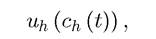
where Uh : R∣∣→ R is increasing and concave and ¾ (t) is the consumption of household h. I take the domain of the utility function to be R ∣ rather than R, so that negative levels of consumption are not allowed.
Even though some well-known economic models allow negative consumption, this is not easy to interpret in general equilibrium or in growth theory, thus this restriction is sensible in most models.The instantaneous utility function captures the utility that an individual (or household) derives from consumption at time t. It is therefore not the same as a utility function specifying a complete preference ordering over all commodities—here consumption levels in all dates. For this reason, the instantaneous utility function is sometimes also referred to as the “felicity function”.
There are two major assumptions in writing an instantaneous utility function. First, it imposes that the household does not derive any utility from the consumption of other households, so consumption externalities are ruled out. Second, in writing the instantaneous utility function, I already imposed that overall utility is time-separable, that is, instantaneous utility at time t is independent of the consumption levels at past or future dates. This second feature is important in enabling us to develop tractable models of dynamic optimization.
Finally, let us introduce a third assumption and suppose that households discount the future “exponentially”—or “proportionally”. In discrete time, and ignoring uncertainty, this implies that household preferences at time t = 0 can be represented as  where βh ∈ (0,1) is the discount factor of household h. This functional form implies that the weight given to tomorrow’s utility is a fraction βh of today’s utility, and the weight given to the utility the day after tomorrow is a fraction βh of today’s utility, and so on. Exponential discounting and time separability are convenient for us because they naturally ensure “time-consistent” behavior.

Time-consistent problems are much more straightforward to work with and satisfy all of the standard axioms of rational decision-making.
Although time-inconsistent preferences may be useful in the modeling of certain behaviors, such as problems of addiction or self-control, timeconsistent preferences are ideal for the focus in this book, since they are tractable, relatively flexible and provide a good approximation to reality in the context of aggregative models. It is also worth noting that many classes of preferences that do not feature exponential and time- separable discounting nonetheless lead to time-consistent behavior. Exercise 5.1 discusses issues of time-consistency further and shows how certain other types of utility formulations lead to time-inconsistent behavior, while Exercise 5.2 introduces some common non-time- separable preferences that lead to time-consistent behavior.There is a natural analog to (5.1) in continuous time, again incorporating exponential discounting, which is introduced and discussed below (see Chapter 7).
The expression in (5.1) ignores uncertainty in the sense that it assumes the sequence of consumption levels for household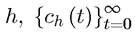 is known with certainty. If instead this
sequence were uncertain, we would need to look at expected utility maximization. Most growth models do not necessitate an analysis of behavior under uncertainty, but a stochastic version of the neoclassical growth model is the workhorse of much of the rest of modern macroeconomics and will be presented in Chapter 17. For now, it suffices to say that in the presence of uncertainty, u⅛ (∙) should be interpreted as a “Bernoulli utility function,” defined over risky acts, so that the preferences of household h at time t = 0 can be represented by the following von Neumann-Morgenstern expected utility function:
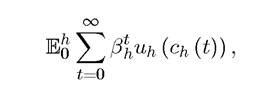
where is the expectation operator with respect to the information set available to household h at time t = 0.
The formulation so far indexes individual utility function, u⅛ (∙), and the discount factor, βh, by “h” to emphasize that these preference parameters are potentially different across households. Households could also differ according to their income processes. For example, each household could have effective labor endowments of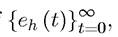 thus a sequence of labor
income of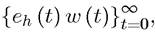 where w (t) is the equilibrium wage rate per unit of effective labor.
Unfortunately, at this level of generality, this problem is not tractable. Even though we can establish some existence of equilibrium results, it would be impossible to go beyond that. Proving the existence of equilibrium in this class of models is of some interest, but our focus is on developing workable models of economic growth that generate insights about the process of growth over time and cross-country income differences. I will therefore follow the standard approach in macroeconomics and assume the existence of a representative household.
5.2.
More on the topic Preliminaries:
- This part of the book is a preparation for what is going to come next. In some sense, it can be viewed as the “preliminaries” for the rest of the book.
- A Very Brief Philosophy of Measurement
- NUMERICAL PROBLEMS
- NUMERICAL PROBLEMS
- Contents
- NUMERICAL PROBLEMS