NUMERICAL PROBLEMS
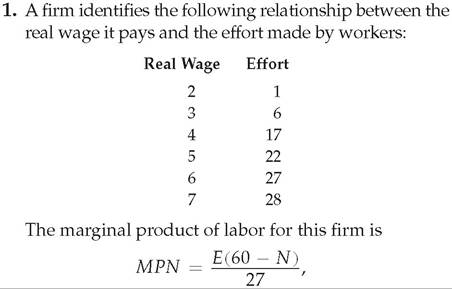
where E is the effort level and N is the number of workers employed. If the firm can pay only one of the wage levels shown above, which should it choose? How many workers will it employ? If the firm launches a morale boosting plan and the effort exerted by workers increases by 10 at the given wage level, will the firm stay at the same wage level as before? How many workers will it employ after the plan?
2.
An economy is described by the following equations: Desired consumption Cd = 130 + 0.5( Y — T) — 500r.Desired investment Id = 100 — 500r.
Government purchases G = 100.
Taxes T = 100.
Real money demand l = 05γ — 1000r
Money supply M = 1320.
Full-employment output = 500
= 500
Note that the expected rate of inflation is assumed to equal zero so that money demand depends directly on the real interest rate, which equals the nominal interest rate.
a. Write the equations for the IS and LM curves. (These equations express the relationship between r and Y when the goods and asset markets, respectively, are in equilibrium.)
b. Calculate the full-employment values of output, the real interest rate, the price level, consumption, and investment.
c. Suppose that, because of investor optimism about the future marginal product of capital, the investment function becomes

f.
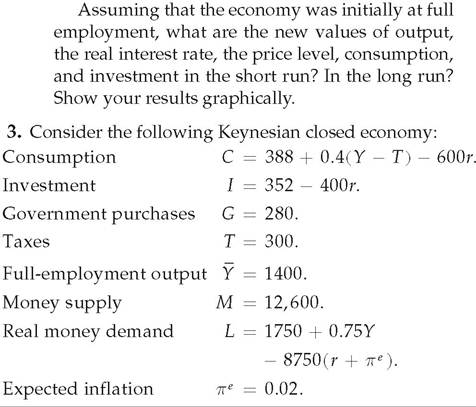
a. What is the equation of the IS curve?
b. Suppose that the price level is fixed at Psr = 7 in the short run.
What is the equation of the LM curve in the short run, while the price level remains fixed?c. What are the short-run equilibrium values of output, the real interest rate, consumption, and investment?
d. What are the long-run equilibrium values of output, the real interest rate, consumption, investment, and the price level?
e. What is the value of velocity in long-run equilibrium?
Suppose that the government wants to increase its purchases to G = 350 and to achieve a long-run equilibrium with investment, I, equal to 320, and the price level, P, equal to 6. What level of taxes, T, and money supply, M, will achieve this long-run equilibrium? The following questions will guide you to the answer. (1) What value of the real interest rate leads to I = 320? (2) What is the value of consumption in long-run equilibrium when I = 320 and G = 350? (3) What value of taxes, T, will lead to the level of consumption, C, in part (2), thereby achieving I = 320 and G = 350 in long- run equilibrium? (4) What value of the nominal money supply, M, will lead to a price level of 6 in long-run equilibrium with I = 320 and G = 350? (Note: continue to assume that πe = 0.02.)
4. An economy is described by the following equations: Desired consumption Cd = 300 + 0.5( Y — T) — 300r.
Desired investment Id = 100 — 100r.
Government purchases G = 100.
Taxes T = 100.
Real money demand L = 0.5Y — 200r.
Money supply M = 6300.
Full-employment output Y = 700.
Note that the expected rate of inflation is assumed to equal zero so that money demand depends directly on the real interest rate, which equals the nominal interest rate.
a. Write the equation for the aggregate demand curve. (Hint: Find the equations describing the goods market and asset market equilibria. Use these two equations to eliminate the real interest rate. For any given price level, the equation of the aggregate demand curve gives the level of output that satisfies both goods market and asset market equilibria.)
b.
Suppose that P = 15. What are the short-run equilibrium values of output, the real interest rate, consumption, and investment?c. What are the long-run equilibrium values of output, the real interest rate, consumption, investment, and the price level?
5. (Appendix 11.A) Consider an economy in which all workers are covered by contracts that specify the nominal wage and give the employer the right to choose the amount of employment. The production function is
equilibrium conditions) are described by the following equations:
IS curve Y = 120 — 500r.
LM curve M/P = 0.5Y — 500r.
d. The money supply M is 300. Use the IS and LM equations to derive a relationship between output, Y, and the price level, P. This relationship is the equation for the aggregate demand curve. Graph it on the same axis as the relationship between the price level and the amount of output supplied by firms (the aggregate supply curve) from part (c).
e. What are the equilibrium values of the price level, output, employment, real wage, and real interest rate?
/.Suppose that the money supply, M, is 135. What are the equilibrium values of the price level, output, employment, real wage, and real interest rate?
6. (Appendix 11.C) Consider the following economy.
Desired consumption Cd = 325 + 0.5( Y — T)
- 500r.
Desired investment Id = 200 - 500r.
Government purchases G = 150.
Taxes T = 150.
Real money demand L = 0.5Y - 1000r.
Money supply M = 6000.
Full-employment output Y = 1000.
Note that the expected rate of inflation is assumed to equal zero so that money demand depends directly on the real interest rate, which equals the nominal interest rate.

and the corresponding marginal product of labor is
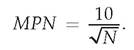
Suppose that the nominal wage is W = 20.
a. Derive an equation that relates the real wage to the amount of labor demanded by firms (the labor demand curve).
b. For the nominal wage of 20, what is the relationship between the price level and the amount of labor demanded by firms?
c. What is the relationship between the price level and the amount of output supplied by firms? Graph this relationship.
Now suppose that the IS and LM curves of the economy (the goods market and asset market
a. Calculate the full-employment values of the real interest rate, the price level, consumption, and investment.
b. What are the values of aIS, Pis, αlm, βlm, and £ r for this economy? (You'll have to refer back to Appendix 9.B for definitions of these coefficients.)
c. Suppose that the price level is fixed at Psr = 15. What are the short-run equilibrium values of output and the real interest rate?
d. With the price level still fixed at Psr = 15, suppose that government purchases increase from G = 150 to G = 250. What are the new values of a1S and the short-run equilibrium level of output?
e. Use Eq. (11.C.5) to compute the government purchases multiplier. Use your answer to compute the short-run change in Y resulting from an increase in government purchases from G = 150 to G = 250. How does your answer here compare to your answer in part (d)?
►
More on the topic NUMERICAL PROBLEMS:
- Arab and Zionist institution-building
- REVIEW OF FORENSIC ASSESSMENT INSTRUMENTS
- Functional forms for the model components
- The Ukrainian Diaspora
- Omitting intermediate entities in models of indirect interactions
- REVIEW OF FORENSIC ASSESSMENT INSTRUMENTS
- Discussion
- More Vague Propositions than Sentences
- PRELIMINARIES: DIMENSIONS, INDICATORS, AND WEIGHTS
- Hospital Care