To help you work through the algebra needed for numerical problems in this chapter, here is a worked-out numerical exercise as an example for solving the IS-LM model:
Consider an economy that is described by the following equations:
Cd = 300 + 0.75(Y - T) - 300r
T = 100 + 0.2Y
Id = 200 - 200r
L = 0.5Y - 500i
Y = 2500; G = 600; M = 133,200; πe = 0.05; Psr = 120.
In the short run, the price level is fixed at Psr. Find the short-run and long-run equilibrium values of Y, P, r, C, I, and i.
To solve this problem, we will follow these steps:
Step 1. Find the equation for the IS curve by using the goods market equilibrium condition, Y = Cd + Id + G. Substitute the equation for T into the equation for Cd from above. Then substitute the resulting equation and the equation for Id from above, along with the value of G, into Y = Cd + Id + G to obtain: Y = {300 + 0.75[ Y — (100 + 0.2Y)] — 300r} + [ 200 — 200r ] + 600. Rearrange this equation as an equation for r in terms of Y:Y = [300 + 0.75Y — 75 — 0.15Y — 300r] + [200 - 200r] + 600, so 0.4Y = [300 - 75 + 200 + 600] - (300 + 200)r, so 500r = 1025 - 0.4Y. Therefore, r = 1025/500 - (0.4/500)Y, so r = 2.05 - 0.0008Y. This is the IS curve.
Step 2. Find the equation for the LM curve by using the asset market equilibrium condition.
a. First, find the equation for the LM curve with an unspecified value of the price level. The asset market equilibrium condition equates real money supply to real money demand. Real money demand is given by L = 0.5Y — 500i = 0.5Y — 500(r + πe) = 0.5Y — 500(r + 0.05), and real money supply is M/P = 133,200∣P. In asset market equilibrium, 133,200/P = 0.5Y - 500(r + 0.05), so 500r = 0.5Y - 25 - 133,200/P. Therefore, r = (0.5/500)Y - (25/500) -(133,200/500)P = 0.001Y - 0.05 - 266.4P- This is the equation of the LM curve for an unspecified value of P.
b. Then find the equation for the LM curve when P = Psr.
Set P = Psr = 120 in the LM curve to obtain r = 0.001Y — 0.05 — 266.4120, so r = 0.001Y — 0.05 — 2.22. Therefore, r = 0.001Y — 2.27. This is the equation of the LM curve when P = Psr.Step 3. Find the short-run equilibrium.
a. Find the intersection of the IS and LM curves to find the short-run equilibrium values of Y and r. We have written the equations of the IS and LM curves so that the left side of each equation is simply r. Setting the right side of the IS curve equal to the right side of the LM curve yields 2.05 — 0.0008Y = 0.001Y — 2.27, so 4.32 = 0.0018Y. Therefore, Y = 4.32/0.0018 = 2400. Now use the value of Y in either the IS or the LM curve. In the IS curve, r = 2.05 — 0.0008Y = 2.05 - (0.0008 ? 2400) = 2.05 - 1.92 = 0.13. In the LM curve, r = 0.001Y - 2.27 = (0.001 ? 2400) - 2.27 = 2.40 - 2.27 = 0.13.
b. Plug these equilibrium values of Y and r into other equations to find equilibrium values for T, C, I, and i.
T = 100 + 0.2Y = 100 + (0.2 ? 2400), so T = 580.
C = 300 + 0.75(Y - T) - 300r = 300 + [0.75(2400 - 580)] - (300 ? 0.13) = 300 + 1365 - 39 = 1626.
I = 200 - 200r = 200 - (200 ? 0.13) = 200 - 26 = 174.
(Note that C + I + G = 1626 + 174 + 600 = 2400, which equals Y.)
i = r + πe = 0.13 + 0.05 = 0.18.
Step 4. Find the long-run equilibrium.
a. Use the fact that in long-run equilibrium, Y = Y. Plug the equilibrium level of output into the IS equation to find the equilibrium real interest rate. Use Y = 2500 and the IS equation, r = 2.05 — 0.0008Y, to obtain r = 2.05 — (0.0008 ? 25000) = 2.05 - 2.00 = 0.05.
b. Plug the equilibrium values of Y and r into other equations to find equilibrium values for T, C, I, and i.
T = 100 + 0.2Y = 100 + (0.2 ? 2500), so T = 600.
C = 300 + 0.75(Y - T) - 300r = 300 + [0.75(2500 - 600)] - (300 ? 0.05)
= 300 + 1425 - 15 = 1710.
I = 200 - 200r = 200 - (200 ? 0.05) = 200 - 10 = 190.
(Note that C + I + G = 1710 + 190 + 600 = 2500, which equals Y.)
i = r + πe = 0.05 + 0.05 = 0.10.
c. Plug the equilibrium values of Y and i into the money demand equation to obtain the value of real money demand L. Then find the value of P that equates real money supply, M∕P, with real money demand, L. The money demand curve is L = 0.5Y - 500i = (0.5 ? 2500) - (500 ? 0.10) = 1250 - 50 = 1200. Setting real money supply equal to real money demand gives 133,200/ P = 1200, so P = 133,200/1200 = 111.
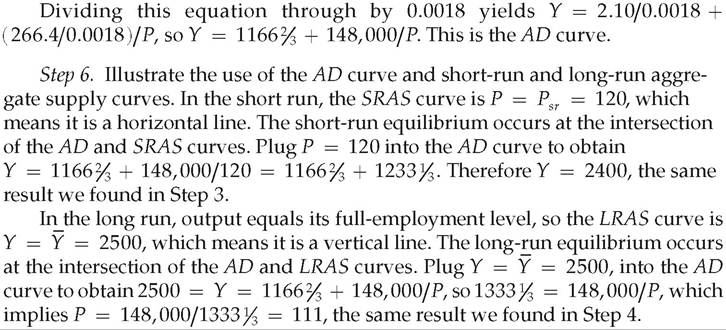
Step 5. Find the equation for the AD curve by using the IS and LM curves. Use the form of the LM curve for an unspecified value of P.
The IS and LM curves are both written so that r appears alone on the left side, so the right sides of both can be equated to obtain:
2.05 - 0.0008Y = 0.001Y - 0.05 - 266.4∣P, so 0.0018Y = 2.10 + 266.4∣P.