Importance of Biased Technological Change
To see the potential importance of the biased technological change, let us first review a number of examples.
1. Perhaps the most important example of biased technological change is the so-called skill-biased technological change, which plays an important role in the analysis of recent labor market developments and changes in the wage structure.
Figure 15.1 plots a measure of the relative supply of skills (defined as the number of college equivalent workers divided by noncollege equivalents) and a measure of the return to skills, the college premium. It shows that over the past 60 years, the US relative supply of skills has increased rapidly, but there has been no tendency for the returns to college to fall in the face of this large increase in supply— on the contrary, there has been an increase in the college premium over this time period. The standard explanation for this pattern is that new technologies over the post-war period have been skill-biased. In fact, at some level this has to be so; if skilled and unskilled workers are imperfect substitutes, an increase in the relative supply of skills, without technological change, will necessarily reduce the skill premium.The figure also shows that beginning in the late 1960s, the relative supply of skills increased much more rapidly than before, and the skill premium increased very rapidly beginning precisely in the late 1970s. The standard explanation for this increase is an acceleration in the skill bias of technological change that happens to be coincidental with the significant changes in the relative supply of skills.
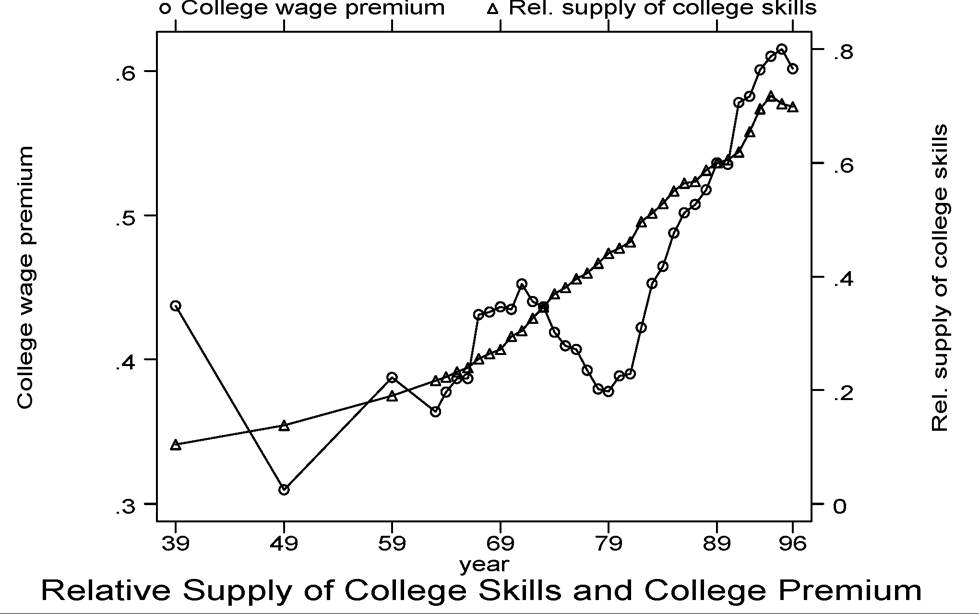
Figure 15.1. Relative supply of college graduates and the college premium in the U.S. labor market.
An obvious question is why technological changes have been skill-biased over the past 60 years or even 100 years? Relatedly, why does it appear that skill-biased technological change accelerated starting in the 1970s, precisely when the supply of skills increased rapidly? While some economists are happy to treat the bias of technological change as exogenous, this is not entirely satisfactory.
We have seen that understanding the endogenous nature of technology is important for our study of cross-country income differences and the process of modern economic growth. It is unlikely that, while the amount of aggregate technological change is endogenous, the bias of technological change is entirely exogenous. It is therefore important to study the determinants of endogenous bias of technological change and ask why technological change has become more skill-biased in recent decades.2. This conclusion is strengthened when we look at the historical process of technological change. In contrast to the developments during the recent decades, technological changes during the late 18th and early 19th centuries appear to have been unskill-biased. The artisan shop was replaced by the factory and later by interchangeable parts and the assembly line. Products previously manufactured by skilled artisans started to be produced in factories by workers with relatively few skills, and many previously complex tasks were simplified, reducing the demand for skilled workers. Mokyr (1990, p. 137) summarizes this process as follows:
“First in firearms, then in clocks, pumps, locks, mechanical reapers, typewriters, sewing machines, and eventually in engines and bicycles, interchangeable parts technology proved superior and replaced the skilled artisans working with chisel and file.”
Even though the types of skills valued in the labor market during the 19th century were different from those supplied by college graduates in today’s labor markets, the juxtaposition of technological change biased towards college graduates in the recent past and biased against the most skilled workers of the time in the 19th century is both puzzling and intriguing. It raises the question: why was technological change, that has been generally skill-biased over the 20th century, biased towards unskilled workers in the 19th century?
3. As another example, consider the potential effect of labor market conditions on technological change. Beginning in the late 1960s and the early 1970s, both unemployment and the share of labor in national income increased rapidly in a number of continental European countries.
During the 1980s, unemployment continued to increase, but the labor share started a steep decline, and in many countries it fell below its initial level. Blanchard (1997) interprets the first phase as the response of these economies to a wage-push by workers, and the second phase as a possible consequence of capital-biased technological changes. Is there a connection between capital-biased technological changes in European economies and the wage push preceding it?4. The other obvious example of the importance of direct technological change is the common restriction to Harrod-neutral (purely labor-augmenting) technological progress in
growth models. Recall from Chapters 2 and 8 that if technological change is not laboraugmenting, equilibrium growth will not be balanced. But a range of evidence suggests that modern economic growth has been relatively balanced. Is there any reason to expect technological change to be endogenously labor-augmenting?
5. Finally, the past several decades have experienced a large increase in the volume of international trade and a rapid process of globalization. Do we expect globalization to affect the types of technologies that are being developed and used?
This chapter shows that a framework of directed technological change can provide potential answers to these questions. The main insight is to think of profit incentives as affecting not only the amount but also the direction of technological change. Before presenting detailed models, let us review the basic arguments, which are quite intuitive.
Imagine an economy which has two different factors of production, say L and H (corresponding, for example, to unskilled and skilled workers), and two different types of technologies that can complement (augment) either one or the other factor. We would expect that whenever the profitability of H -augmenting technologies is greater than the L-augmenting technologies, more of the former type will be developed by profit-maximizing (research) firms.
But then, what determines the relative profitability of developing different technologies? The answer to this question summarizes most of the economics in the models of directed technological change. Two potentially counteracting effects shape the relative profitabilities of different types of technologies:(1) The price effect: there will be stronger incentives to develop technologies when the goods produced by these technologies command higher prices.
(2) The market size effect: it is more profitable to develop technologies that have a larger market (for example, for the reasons discussed in Chapter 12).
An important result of the analysis in this chapter will be that this market size effect is powerful enough to outweigh the price effect. In fact, under fairly general conditions the following two results will hold:
• Weak Equilibrium (Relative) Bias: an increase in the relative supply of a factor always induces technological change that is biased in favor of this factor.
• Strong Equilibrium (Relative) Bias: if the elasticity of substitution between factors is sufficiently large, an increase in the relative supply of a factor induces sufficiently strong technological change biased towards itself that the endogenous- technology relative demand curve of the economy becomes upward-sloping.
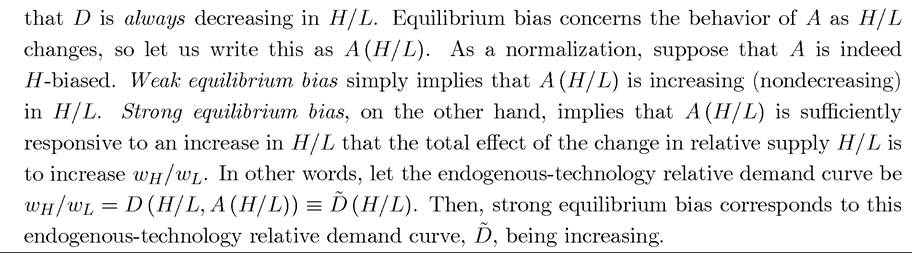
At first, both the weak and the strong equilibrium bias results appear surprising. However, they become quite intuitive once the logic of directed technological change is understood. Moreover, they have a range of important implications. In particular, subsection 15.3.3 below shows how the weak and the strong relative bias results provide us with potential answers to the questions posed at the beginning of this section.
15.2.