Basics and Definitions
Before studying directed technological change, it is useful to clarify the difference between factor-augmenting and factor-biased technological changes, which are sometimes confused in the literature.
Suppose that the production side of the economy can be represented by an aggregate production function,
where L (t) is labor, and H (t) denotes another factor of production, which could be skilled labor, capital, land or some intermediate goods, and A (t) represents technology. Without loss of generality imagine that ∂F∕∂A > 0, so a greater level of A corresponds to “better technology”. Recall that technological change is L-augmenting if

This is clearly equivalent to the production function taking the more special form, F (AL, H). In the case where L corresponds to labor and H to capital, this is also equivalent to Harrod- neutral technological change. Conversely, H -augmenting technological change is defined similarly, and corresponds to the production function taking the special form F (L, AH).
Though often equated with factor-augmenting changes, the concept of factor-biased technological change is very different. We say that technological change change is L-biased, if it increases the relative marginal product of factor L compared to factor H. Mathematically, this corresponds to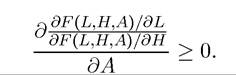
Put differently, biased technological change shifts out the relative demand curve for a factor, so that its relative marginal product (relative price) increases at given factor proportions (given relative quantity of factors). Conversely, technological change is H -biased if this inequality holds in reverse. Figure 15.2 plots the effect of an H -biased (skill-biased) 563
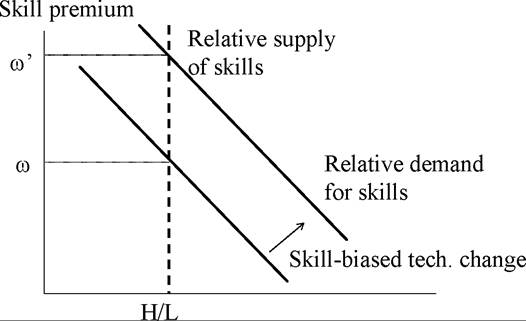
Figure 15.2. The effect of H-biased technological change on relative demand and relative factor prices.
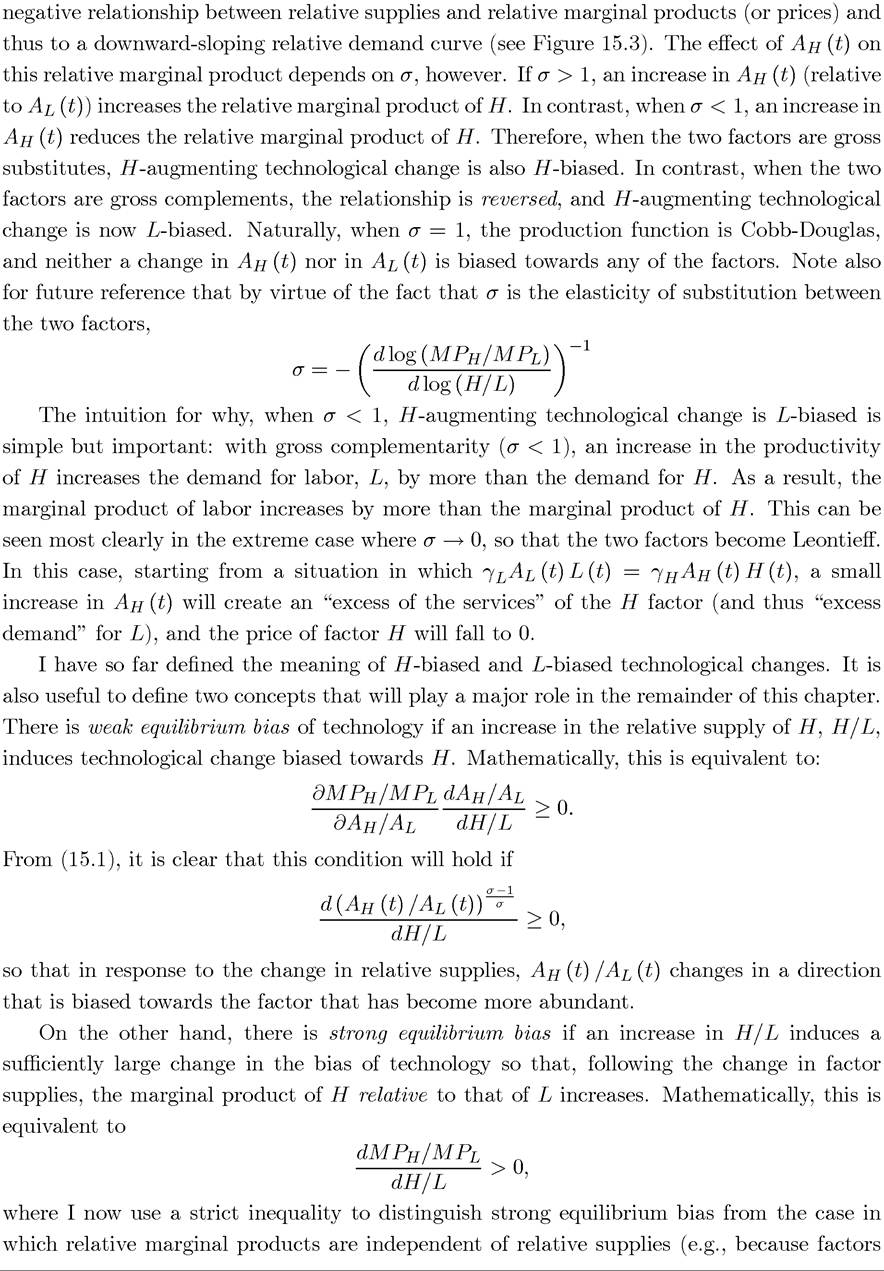
are perfect substitutes). These equations make it clear that the major difference between weak and strong equilibrium bias is whether the relative marginal product of the two factors are evaluated at the initial relative supplies (in the case of weak bias) or at the new relative supplies (in the case of strong bias). Consequently, strong equilibrium bias is a much more demanding concept than weak equilibrium bias.
15.3.