Infinite Planning Horizon
Another important microfoundation for the standard preferences used in growth theory and macroeconomics concerns the planning horizon of individuals. Although some growth models are formulated with finitely-lived households (see, e.g., Chapter 9), most growth and macro models assume that households have an infinite-planning horizon as in eq.
(5.2) or eq. (5.26) below. A natural question to ask is whether this is a good approximation to reality. After all, most individuals we know are not infinitely-lived.There are two reasonable microfoundations for this assumption. The first comes from the “Poisson death model” or the perpetual youth model, which will be discussed in greater detail in Chapter 9. The general justification for this approach is that, while individuals are finitely-lived, they are not aware of when they will die. Even somebody who is 100 years old will recognize that he cannot consume all his assets, since there is a fair chance that he will live for another 5 or 10 years. At the simplest level, we can consider a discrete-time model and assume that each individual faces a constant probability of death equal to v > 0. This is a strong simplifying assumption, since the likelihood of survival to the next age in reality is not a constant, but a function of the age of the individual (a feature best captured by actuarial life tables, which are of great importance to the insurance industry). Nevertheless, this is a good starting point, since it is relatively tractable and also implies that individuals have an expected lifespan of 1/v < ∞ periods, which can be used to get a sense of what the value of ν should be.

would apply between consumption today and tomorrow if he were sure to live between the two dates. Moreover, let us normalize u (0) = 0 to be the utility after death.
Now consider an individual who plans to have a consumption sequence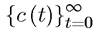 (conditional on living).
 Clearly, after the individual dies, the future consumption plans do not matter. Standard arguments imply that this individual would have expected utility at time t = 0 given by
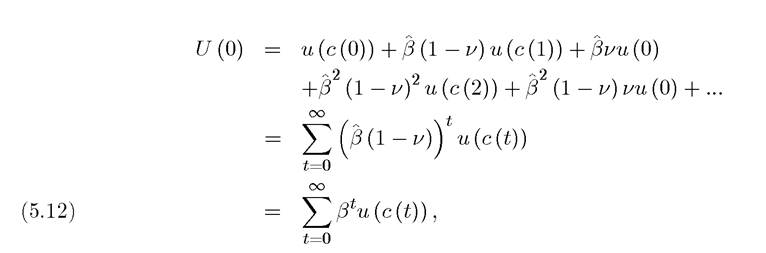
where the second line collects terms and uses u (0) = 0, while the third line defines  as the “effective discount factor” of the individual. With this formulation, the model with finite-lives and random death leads to an individual maximization problem identical to that in the model with infinitely-lived households (though the reasonable values of β in this case would differ; see also Exercise 5.7 for a similar derivation in continuous time). Note also the emphasized adjective “expected” utility here. While until now agents faced no uncertainty, the possibility of death implies that there is a non-trivial (in fact quite important!) uncertainty in individuals’ lives. As a result, instead of the standard ordinal utility theory, we have to use the expected utility theory as developed by von Neumann and Morgenstern. In particular, eq. (5.12) is already the expected utility of the individual, since probabilities have been substituted in and there is no need to include explicit expectations.
Throughout, except in the stochastic growth analysis in Chapters 16 and 17, I do not introduce expectations operators. Instead whenever possible, I directly specify the expected utility function of households.
A second justification for the infinite planning horizon comes from intergenerational altruism or from the “bequest” motive. At the simplest level, imagine an individual who lives for one period and has a single offspring (who will also live for a single period and will beget a single offspring and so on).
Suppose that this individual not only derives utility from his consumption but also from the bequest he leaves to his offspring. For example,
where c (t) is his consumption and b (t) denotes the bequest left to his offspring. For concreteness, let us suppose that the individual has total income y (t), so that his budget constraint is

The function contains information about how much the individual values bequests left to his offspring. In general, there may be various reasons why individuals leave bequests (including accidental bequests that will be left by an individual facing random death probability as in the example discussed in the previous paragraph). Nevertheless, a natural benchmark might be one in which the individual is “purely altruistic” so that he cares about the utility of his offspring (with some discount factor).[VIII] Let the discount factor between generations be β. Also assume that the offspring will have an income of w without the bequest. Then, the utility of the individual can be written as

where V (∙) can now be interpreted as the continuation value, equal to the utility that the offspring will obtain from receiving a bequest of b (t) (together with his own income of w). Naturally, the value of the individual at time t can in turn be written as

which defines the current-value of the individual starting with income y (t) and takes into account what the continuation value will be. The next chapter shows that this is the canonical form of a dynamic programming representation of an infinite-horizon maximization problem. In particular, under some mild technical assumptions, this dynamic programming representation is equivalent to maximizing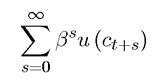
at time t. Intuitively, while each individual lives for one period, he cares about the utility of his offspring, and realizes that in turn his offspring cares about the utility of his own offspring, and so on. This makes each individual internalize the utility of all future members of the “dynasty”. Consequently, fully altruistic behavior within a dynasty (so-called “dynastic” preferences) will also lead to an economy in which decision makers act as if they have an infinite planning horizon.
5.4.