KEY DIAGRAM 6
The IS-LM model
The IS-LM model shows general equilibrium in the goods, asset, and labor markets. It can be used to analyze the effects of economic shocks on output, the real interest rate, the price level, and other macroeconomic variables.
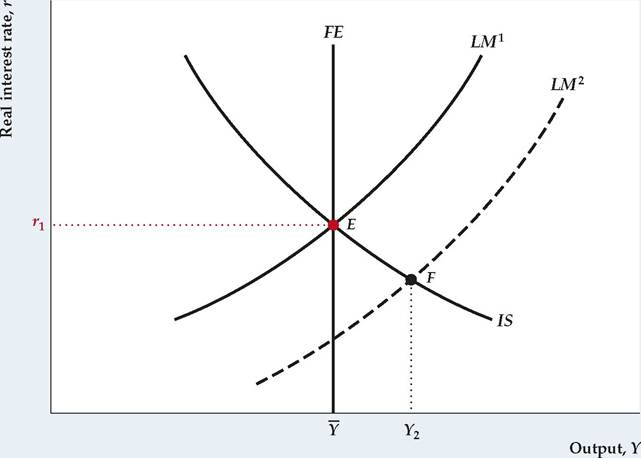
Diagram Elements
■ The real interest rate, r, is on the vertical axis, and output, Y, is on the horizontal axis.
■ The full-employment line, FE, is vertical at fullemployment output. Full-employment output, Y, is the level of output that firms supply when wages and

■ For any level of output, Y, the IS curve gives the real interest rate, r, that clears the goods market—or, in other words, the rate that equalizes desired national saving, Sd, and desired investment, Id. Because higher output raises desired saving and lowers the real interest rate that clears the goods market, the IS curve slopes downward. Equivalently, the IS curve gives combinations of output, Y, and the real interest rate, r, that equalize the aggregate quantities of goods supplied and demanded, Y = Cd + Id + G.
■ For given values of the price level and output, the LM curve gives the real interest rate that clears the asset market, making the real money supply, M∕P,and the real quantity of money demanded,
equal. Because an increase in income raises real money demand, which raises the real interest rate that clears the asset market, the LM curve slopes upward.
Factors That Shift the Curves
■ Any factor that raises full-employment output shifts the FE line to the right.
See Summary table 11.■ For constant output, any change that reduces desired national saving relative to desired investment increases the real interest rate that clears the goods market and shifts the IS curve up and to the right. Equivalently, any change that increases the aggregate demand for goods at a specific level of income raises the real interest rate that clears the goods market and shifts the IS curve up and to the right. See Summary table 12.
■ For constant output, any change that reduces real money supply relative to real money demand increases the real interest rate that clears the asset market and shifts the LM curve up and to the left. See Summary table 13.
Analysis
■ If we assume that the LM curve is LM1, the economy is in general equilibrium at point E, which lies on all three curves. At E the labor market (FE line), the goods market (IS curve), and the asset market (LM curve) are all in equilibrium. At E output equals fullemployment output, Y; and the real interest rate, r1, clears both the goods and asset markets.
■ If we assume that the LM curve is LM2, the FE line and IS and LM curves don't all intersect, and the economy is out of general equilibrium. We assume that, when the economy is out of general equilibrium, the short-run equilibrium of the economy occurs at the intersection of the IS and LM curves (point F), where the goods and asset markets are in equilibrium but the labor market isn't. If we assume that (at least temporarily) firms produce enough output to meet the increased aggregate demand at F, in short-run equilibrium the economy's output is Y2.
■ At the short-run equilibrium point, F, output, Y2, js greater than firms' profit-maximizing level of output, Y. Because aggregate demand at F exceeds what firms want to produce, they raise prices. An increase in the price level, P, lowers the real money supply, M/P, and shifts the LM curve up and to the left, to LM1, and general equilibrium is reached at E. At E output again equals full-employment output, Y. Similarly, if the short-run equilibrium had been to the left of the FE line, declines in the price level, P, would have shifted the LM curve down and to the right and restored general equilibrium at E.
■ According to classical economists, the price adjustment process quickly restores the economy to general equilibrium at point E, so the economy spends little or no time at point F, away from full employment. Keynesians argue that prices and wages are slow to adjust, so the economy may remain at the short-run equilibrium point, F, with output different from Y, for an extended period of time.
►