Learning-by-Doing, Trade and Growth
The previous section showed how international trade can increase economic growth in all countries in the world by encouraging faster technological progress. In addition to this effect of trade on growth working via technological change, the “static gains” from trade are well recognized and understood.
By improving the allocation of resources in the world economy, these static gains can also encourage economic growth. Nevertheless, as mentioned in the previous section many commentators and some economists remain skeptical of the positive growth effects of international trade. A popular argument, often used to justify infant industry protection, is that the static gains from trade come at the cost of dynamic gains, because international trade induces some countries to specialize in industries with relatively low growth potential. In this section, I will outline a simple model with this feature. Richer models that also lead to similar conclusions have been presented by, among others, Matsuyama (1992), Young (1993) and Galor and Mountford (2006). There are also more subtle arguments for why trade may have negative effects on growth based on institutional differences across countries, which are discussed at the end of this chapter. My purpose here is to use the simplest model to illustrate the potential negative effects of trade—and also show when they may not apply. As in the models by Matsuyama and Young, the mechanism for potential dynamic losses from trade (for some countries) will be the presence of learning- by-doing externalities in some sectors.In particular, consider a world economy consisting of two blocks of countries, the North and the South, and suppose that each block consists of many identical countries. The thought experiment is a move from autarky to full international trade integration between these two blocks. To simplify the exposition and to focus on the main ideas, let us assume that all countries are “almost identical”.
In particular, each country has a total labor force of 1, and labor can be used to produce one of two intermediate goods with the production functions with the labor market clearing condition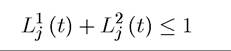
for j ∈ {n, s} denoting a Northern or Southern country. Moreover, let us assume that the total number of Northern and Southern countries are equal, and denote the total number of countries in the world by 2 J.
The final good is produced as a CES aggregate of these two intermediates. Once again distinguishing between the production of intermediates and their use in the final good sector, 792
we write this as

where ε is the elasticity of substitution between the two intermediates. Throughout this section we assume that these two intermediates are gross substitutes, so that ε > 1. However, the case of ε = 1 (where the production function becomes Cobb-Douglas) is also of special-interest, so I will treat this case separately. Moreover, to simplify the algebra and the exposition below, I set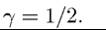
Learning-by-doing is modeled as follows:

so that when more workers are employed in sector 1, the technology of sector 1 improves. There are no learning-by doing opportunities in sector 2. Thus one might think of sector 1 is manufacturing or some high-tech sectors, while sector 2 may correspond to agriculture or to low-tech sectors (though whether there are greater opportunities for learning-by-doing in manufacturing than in agriculture is quite debatable). As in Romer’ (1986) model of growth through externalities, which was studied in Chapter 11, we assume that each producer ignores the positive externality that it creates on the future productivity of sector 1 by its production decisions today.
The only difference between the North and the South is a small “comparative advantage” for the North in the production of sector 1. In particular, we assume that  where δ is a small number.
Given this structure, the equilibrium both without international trade and with international trade are relatively straightforward to characterize.
The key in both cases is that the value of the marginal product of labor (the “wage rates”) in the two sectors have to be equalized or only one of the two sectors will be active. Let us start with the closed economy, and suppose that both sectors have to be active at t. This implies that the marginal products have to be equalized in the two sector, thus

where pj (t) and denote the prices of the two intermediates in country j in terms of the final good, and Aj (t) is the level of productivity and sector 1 in country j. Notice that prices are indexed by j, since we are in the closed economy case. Profit-maximization by the 793
final good producers immediately implies that

where Lj (t) denotes the amount of labor allocated the sector 1 in country j at time t, and naturally, the amount of labor allocated to sector 2 is Combining this
with (19.58), we obtain

The evolution of the productivity of sector 1 is then given by (19.56).
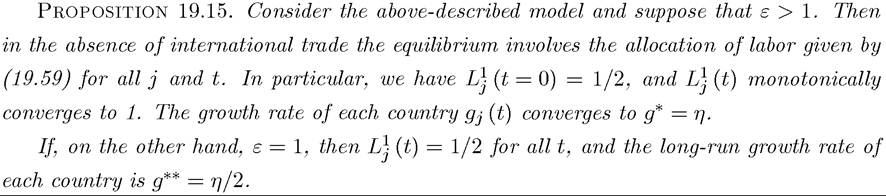
Proof. See Exercise 19.31.
?
Next consider the same world economy with free international trade starting at time t = 0. For each intermediate good, there is now only a single world price, ρj (t) for good 1 and p2 (t) for good 2. With standard arguments, these prices satisfy where the subscripts n and s denote Northern and Southern countries.

It is straightforward to verify that as a result of the slight comparative advantage introduced in equation (19.57), at t = 0, the marginal product of Northern workers in sector 1 is higher, and all of the labor force in the North will be employed in sector 1, and all of the labor force in the South will be employed in sector 2. Moreover, all of sector 1 production will be in Northern countries and all of sector 2 production will be in the South. In all subsequent periods, the productivity of Northern workers in sector 1 is even higher, while the productivity of Southern workers in sector 1 remains stagnant. Consequently, we obtain the following proposition:
PROPOSITION 19.16. Consider the above-described model. Then with free international trade, the equilibrium is as follows: for all t. In this equilibrium,
we have that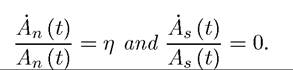
The world economy converges to a growth rate of g* = η in the long run. Throughout, the ratio of income in the North and the South is given by
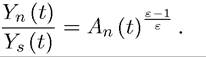

Proof. See Exercise 19.32.
?
This proposition contains the main result about how international trade can harm certain countries when there are learning-by-doing externalities in some sectors.
In particular, the South has a slight comparative disadvantage in sector 1. In the absence of trade, it devotes enough of its resources to that sector and achieves the same growth rate as the North. However, if there is free trade, the South specializes in sector 2 (because of its slight comparative disadvantage in sector 1) and fails to benefit from the learning-by-doing advantages emanating from production in sector 1. As a result, the South becomes progressively poorer relative to the North. This proposition therefore captures the main critique against international trade coming from models such as Young (1993) and proponents of the infant industry arguments.However, the proposition also shows some of the shortcomings of these arguments. For example, if ε = 1 (or sufficiently close to 1), specialization in sector 2 does not hurt the South. The reason is closely related to the effects highlighted in Section 19.4: the increase in the productivity of sector 1 in the North creates a negative terms of trade effect against the North. This effect is always present, but when ε = 1 it becomes sufficiently powerful to prevent the impoverishment of the South despite the fact that they have specialized in the sector with the low growth potential. Another caveat is highlighted in Exercise 19.33: in the world economy described here, infant industry protection will not help the South. Even if there is no trade for some infant industry protection period of duration T > 0, the ultimate outcome will be the same as in Proposition 19.16.
So what are we to make of the results in this section and the general issue of the impact of trade on growth? An immediate answer is that the juxtaposition of the models of this and the previous section suggest that the effect of trade on growth must be an empirical one. Since there are models that highlight both the positive and the negative effects of trade on 795
growth, the debate can be resolved only by empirical work. Having said that, the theoretical perspectives are still useful.
A couple of issues are particularly worth noting. First, the effect of trade integration on the rate of endogenous technological progress may be limited because of the factors already discussed at the end of the previous section. For example, significant effects are possible only when trade opening does not increase wages in the final good sector competing for workers against the R&D sector (i.e., when the R&D sector does not compete for workers with the final good sector). Moreover, if the extreme scale effects are removed, trade opening creates a temporary boost in innovation, but does not necessarily change long- run growth rate. Nevertheless, the benefits of the greater market size for firms involved in innovation must be present according to any model of endogenous technological change. Taking all of these factors into account, we should expect some inducement to innovation from trade opening. Whether these effects are commensurate with or even greater than the static gains of international trade is much harder to ascertain. It may well be that the static gains from trade are more important than the subsequent innovation gains. On the other side of the tradeoff are the potential costs of trade in terms of inducing specialization of some economies in the wrong sectors. The model in this section illustrates this possibility. Nevertheless, I believe that the potential negative effects of trade on growth because of such “incorrect” specialization are much exaggerated. First, there is no strong evidence that learning-by-doing externalities are important in general and much more important in some sectors than in others (which is what is necessary for “incorrect” specialization). Second, even if this were the case, in most situations specialization is not perfect, thus some amount of learning-by-doing takes place in all economies. Third and most important, international flows of information, which often accompany trade opening but also exist independently, imply that improvements in productivity in some countries will affect productivity in others that were not initially specializing in those sectors (for example, Korea was initially an importer of cars, and is now a net exporter, its productivity in the automotive sector having increased with technology transfer). Finally, as the main result in this section showed, terms of trade effects ameliorate any negative impact of specialization in some countries. All in all, it seems that the theoretical case for worrying about the negative growth implications of trade is very weak.19.8.