Trade and Endogenous Technological Change
The effect of trade on growth has attracted much academic and policy attention. Most economists believe that trade promotes growth, and there is both micro and macro evidence consistent with this belief.
A number of papers, for example, Dollar (1992) and Sachs and Warner (1995), find a positive correlation between openness to international trade and economic growth. While these studies are not entirely convincing, since they suffer from the typical difficulties of reaching causal conclusions from growth regressions (recall the discussion in Chapter 3), other papers have tried to overcome these difficulties by using instrumentalvariables strategies. In this context, a well-known paper by Frankel and Romer (1999) exploits differences in the trade capacity of countries as given by the gravity equations of trade as a source of variation to estimate the effect of trade on long-run income differences. Gravity equations, which are widely used in the empirical trade literature, link the volume of trade between two countries to their geographic and economic characteristics and their interactions (such as size of country, GDP, distance, etc.). Frankel and Romer exploit the geographically- determined component of these gravity equations to construct a measure of “predicted trade” for each country and use this as an instrument for actual trade openness. Using this strategy, they show that greater trade is associated with higher income per capita (thus with greater long-run growth). In addition, recent microeconomic evidence by Bernard and Jensen (1997), Bernard, Eaton, Jensen and Kortum (2004) and others show that firms that engage in exporting are typically more productive, which might be partly due to “learning by exporting,” 789though at least some part of this correlation is likely to be due to selection (Melitz, 2003). Similarly, firms in developing countries that import machinery from more advanced economies appear to be more productive (e.g., Goldberg and Pavnik, 2007).
Nevertheless, a number of economists are skeptical of the growth effects of trade. Rodrik (1997) and Rodriguez and Rodrik (1999) argue that the empirical evidence that trade promotes growth is not entirely compelling. On the theoretical side, a number of authors, for example, Matsuyama (1992) and Young (1993), have presented models in which international trade can slow down growth in some countries.In this and the next section, I investigate some of the simplest models that link trade to growth in order to investigate the potential impacts of international trade on economic growth. I start with a model illustrating how trade opening may change the pace of endogenous technological change. This model is inspired by Grossman and Helpman (1991b), who investigate many different interactions between international trade and endogenous technological change. Briefly, the model consists of two independent economies that can be approximated by the baseline endogenous technological change model with expanding input varieties as in Chapter 13. In fact, the model we will study is identical to the lab equipment specification in Section 13.1. The advantage of this model is that there are no knowledge spillovers, thus we do not have to make some potentially problematic assumption about knowledge spillovers occurring at the same time as trade opening.[41] [42] We will look at these two economies first without any international trade and then with costless international trade. We will compare the equilibrium growth rates under these two scenarios. Naturally, a smoother transition, in which trade costs decline slowly, is more realistic in practice, but the sharp thought experiment of moving from autarky to full trade integration is sufficient for us to obtain the main insights concerning the effect of international trade on technological progress. Given the analysis in Section 13.1 of Chapter 13, there is no need to repeat the analysis here. Proposition 19.13. Suppose that condition holds. Then in autarky there exists a unique equilibrium in which starting from any level of technology, both countries innovate and grow at the same rate Proof. See Exercise 19.27. ? Next, we will analyze what happens when these two economies start trading. The exact implications of trade will depend on whether, before trade opening, the two countries were producing some of the same inputs or not (recall that there is a continuum of available inputs that can be produced). To the extent that they were producing some of the same inputs, the static gains from trade will be limited. If, on the other hand, the two countries were producing different inputs, there will be larger static gains. However, our interest here is with the dynamic effects of trade opening, that is, the effects of trade opening on economic growth. Once again, the analysis from Chapter 13 immediately leads to the following result: Proposition 19.14. Suppose that condition (19.54) holds. Then after trade opening, the world economy and both countries produce new technologies and grow at the rate Proof. See Exercise 19.28. ? This proposition shows that opening to international trade encourages technological change and increases the growth rate of the world economy. The main effect captured in this simple model is reasonably robust. Grossman and Helpman (1991b) provide a number of extensions in richer models of international trade (for example with multiple factors). The economic force, a version of the market size effect, leading to the innovation gains from trade is also reasonably robust. Nevertheless, a number of caveats are necessary. First, as Exercise 19.29 shows, if the R&D sector competes with production, there will be powerful offsetting effects, because trade will also increase the demand for production workers. In this case, the qualitative result in this section, that trade opening increases the rate of technological progress, generally applies, but it is also possible to construct versions of this baseline model, where this effect is entirely offset. Exercise 19.29 also provides an example of this type of extreme offset, which should be borne in mind as a useful caveat. Second, Exercise 19.30 shows that if the full scale effect is removed and we 791 focus on an economy with semi-endogenous growth (as the model studied in Section 13.3 in Chapter 13), trade opening will increase innovation temporarily, but not in the long run. 19.7.


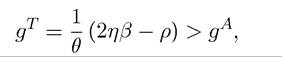 where gA is the autarky growth rate given by (19.55).