Trade, Technology Diffusion and the Product Cycle
The previous chapter highlighted the importance of technology diffusion in understanding cross-country income differences. But this was done in the context of a world consisting of a collection of closed economies.
The presence of international trade enriches the process of technology diffusion, since it allows for the process of the “international product cycle,” whereby technology diffusion goes hand-in-hand with certain products previously produced by technologically advanced economies migrating to less-developed nations. The idea of the international product cycle was first suggested by Vernon (1966). Here I present a simple model, originally developed by Krugman (1979), which provides a formalization of these ideas. The main use of the model presented here is that, thanks to its simplicity, it has many applications in the study of various different issues in macroeconomics, international trade and economic development.19.5.1. The International Division of Labor. Consider the world economy consisting of two sets of economies, the North and the South. For the analysis in this section, it does not matter whether there is one Northern and one Southern country, or many countries within each group. There is free international trade, without any trading costs.
All individuals in all countries have the same CES preferences with love for variety defined over a consumption index. This consumption index for country j ∈ {n, s} at time t is  where Cj (t, z) is the consumption of the zth good in country j ∈ {n, s} at time t, N (t) is the total number of goods in the world economy at time t that will be determined endogenously and traded freely, and ε > 1 is the elasticity of substitution between these goods. Naturally, without the free-trade assumption, the range of goods consumed by households in country j would not be N (t), but a subset of these goods to which they have access to.
Each country admits a representative household with dynamic preferences defined over streams of consumption Cj (t).
For our purposes here, we do not need to specify what these dynamic preferences are, but for concreteness, the reader may want to assume that these are given by the standard CRRA preferences as in (19.1).The key assumption of the model is that goods fall into two categories: new goods are just invented in the North and can only be produced there; old goods have been invented in the past and their production technology has been imitated by the South, so they can be produced both in the South and in the North.
The technology of production is simple: one worker produces one unit of any good to which the country in which he is located has access to.
Workers in the North have access to all goods, but workers in the South only have access to “old goods”. It is important to emphasize that when producing old goods, Northern workers have no productive advantage. Their only advantage (and the only difference in technology) arises because they have access to a larger set of goods.
We assume that the total labor supply in the North is Ln at all times and the labor supply in the South is Ls. All labor is supplied inelastically.
An equilibrium is defined in the usual way as sequences of prices for all goods and allocation of labor across goods.
This description of the environment immediately implies that there can be two types of equilibria.
(1) Equalization equilibrium: in this type of equilibrium, there are sufficiently few new goods that both workers in the South and the North will produce some of the old goods. We will see below that in this type of equilibrium both new goods and old goods will command the same price, and incomes in the North and South will be the same. This justifies the label “equalization equilibrium”.
(2) Specialization equilibrium: in this type of equilibrium the South specializes in the production of old goods, while the Northern producers specializes in the production of new goods.
Let us start by studying the international division of labor for a given set of new and

To start with let us suppose that the world is in a specialization equilibrium.
Clearly, the prices of all new goods and the prices of all old goods will be equalized. Denote these two sets of prices by pn (t) and po (t). Let the wage rate in the North be wn (t) and that in the 785South ws (t). By its very nature, a specialization equilibrium implies that

It must be the case that since otherwise Northern workers would prefer to
produce the old goods. Thus a specialization equilibrium can exist only if when all old goods are produced in the South, the implied equilibrium wage rate in the South is lower than that in the North. To find out when this will be so is straightforward. The CES preferences specified in (19.47) imply that utility maximization requires the ratio of the consumption of new and old goods to satisfy

Specialization implies that all of the labor force of the South is used to produce old goods, while all of the labor force of the North is employed in the production of new goods. Therefore

Combining the previous three equations, we obtain the following simple relationship between relative wages and labor supplies and technology:

Notice that the right-hand side of (19.51) are all known quantities at time t. Thus they determine a unique relative wage between the North and the South. A specialization equilibrium will exist only if this ratio ω (t) is greater than or equal to 1. If it happens to be less than 1, then a specialization equilibrium does not exist; instead, the equilibrium will take the form of an equalization equilibrium.
In this equalization equilibrium, wages in the North and the South are equalized, and some of the old goods are produced in the North. In particular, suppose that ω (t) as defined by (19.51) is strictly less than 1. Then, there exists a unique equilibrium, which takes the form of an equalization equilibrium, where new goods and old goods all command the same price, and are consumed in the same quantity. Therefore, we have
where φ ∈ (0,1) is chosen such that cn (t) = co (t). We know that such a φ ∈ (0,1) exists, since ω(t) < 1, which implies that
The characterization of the equilibrium is shown diagrammatically in Figure 19.1. This figure shows that there is a downward sloping relationship between the relative supply of labor 
case the relative supply of labor in the North is sufficiently large that we entered region of equalization equilibrium.
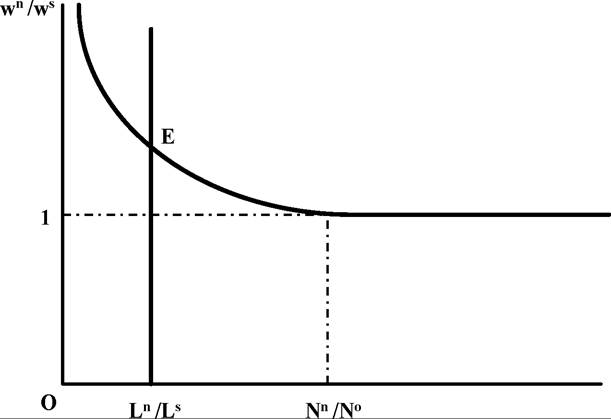
Figure 19.1. Determination on the relative wages in the North and the South in the basic product cycle model.
An interesting implication of this equilibrium is that even when there is a technology gap between the North and the South, Northern and Southern incomes may be equalized. There will only be an income gap between the North and the South when the technology gap is relatively large or when the labor supply in the South, Ls, is sufficiently large. This last feature is particularly interesting in the context of the current wave of globalization, which has involved the incorporation of India and China into the world economy as potential low-cost producers of “old” goods.
While we may think that the case with a sufficiently large technology gap and sufficiently large Ls, which leads to a positive income gap between the North and the South is more realistic, the possibility that such a gap may not exist is of theoretical interest and helps us understand the impact of the international division of labor on cross-country income differences. The possibility that incomes in the North and the South are equalized may appear surprising at first, but the intuition is straightforward. International trade ensures that the Southern consumers have access to goods that their country does not have the technology to produce. Consequently, despite the fact that the South is technologically behind the North, it may achieve the same consumption bundle and the same level of income. This discussion therefore suggests that international trade is a powerful force limiting the extent of crosscountry income inequality (for example, resulting from technological differences). This is 787
typically the case, but perhaps surprisingly, not always so. Exercise 19.26 goes through the implications of trade on cross-country income differences and shows that even in the context of the current model, it can sometimes lead to a larger gap of income between rich and poor countries.
19.5.2. Product Cycles and Technology Transfer. The characterization of the equilibrium in the previous subsection was for a given number of new and old goods. Our interest in this model originates because its relative simplicity enables us to endogenize the number of new and old goods, and generates a pattern of product cycle across countries. Here I will follow Krugman (1979) and endogenize the number of new and old goods using a model of exogenous technological change. Exercise 19.25 considers a version of this model with endogenous creation of new products.
In particular, let us suppose that new goods are created in the North according to the following simple differential equation
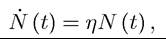
with some initial condition N (0) > 0 and innovation parameter η > 0.
Goods invented in the North can be imitated by the South. As in the models of technology diffusion in the previous chapter, this process is assumed to be slow and follow the differential equation
where l > 0 is the imitation parameter, and this differential equation has a motivation similar to the technology diffusion equations in the previous chapter, and captures the idea that the South can only imitate from the set of goods that have not so far been imitated (of which there is a total of Nn (t) at time t). Also, as specified above, N (t) = Nn (t) + No (t). Combining these equations, we obtain a unique globally stable steady-state ratio of new to old goods given by
This equation is intuitive: the ratio of new to old goods will be high when the rate of innovation in the North, η, is high relative to the rate of imitation from the South, ι. Combining this equation with (19.51), we obtain the equilibrium wage ratio between the North and the South as:

In this expression, when the max operator picks 1, then we are in the equalization equilibrium. Otherwise we are in the specialization equilibrium. Since the ratio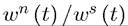 also
also
corresponds to the ratio of income between the North and the South, this equation also implies that a high rate of innovation by the North makes the South relatively poor (though
not absolutely so), while a higher rate of imitation by the South makes the South relatively richer and the North relatively poorer (see Exercise 19.24). In view of the results from the previous chapter, these results are not surprising.
An important and interesting feature of this steady-state equilibrium is the product cycle. Let us focus on the specialization equilibrium. Then new goods are invented in the North and produced there by workers that receive relatively high wages (since in the specialization equilibrium,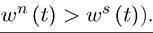 After a while, a given new good is imitated by the South, so its
production shifts to the South, where labor costs are lower. Thus in this model we witness the international product cycle, starting with production at high labor costs in the North and then transitioning to a mode of “cheap production” in the South.
An important application of the product cycle model is to the implications of international protection of intellectual property rights (IPR). The rate of imitation ι can also be considered as an inverse measure of the international protection of IPR. Then as shown in Exercise 19.24, in this baseline model stronger international IPR protection will always increase the income gap between the North and the South. Interestingly, however, the exercise also shows that it does not always lead to a welfare improvement in the North.
19.6.